
Written by Arthur Simitian | PartsAdvisory
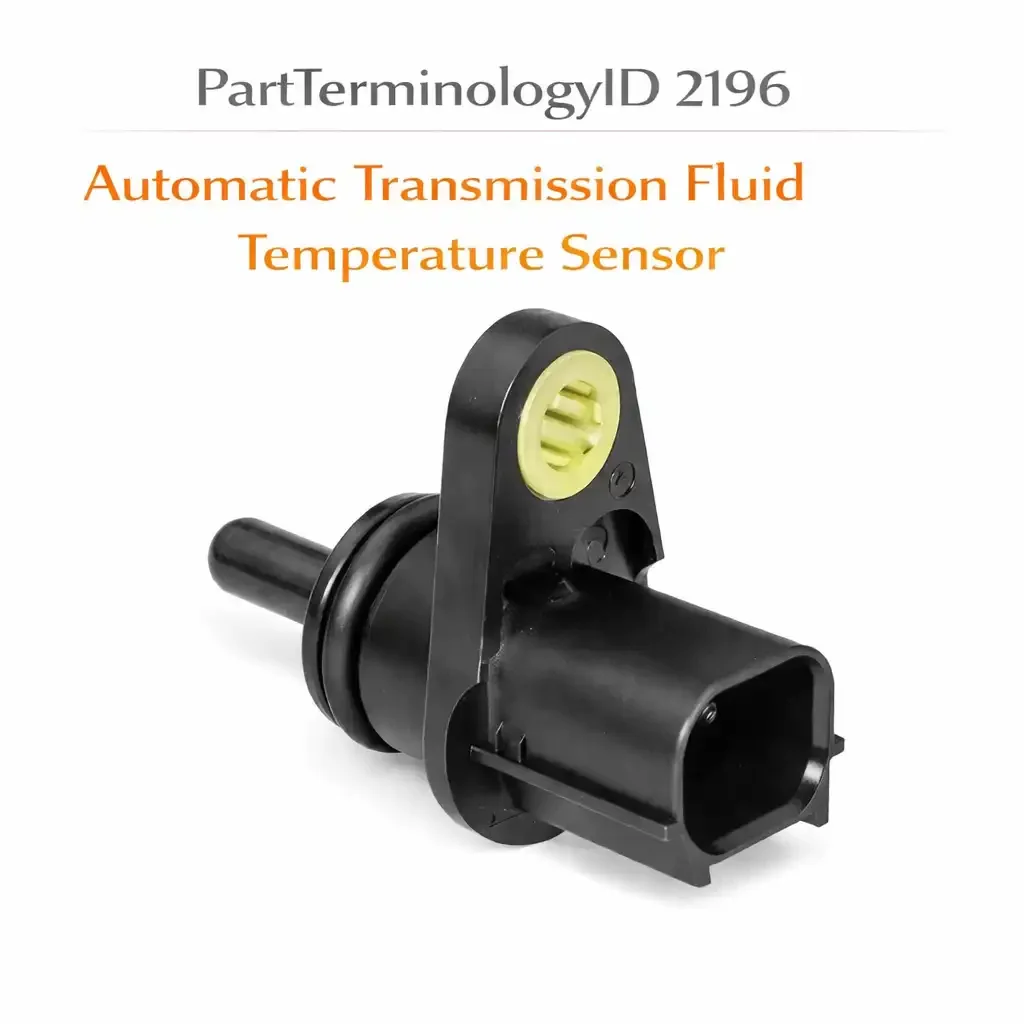
PartTerminologyID 2196, Automatic Transmission Fluid Temperature Sensor, is a sensor that measures automatic transmission fluid temperature and sends that measurement to the transmission control module. That definition communicates the function. It does not communicate whether the sensor is mounted in the transmission oil pan, in the valve body, in the transmission fluid cooler circuit, or in the transmission housing; whether the sensor is a standalone component or integrated into the wiring harness inside the transmission; what the sensor's resistance-versus-temperature curve is and whether it matches the TCM's calibration; what the thread specification or connector configuration is; or whether the sensor is a separate part or part of a transmission internal wiring harness assembly that must be replaced as a unit. A listing under PartTerminologyID 2196 that does not specify the mounting location, the resistance curve, and the connector configuration is asking the buyer to guess at the three specifications that determine whether the TCM receives accurate fluid temperature data after the sensor is installed.
For sellers, the automatic transmission fluid temperature sensor is a part where a wrong resistance curve produces TCM behavior that damages the transmission slowly and invisibly. The TCM uses the fluid temperature signal to control shift scheduling, torque converter lockup, transmission line pressure, and thermal protection modes. A sensor that reads fluid temperature as consistently lower than actual prevents the TCM from activating thermal protection modes when the fluid reaches damaging temperatures. A sensor that reads consistently higher than actual causes the TCM to activate protection modes prematurely, which produces harsh shifting and delayed engagement on a transmission that is actually operating within its safe temperature range. Neither failure mode triggers an obvious fault code unless the TCM's plausibility monitoring detects that the temperature signal is inconsistent with ambient conditions or with other thermal inputs. The transmission is either damaged from undetected overheating or operates in degraded shift quality from unnecessary thermal protection, and the cause is traced back to the replacement sensor only after the more obvious components have been inspected.
For sellers, the listing under this PartTerminologyID is only useful if it includes the transmission code, the sensor mounting location, the resistance curve at key temperature checkpoints, the connector pin count and configuration, and whether the sensor is a standalone replacement or requires replacing an integrated internal harness assembly. Without those five attributes, the return rate is set by how many buyers happen to have the correct transmission and the correct resistance curve match.
What the Automatic Transmission Fluid Temperature Sensor Does
Providing the temperature signal that drives transmission control strategy
The transmission control module uses the fluid temperature signal as one of its primary inputs for adaptive shift control. The functions it governs include:
shift scheduling, where cold fluid requires different clutch apply timing and pressure than hot fluid because viscosity affects hydraulic response throughout the valve body
torque converter clutch lockup, which is typically disabled below a minimum fluid temperature to prevent shudder from cold, viscous fluid engaging the clutch
line pressure regulation, where higher pressure compensates for cold fluid viscosity and ensures complete clutch apply at cold start
thermal protection mode activation, which typically reduces shift frequency, increases line pressure, and forces earlier lockup to minimize heat generation when fluid temperature exceeds a threshold
cold-start shift hold, where the transmission holds lower gears longer during the warm-up phase to allow the fluid to reach operating temperature before normal shift patterns are enabled
A fluid temperature sensor that reads 30 degrees Fahrenheit colder than actual keeps all of those strategies in cold-start mode longer than necessary, which reduces fuel economy, produces sluggish upshifts, and delays torque converter lockup engagement. A sensor that reads 30 degrees Fahrenheit hotter than actual activates thermal protection modes on a transmission that is operating normally, producing unnecessarily harsh shifts, reduced engine power from the TCM's thermal management commands to the ECM, and potentially a false transmission over-temperature warning on the instrument cluster.
The transmission fluid temperature sensor versus the engine coolant temperature sensor
Both sensors are NTC thermistors with decreasing resistance as temperature increases. Both use the same sensing principle. They are not interchangeable. The resistance curves of coolant temperature sensors and transmission fluid temperature sensors are different because they are calibrated for different control modules with different temperature ranges and different calibration maps. A coolant temperature sensor installed in a transmission fluid temperature sensor port may fit physically and connect electrically but will send a temperature signal that the TCM cannot interpret correctly.
This substitution is attempted more often than it should be because both sensor types look similar and the thread specifications occasionally overlap. The listing must not present a coolant temperature sensor as compatible with a transmission fluid temperature sensor application or vice versa.
The integrated internal harness sensor
On many current-production automatic transmissions, the fluid temperature sensor is integrated into the internal transmission wiring harness. The harness runs inside the transmission housing, connects to the solenoids and sensors in the valve body, and exits through a multi-pin connector at the transmission case. The fluid temperature sensor is a component on that harness rather than a separate threaded sensor that can be unscrewed and replaced independently.
When the sensor on an integrated harness fails, the repair requires removing the transmission oil pan, removing the valve body, disconnecting the internal harness, and replacing the entire internal harness assembly. A listing under PartTerminologyID 2196 for an integrated harness application that presents the sensor as a standalone threaded part produces a return every time, because the buyer cannot install the standalone sensor: there is no threaded boss to accept it.
The listing must specify whether the sensor is a standalone replacement or requires an integrated internal harness assembly for the application.
What a failed sensor produces in the TCM
A failed sensor that is open-circuit typically produces a fluid temperature reading that is pegged at either maximum or minimum temperature, depending on the TCM's default behavior for a missing signal. On most TCMs, an open sensor circuit defaults to a maximum temperature reading, which activates thermal protection mode. The driver experiences harsh shifts, reduced engine power, and potentially a transmission over-temperature warning on an otherwise functional transmission.
A failed sensor that is stuck at a mid-range resistance value tells the TCM the fluid is at a consistent temperature regardless of actual conditions. Shift quality may appear normal while the TCM is operating on incorrect data. This is the more dangerous failure mode because it produces no obvious symptom while the TCM may be failing to activate thermal protection at the moments the transmission most needs it.
The Sensor Locations Under This PartTerminologyID
Oil pan-mounted sensor
The sensor is threaded into a boss in the transmission oil pan. The oil pan is removed for access. Thread specifications for pan-mounted sensors include M12x1.5, M14x1.5, and 1/4-NPT depending on the transmission and the vehicle. This is the most serviceable configuration because the oil pan is removed at every transmission fluid service interval.
Valve body-mounted sensor
The sensor is mounted on or in the valve body inside the transmission. Access requires removing the oil pan and in some cases partially removing the valve body. The sensor is typically threaded or clipped into a valve body port. This configuration is common on European transmissions and on some domestic applications with advanced adaptive shift control.
Transmission case-mounted sensor
The sensor is threaded into a boss in the outer wall of the transmission case. It is accessible without removing the oil pan. Thread specification and sensor orientation are specific to the transmission and must be stated in the listing.
Integrated internal harness assembly
As described in the sensing function section above: the sensor is part of the internal wiring harness. Replacement requires the full harness assembly. Standalone sensor listings under PartTerminologyID 2196 do not apply to these applications.
Why This Part Generates Returns
Buyers order the wrong automatic transmission fluid temperature sensor because:
the transmission code is not specified and the same vehicle platform uses different transmissions with different sensor specifications across production years or engine variants
the sensor is listed as a standalone threaded part for an application that uses an integrated internal harness sensor, and the buyer has no threaded boss to install it in
the resistance curve does not match the TCM calibration and the transmission operates in the wrong shift strategy after replacement
the connector pin count or type does not match the transmission harness connector
the mounting location is not specified and the buyer installs a pan-mounted sensor in a vehicle where the sensor is on the valve body, or the reverse
a coolant temperature sensor is substituted for the fluid temperature sensor on the grounds that both use NTC thermistor technology, and the TCM receives incorrect temperature data
Status in New Databases
PIES/PCdb: PartTerminologyID 2196, Automatic Transmission Fluid Temperature Sensor
PIES 8.0 / PCdb 2.0: No change
Top Return Scenarios
Scenario 1: "No threaded boss in the transmission for this sensor"
The buyer's transmission uses an integrated internal harness sensor. The listing presented the sensor as a standalone threaded part. The buyer removed the oil pan and found no threaded boss for a standalone sensor. The sensor cannot be installed.
Prevention language: "Sensor type: [standalone threaded sensor / integrated internal harness assembly]. Verify your transmission uses a standalone threaded fluid temperature sensor before ordering. Many current-production transmissions use a fluid temperature sensor that is integrated into the internal transmission wiring harness. On those applications, the entire internal harness assembly must be replaced, not a standalone sensor."
Scenario 2: "Transmission shifts harshly after sensor replacement"
The replacement sensor has a different resistance curve from the original. The TCM interprets the sensor's output as a fluid temperature that is higher than actual. The TCM activates thermal protection mode on a transmission that is at normal operating temperature, producing harsh, late upshifts and reduced converter lockup.
Prevention language: "Resistance at 68 degrees F: approximately [X] ohms. Resistance at 195 degrees F: approximately [X] ohms. OE part number cross-reference: [OE part number]. Verify the replacement sensor's resistance curve matches the OE specification for your transmission. A resistance curve mismatch will cause the TCM to operate incorrect shift strategies."
Scenario 3: "Wrong transmission code, sensor connector does not match"
The vehicle has been fitted with a replacement transmission from a different production year that uses a different connector type. The sensor listing was for the original transmission specification. The buyer ordered by vehicle year/make/model and received the sensor for the original transmission, not the replacement transmission that is currently installed.
Prevention language: "Transmission code: [specific transmission code]. Verify your current transmission code before ordering. If your transmission has been replaced with a unit from a different production year or a different variant, the sensor specification of the installed transmission may differ from the OE specification for your vehicle."
Scenario 4: "Installed a coolant temperature sensor by mistake"
The buyer could not find the correct fluid temperature sensor and installed a coolant temperature sensor with the same thread specification as a substitute. The TCM received incorrect temperature data throughout the operating range. The transmission shifted incorrectly and a fluid temperature circuit fault code was set.
Prevention language: "Do not substitute an engine coolant temperature sensor for this application. Engine coolant temperature sensors and automatic transmission fluid temperature sensors use different resistance curves calibrated for different control modules. A coolant temperature sensor in a fluid temperature sensor location will send a temperature signal the TCM cannot interpret correctly."
Scenario 5: "Valve body sensor, not oil pan sensor"
The listing did not specify the mounting location. The buyer removed the oil pan and found the sensor on the valve body rather than on the pan. The oil pan removal was necessary regardless, but the buyer did not anticipate having to remove the valve body access cover for the sensor.
Prevention language: "Sensor mounting location: [oil pan / valve body / transmission case]. Verify the mounting location of your original sensor before starting the repair. Oil pan-mounted sensors are accessible after pan removal only. Valve body-mounted sensors require additional disassembly beyond pan removal. Transmission case-mounted sensors are accessible without pan removal."
What to Include in the Listing
Core essentials
PartTerminologyID: 2196
component: Automatic Transmission Fluid Temperature Sensor
transmission code (mandatory)
sensor type: standalone threaded or integrated internal harness assembly (mandatory)
mounting location: oil pan, valve body, or transmission case (mandatory)
thread specification: nominal diameter, pitch, and thread form for threaded sensors (mandatory)
connector pin count and type (mandatory)
resistance at cold temperature checkpoint in ohms (32 to 68 degrees F)
resistance at operating temperature checkpoint in ohms (176 to 212 degrees F)
OE part number cross-reference (mandatory when resistance values are not provided)
sealing method: tapered thread, O-ring, or crush washer
sealing element included: yes or no
quantity: 1
Fitment essentials
year/make/model/submodel
transmission code (mandatory, non-negotiable)
engine code when the same transmission is used with different engine variants that have different TCM calibrations
production date range when the sensor specification changed during the model year
note for integrated harness applications: full harness assembly part number and what the replacement procedure requires
Dimensional essentials
thread specification for threaded sensors: nominal diameter, pitch, thread form
sensor body length below hex in mm
connector body dimensions for harness fitment verification
sealing element dimensions if O-ring or crush washer sealed
Image essentials
sensor in isolation showing body, thread end or mounting feature, connector, and wire leads
thread end close-up with thread specification callout
connector close-up showing pin count and layout
for integrated harness sensors, the full harness assembly showing the sensor element and the multi-pin external connector
installed context showing the sensor at its mounting location in the pan or on the valve body
Catalog Checklist for ACES/PIES Teams
PartTerminologyID = 2196
require transmission code (mandatory, non-negotiable: vehicle year/make/model alone is insufficient when the same vehicle uses different transmissions across production years or engine variants)
require sensor type: standalone or integrated harness (mandatory)
do not list a standalone sensor for integrated harness applications: flag these applications and cross-reference the full harness assembly
require mounting location: oil pan, valve body, or transmission case
require thread specification in full for threaded sensors
require connector pin count and type
require resistance values at two temperature checkpoints or OE part number cross-reference
require sealing element inclusion disclosure
differentiate from engine coolant temperature sensor (PartTerminologyID 2188): same sensing technology, different resistance curve, different application; the two are not interchangeable and must not be cross-listed as compatible
differentiate from transmission internal wiring harness (PartTerminologyID varies): on integrated-sensor applications, the sensor is a component of the harness assembly; the harness is the part that is replaced; the sensor alone is not available
differentiate from transmission oil temperature warning switch (PartTerminologyID varies): some transmissions use a binary switch that activates at a threshold temperature rather than a continuous resistance-based sensor; a binary switch and a continuous NTC sensor are not interchangeable
flag resistance curve requirement: this is the same critical attribute as for PartTerminologyID 2188 (Engine Coolant Temperature Sensor); a sensor without a verifiable resistance curve cannot be confirmed compatible with the TCM calibration
flag integrated harness applications: the most consequential listing error for this PartTerminologyID is presenting a standalone sensor for an application that requires a full internal harness assembly
FAQ (Buyer Language)
How do I know if my transmission uses a standalone fluid temperature sensor or an integrated internal harness sensor?
Consult the factory service manual's automatic transmission section for your transmission code. The sensor replacement procedure will specify whether the sensor is accessible as a standalone threaded unit after pan removal, or whether the internal harness must be replaced. If the pan removal procedure does not include a standalone sensor removal step and instead references an internal wiring harness replacement, your application requires the full harness assembly.
My transmission shifts harshly after I replaced the fluid temperature sensor. What went wrong?
The most likely cause is a resistance curve mismatch between the replacement sensor and the original. The TCM is interpreting the replacement sensor's output as a higher or lower temperature than actual and adjusting its shift strategy accordingly. Compare the replacement sensor's resistance at operating temperature to the OE specification for your transmission. If the replacement sensor has a different resistance curve, it must be replaced with a sensor that matches the OE resistance specifications. Clearing the TCM's adaptive data after installing the correct sensor may be necessary to allow the TCM to relearn shift quality parameters without residual influence from the period when the wrong sensor was in place.
Can I use an engine coolant temperature sensor in place of the transmission fluid temperature sensor?
No. The resistance curves of coolant temperature sensors and transmission fluid temperature sensors are calibrated for different control modules with different calibration maps. Even if the thread specification and the connector are the same, the resistance the coolant sensor produces at any given temperature is different from what the TCM expects from its calibration. The TCM will calculate an incorrect fluid temperature and operate incorrect shift strategies as a result. Use only a sensor with the resistance curve specified for your transmission.
How do I access the fluid temperature sensor on a valve body-mounted application?
Remove the transmission oil pan and drain the fluid. The valve body will be visible after pan removal on most applications. The sensor is typically on the lower face of the valve body or in a sensor block mounted to the valve body. On some applications, a valve body cover plate must be removed for sensor access. The factory service manual for your transmission will show the specific access procedure. Valve body work requires clean, careful handling to prevent contamination of the hydraulic passages.
My transmission throws a fluid temperature circuit fault code (P0711, P0712, P0713, or similar). Does that confirm the sensor is bad?
Not necessarily. Those codes indicate a fault in the fluid temperature sensor circuit, which could be the sensor, the wiring harness connection to the sensor, or the TCM's input circuit for the sensor signal. Before replacing the sensor, check the resistance at the sensor terminals with a multimeter at a known ambient temperature and compare it to the specification. Check the harness connector for corrosion, bent pins, or moisture intrusion. A sensor that reads within specification is not the fault source. A harness connection that has corroded open or shorted to ground is more common than internal sensor failure on high-mileage applications.
Cross-Sell Logic
Transmission Internal Wiring Harness (PartTerminologyID varies: on integrated-sensor applications, the harness is the replacement assembly; for standalone-sensor applications, the harness should be inspected for corrosion and chafing at the sensor connector when the sensor is replaced)
Automatic Transmission Fluid (the transmission oil pan must be removed to access the sensor on most applications; fresh fluid is required after pan removal and reinstallation; verify the correct fluid specification for the transmission code)
Transmission Oil Pan Gasket (the pan gasket is replaced every time the pan is removed; order the gasket before starting the repair to avoid a delay after the pan is already off)
Transmission Filter (replace the filter whenever the pan is removed; the sensor replacement service interval is the same as the fluid and filter service on pan-mounted sensor applications)
Automatic Transmission Oil Cooler (PartTerminologyID 2088: if the sensor replacement was triggered by a transmission over-temperature event, inspect the transmission oil cooler for adequate flow; a partially blocked cooler may have caused the overheating event that triggered the sensor failure or the fault code)
Scan Tool with Transmission Live Data (verifying the replacement sensor output matches the TCM's interpretation requires a scan tool with transmission live data capability; a basic code reader is not sufficient for confirming resistance curve compatibility after replacement)
Frame as "the sensor tells the TCM what temperature the fluid is at. The fluid circulates through the cooler that manages the temperature the sensor monitors. The pan contains the fluid the sensor is submerged in. The filter protects the fluid circuit the sensor is part of. Replacing the pan gasket and filter at the same service event as the sensor is standard practice because the pan must be removed for all three."
Final Take for PartTerminologyID 2196
Automatic Transmission Fluid Temperature Sensor (PartTerminologyID 2196) is the input to the transmission control module that determines shift scheduling, torque converter lockup, line pressure, and thermal protection strategy across every operating condition. A sensor with the correct thread and connector but the wrong resistance curve installs, connects, and runs the transmission on incorrect temperature data. The transmission either operates in incorrect shift strategies for all conditions, or fails to activate thermal protection when the fluid reaches temperatures that cause accelerating wear.
The transmission code is the primary fitment attribute, not the vehicle model, because the same vehicle platform frequently uses different transmissions across production years and engine variants. The sensor type disclosure is the most consequential attribute for preventing returns because an integrated harness application has no threaded boss for a standalone sensor. The resistance curve is the most consequential attribute for preventing transmission damage from a correctly installed but incorrectly calibrated sensor.
State the transmission code. State the sensor type. State the mounting location. State the thread specification in full. State the resistance at two temperature checkpoints or provide the OE cross-reference. State the connector pin count. Disclose integrated harness applications. That is the same listing strategy as every other PartTerminologyID in this series: the generic PartTerminologyID requires specific attributes at every level to become a listing buyers can act on without guessing. For PartTerminologyID 2196, guessing on the sensor type sends the buyer to a transmission with no installation location, and guessing on the resistance curve sends the transmission to a control module that is protecting it from the wrong temperature.