
Written by Arthur Simitian | PartsAdvisory
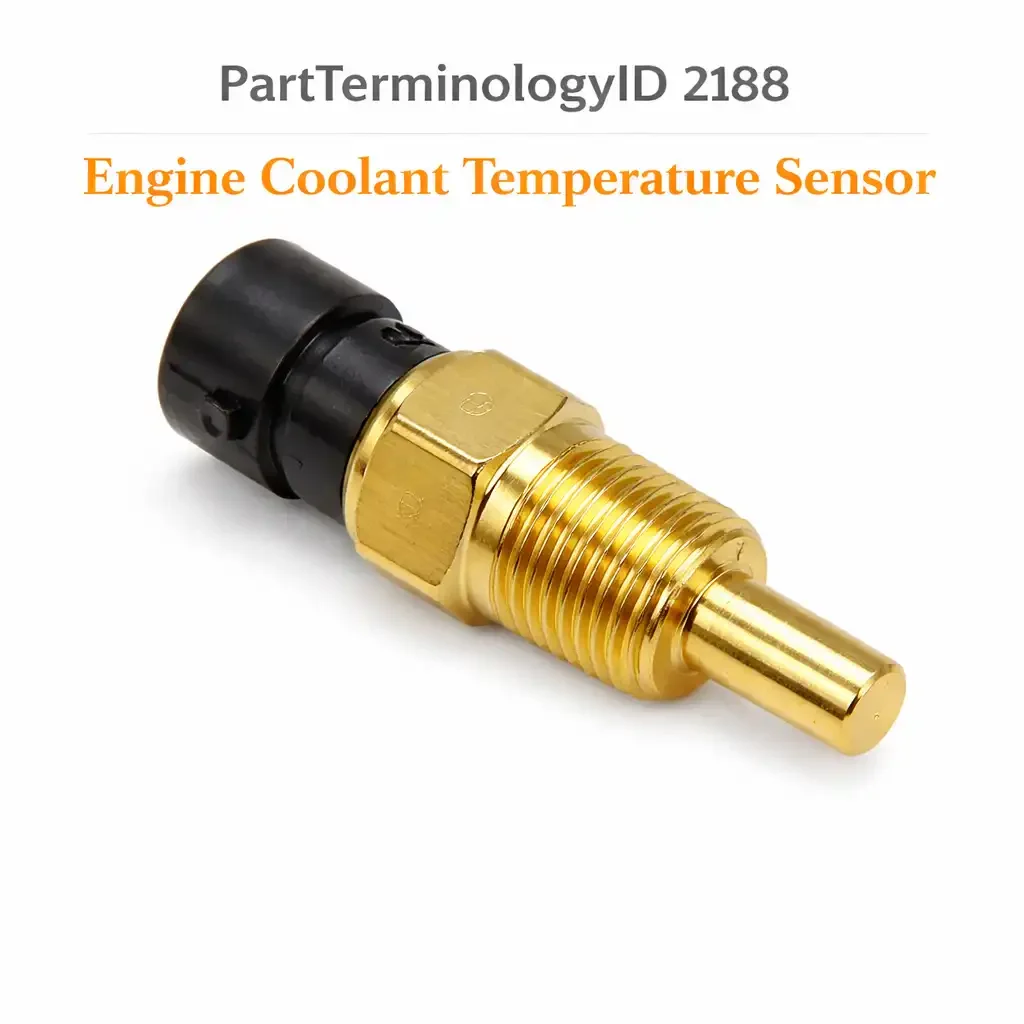
PartTerminologyID 2188, Engine Coolant Temperature Sensor, is a sensor that measures engine coolant temperature and sends that measurement to the engine control module. That definition is understood by every buyer who searches for this part. It does not communicate the thread specification of the sensor port in the engine block or cylinder head, whether the sensor is a two-wire or three-wire unit, what the sensor's resistance-versus-temperature curve is and whether it matches the ECM's calibration, whether the vehicle uses one coolant temperature sensor or two, what the second sensor does if two are present, or what connector type and pin layout the sensor uses. A listing under PartTerminologyID 2188 that does not include the thread specification, the resistance curve characteristics, and the connector configuration is asking the buyer to guess at the three specifications that most directly determine whether the ECM receives accurate coolant temperature data after the sensor is installed.
For sellers, the engine coolant temperature sensor is a part where an incorrect resistance curve produces engine behavior that is misdiagnosed at a high rate. A sensor with the correct thread and connector but a different resistance curve will install correctly, connect correctly, and send a signal that the ECM can read. The ECM will interpret that signal as a coolant temperature. The temperature it calculates will be wrong, and the engine management system will adjust fuel delivery, ignition timing, idle speed, and emissions controls based on an inaccurate temperature reading. The engine may run rich on a cold start, idle poorly when warm, fail emissions, or show a check engine light for a coolant temperature implausibility fault, all symptoms that point to sensors and calibration rather than obviously pointing to the replacement sensor that was installed at the last service. The buyer replaces the thermostat, the mass air flow sensor, or performs a fuel system cleaning before the resistance curve mismatch is identified.
For sellers, the listing under this PartTerminologyID is only useful if it includes the engine code, the thread specification, the resistance curve at key temperature points, the number of wires, the connector type, and whether the sensor is the primary ECM sensor or the secondary instrument cluster sensor on applications that use both. Without those six attributes, the listing ships a sensor that may run the engine incorrectly for weeks before the cause is found.
What the Engine Coolant Temperature Sensor Does
Providing the temperature signal that drives the engine management system
The coolant temperature sensor is one of the most influential inputs to the engine control module. The ECM uses the coolant temperature signal to determine:
fuel injection pulse width on cold starts, where cold coolant requires more fuel to achieve correct combustion
idle speed on cold starts, where a higher idle compensates for cold oil viscosity and cold combustion chamber temperatures
ignition timing, which is adjusted for thermal conditions throughout the warm-up cycle
exhaust gas recirculation activation, which is disabled below a threshold temperature on most systems
cooling fan activation on engines with coolant temperature-controlled electric fans
closed-loop fuel control entry, which requires the engine to reach a minimum operating temperature before the ECM uses oxygen sensor feedback to trim fuel delivery
catalyst warm-up strategy on cold starts
A coolant temperature sensor that reads consistently 20 degrees Fahrenheit too cold tells the ECM the engine is perpetually warming up. The ECM adds fuel it does not need, retards timing it does not need to retard, keeps the idle higher than necessary, delays closed-loop fuel control entry, and may not activate the cooling fan at the correct temperature. The engine runs rich, fuel economy decreases, and the catalytic converter runs hotter than designed from the excess fuel.
A coolant temperature sensor that reads consistently 20 degrees Fahrenheit too warm tells the ECM the engine is at operating temperature before it is. The ECM reduces cold-start enrichment too early, causing rough idle and potential stalling during warm-up. On a very cold day, this can prevent the engine from starting reliably.
Neither of those failure modes triggers an obvious fault code unless the ECM's plausibility monitoring detects that the coolant temperature signal is inconsistent with other sensor data. In most cases, the engine runs poorly and the cause is identified only when the replacement sensor's resistance curve is compared to the ECM's calibration data.
The resistance-versus-temperature curve
The coolant temperature sensor is a negative temperature coefficient thermistor: as temperature increases, resistance decreases. The ECM applies a reference voltage to the sensor circuit and measures the voltage drop across the sensor. It converts the measured voltage to a temperature using the sensor's resistance curve, which is stored in the ECM's calibration map.
The resistance curve is specific to the sensor design. A sensor from a different manufacturer, a different application, or a different production batch may have a different resistance at any given temperature. The resistance values at 32 degrees Fahrenheit, 68 degrees Fahrenheit, 104 degrees Fahrenheit, 140 degrees Fahrenheit, 176 degrees Fahrenheit, and 212 degrees Fahrenheit are the standard calibration checkpoints used to verify sensor compatibility with a specific ECM calibration map.
A sensor that is within 5 percent of the OE resistance at all those checkpoints will produce temperature readings within a few degrees of the correct value and will not cause noticeable engine behavior changes. A sensor that differs by 15 percent or more at any checkpoint will produce a meaningful temperature error at that operating point and may produce drivability symptoms.
The primary ECM sensor versus the secondary instrument cluster sensor
Many vehicles use two coolant temperature sensors. The primary sensor is in the cylinder head coolant outlet or the water jacket and feeds the ECM for engine management. The secondary sensor is in the thermostat housing or the coolant outlet and feeds the instrument cluster temperature gauge. On some vehicles, a single sensor feeds both the ECM and the instrument cluster. On others, two separate sensors are at different locations with different thread specifications, different resistance curves, and different connectors.
A listing under PartTerminologyID 2188 that does not specify whether it is the primary ECM sensor or the secondary instrument cluster sensor will generate returns on vehicles that use two sensors and require the buyer to determine which sensor position needs to be replaced. The buyer who receives the ECM sensor when they need the instrument cluster sensor will have a temperature gauge that reads incorrectly while the ECM receives correct data, or vice versa, which is a confusing diagnostic state.
Sensor location on the engine
The coolant temperature sensor is typically installed at the coolant outlet, in the cylinder head water jacket, near the thermostat housing, or at the intake manifold coolant passage depending on the engine architecture. The location must be accessible for service without removing major components and must be in a location where the sensor is continuously submerged in coolant at operating temperature.
On some engines, the coolant temperature sensor location and the thread specification are shared with the coolant outlet gasket location, meaning the sensor and the coolant outlet gasket are in the same assembly stack. A buyer who replaces the sensor without replacing the coolant outlet gasket at the sensor port may have a coolant seep at the sensor boss after the repair.
The Sensor Specifications That Determine Correct ECM Function
Thread specification
The sensor threads into a boss in the engine block, cylinder head, thermostat housing, or coolant passage. Thread specifications for passenger vehicle coolant temperature sensors include M12x1.5, M14x1.5, 1/4-NPT, and 3/8-NPT depending on the engine manufacturer, the application, and the production year. The thread specification is the primary fitment attribute for physical installation. A sensor with the wrong thread specification will either not thread into the port or will cross-thread it.
The listing must state the full thread specification: nominal diameter, pitch, and thread form. A listing that states only the nominal diameter invites the buyer to assume a common pitch and install a sensor that cross-threads the boss on the cylinder head.
Number of wires and connector configuration
Two-wire coolant temperature sensors are the most common. One wire carries the ECM reference voltage signal. One wire is ground. The ECM measures the voltage drop across the sensor on the signal wire.
Three-wire coolant temperature sensors carry a signal wire, a ground wire, and an additional wire that may carry a second signal to the instrument cluster, a reference voltage for a built-in voltage divider circuit, or a shield wire for noise suppression. On some vehicles, the third wire connects to a warning light circuit that activates independently of the instrument cluster gauge.
A two-wire replacement on a three-wire application will leave one circuit unconnected. Depending on which circuit the third wire serves, this may prevent the instrument cluster gauge from working, prevent a warning light from activating, or produce a fault code for an open circuit in the sensor signal path.
Resistance values at standard temperature checkpoints
The listing should provide the sensor's resistance at a minimum of two temperature checkpoints. The most commonly used checkpoints are at cold temperature (approximately 32 to 40 degrees Fahrenheit) and at operating temperature (approximately 176 to 195 degrees Fahrenheit). Common cold-temperature resistances for passenger vehicle coolant temperature sensors range from 4,000 to 7,000 ohms. Common operating-temperature resistances range from 200 to 500 ohms.
If the seller cannot provide measured resistance values, the OE part number cross-reference allows the buyer to verify resistance compatibility independently. A listing with neither resistance values nor an OE part number cross-reference cannot be verified for calibration compatibility with the ECM.
Coolant temperature sensor sealing method
Coolant temperature sensors seal the sensor boss against coolant leakage through either a tapered thread seal, an O-ring on the sensor body, or a copper or aluminum crush washer under the sensor hex. The sealing method must be appropriate for the boss in the engine. A sensor that uses a crush washer on a boss designed for a tapered thread seal may not seal at the correct torque. A sensor with an O-ring on a tapered thread boss will leave the O-ring outside the thread engagement and it will not seal.
The listing must disclose the sealing method and whether the sealing washer or O-ring is included.
Why This Part Generates Returns
Buyers order the wrong engine coolant temperature sensor because:
the thread specification is not stated and the buyer installs a sensor with the wrong pitch into the cylinder head boss, cross-threading it
the listing is for the instrument cluster sensor on a vehicle that uses two sensors, and the buyer needed the ECM sensor at a different location with a different thread specification
the resistance curve of the replacement does not match the ECM calibration and the engine runs rich, idles rough, or shows a coolant temperature implausibility fault code after the replacement
the connector pin count does not match the harness and the buyer cannot connect the sensor
the sealing washer is not included and the buyer installs the sensor without a sealing element, and the boss leaks coolant after the first startup
the engine code is not specified and the same vehicle platform uses different sensor specifications on different engine variants with different ECM calibrations
Status in New Databases
PIES/PCdb: PartTerminologyID 2188, Engine Coolant Temperature Sensor
PIES 8.0 / PCdb 2.0: No change
Top Return Scenarios
Scenario 1: "Engine runs rich after sensor replacement, check engine light on"
The replacement sensor has a different resistance curve from the original. The ECM interprets the sensor's output as a coolant temperature that is lower than actual throughout the warm-up cycle. The ECM enriches the fuel mixture for a cold engine that is already warm, causing rich running, elevated HC emissions, and a pending misfire code from the rich condition.
Prevention language: "Resistance at 68 degrees F: approximately [X] ohms. Resistance at 195 degrees F: approximately [X] ohms. OE part number cross-reference: [OE part number]. Verify the replacement sensor's resistance curve is compatible with your ECM calibration before installing. A resistance curve that does not match the ECM's calibration map will produce incorrect temperature readings and engine management errors."
Scenario 2: "Wrong sensor location, this is the gauge sensor not the ECM sensor"
The buyer needed the primary ECM coolant temperature sensor at the cylinder head. The listing was for the secondary instrument cluster gauge sensor at the thermostat housing. Both sensors are present on the vehicle. Both have different thread specifications and different resistance curves. The buyer installed the gauge sensor in the ECM sensor location and the engine management system received incorrect data.
Prevention language: "Sensor function: [primary ECM coolant temperature sensor / secondary instrument cluster gauge sensor]. Verify which sensor position requires replacement before ordering. The ECM sensor and the instrument cluster gauge sensor on this application are different parts at different locations with different thread specifications and resistance curves."
Scenario 3: "Thread stripped the cylinder head boss on installation"
The sensor thread pitch did not match the boss. The listing stated only the nominal thread diameter. The buyer assumed the common pitch for that diameter and installed the sensor. After two turns of hand pressure, the sensor required tool force and cross-threaded the aluminum cylinder head boss.
Prevention language: "Thread specification: [M12x1.5 / M14x1.5 / 1/4-NPT / 3/8-NPT]. Verify the full thread specification of your engine's sensor boss before installing. Do not apply tool force to a sensor that does not turn smoothly by hand. A sensor that requires force to start threading is the wrong thread specification and will cross-thread the boss in the cylinder head."
Scenario 4: "Temperature gauge reads incorrectly, ECM temperature reads correctly"
The buyer replaced the primary ECM sensor correctly. The instrument cluster gauge reads incorrectly because the secondary gauge sensor, which they did not replace, has also failed. The vehicle uses two sensors and the buyer replaced only one.
Prevention language: "This vehicle uses two coolant temperature sensors: a primary ECM sensor at [location] and a secondary instrument cluster gauge sensor at [location]. This listing covers the [primary / secondary] sensor only. If both the ECM readings and the instrument cluster gauge readings are incorrect, verify which sensor corresponds to each reading before ordering."
Scenario 5: "Boss leaks coolant after sensor installation"
The sensor sealing method uses a copper crush washer. The crush washer was not included in the listing and the buyer installed the sensor without a sealing element. The boss leaks at the sensor shoulder after the first fill.
Prevention language: "Sealing method: copper crush washer. A crush washer is required between the sensor hex and the sensor boss seating surface. A new crush washer is [included / not included]. Do not install this sensor without the correct sealing element. A sensor installed without a crush washer will leak coolant at the boss on the first pressurized fill."
Scenario 6: "Three-wire harness, two-wire sensor, temperature gauge does not work"
The vehicle has a three-wire harness at the sensor location. The third wire carries the instrument cluster gauge signal on a separate circuit from the ECM signal. The two-wire replacement sensor connects only the ECM signal wire and the ground. The instrument cluster gauge receives no signal and reads cold or pegged.
Prevention language: "Wire count: [2-wire / 3-wire]. Verify your vehicle's coolant temperature sensor harness has [the same number of wires] as this sensor. A two-wire sensor on a three-wire harness will leave one circuit unconnected, which may prevent the instrument cluster gauge from receiving a temperature signal."
Scenario 7: "Coolant temperature implausibility code after replacement"
The ECM has a plausibility monitor that compares the coolant temperature sensor signal to the intake air temperature sensor signal on cold starts. The replacement sensor's resistance curve sends a temperature reading at cold start that is significantly higher than the intake air temperature, which the ECM's plausibility monitor flags as implausible for a cold-start condition.
Prevention language: "If a P0116 (Coolant Temperature Range/Performance) or similar implausibility code is set after sensor replacement, verify the replacement sensor's resistance curve matches the OE specification. The ECM compares coolant temperature to intake air temperature on cold starts. A sensor that reads higher than ambient on a cold engine will trigger a plausibility fault."
What to Include in the Listing
Core essentials
PartTerminologyID: 2188
component: Engine Coolant Temperature Sensor
sensor function: primary ECM sensor, secondary instrument cluster gauge sensor, or combined single sensor (mandatory)
engine code (mandatory)
thread specification: nominal diameter, pitch, and thread form (mandatory)
wire count: 2-wire or 3-wire (mandatory)
connector type and pin count (mandatory)
resistance at cold temperature checkpoint in ohms (recommended: 32 to 40 degrees F or 0 to 5 degrees C)
resistance at operating temperature checkpoint in ohms (recommended: 176 to 195 degrees F or 80 to 90 degrees C)
OE part number cross-reference (mandatory when resistance values are not provided)
sealing method: tapered thread, O-ring, or crush washer (mandatory)
sealing element included: yes or no (mandatory)
quantity: 1
Fitment essentials
year/make/model/submodel
engine code (mandatory, non-negotiable: different engine variants use different ECM calibrations and different sensor resistance curves)
sensor location on engine: cylinder head, block water jacket, thermostat housing, or coolant outlet
compatible ECM or PCM part number when resistance curve is ECM-calibration-specific
Dimensional essentials
thread specification: nominal diameter in mm or inches, pitch, thread form
sensor hex size in mm for installation torque purposes
sensor body length below hex in mm for thread engagement verification
connector body dimensions for harness fitment verification
crush washer outer diameter and thickness in mm if washer-sealed
Image essentials
sensor in isolation showing body, thread end, connector, and wire leads
thread end close-up with thread form visible and thread specification callout
connector close-up showing pin count and pin layout
sealing element detail: O-ring on body, crush washer under hex, or tapered thread profile
resistance-temperature chart if available from the manufacturer
installed context showing the sensor at the correct engine location
Catalog Checklist for ACES/PIES Teams
PartTerminologyID = 2188
require engine code (mandatory, non-negotiable)
require sensor function attribute: primary ECM, secondary gauge, or combined (mandatory)
require thread specification in full: nominal diameter, pitch, and thread form (mandatory)
require wire count (mandatory)
require connector pin count and type (mandatory)
require resistance values at two temperature checkpoints or OE part number cross-reference
require sealing method and sealing element inclusion disclosure
require sensor location on engine
differentiate from engine coolant level sensor (PartTerminologyID 2184): the level sensor detects coolant presence; the temperature sensor measures coolant temperature; they are different sensors at different locations serving different functions
differentiate between primary ECM sensor and secondary instrument cluster gauge sensor on vehicles that use both: the two sensors are different parts with different thread specifications, different resistance curves, different connectors, and different installation locations; they must be listed separately
differentiate from engine oil temperature sensor (PartTerminologyID varies): on vehicles with oil temperature sensing, the oil temperature sensor may be in a similar location to the coolant temperature sensor; verify the fluid circuit the sensor is in before listing
flag resistance curve as a mandatory attribute or require OE part number cross-reference: a sensor without a verifiable resistance curve cannot be confirmed compatible with the ECM calibration
flag dual-sensor applications: vehicles that use two coolant temperature sensors must have each sensor listed separately with its function, location, and specifications clearly identified
flag thread cross-threading risk on aluminum bosses: the most expensive consequence of a wrong thread specification for this sensor is a stripped cylinder head boss, which is a machine damage event
FAQ (Buyer Language)
How do I know if my vehicle uses one coolant temperature sensor or two?
Consult the factory service manual's cooling system and engine management sections for your engine code. The cooling system section will list all temperature sensors in the cooling circuit with their locations and functions. Alternatively, trace the wiring from the temperature gauge and from the ECM's coolant temperature input to their respective sensors: if those two wires lead to different sensors at different locations, the vehicle uses two sensors. If both lead to the same sensor, the vehicle uses a combined single sensor.
What happens if I install a sensor with the wrong resistance curve?
The ECM will read an incorrect coolant temperature. The engine management system will make fuel delivery, timing, idle speed, and emissions control decisions based on that incorrect temperature. The symptoms depend on whether the sensor reads hotter or colder than the actual temperature and by how much. Common symptoms include rich cold starts, poor fuel economy, rough idle at operating temperature, delayed catalyst warm-up, and a check engine light for a coolant temperature range or plausibility fault. None of those symptoms obviously point to the replacement sensor's resistance curve, which is why a resistance curve mismatch is one of the harder cooling system diagnostic problems to trace.
How do I verify the resistance curve of a replacement sensor matches my vehicle?
Measure the resistance of the original sensor at a known temperature before removing it: in a cup of ice water (approximately 32 degrees Fahrenheit), at room temperature (approximately 68 degrees Fahrenheit), and in hot water at a measured temperature (approximately 176 degrees Fahrenheit using a thermometer). Compare those measurements to the resistance values stated in the replacement sensor listing. If the replacement listing does not provide resistance values, compare the OE part number cross-reference to the OE specification for your vehicle. If neither resistance values nor an OE cross-reference are available, do not order that sensor.
My temperature gauge reads correctly but the engine runs rich and sets a fault code. Could the coolant temperature sensor be the problem?
Yes, if the vehicle uses separate sensors for the ECM and the gauge. The gauge sensor may read correctly while the ECM sensor is sending a different, incorrect signal. A fault code for coolant temperature range, performance, or implausibility points directly to the ECM sensor circuit. Pull the ECM sensor connector and measure the resistance at the sensor terminals. Compare the reading to the specification for your engine at the current ambient temperature. A sensor reading that is significantly outside the specification at ambient temperature confirms the sensor needs replacement.
My coolant temperature sensor boss is leaking after I replaced the sensor. What did I miss?
You likely installed the sensor without the required sealing element. Coolant temperature sensor bosses seal through either a crush washer under the sensor hex, an O-ring on the sensor body, or a tapered thread form that seals as the threads are torqued. If the sensor uses a crush washer and the washer was not included in the kit or was not transferred from the original sensor, the boss will leak. Remove the sensor, install the correct sealing element, retorque to specification, and pressure test the cooling system before restarting the engine.
Do I need to reset the ECM after replacing the coolant temperature sensor?
On most vehicles, the ECM will recalibrate its fuel trim and idle speed learning values automatically over the first few drive cycles after the sensor is replaced. On some vehicles with adaptive learning systems, clearing the ECM fault codes and performing a drive cycle that allows the ECM to verify the new sensor's output will speed up the recalibration. If the engine continues to run rich or idle poorly after several normal drive cycles following a correct sensor replacement, a scan tool with live data capability should be used to verify the ECM is reading the new sensor's output correctly and that no residual fuel trim adaptations from the failed sensor are affecting performance.
Cross-Sell Logic
Engine Coolant Temperature Sensor Seal or Crush Washer (if the seal is not included with the sensor, the correct sealing element must be ordered and installed before the sensor is put into service)
Thermostat (PartTerminologyID varies: a coolant temperature sensor that has been reading cold may have been masking a failed thermostat that is stuck open; when the sensor is replaced and correct temperature readings are restored, a thermostat that was failing may become apparent through slow or incomplete engine warm-up)
Thermostat Housing Gasket (PartTerminologyID 2136: on engines where the coolant temperature sensor is at the thermostat housing, the housing gasket should be inspected when the sensor is serviced; if the housing has been disturbed for sensor access, replace the gasket)
Engine Coolant (if the sensor replacement required partial coolant drainage, the coolant level must be restored and the system bled of air; if the coolant is due for replacement, combine the service events)
Engine Cooling System Pressure Tester Adapter (PartTerminologyID 2054: pressure test the system after replacing the sensor to confirm the sensor boss seals at operating pressure before the vehicle returns to service)
Scan Tool (diagnosing a resistance curve mismatch requires live data capability to compare the sensor's output to the actual coolant temperature; a basic code reader is not sufficient for this diagnosis)
Mass Air Flow Sensor (PartTerminologyID varies: a coolant temperature sensor that has been reading cold often produces the same symptoms as a failed MAF sensor; both are commonly replaced before the correct diagnosis is made; if the MAF was replaced before the coolant temperature sensor was identified as the fault, the MAF replacement should be evaluated for return)
Frame as "the temperature sensor tells the ECM what temperature the coolant is at. The thermostat controls what temperature the coolant reaches. The coolant carries the temperature signal the sensor measures. The pressure test confirms the sensor boss is sealed. The scan tool confirms the ECM is reading the correct signal after the repair."
Final Take for PartTerminologyID 2188
Engine Coolant Temperature Sensor (PartTerminologyID 2188) is the input to the engine management system that determines fuel delivery, timing, idle speed, and emissions control strategy from the first second of startup to every idle event at operating temperature. A sensor with the correct thread and connector but the wrong resistance curve installs correctly, connects correctly, and sends the wrong temperature to the ECM continuously, producing a vehicle that runs on incorrect calibration data with no obvious indication that the sensor is the cause.
The thread specification determines whether the sensor can be physically installed. The resistance curve determines whether the ECM receives correct data. The wire count and connector configuration determine whether the circuit can be completed. The sensor function designation determines which of the two sensors on a dual-sensor application is being replaced. The sealing element disclosure determines whether the installation produces a coolant leak.
State the engine code. State the sensor function. State the thread specification in full. State the resistance at two temperature checkpoints or provide the OE part number cross-reference. State the wire count. State the connector pin count. State the sealing method and whether the element is included. That is the same listing strategy as every other PartTerminologyID in this series: the generic PartTerminologyID requires specific attributes at every level to become a listing buyers can act on without guessing. For PartTerminologyID 2188, guessing on the resistance curve produces a vehicle that runs on wrong data and a buyer who replaces other components before finding the cause.