
Written by Arthur Simitian | PartsAdvisory
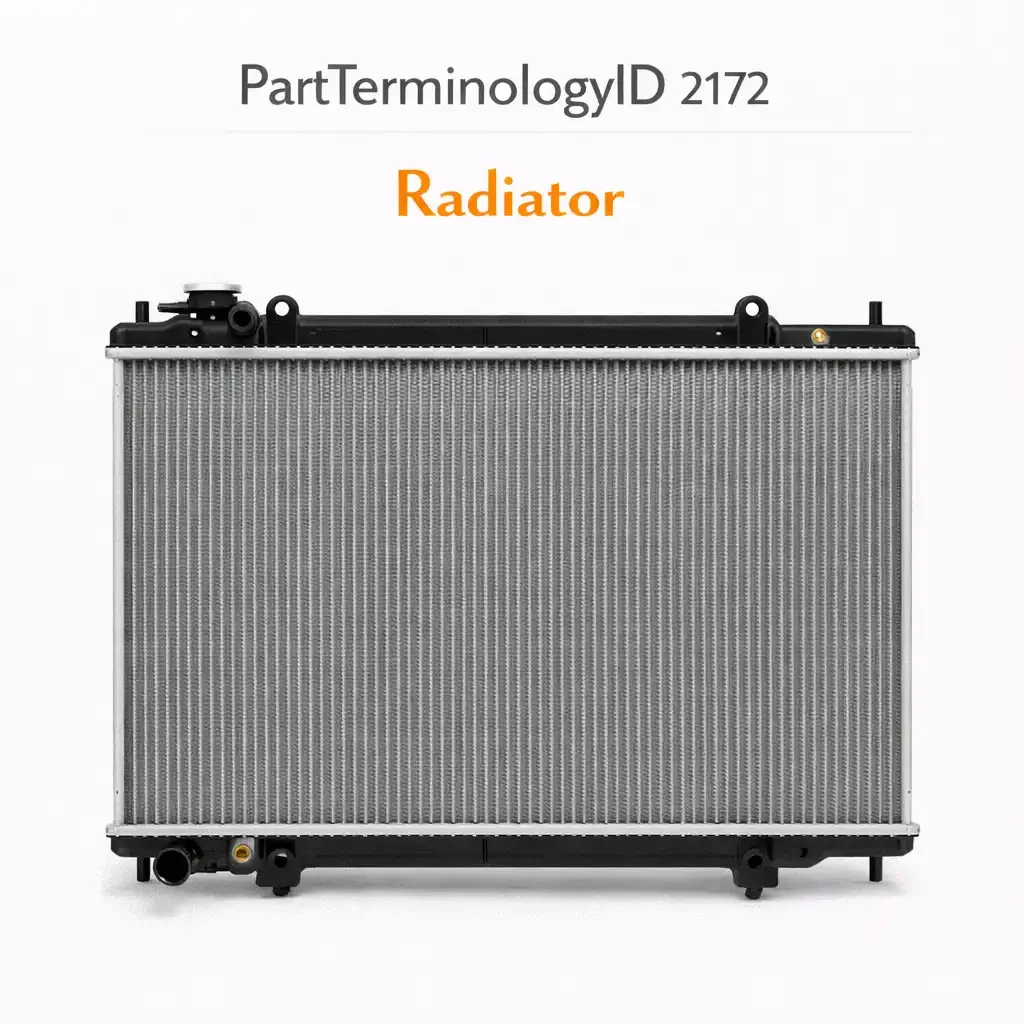
PartTerminologyID 2172, Radiator, is the primary heat exchanger in the engine cooling system. That definition is understood by every buyer who searches for this part. It does not specify the radiator core size, the core configuration, the number of rows, the fin density, the inlet and outlet hose connection diameter and position, the transmission oil cooler configuration, the engine coolant capacity, the material, the tank material and construction, the drain valve position, whether the radiator includes an integrated transmission oil cooler in the end tank, or which engine on the vehicle the radiator is designed for. A listing under PartTerminologyID 2172 that includes the year, make, model, and nothing else is a listing that covers a product that can be verified only by buyers who already know every specification of their original radiator and can cross-reference it to the listing independently. That is a small fraction of the buyer population. The rest will order, install, and discover one of seven specifications that the listing failed to disclose.
For sellers, the radiator is the highest-dollar part in the cooling system series and generates some of the most expensive return events because a wrong radiator typically requires the buyer to drain and refill the cooling system, remove the upper and lower radiator hoses, disconnect the transmission cooler lines on equipped vehicles, remove the fan shroud, and then reverse all of that to remove the wrong radiator before installing the correct one. The labor cost to the buyer is significant. The cost to the seller is a return of a high-value part that may have been installed, a restocking dispute, and a buyer who does not return for a second order.
For sellers, the listing under this PartTerminologyID is only useful if it includes the engine code, the core dimensions, the tank material, the hose connection positions and diameters, the transmission cooler configuration, the fin density or row count, and the drain valve position. Without those seven attributes, the listing is a radiator-shaped object the buyer cannot verify before ordering.
What the Radiator Does
Rejecting engine combustion heat to the ambient air
The radiator's function is to transfer the heat absorbed by the engine coolant into the ambient air flowing through the radiator core. Coolant enters the radiator through the upper inlet connection, passes through a network of narrow tubes running from the upper tank to the lower tank, and exits through the lower outlet connection. Thin aluminum fins bonded to the tubes increase the surface area in contact with the airflow passing through the core. The temperature differential between the hot coolant in the tubes and the cooler air passing through the fins drives the heat transfer. On a vehicle moving at highway speed, the ram airflow through the radiator provides substantial heat rejection capacity. At low speeds and at idle, the electric or mechanical cooling fan supplements the ram airflow.
The radiator's heat rejection capacity must be matched to the engine's heat load. A radiator that is undersized for the engine will allow coolant temperature to rise above the operating range under sustained load, in high ambient temperatures, and in towing conditions. A radiator from a four-cylinder application installed on a V8 application will be too small, too light, and will not provide adequate heat rejection at the V8's heat output. The core dimensions and the row count determine the radiator's capacity, and those specifications are engine-specific.
The transmission oil cooler in the radiator end tank
On most domestic vehicles with automatic transmissions, the factory cooling system includes a transmission oil cooler integrated into one of the radiator end tanks. Transmission fluid from the transmission circulates through the cooler, transfers heat to the coolant in the end tank, and returns to the transmission. When the radiator is replaced, the replacement must match the original transmission cooler configuration: present or absent, and if present, the line connection type and position.
A radiator with an integrated transmission cooler installed on a vehicle that has no transmission cooler lines will have two capped or open ports on the end tank with no use. A radiator without a transmission cooler installed on a vehicle that has transmission cooler lines will leave those lines with no connection. The buyer will either cap the lines, which removes the transmission fluid cooling and risks transmission damage from overheating fluid, or will be unable to complete the installation.
The cooling system's thermal history and the replacement trigger
Radiators fail through internal corrosion from depleted coolant, electrolytic corrosion between dissimilar metals in the coolant circuit, physical damage from road debris or accidents, and scale buildup from mineral-rich make-up water. The failure mode affects the replacement selection. An internally corroded radiator on a vehicle with a long history of neglected coolant service may have corroded the entire cooling circuit, including the water pump and the heater core. Replacing the radiator alone without flushing the circuit and addressing the root cause of the corrosion will expose the new radiator to the same conditions that destroyed the original.
A radiator listing that does not acknowledge this context cannot address it. A listing that does acknowledge it, even briefly in the installation guidance, reduces the rate of premature new radiator failures that generate a second return and a frustrated buyer.
The Seven Specifications That Determine Radiator Fitment
Core dimensions: height, width, and thickness
The radiator core must fit within the radiator support structure and the mounting brackets of the vehicle. Core height, width, and thickness are the primary dimensional specifications. A core that is wider or taller than the original will not fit in the radiator support. A core that is thinner than the original will fit but may not be retained by the original mounting points, which are designed for the original core thickness.
Core dimensions for passenger vehicle radiators range from approximately 14 inches to 28 inches in height and 20 inches to 36 inches in width. Core thickness ranges from approximately 1 inch to 3 inches depending on the application and whether the radiator is a single-pass or multi-pass design. The listing must state all three core dimensions. Stating the overall radiator size without the core dimensions is insufficient because the tanks and mounting brackets add to the overall size in ways that vary between radiator designs.
Row count and fin density
The row count, which is the number of tube rows in the core, and the fin density, which is the number of fins per inch on the tubes, together determine the heat exchange surface area and the heat rejection capacity. A two-row radiator has more capacity than a single-row radiator of the same external dimensions. Higher fin density increases capacity but also increases restriction to airflow, which requires more fan work to move air through a high-density core at low vehicle speeds.
OE-specification radiators are designed for the engine's heat output at the designed operating conditions. Aftermarket radiators may be offered in OE-specification configurations and in high-performance configurations with additional rows or higher fin density. The listing must specify the row count and the fin density so the buyer can verify the replacement matches the OE specification or can consciously select a higher-capacity replacement for a performance or towing application.
Tank material: plastic-over-aluminum versus full aluminum versus copper-brass
Three primary material constructions are used in modern radiators. Plastic-over-aluminum is the most common construction on post-1990 passenger vehicles. The core is aluminum tubes and fins. The end tanks are injection-molded plastic, typically nylon or polyamide, crimped to the aluminum core through a rubber gasket. This construction is light, efficient, and cost-effective but is subject to plastic tank cracking from thermal cycling over time, and the plastic-to-aluminum crimp joint is a potential leak point as the gasket ages.
Full aluminum radiators use welded aluminum end tanks rather than plastic. They are more durable under high-pressure and high-temperature conditions and are commonly used on performance, diesel, and heavy-duty applications. Copper-brass radiators, which were standard on pre-1990 domestic vehicles and are still used on some heavy-duty and vintage applications, use copper tubes and brass end tanks brazed together. They are heavier than aluminum but are more repairable than plastic-tank designs.
The replacement radiator material must be compatible with the mounting brackets, the hose connections, and the coolant formulation in the system. Some OAT extended-life coolants are not compatible with copper-brass radiators. A full aluminum aftermarket radiator installed on a vehicle that used a plastic-tank OE radiator may require different hose clamp positions and may not seat correctly in the mounting brackets designed for the plastic-tank OE unit.
Inlet and outlet connection positions and diameters
The upper radiator hose inlet and the lower radiator hose outlet must be at the same position and diameter as the original radiator for the hoses to connect correctly. On most vehicles the upper inlet is at the top of one end tank and the lower outlet is at the bottom of the opposite end tank, creating an S-flow or cross-flow path through the core. On some vehicles both connections are on the same side. On others the connections are at mid-tank height rather than at the top and bottom.
The connection position on the end tank, whether it is at the top, middle, or bottom and whether it faces forward, rearward, or downward, determines whether the original hose can connect without being forced or kinked. The connection diameter determines whether the hose clamp can seal the interface. A radiator with an upper inlet at the correct position but 1/2 inch smaller in diameter than the original will require a different hose or a reducer fitting to connect, which is not disclosed in the listing and is not apparent to the buyer until the original hose will not seat.
Transmission cooler configuration
The presence, absence, and type of the integrated transmission oil cooler must match the original. On automatic transmission vehicles, the replacement radiator must include a transmission cooler with the same line connection type (compression fitting, threaded fitting, or quick-connect) and the same line connection position as the original. On manual transmission or transmission-cooler-delete applications, the replacement must either have no cooler ports or have ports that are factory-capped.
A replacement radiator with cooler ports on a non-cooler application is not a problem if the ports are capped at the factory. It becomes a problem if the buyer removes the caps without understanding their purpose, or if the caps are not fully seated and weep coolant at operating temperature. A replacement radiator without cooler ports on an automatic transmission application requires the buyer to route the transmission cooler lines to an external auxiliary cooler or leaves the transmission fluid circuit without cooling, which is a transmission-destroying condition that develops over months rather than miles.
Drain valve position and type
The radiator drain valve, also called a petcock, is used to drain the coolant from the radiator for service. The drain valve position on the replacement must be accessible with the radiator installed in the vehicle. On most vehicles, the drain valve is at the bottom of the lower tank or at the bottom of one end tank in a position that allows a drain hose to be attached and directed into a drain pan without removing the radiator.
A replacement radiator with the drain valve on the opposite side of the tank from the original may position the valve behind a frame rail, a suspension component, or the bumper fascia where it cannot be accessed without lifting the vehicle or removing components. This is discovered at the first coolant service after the radiator replacement and generates a frustrated owner complaint rather than a formal return, but it reduces buyer satisfaction and brand credibility.
Engine code specificity on multi-engine platforms
The same vehicle body is frequently offered with two, three, or four different engine options. The four-cylinder, the V6, and the V8 variants of the same platform do not share a radiator. The V8 generates significantly more heat than the four-cylinder and requires a higher-capacity radiator with more rows, larger core dimensions, and a higher coolant flow rate through the inlet and outlet connections. Installing a four-cylinder radiator on a V8 application will produce an engine that overheats under any sustained load.
The engine code is the mandatory fitment attribute for radiator listings on multi-engine platforms. Year, make, and model alone are not sufficient when the same model was available with engine options that use different radiator specifications.
Why This Part Generates Returns
Buyers order the wrong radiator because:
the engine code is not specified and the replacement is sized for a four-cylinder application on a V6 or V8 vehicle
the core dimensions are not stated and the replacement does not fit in the radiator support
the transmission cooler configuration does not match: a cooler-equipped radiator on a non-cooler application, or a non-cooler radiator on an automatic transmission application
the inlet and outlet positions are different from the original, preventing the original hoses from connecting without modification
the inlet or outlet diameter is different from the original, requiring a different hose or a reducer fitting
the tank material is different from the original and the mounting brackets or hose clamps do not fit the replacement correctly
the drain valve is on the wrong side or in an inaccessible position
the row count is lower than the original, producing a radiator that cannot reject the engine's heat output under load
Status in New Databases
PIES/PCdb: PartTerminologyID 2172, Radiator
PIES 8.0 / PCdb 2.0: No change
Top Return Scenarios
Scenario 1: "Radiator is too small, engine overheats under load"
The replacement radiator was listed for the vehicle model without specifying the engine code. The buyer has a V8. The replacement was sized for the four-cylinder variant. The core is smaller, has fewer rows, and cannot reject the V8's heat output at highway speed under any load condition.
Prevention language: "Engine code: [specific engine code or codes]. This radiator fits the [X]-cylinder engine variant only. Verify your engine code before ordering. The same vehicle model uses different radiators on different engine variants. A radiator sized for a smaller engine will not provide adequate cooling on a larger engine."
Scenario 2: "Transmission cooler ports are on the radiator, my car has no cooler lines"
The buyer has a manual transmission or a vehicle that did not receive the optional transmission cooler package. The replacement radiator has two open cooler line ports on the end tank. The buyer sealed them with tape as a temporary measure and returned the radiator.
Prevention language: "Transmission oil cooler: [integrated / not integrated]. This radiator includes an integrated automatic transmission oil cooler in the [upper / lower] end tank. If your vehicle does not have automatic transmission cooler lines, verify your application requires a cooler-equipped radiator before ordering. [Cooler ports are factory-capped on non-cooler applications if applicable.]"
Scenario 3: "No transmission cooler in this radiator, my AT lines have nowhere to go"
The buyer has an automatic transmission and the original radiator had an integrated cooler. The replacement radiator has no cooler. The buyer cannot connect the transmission cooler lines. The listing did not specify whether the transmission cooler was included or absent.
Prevention language: "Transmission oil cooler: [integrated / not integrated]. This radiator does not include an integrated transmission oil cooler. If your vehicle has an automatic transmission with factory cooler lines, verify your application does not require an integrated cooler before ordering. If your vehicle requires a cooler, an auxiliary external transmission oil cooler (PartTerminologyID 2088) must be installed in the circuit."
Scenario 4: "Upper hose inlet is on the wrong side"
The original radiator has the upper inlet on the passenger side. The replacement has the upper inlet on the driver's side. The upper radiator hose cannot reach the inlet without being forced across the engine bay. The hose contacts the fan belt.
Prevention language: "Upper inlet position: [driver side / passenger side / center], facing [forward / rearward / upward]. Inlet inner diameter: [X]mm. Verify your original upper hose connects to the [same position and direction] before ordering. An inlet on the wrong side will prevent the original hose from reaching without modification."
Scenario 5: "Core is 1 inch too wide, will not fit in the radiator support"
The core width is not stated in the listing. The replacement core is 1 inch wider than the original. The radiator will not slide into the lower mounting channels in the radiator support and cannot be installed without modifying the support structure.
Prevention language: "Core dimensions: [X] inches wide x [X] inches tall x [X] inches thick. Verify the core dimensions fit your radiator support structure before ordering. Core width and height must not exceed the opening in the radiator support. Core thickness must be compatible with the mounting brackets."
Scenario 6: "Plastic tank cracked on the second day"
The replacement radiator's plastic tank was damaged in shipping. The listing image showed only the radiator core and did not show the end tanks. The buyer installed the radiator, filled the system, and found a pinhole leak in the end tank on the second day.
Prevention language: "Inspect the plastic end tanks for cracks, distortion, and damage to the crimp joint before installing. Shipping damage to plastic tanks is not always visible externally. Fill the radiator with coolant and inspect all four edges of each end tank, the crimp joint along the tank perimeter, and the hose connections before operating the vehicle."
Scenario 7: "Drain valve is behind the frame, cannot drain the coolant"
The drain valve position on the replacement is on the opposite side of the lower tank from the original. The valve is positioned directly behind the front frame rail on the buyer's vehicle and cannot be accessed without a lift and a 90-degree reach behind the rail.
Prevention language: "Drain valve position: [driver side lower tank / passenger side lower tank / center lower tank], facing [forward / rearward / downward]. Verify the drain valve is accessible with the radiator installed in your vehicle before ordering."
What to Include in the Listing
Core essentials
PartTerminologyID: 2172
component: Radiator
engine code (mandatory)
core height in inches or mm (mandatory)
core width in inches or mm (mandatory)
core thickness in inches or mm (mandatory)
row count and fin density (mandatory)
tank material: plastic-over-aluminum, full aluminum, copper-brass (mandatory)
upper inlet position and inner diameter in mm (mandatory)
lower outlet position and inner diameter in mm (mandatory)
transmission cooler: integrated or not integrated (mandatory)
transmission cooler line connection type if integrated: compression, threaded, quick-connect
drain valve position (mandatory)
coolant capacity in quarts or liters
Fitment essentials
year/make/model/submodel
engine code (mandatory, non-negotiable)
transmission type: automatic or manual (mandatory on vehicles where the radiator specification differs by transmission type)
air conditioning equipped when the radiator specification differs between AC and non-AC applications
factory tow package equipped when a different radiator is used on tow-package vehicles
Dimensional essentials
core height in inches and mm
core width in inches and mm
core thickness in inches and mm
overall radiator height including tanks in inches and mm
overall radiator width including tanks in inches and mm
upper inlet inner diameter in mm and position on end tank
lower outlet inner diameter in mm and position on end tank
transmission cooler line port outer diameter or thread specification if integrated
drain valve position and type: petcock or quick-release drain
Image essentials
full frontal view of the radiator showing core, tanks, and connections
upper inlet connection close-up showing position on end tank and diameter callout
lower outlet connection close-up showing position and diameter callout
transmission cooler ports close-up showing connection type and position on end tank
drain valve close-up showing position and access direction
rear view of the radiator showing mounting points and bracket compatibility
dimensional callout image showing core height, width, and thickness
Catalog Checklist for ACES/PIES Teams
PartTerminologyID = 2172
require engine code (mandatory, non-negotiable)
require core height, width, and thickness
require row count
require tank material
require upper inlet position and inner diameter
require lower outlet position and inner diameter
require transmission cooler presence or absence (mandatory)
require transmission cooler line connection type and position if integrated
require drain valve position
require year/make/model/submodel
require transmission type when radiator specification differs between automatic and manual
require AC-equipped designation when radiator specification differs between AC and non-AC
require tow package designation when a high-capacity radiator is used on tow-package vehicles
differentiate from heater core (PartTerminologyID varies): the heater core is a separate heat exchanger inside the cabin; the radiator is external in the engine bay
differentiate from transmission oil cooler (PartTerminologyID 2088): the standalone transmission cooler is a separate auxiliary unit; the integrated cooler is within the radiator end tank; when the radiator is replaced on an AT application, the integrated cooler is replaced as part of the radiator
differentiate from radiator cap (PartTerminologyID 2068): the radiator cap is a separate part; some radiator listings incorrectly include the cap specification in the listing without clarifying whether the cap is included
differentiate from condenser (PartTerminologyID varies): the AC condenser is mounted in front of the radiator on most vehicles and is a separate heat exchanger; replacing the radiator typically requires removing the condenser; inspect the condenser for damage during the radiator replacement
flag that core dimensions must be stated, not just overall dimensions: tank thickness adds to overall width and height and must not be confused with core dimensions
flag that transmission cooler configuration is mandatory: it is the most consequential fitment attribute after engine code for automatic transmission vehicles
flag that engine code is mandatory: year/make/model alone is insufficient on multi-engine platforms
FAQ (Buyer Language)
How do I know which radiator fits my engine?
Identify your engine code from the vehicle identification label in the engine bay doorjamb sticker or the engine cover label. On most domestic vehicles the engine code is a combination of letters and numbers such as 5.0L, 6.2L, or LS1. Cross-reference the engine code to the radiator listing and verify the core dimensions match your original radiator by measuring the core height, width, and thickness before removing the original. If the dimensions on the listing match, confirm the hose connection positions and the transmission cooler configuration before ordering.
My radiator has two small fittings on one end tank that I have never connected anything to. What are they?
Those are the transmission oil cooler line fittings. On automatic transmission vehicles, those fittings connect to the transmission fluid lines that route from the transmission to the cooler. If your vehicle has an automatic transmission but the lines are not connected, the transmission may have been overheating. If your vehicle has a manual transmission, those fittings should be capped. Verify whether your transmission is equipped with cooler lines before capping or connecting them.
Can I use a radiator with more rows than the original for better cooling?
Yes, on most applications, if the core dimensions fit the radiator support and the mounting brackets. A two-row replacement on a single-row OE application provides more heat rejection capacity, which is beneficial for towing, performance, or high-temperature environments. The increased fin density of a higher-row radiator may reduce airflow through the core at low fan speeds, so verify that the fan can move adequate air through the higher-density core. On vehicles with tight engine bays, a thicker core may interfere with the fan shroud or the condenser.
Should I flush the cooling system before installing a new radiator?
Yes, always. If the original radiator failed from corrosion, scale, or depleted coolant, the same conditions are present in the rest of the cooling circuit. Installing a new radiator into a circuit with depleted coolant and corrosion products will expose the new radiator to the same failure mechanism that destroyed the original. Drain and flush the entire cooling circuit, inspect and replace the thermostat, and refill with fresh coolant of the correct formulation before putting the new radiator into service.
The original radiator has three connections on the bottom: two for the lower hose and one that looks like a drain. Is that normal?
Yes on many applications. The lower outlet for the coolant hose is typically at the bottom of the end tank. A separate petcock drain valve is also typically on the lower tank. On some radiators, there is also a drain plug or a transmission cooler outlet port at the lower tank. Identify each connection before ordering the replacement to confirm the replacement has the same configuration.
My original radiator is a copper-brass unit. Should I replace it with copper-brass or switch to aluminum?
It depends on the application and the coolant formulation. On vintage vehicles that use conventional green coolant, a copper-brass replacement is appropriate and will last long on that coolant chemistry. Modern OAT extended-life coolants are not compatible with copper-brass radiators over extended service intervals and will corrode the solder joints. If the vehicle is being converted to OAT coolant, an aluminum replacement is the correct choice. If the vehicle uses conventional coolant and you want to maintain the original architecture, a copper-brass replacement is acceptable. Verify the coolant formulation compatibility before selecting the material.
Does the new radiator come with a drain valve?
Most replacement radiators include a drain valve or petcock in the lower tank. Verify the listing states whether a drain valve is included. If the replacement radiator does not include a drain valve and the original had one, the replacement may have a plugged drain port that accepts the original drain valve from the old radiator. Inspect the original petcock and transfer it to the new radiator if it is undamaged and the thread specification matches.
Cross-Sell Logic
Radiator Cap (PartTerminologyID 2068: the radiator cap is replaced whenever the radiator is replaced; the cap pressure rating must match the new radiator's specification, which may differ from the old cap if the replacement is from a different manufacturer or specification)
Upper Radiator Hose (PartTerminologyID varies: the upper hose is disturbed during every radiator replacement; inspect for cracking and softness and replace if the hose is at the same service age as the failed radiator)
Lower Radiator Hose (PartTerminologyID varies: the lower hose is removed during every radiator replacement; replace at the same service event)
Transmission Oil Cooler Lines (PartTerminologyID varies: the cooler lines are disconnected during radiator replacement on AT vehicles; inspect for cracking, corrosion, and fitting condition and replace if at the same service age)
Engine Coolant (the system must be fully drained and refilled with fresh coolant at the correct formulation after every radiator replacement)
Thermostat and Thermostat Housing Gasket (PartTerminologyID varies and 2136: if the radiator failure was caused by overheating, the thermostat should be inspected and replaced; a thermostat that failed closed caused the overheat event that destroyed the radiator)
Engine Cooling Fan Motor (PartTerminologyID 2164: inspect the fan motor and relay while the radiator is removed; a fan motor that has been running continuously due to the overheating event that caused the radiator failure may have worn its brushes or overloaded its windings)
Fan Shroud (PartTerminologyID varies: the fan shroud is removed during radiator replacement on most vehicles; inspect for cracks and distortion and replace if damaged)
Coolant Temperature Sensor (PartTerminologyID varies: if the radiator failed from overheating, the coolant temperature sensor that should have triggered the fan or the warning light should be tested for correct operation)
Frame as "the radiator is the heat exchanger. The cap controls the pressure the radiator operates at. The hoses carry the coolant to and from the radiator. The thermostat controls when the radiator enters the circuit. The fan motor moves air through the radiator at low speed. The coolant fills the circuit the radiator sits in. All of them are inspected or replaced when the radiator is replaced because they all contributed to or were affected by the failure that brought the vehicle in."
Final Take for PartTerminologyID 2172
Radiator (PartTerminologyID 2172) is the highest-dollar part in the cooling system PartTerminologyID series and the one where a wrong fitment requires the most labor to discover and correct. The buyer drains the coolant, removes the hoses, disconnects the transmission lines, takes the fan shroud out, drops the old radiator, and only then discovers that the replacement has the wrong core size, the wrong inlet position, the wrong transmission cooler configuration, or the wrong row count for their engine.
All seven specifications that determine radiator fitment are required in the listing to prevent that discovery from happening after the installation begins. The engine code is the primary attribute. The core dimensions determine whether the radiator fits the vehicle structure. The tank material determines bracket and hose clamp compatibility. The inlet and outlet positions determine whether the original hoses connect. The transmission cooler configuration determines whether the AT lines have a connection point. The row count determines whether the radiator can reject the engine's heat load. The drain valve position determines whether the coolant can be serviced after installation.
State the engine code. State the core dimensions. State the tank material. State the inlet and outlet positions and diameters. State the transmission cooler configuration. State the row count. State the drain valve position. That is the same listing strategy as every other PartTerminologyID in this series. For PartTerminologyID 2172, the consequence of an incomplete listing is the most labor-intensive return event in the cooling system category, because it is discovered after the old radiator has already been removed and cannot go back.