
Written by Arthur Simitian | PartsAdvisory
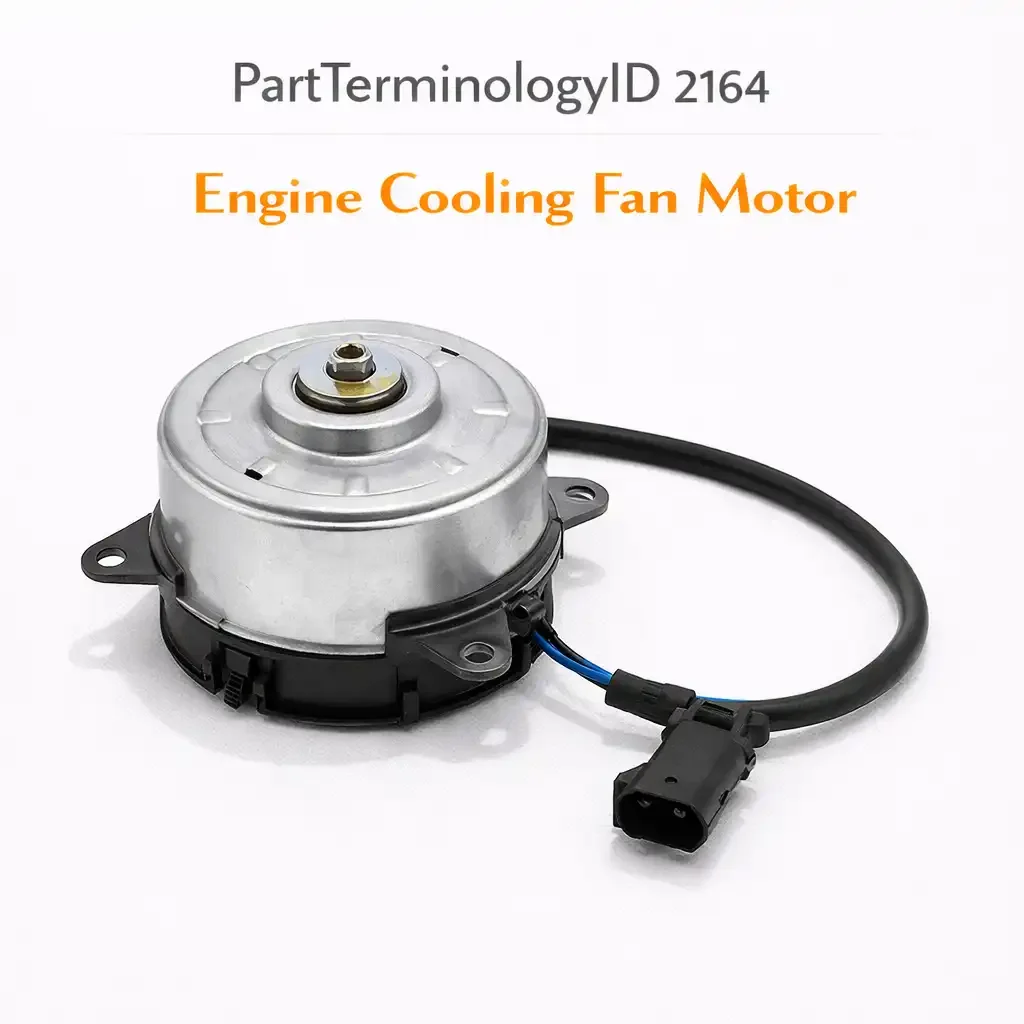
PartTerminologyID 2164, Engine Cooling Fan Motor, is an electric motor that drives a cooling fan in the engine cooling system. That definition identifies the function without specifying the motor amperage draw, the voltage, the rotation direction, the mounting configuration, the connector pin count and pin configuration, the shaft diameter, the shaft length, the motor diameter, whether the motor is for a primary cooling fan or an auxiliary fan, whether the motor drives a single-speed or multi-speed fan, or which vehicle the motor fits. A listing under PartTerminologyID 2164 that does not include the amperage, the rotation direction, and the connector pin configuration is asking the buyer to guess three of the specifications that most commonly cause installation failures on cooling fan motors, before they have even compared the motor dimensions to their fan shroud.
For sellers, the engine cooling fan motor is a part where a fitment error can produce three different failure outcomes depending on which specification is wrong. A motor with the wrong rotation direction spins the fan blade backward, which moves air in the wrong direction and can cause the engine to overheat while the fan appears to be running normally. A motor with the wrong amperage draw trips the cooling fan relay or blows the cooling fan fuse on every startup attempt. A motor with the wrong connector pin count or pin layout cannot be connected to the vehicle wiring harness without modification, which the buyer cannot complete without access to wiring diagrams and the correct terminals. Each of these failure modes produces a return, but the rotation direction failure is the one that is most likely to be misdiagnosed: a fan spinning backward looks like a working fan to anyone who does not know the blade pitch, and an engine that overheats despite a visibly spinning fan is a diagnostic puzzle that wastes the buyer's time and erodes confidence in the part.
For sellers, the listing under this PartTerminologyID is only useful if it includes the vehicle fitment by year/make/model and engine, the motor amperage, the rotation direction, the connector pin count and pin layout, the shaft diameter and length, and whether the motor is for the primary fan or an auxiliary fan. Without those six attributes, the return rate for this PartTerminologyID is set by the probability that the buyer's vehicle uses the same motor specification as the one the seller happened to stock.
What the Engine Cooling Fan Motor Does
Forcing airflow through the radiator at low vehicle speeds
The engine cooling fan motor drives an electric fan that pulls or pushes air through the radiator and condenser when the vehicle is moving too slowly for ram airflow to provide adequate heat rejection. At highway speeds, the vehicle's forward motion forces sufficient air through the radiator without the fan running. At low speeds, in traffic, at idle, and when the air conditioning compressor is engaged, the fan motor is activated to maintain coolant temperature within the operating range.
The cooling fan is the last line of defense between the cooling system and overheating during low-speed and stationary operation. A fan motor that does not operate correctly at idle in traffic on a warm day can allow the coolant temperature to rise to the point where the engine protection system reduces power or shuts the engine off. A fan motor that appears to operate but spins the blade in the wrong direction moves heated air from behind the radiator forward through the fins in the wrong direction, reducing rather than increasing heat rejection.
Primary fan versus auxiliary fan
Many vehicles use two electric fans at the radiator and condenser: a primary cooling fan and an auxiliary fan. The primary fan is larger and higher-wattage. It is the main coolant temperature management fan. The auxiliary fan is smaller and is typically dedicated to condenser airflow when the air conditioning is engaged, or it operates at a lower speed as a supplemental cooling assist. On many vehicles the two fans use different motors with different amperage ratings, different shaft diameters, and different connector configurations even when they appear visually similar.
A listing that does not specify primary or auxiliary fan position will generate returns when a buyer who needs the auxiliary fan motor receives the primary fan motor, or vice versa. The motor diameter and the bracket mounting configuration may be identical between the two positions on some vehicles, which allows the motor to physically install in either location, but the amperage draw will be different and the motor will not operate correctly on the relay and circuit designed for the other position.
Single-speed versus multi-speed motor operation
Some cooling fan systems operate the fan at a single speed determined by the relay switching the fan circuit on and off. Others operate the fan at multiple speeds by varying the voltage or current supplied to the motor, or by switching between a full-voltage circuit and a series-resistance circuit. On multi-speed systems, the motor must be wound or designed to operate correctly across the speed range the system provides. A single-speed motor installed on a multi-speed circuit will not modulate speed correctly and will either run at full speed continuously or not at all depending on how the multi-speed circuit is implemented.
The listing must specify whether the motor is designed for single-speed or multi-speed operation. This attribute is absent from most listing data under PartTerminologyID 2164 and it is one of the reasons that buyers who replace a cooling fan motor with a part that fits physically and connects electrically still end up with a fan that does not operate correctly.
The pulse-width modulation control fan
On current-production vehicles with advanced thermal management systems, the cooling fan speed is controlled by the engine control module or a dedicated fan control module using pulse-width modulation. The fan motor on a PWM-controlled system is a brushless motor or a variable-speed brushed motor designed to respond to PWM signals rather than simple on/off relay switching. A conventional brushed motor installed on a PWM-controlled circuit will either not respond to the PWM signal correctly, will run at a fixed speed regardless of the signal, or will generate electrical noise that interferes with the control module communication.
A listing that does not specify whether the motor is PWM-compatible on a PWM-controlled application will generate returns from buyers on those vehicles regardless of whether the physical dimensions and connector match.
The Motor Specifications This Part Must Match
Amperage draw
The cooling fan motor's amperage draw at full load determines the size of the fuse, the rating of the relay, and the wire gauge in the fan circuit. The vehicle's electrical system is designed for the amperage draw of the original equipment motor. A replacement motor with a higher amperage draw will exceed the fuse rating, trip the relay, or overheat the wiring on sustained operation. A replacement motor with a lower amperage draw than the original will not provide the designed torque at the fan blade, which reduces airflow at a given fan speed and may cause the fan to stall under high blade resistance at low motor speeds.
Common amperage draws for passenger vehicle primary cooling fan motors range from 15 amperes to 35 amperes at full load. Auxiliary fan motors typically draw 10 to 20 amperes. Heavy-duty truck cooling fan motors can exceed 50 amperes. The listing must state the motor amperage at rated load. A listing that states wattage rather than amperage can be converted but should state both to avoid conversion errors.
Rotation direction
The rotation direction of the motor shaft determines the rotation direction of the fan blade. Fan blades are designed to move air in one direction when rotating in one direction. Reversing the rotation direction reverses the airflow. A cooling fan motor that rotates clockwise when the original rotated counterclockwise, or vice versa, moves air from the engine side of the radiator toward the vehicle's front, which is the opposite of the intended direction for a puller fan configuration. The engine overheats as a result.
Rotation direction is specified from the perspective of the shaft end of the motor: looking at the end of the shaft from outside the motor, the shaft rotates either clockwise or counterclockwise. The listing must state the rotation direction using this convention. A listing that omits rotation direction is omitting the single most consequential specification for airflow performance after the motor is installed.
Connector pin count and pin layout
The cooling fan motor connects to the vehicle wiring harness through a multi-pin connector. The number of pins and the pin layout are specific to the vehicle and the motor speed control system. A single-speed motor on a simple relay circuit may use a two-pin connector. A multi-speed motor with a ground, a low-speed, and a high-speed input may use a three-pin connector. A PWM-controlled motor may use a four-pin or five-pin connector with a PWM signal input, a tachometer output, a power supply, and a ground.
The connector pin count must match the vehicle harness connector exactly. A two-pin replacement motor on a three-pin harness connector cannot be connected without modification. A three-pin motor on a two-pin harness leaves a pin unconnected, which may prevent correct operation or may provide no signal path for a required circuit.
The pin layout within the connector, which is the physical position of each pin within the connector housing, must also match. A connector with the correct pin count but a different pin layout will force the buyer to either use a connector adapter or repin the harness, neither of which is a straightforward task for a cooling fan replacement.
Shaft diameter and shaft length
The shaft diameter must match the fan blade hub bore. The fan blade is pressed or keyed onto the motor shaft. A shaft that is undersized for the hub bore will allow the blade to slip on the shaft, which reduces airflow and can cause blade vibration. A shaft that is oversized will not accept the blade hub. Shaft diameters for passenger vehicle cooling fan motors range from approximately 6mm to 12mm.
The shaft length must be sufficient for the fan blade hub depth plus the mounting hardware. A shaft that is too short will not allow the fan blade to be secured. A shaft that is excessively long may contact the radiator core or the fan shroud.
Motor diameter and mounting configuration
The motor body diameter and the mounting bracket configuration must match the fan shroud. Most cooling fan motors are held in the center of the fan shroud by a mounting bracket that bolts or clips to the shroud. The motor body diameter must clear the shroud center opening and the bracket must align with the shroud mounting points. A motor with a body diameter that is 5mm larger than the original will not pass through the shroud opening, regardless of correct electrical specifications.
Why This Part Generates Returns
Buyers order the wrong engine cooling fan motor because:
the rotation direction is not stated and the replacement motor spins the fan blade in the wrong direction, reversing airflow and causing overheating that appears to be a thermostat or water pump failure
the connector pin count does not match the vehicle harness and the motor cannot be connected without modification
the amperage draw is not stated and the replacement motor trips the fuse or relay on first startup
the listing does not distinguish primary fan from auxiliary fan, and the buyer installs the primary motor in the auxiliary position or vice versa
the motor is specified for a single-speed relay circuit and the vehicle uses a PWM-controlled multi-speed system
the shaft diameter does not match the fan blade hub and the blade cannot be transferred to the replacement motor
the motor diameter is larger than the original and the motor body does not clear the shroud center opening
the listing applies a motor from one engine variant to another engine variant on the same platform, where the cooling system is different enough to require a different fan motor amperage
Status in New Databases
PIES/PCdb: PartTerminologyID 2164, Engine Cooling Fan Motor
PIES 8.0 / PCdb 2.0: No change
Top Return Scenarios
Scenario 1: "Fan is spinning but engine is overheating"
The replacement motor has the opposite rotation direction from the original. The fan blade spins in the wrong direction and pushes air forward through the radiator rather than pulling air through it from behind. The fan appears operational. The engine overheats in traffic. The buyer replaces the thermostat and the water pump before discovering the fan is spinning backward.
Prevention language: "Motor rotation direction: [clockwise / counterclockwise] when viewed from the shaft end. Verify your original motor's rotation direction matches before installing. A motor with the opposite rotation direction will spin the fan blade in reverse, moving air in the wrong direction through the radiator. The engine will overheat despite the fan appearing to operate normally."
Scenario 2: "Motor blows the fuse on every startup"
The replacement motor draws more amperage than the vehicle's fuse is rated for. The fuse blows within seconds of the fan circuit being energized. The buyer replaces the fuse and the fuse blows again. The listing did not state the motor amperage.
Prevention language: "Motor amperage at rated load: [X] amperes. Verify your vehicle's cooling fan fuse rating is compatible with the motor amperage before installing. A motor that exceeds the fuse rating will blow the fuse on every startup. Check the fuse box diagram for the cooling fan fuse rating before ordering."
Scenario 3: "Connector does not match the harness"
The replacement motor has a three-pin connector and the vehicle harness has a two-pin connector. The buyer cannot connect the motor without purchasing a connector adapter and repinning the harness.
Prevention language: "Connector: [X]-pin [connector description]. Verify your vehicle's cooling fan harness connector pin count and pin layout match before ordering. A connector with the wrong pin count cannot be connected to the harness without modification. Pin count and pin layout must both match."
Scenario 4: "Primary motor installed in auxiliary position draws too much current"
The buyer needed the auxiliary fan motor. The listing did not distinguish primary from auxiliary. The buyer received the primary motor and installed it in the auxiliary fan position. The auxiliary fan relay is not rated for the primary motor's higher amperage. The relay overheats and fails.
Prevention language: "Fan position: [primary cooling fan / auxiliary fan]. Primary and auxiliary fan motors on the same vehicle use different amperage ratings and are not interchangeable. Verify which fan position requires the motor before ordering."
Scenario 5: "Vehicle uses PWM control, conventional motor does not modulate speed"
The buyer's vehicle uses a PWM fan control module. The replacement is a conventional brushed motor designed for relay on/off switching. The motor runs at full speed continuously because it does not respond to the PWM signal. The engine runs with the fan at maximum speed regardless of coolant temperature.
Prevention language: "Motor control type: [relay on/off / multi-speed / PWM compatible]. Verify your vehicle's fan control system type before ordering. Vehicles with PWM fan control modules require a PWM-compatible motor. A conventional relay-switched motor will not modulate speed on a PWM-controlled circuit."
Scenario 6: "Fan blade will not attach to the shaft"
The replacement motor shaft diameter is different from the original. The fan blade hub is machined for the original shaft diameter and will not seat on the replacement shaft.
Prevention language: "Shaft diameter: [X]mm. Shaft length: [X]mm. Verify your fan blade hub bore diameter matches the motor shaft diameter before ordering. The fan blade from the original motor is transferred to the replacement motor. A shaft that is undersized will allow the blade to slip. A shaft that is oversized will not accept the blade hub."
Scenario 7: "Motor body does not fit through the shroud opening"
The replacement motor has a slightly larger body diameter than the original. The motor body contacts the shroud center opening and cannot be inserted into the mounting position.
Prevention language: "Motor body diameter: [X]mm. Verify clearance between the motor body and the fan shroud center opening before ordering. A motor body that is larger than the shroud opening cannot be installed without modifying the shroud."
What to Include in the Listing
Core essentials
PartTerminologyID: 2164
component: Engine Cooling Fan Motor
fan position: primary cooling fan or auxiliary fan (mandatory)
motor rotation direction: clockwise or counterclockwise from shaft end (mandatory)
motor amperage at rated load in amperes (mandatory)
motor voltage: 12V DC for passenger vehicles, 24V for heavy-duty applications
connector pin count (mandatory)
motor control type: relay on/off, multi-speed, or PWM compatible (mandatory)
shaft diameter in mm (mandatory)
shaft length in mm (mandatory)
motor body diameter in mm (mandatory)
mounting bracket configuration: bolt pattern, bracket type
material: motor housing material
quantity: 1
Fitment essentials
year/make/model/submodel
engine code when cooling system specification varies by engine within the same model
air conditioning equipped or not equipped when the fan motor specification differs between AC and non-AC vehicles
compatible fan shroud part number when motor is shroud-specific
Dimensional essentials
motor body diameter in mm
motor body length excluding shaft in mm
shaft diameter in mm
shaft length from motor face in mm
mounting bracket bolt hole spacing in mm
connector body dimensions in mm for fitment with original harness connector
Image essentials
motor in isolation showing body, shaft, connector, and mounting bracket
shaft end view showing rotation direction arrow or callout
connector close-up showing pin count and pin layout
dimensional callout image showing body diameter, shaft diameter, and shaft length
installed context showing the motor in the fan shroud with blade attached
Catalog Checklist for ACES/PIES Teams
PartTerminologyID = 2164
require fan position: primary or auxiliary (mandatory)
require rotation direction: clockwise or counterclockwise from shaft end (mandatory)
require amperage at rated load (mandatory)
require voltage
require connector pin count (mandatory)
require motor control type: relay, multi-speed, or PWM (mandatory)
require shaft diameter in mm
require shaft length in mm
require motor body diameter in mm
require year/make/model/submodel fitment
require engine code when fan motor specification varies by engine on the same platform
require AC-equipped or not-equipped designation when fan motor specification differs
differentiate from engine cooling fan blade (PartTerminologyID varies): the blade is the rotating component attached to the motor shaft; the motor is the drive unit; both are in the same assembly but are separate parts
differentiate from engine cooling fan assembly (PartTerminologyID varies): the assembly includes the motor, the blade, and the shroud as a unit; the motor alone is this PartTerminologyID
differentiate from engine cooling fan relay (PartTerminologyID varies): the relay switches the fan circuit on and off; the motor is the load the relay switches; a blown fuse or failed relay may be misdiagnosed as a motor failure
differentiate from engine cooling fan resistor or fan control module (PartTerminologyID varies): the resistor or module controls fan speed on multi-speed systems; the motor is the component the module controls
flag rotation direction as mandatory: a motor with the wrong rotation direction produces overheating despite apparent fan operation and is the hardest failure mode to diagnose
flag PWM compatibility: a conventional motor on a PWM-controlled circuit will not modulate speed and will produce incorrect thermal management behavior
flag primary-versus-auxiliary distinction: different amperage ratings, different relay ratings, not interchangeable
FAQ (Buyer Language)
How do I determine the rotation direction of my original cooling fan motor?
With the vehicle off and the fan shroud accessible, look at the motor shaft end from outside the motor. Note the direction the blade tips point and the cupped face of each blade. Fan blades are designed to move air in one direction when rotating in one direction. If you can safely spin the blade by hand with the ignition off and the fan circuit disconnected, note which direction it naturally wants to spin or which direction moves air toward the engine when spun forward. Compare this to the rotation direction stated in the replacement motor listing before ordering. When in doubt, photograph the original motor and the blade before removal and note the blade curvature direction.
My cooling fan runs but the engine still overheats at idle. Is the motor the problem?
Not necessarily. A motor that runs but spins the blade in the wrong direction is one possibility, but the same symptom is produced by a clogged radiator, a low coolant level, a failed thermostat, a low-flow water pump, or a fan blade that is cracked and not moving air efficiently. Before replacing the motor, verify the fan is spinning in the correct direction by observing the airflow direction at the radiator face with the fan running. Correct airflow from a puller fan pulls air from the front of the vehicle through the radiator fins toward the engine. If air is moving from the engine toward the front of the vehicle, the fan is spinning backward.
My vehicle has two fans at the radiator. How do I know which motor I need?
Identify the failed fan by checking which fan is not spinning when the cooling system activates. The primary fan is typically the larger fan and is directly behind the radiator. The auxiliary fan is typically smaller and is positioned adjacent to the primary fan. On many vehicles, the primary fan is controlled by engine coolant temperature and the auxiliary fan is controlled by air conditioning compressor engagement. Check which fan circuit is active but not operating by testing for voltage at the motor connector with the fan circuit engaged.
Can I use a higher-amperage motor than the original to get better airflow?
No. A higher-amperage motor draws more current than the vehicle's fuse, relay, and wiring are rated for. Running a higher-amperage motor will blow the fuse on sustained operation, overheat and fail the relay, and may damage the wiring insulation from sustained over-current. Improved airflow from a higher-amperage motor is achieved through a different fan blade design rather than a higher-amperage motor in the same circuit. Do not exceed the original motor's amperage specification.
My fan motor connector has four pins but I can only find a three-pin replacement. Can I use it?
No without modification. A three-pin motor on a four-pin harness leaves one circuit unconnected, which may be a PWM signal input, a tachometer output, a fault signal, or a second speed input depending on the vehicle. Operating without that circuit may cause the fan to run at a single speed only, generate a fault code in the engine control module, or prevent the fan from responding correctly to thermal management commands. Match the pin count and pin layout exactly.
How do I test the cooling fan motor before installing?
Apply 12 volts DC directly to the motor power pin and connect the ground pin to chassis ground using jumper wires. The motor should spin smoothly with no roughness, grinding, or irregular speed variation. Note the rotation direction with the 12V applied. If the motor runs smoothly in the correct direction and draws approximately the rated amperage, it is functional. Do not run the motor without the fan blade attached for more than a few seconds, as the motor is designed to operate with the load of the blade and running unloaded at full voltage can overspeed some motor designs.
The original motor shaft is D-shaped, not round. Does this matter?
Yes. A D-shaped shaft requires a fan blade hub with a matching D-shaped bore. If the replacement motor has a round shaft and the fan blade hub has a D-shaped bore, the blade will slip on the round shaft. If the replacement motor has a D-shaped shaft and the blade hub is round, the blade will install but will not be keyed to the shaft. The shaft profile must match the fan blade hub profile exactly.
Cross-Sell Logic
Engine Cooling Fan Blade (PartTerminologyID varies: the blade is transferred from the original motor to the replacement; if the blade is cracked, chipped, or unbalanced, it should be replaced at the same time as the motor)
Engine Cooling Fan Relay (PartTerminologyID varies: a failed motor may have been caused by a relay that was sticking closed and overheating the motor windings; inspect and replace the relay when the motor is replaced to prevent the same failure mode from repeating)
Engine Cooling Fan Fuse (if the original motor failure caused the fuse to blow repeatedly, the fuse may have been weakened and should be replaced with a new fuse of the correct rating)
Fan Control Module or Fan Speed Resistor (PartTerminologyID varies: on multi-speed or PWM-controlled systems, the control module or resistor should be inspected when the motor is replaced; a failed control module may have caused the motor to run at incorrect speeds, contributing to motor overheating and failure)
Coolant Temperature Sensor (PartTerminologyID varies: on vehicles where the cooling fan is activated by the coolant temperature sensor signal, a failed sensor may have prevented the fan from activating when needed, causing the engine to overheat and potentially damaging the motor from thermal stress)
Engine Coolant (if the motor failure was accompanied by overheating that caused coolant loss or coolant degradation, the coolant should be inspected and replaced after the motor repair)
Fan Shroud (PartTerminologyID varies: inspect the fan shroud for cracks and distortion while the motor is removed; a cracked shroud reduces the efficiency of the fan by allowing air to recirculate rather than passing through the radiator)
Frame as "the motor drives the fan. The relay activates the motor. The control module manages the relay on multi-speed systems. The sensor signals the module. The blade moves the air. The shroud channels the air. Every component in the chain must function correctly for the fan to protect the engine. Replacing the motor without inspecting the relay and the control module leaves the root cause of the motor failure in place."
Final Take for PartTerminologyID 2164
Engine Cooling Fan Motor (PartTerminologyID 2164) is an electrical component where a wrong fitment produces consequences ranging from a blown fuse on startup to an overheating engine that appears to have a working fan. The rotation direction failure is the most consequential and the hardest to diagnose, which makes it the most important specification to include in the listing. The connector pin count failure is the most obvious, producing a motor that cannot be connected. The amperage mismatch is the most immediate, producing a blown fuse on the first startup. The PWM compatibility mismatch is the most modern, affecting current-production vehicles with advanced thermal management and producing a fan that operates incorrectly despite correct physical and connector fitment.
Every one of those failure modes is preventable with a complete listing. The rotation direction prevents the airflow reversal. The amperage prevents the fuse failure. The connector pin count and layout prevent the wiring mismatch. The PWM compatibility prevents the speed control failure. The fan position prevents the relay overload from installing the wrong amperage motor in the wrong circuit.
State the fan position. State the rotation direction. State the amperage. State the connector pin count. State the motor control type. State the shaft diameter. State the motor body diameter. That is the same listing strategy as every other PartTerminologyID in this series: the generic PartTerminologyID requires specific attributes at every level to become a listing buyers can act on without guessing. For PartTerminologyID 2164, the consequence of guessing wrong on rotation direction is an engine that overheats with a fan running, which is a failure mode that looks like every other cooling system problem except the one it actually is.