
Written by Arthur Simitian | PartsAdvisory
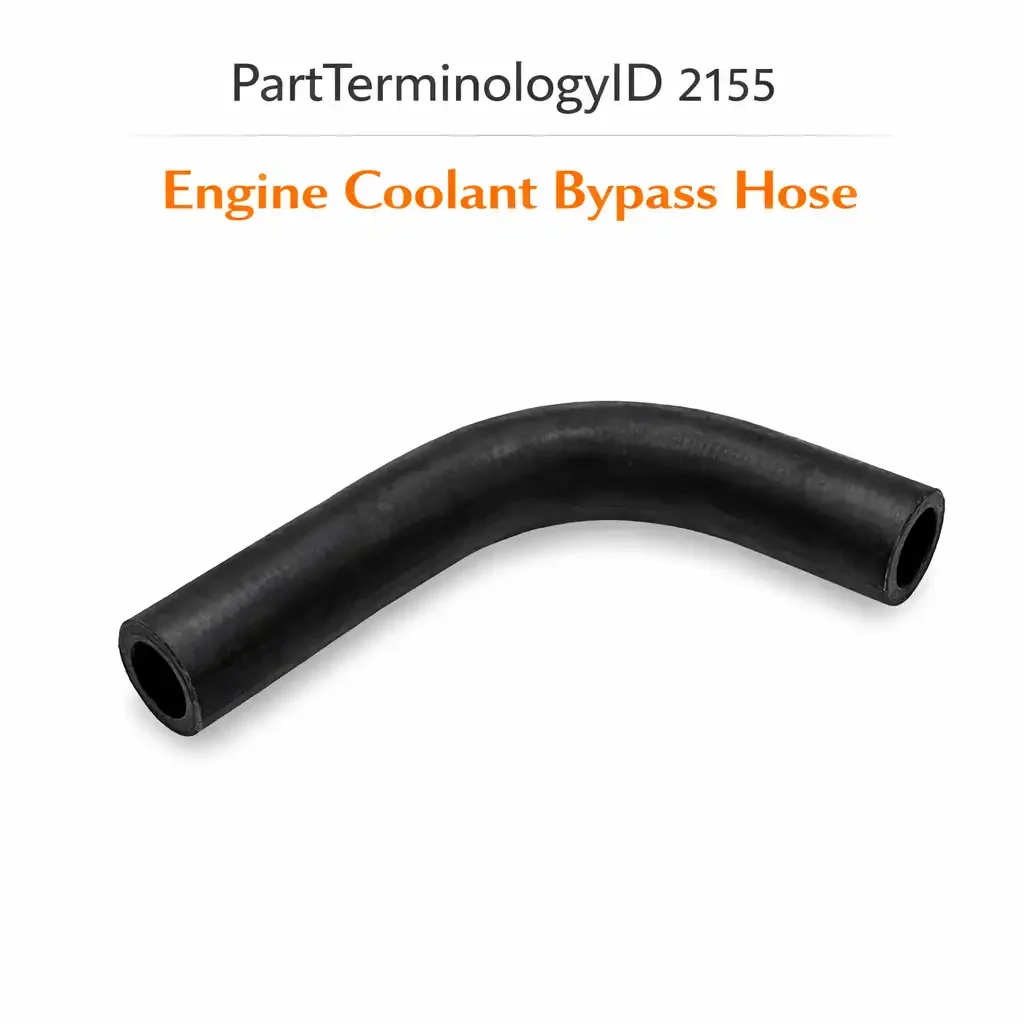
PartTerminologyID 2155, Engine Coolant Bypass Hose, is a hose that routes coolant around the thermostat when the thermostat is closed. That definition identifies the function without communicating the hose inner diameter, the hose outer diameter, the hose length, the shape, the connection points at each end, or the engine it belongs to. The coolant bypass hose is on every engine with a bypass circuit, it is specific to the engine in its dimensions and routing, and it is almost never listed with the dimensional attributes that would allow a buyer to verify fitment before ordering. A listing under PartTerminologyID 2155 that relies on year/make/model fitment alone without the hose dimensions and the connection point specifications is a listing that will generate returns on every engine variant that shares the same fitment row but uses a different bypass hose length or diameter.
For sellers, the bypass hose is a part where the buyer population includes two groups with very different ordering behaviors. The first group is replacing the hose during a cooling system service and has the original hose in hand to compare dimensions. This buyer needs the dimensions in the listing to confirm the replacement matches. The second group is replacing the hose as part of a complete cooling system overhaul and may have already discarded the original hose. This buyer has only the listing to determine whether the part is correct. A listing without dimensions serves neither group reliably.
For sellers, the listing under this PartTerminologyID is only useful if it includes the hose inner diameter, the hose length, the hose shape, and the connection point specifications at each end. Without those four attributes, the listing cannot be verified by a buyer who measures their original hose or by a buyer who has no original to measure.
What the Engine Coolant Bypass Hose Does
Maintaining coolant circulation when the thermostat is closed
The thermostat in a cooling system is a temperature-sensitive valve. When the engine is cold, the thermostat closes and blocks the main coolant flow path to the radiator. Without a bypass circuit, the water pump would be pumping against a closed valve, which would create a deadhead condition: pressure would build at the pump outlet, pump efficiency would drop, and coolant circulation through the engine water jacket would stop. The coolant near the combustion chamber would stagnate and develop hot spots within seconds of the pump running against a closed thermostat.
The bypass hose provides an alternative flow path for coolant when the thermostat is closed. Coolant from the water pump outlet enters the bypass hose, circulates through the heater core and back, or loops through a short bypass passage, and returns to the pump inlet without passing through the radiator. This allows the water pump to circulate coolant continuously through the engine block from the first second of startup, which equalizes temperature throughout the block and ensures the thermostat is sensing the actual average coolant temperature rather than a localized temperature near the sensor.
When the thermostat opens as the coolant warms, flow through the bypass circuit decreases because the lower-resistance path through the radiator becomes available. The bypass circuit does not stop entirely on most designs: a small amount of bypass flow continues even when the thermostat is fully open, which maintains some circulation through the heater circuit and prevents thermal gradients from developing in the engine water jacket at operating temperature.
The bypass circuit on engines with a separate bypass tube
On many engines, the coolant bypass is an internal passage within the thermostat housing or the engine block itself. On these engines, no external bypass hose exists and PartTerminologyID 2155 does not apply. On engines where the bypass circuit requires an external hose, the hose runs from a port on the thermostat housing or the water outlet to a port on the intake manifold, the heater circuit return, the water pump housing, or a dedicated bypass port on the engine block. The connection points and the routing path are specific to the engine architecture.
A listing for PartTerminologyID 2155 applied to an engine with an internal bypass passage and no external hose produces a return for a part that the buyer cannot install because there is no external bypass circuit on their engine. The listing must confirm that the engine uses an external bypass hose before the listing is created.
Bypass hose failure modes
The bypass hose is subject to the same failure modes as any coolant hose: internal collapse, external cracking, swelling at the clamp interfaces, and hardening from prolonged heat exposure. The bypass hose is shorter than the upper or lower radiator hose on most engines and is routed in a tight space near the thermostat housing, which means it is exposed to higher localized temperatures than the radiator hoses. On engines where the bypass hose is routed close to the exhaust manifold, the heat exposure is compounded and the hose degrades faster than on engines with more thermal clearance.
Internal collapse is a failure mode specific to bypass hoses that is less common in radiator hoses. A bypass hose that collapses internally restricts bypass flow when the thermostat is closed, which can cause uneven engine warm-up and imprecise thermostat operation. The restriction may not produce a visible external leak but will show up as inconsistent warm-up behavior and potential engine temperature gauge irregularity on cold mornings.
The Dimensional Specifications This Hose Must Match
Hose inner diameter
The hose inner diameter determines whether the hose will accept the connector or nipple at each connection point. Bypass hose inner diameters for passenger vehicle engines range from approximately 3/4 inch to 1-1/2 inch depending on the engine and the bypass circuit capacity. The same engine family at different displacements may use different bypass hose diameters because the bypass flow rate scales with the pump capacity, which scales with displacement.
A hose with the correct length and shape but wrong inner diameter will not clamp correctly at the connection points. A hose that is slightly undersized may force onto the nipple with effort but will not seat at the correct depth and will develop a leak at the clamp interface. A hose that is oversized will seat but will not be retained by the clamp at the designed tension.
Hose length
Bypass hoses are shorter than radiator hoses on most engines, typically ranging from 4 inches to 18 inches. The length must accommodate the routing path between the two connection points without excess slack that causes the hose to contact moving components or without tension that prevents the hose from seating correctly at both ends. A hose that is 2 inches too long will bow and may contact the belt or the pulley adjacent to the thermostat housing. A hose that is 2 inches too short will be under tension and will pull off the fitting at the point of least clamp grip.
Hose shape
The routing of the bypass circuit between the two connection points determines the hose shape. Straight bypass hoses are uncommon because the connection points are rarely directly opposed. Molded elbow shapes, S-curves, and combination shapes are more common. The shape must follow the routing path without forcing the hose to bend beyond its minimum bend radius, which would collapse the bore and restrict flow.
A replacement hose with the correct inner diameter and length but wrong shape will either not reach both connection points or will contact a belt, a bracket, or a heat source that causes accelerated degradation. The shape is not a suggestion. It is the geometry the hose routing requires.
Connection point specifications at each end
The inner diameter of the hose at each end must match the outer diameter of the nipple or connector at that end. On some bypass hoses, the two ends have different inner diameters because one end connects to a larger-bore port and the other connects to a smaller-bore port. These reducer-style bypass hoses are common on engines where the thermostat housing port and the water pump port are different diameters. A listing that states one diameter for a reducer bypass hose has communicated half the fitment requirement, the same problem that PartTerminologyID 2076 (Radiator Coolant Hose Connector) creates for reducer connectors.
Why This Part Generates Returns
Buyers order the wrong engine coolant bypass hose because:
the listing does not state the hose inner diameter and the replacement hose does not fit the connection point nipples
the hose length is not stated and the replacement is too long or too short for the routing path on the engine
the hose shape is not specified and the replacement hose cannot follow the routing path between the two connection points
the listing is applied to an engine with an internal bypass passage and no external hose, and the buyer cannot find an installation location
one end of the bypass hose is a different diameter than the other and the listing states only one diameter, causing the buyer to order based on the one stated diameter and discover the other end does not fit on installation
the engine code is not specified and the same vehicle platform uses a different bypass hose length and shape on a different engine variant
the hose material is not specified and the replacement hose is not rated for the coolant formulation or the heat exposure at the bypass location
Status in New Databases
PIES/PCdb: PartTerminologyID 2155, Engine Coolant Bypass Hose
PIES 8.0 / PCdb 2.0: No change
Top Return Scenarios
Scenario 1: "Cannot find a bypass hose port on my engine"
The listing was applied to an engine with an internal bypass passage. The buyer's engine has no external bypass hose port. The replacement hose has no location to be installed.
Prevention language: "This hose fits engines with an external coolant bypass circuit. Verify your engine has an external bypass hose connecting two ports in the cooling system before ordering. Engines with internal bypass passages in the thermostat housing or engine block do not use an external bypass hose."
Scenario 2: "Hose is the right diameter but 3 inches too long"
The length was not stated in the listing. The replacement hose bows against the alternator belt when installed and contacts the belt at idle. The buyer returns the hose because it cannot be safely routed.
Prevention language: "Hose length: [X] inches. Verify the distance between the two bypass hose connection points on your engine before ordering. A hose that is too long will bow and may contact belts or brackets adjacent to the thermostat housing."
Scenario 3: "Hose shape is wrong, cannot reach both connection points"
The replacement hose is a straight tube. The buyer's bypass circuit requires a 90-degree elbow at one end to clear the intake manifold. The straight hose cannot follow the routing path and cannot seat at the upper connection point.
Prevention language: "Hose shape: [straight / 90-degree elbow / S-curve / molded combination]. Verify the routing path between your bypass hose connection points requires this hose shape before ordering. The correct shape is determined by the relative positions of the two connection points and any obstructions in the routing path."
Scenario 4: "One end fits, the other does not"
The bypass hose is a reducer type with two different end diameters. The listing stated one diameter. The buyer's thermostat housing port matched the stated diameter. The water pump bypass port is a different diameter and the hose will not seat at that end.
Prevention language: "This is a reducer bypass hose. Thermostat housing end inner diameter: [X] inch. Water pump end inner diameter: [Y] inch. Verify both connection point outer diameters match the corresponding hose end inner diameters before ordering."
Scenario 5: "Hose hardened and cracked within one season"
The bypass hose material was not rated for the heat exposure at the bypass location on the engine. The hose routing places it close to the exhaust manifold on this engine. A standard EPDM hose at that location degraded faster than expected. A silicone-reinforced hose is required for this routing location.
Prevention language: "Hose material: [EPDM rubber / silicone / reinforced EPDM]. For applications where the bypass hose is routed near the exhaust manifold or in a high-heat area of the engine bay, a silicone or heat-shielded hose is recommended for longer service life. Verify the thermal environment at your bypass hose routing location before ordering."
What to Include in the Listing
Core essentials
PartTerminologyID: 2155
component: Engine Coolant Bypass Hose
bypass circuit type: external hose or confirm external circuit exists (mandatory: do not list for engines with internal bypass passages)
engine code (mandatory)
hose inner diameter in inches or mm (mandatory: state both ends if reducer)
hose length in inches or mm (mandatory)
hose shape: straight, 90-degree elbow, S-curve, molded combination (mandatory)
connection points: thermostat housing to water pump, thermostat housing to intake manifold, thermostat housing to heater return, or other (mandatory)
hose material: EPDM, silicone, reinforced EPDM
quantity: 1
Fitment essentials
year/make/model/submodel
engine code (mandatory, non-negotiable)
engine displacement when the same engine family uses different bypass hose dimensions at different displacements
Dimensional essentials
hose inner diameter at each end in inches or mm (both ends mandatory for reducer hoses)
hose outer diameter in inches or mm
hose overall length in inches or mm
minimum bend radius in inches or mm for shaped hoses
wall thickness in inches or mm
Image essentials
hose in isolation showing full length and shape with dimensional callouts for length and diameter at each end
shape detail showing elbow angle or curve geometry
for reducer hoses, close-up of each end showing the diameter difference
installed context showing the hose routed between the two connection points on the engine
Catalog Checklist for ACES/PIES Teams
PartTerminologyID = 2155
confirm external bypass circuit exists before creating the listing: do not list for engines with internal bypass passages
require engine code (mandatory, non-negotiable)
require hose inner diameter at each end: both ends must be stated for reducer hoses
require hose length
require hose shape with angle specification for elbow configurations
require connection point identification: which two engine components the hose connects
require hose material
differentiate from upper radiator hose (PartTerminologyID varies): the upper radiator hose connects the thermostat housing outlet to the radiator; the bypass hose connects the thermostat housing to a point that does not pass through the radiator
differentiate from heater hose (PartTerminologyID varies): the heater hose connects the heater circuit; some bypass circuits share routing with the heater circuit on some engines; the connection points must be specified to differentiate
differentiate from lower radiator hose (PartTerminologyID varies): the lower radiator hose connects the radiator outlet to the water pump inlet; the bypass hose connects the thermostat housing to the water pump or engine block without passing through the radiator
flag reducer bypass hoses: both end diameters must be stated; stating one diameter is insufficient
flag that hose shape is a mandatory attribute: a replacement hose with the correct diameter and length but wrong shape cannot be safely installed
FAQ (Buyer Language)
What is a coolant bypass hose and does my engine have one?
The coolant bypass hose provides a flow path for coolant to circulate through the engine when the thermostat is closed during cold startup. On engines with an external bypass circuit, the hose connects two ports in the cooling system, typically the thermostat housing and the water pump or intake manifold. On engines with an internal bypass passage built into the thermostat housing or the engine block casting, no external bypass hose exists. To determine whether your engine uses an external bypass hose, look for a short hose connecting the thermostat housing to another point on the engine that does not route through the radiator.
How do I measure my bypass hose for a replacement?
Remove the original hose. Measure the inner diameter at each end, which is the inside bore diameter of the hose. Measure the overall length from end to end. Note the shape: whether the hose is straight, has a single elbow, or has a complex molded shape. Verify whether the inner diameter is the same at both ends or different. If the diameters differ, note both. Match all three measurements to the replacement hose specification before ordering.
My bypass hose is cracked but still in place. How do I measure it without removing it?
Measure the outer diameter of the nipple or connector at each connection point while the hose is still on. The hose inner diameter is approximately equal to the nipple outer diameter for a correct-fit hose. Measure the distance between the two connection points along the routing path to estimate the required hose length. Note the general shape by observing the routing. Remove the cracked hose once the replacement is in hand and compare the dimensions before installing.
The replacement hose is the correct diameter and length but it will not route between the connection points without forcing it. What is wrong?
The hose shape does not match the routing path between your connection points. The correct replacement hose has a molded shape that follows the routing geometry without forcing. A straight hose on a routing path that requires an elbow will either not reach both connection points or will contact an adjacent component when forced. Order a hose with the molded shape that matches your routing path.
How often should the coolant bypass hose be replaced?
Inspect the bypass hose at every coolant service interval for cracking, softness, swelling, and hardening. The bypass hose is exposed to higher localized temperatures than the radiator hoses on many engines and may degrade faster. A hose that shows surface cracking, feels hard and brittle, or is swollen at the clamp interfaces should be replaced regardless of age. The hose should always be replaced when the thermostat or the water pump is being serviced because those repairs require the bypass hose to be removed or disturbed.
Cross-Sell Logic
Thermostat (PartTerminologyID varies: the bypass hose connects to the thermostat housing and is disturbed during every thermostat service; replace the bypass hose at the same time as the thermostat to avoid repeating the coolant drain at the next service interval)
Thermostat Housing Gasket (PartTerminologyID 2136: the thermostat housing is the primary connection point for the bypass hose; if the housing gasket is also at end of life, both should be replaced at the same service event)
Water Pump (PartTerminologyID varies: the bypass hose often connects to the water pump housing; if the pump is being replaced, the bypass hose should be inspected and replaced if at the same service age as the pump)
Hose Clamps (the bypass hose clamps at both connection points should be replaced with the hose; a worn or deformed clamp on a new hose will not provide the designed clamping force)
Engine Coolant (the cooling circuit must be partially drained when the bypass hose is replaced; fresh coolant is required after reassembly)
Engine Cooling System Pressure Tester Adapter (PartTerminologyID 2054: pressure test the cooling system after replacing the bypass hose to confirm both clamp connections seal at operating pressure)
Upper Radiator Hose (PartTerminologyID varies: if the cooling system hoses are being replaced comprehensively, the upper and lower radiator hoses should be replaced at the same service event as the bypass hose)
Frame as "the bypass hose is serviced when the thermostat is serviced. The thermostat, the housing gasket, and the hose clamps are the concurrent parts. The coolant is the fluid replaced after the service. The pressure test confirms the connections before the engine returns to service."
Final Take for PartTerminologyID 2155
Engine Coolant Bypass Hose (PartTerminologyID 2155) is a dimensionally specific, shape-specific, engine-specific hose that routes coolant around the thermostat during cold startup. It is present on every engine with an external bypass circuit and absent on engines with internal bypass passages. It connects two specific engine components at specific diameters and follows a specific routing path that determines its shape and length.
None of that is communicated by the PartTerminologyID alone. The hose inner diameter tells the buyer whether it fits the connection points. The length tells the buyer whether it reaches between them. The shape tells the buyer whether it can follow the routing path. The connection points tell the buyer which two engine components the hose bridges. For reducer hoses, both end diameters must be stated because stating one is half a listing.
State the engine code. State both end diameters. State the length. State the shape. State the connection points. That is the same listing strategy as every other PartTerminologyID in this series: the generic PartTerminologyID requires specific attributes at every level to become a listing buyers can act on without guessing.