
Written by Arthur Simitian | PartsAdvisory
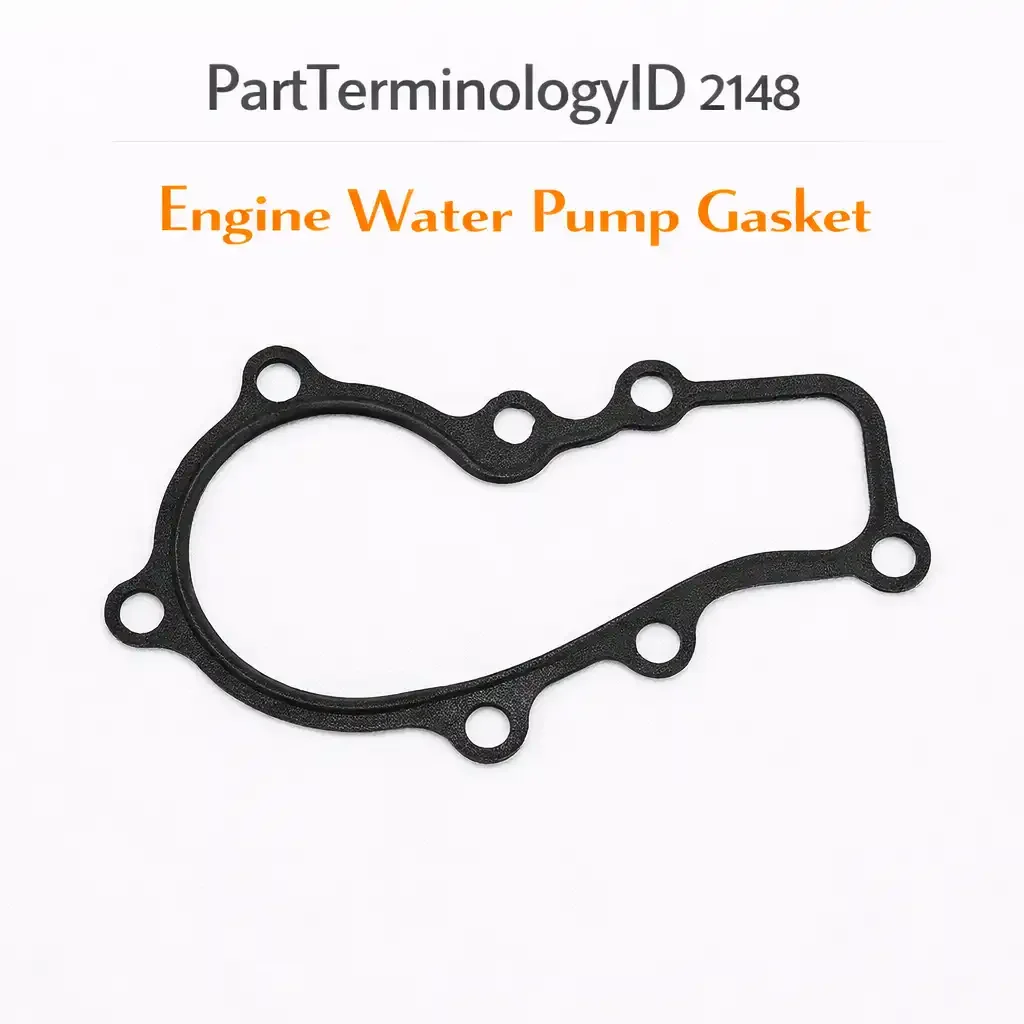
PartTerminologyID 2148, Engine Water Pump Gasket, is a gasket that seals the water pump to the engine block. That definition identifies the location and the function. It does not identify the engine the pump belongs to, the number of gaskets the application requires, the gasket material, the gasket form, whether the gasket seals the pump to the block directly or seals the pump to an intermediate housing, whether a separate inlet gasket is required in addition to the mounting face gasket, or whether the application uses gaskets at all rather than RTV sealant at the pump mounting face. A listing under PartTerminologyID 2148 that does not specify the engine code, the gasket count, and the gasket form is asking the buyer to guess how many gaskets the pump installation requires and whether the part they receive matches the sealing architecture of their engine, the same problem that PartTerminologyID 2136 and 2144 create when the engine code and the gasket form are absent.
For sellers, the water pump gasket occupies a distinctive position in the gasket category because the pump mounting face is the largest flat sealing surface in the cooling system and the one most likely to be compromised by corrosion, warping from a previous overheat event, or pitting from electrolytic coolant degradation. A technically correct gasket installed on a damaged mounting surface will not seal. The listing cannot address surface condition, but the listing can prepare the buyer for what to inspect and what to do if the surface is not flat. A listing that does not acknowledge this variable sends the buyer to a pump installation where a new gasket on a corroded surface produces the same coolant leak as the original failed gasket, and the buyer returns the new gasket without identifying the root cause.
For sellers, the listing under this PartTerminologyID is only useful if it includes the engine code, the gasket count, the gasket form, the gasket material, and whether the application is a gasket-sealed or RTV-sealed pump face. Without those five attributes, the return rate is set by surface conditions and fitment mismatches that the listing did not prepare the buyer to address.
What the Engine Water Pump Gasket Does
Sealing the pump mounting face under continuous flow
The water pump mounts to the engine block at a machined face and is driven by the belt or the timing chain. The mounting face carries the full coolant pressure generated by the pump impeller, which is the highest pressure point in the cooling circuit. On a pump running at highway engine speeds, the pressure at the pump outlet can exceed system static pressure by a meaningful margin before the circuit restricts flow at the thermostat. The mounting face gasket must seal against that dynamic pressure continuously across every heat cycle for the service life of the pump.
A gasket that leaks at the pump face produces a coolant drip or seep at the front of the engine, typically visible at the pump weep hole drainage path or at the lower edge of the pump mounting flange. This leak pattern is distinct from a shaft seal failure, which drips from the weep hole itself. A face gasket leak is at the perimeter of the pump flange, and the trace follows the lowest point of the flange to the drainage path. Distinguishing a face gasket leak from a shaft seal leak before ordering the replacement part prevents ordering the pump when only the gasket is needed, or ordering only the gasket when the shaft seal is also compromised.
The multi-gasket water pump installation
Many water pump installations require more than one gasket. The pump may have a primary mounting face gasket where the pump body contacts the block, and a secondary inlet gasket where the lower radiator hose inlet connector or an inlet passage cover connects to the pump body or to the engine. Some V-configuration engines require a separate gasket at the pump-to-front-cover interface in addition to the pump-to-block interface. The listing must specify the number of gaskets included and which interface each one seals.
A buyer who receives one gasket for a two-gasket application installs the pump, torques the flange, discovers a second open interface with no gasket, and must source the missing part before the pump can be installed. If the engine is in a vehicle that must be returned to service, the buyer disassembles the already-torqued pump, waits for the missing gasket, and reassembles. The pump flange that was already torqued once may have compressed the installed gasket, which changes the seating behavior of the reinstallation. The missing gasket is not a minor inconvenience. It is a rework event with a time cost that exceeds the cost of the gasket by a factor of ten or more in labor.
The RTV-sealed pump face
On a significant number of current-production engines, the water pump mounting face does not use a cut gasket at all. The factory specifies room temperature vulcanizing sealant applied directly to the pump mounting face. When the pump is replaced on these applications, RTV is reapplied rather than a gasket being installed. A listing under PartTerminologyID 2148 applied to an RTV-sealed pump face application produces a gasket that the buyer cannot use and an installation that the buyer may attempt incorrectly by using the gasket instead of RTV, which will seal initially but may develop leaks as the gasket and the RTV interact or as the gasket compresses unevenly without the groove or controlled surface geometry that flat gaskets require.
The listing must identify whether the application uses a cut gasket or RTV. If the application uses RTV, the listing should not exist under PartTerminologyID 2148 for that engine code, or if it does exist, it must clearly state that the part is an optional gasket for non-factory use and that the OE procedure specifies RTV.
The pump-to-front-cover gasket on timing-cover-mounted pumps
On some overhead camshaft engines, the water pump mounts to the timing chain front cover rather than directly to the engine block. The pump-to-front-cover gasket seals the pump to the cover. A second gasket or seal may exist at the front cover-to-block interface. Replacing only the pump-to-cover gasket on an application where the front cover-to-block seal is also weeping will not address both leak sources. The listing must be specific about which interface the gasket seals on timing-cover-mounted pump applications.
The Gasket Forms Under This PartTerminologyID
Flat cut gasket
The traditional form, cut from a flat sheet of gasket material to match the pump flange profile. Common materials include compressed fiber, cork-and-rubber composite, rubber-coated steel, and multi-layer steel. Flat cut gaskets require both mating surfaces to be flat and free of corrosion, pitting, and old gasket material. Any deviation from flatness at the pump mounting face will create an uneven compression zone that produces a leak at the low-pressure side of the deviation.
Compressed fiber gaskets are single-use. They compress permanently on the first installation and cannot provide reliable sealing on a reinstallation. Rubber-coated steel gaskets are more durable and release more cleanly from aluminum pump housings and aluminum block faces at service. Multi-layer steel gaskets require very flat, clean surfaces and are less forgiving of surface irregularities than rubber-coated steel. The listing must specify the material.
Formed rubber or molded seal
Some water pumps, particularly on current-production aluminum-block engines with plastic pump housings, use a molded rubber seal or a formed gasket with integrated rubber beads rather than a flat cut gasket. These seals are dimensionally specific to the pump housing profile and must match the pump exactly. They are not interchangeable between pump designs even when the pump mounting bolt pattern is the same.
O-ring sealed pump
On some engine designs, the water pump seals to the engine through one or more O-rings rather than a flat gasket. The O-rings seat in grooves on the pump body and compress against the block surface when the pump is bolted in place. O-ring diameters must match the groove dimensions on the pump exactly. An oversized O-ring will not compress correctly in the groove and may prevent the pump from seating flush. An undersized O-ring will compress to fill the groove but may not provide sufficient sealing force against the block surface.
Combination gasket and O-ring
Some pump installations use a flat gasket at the main pump face and a separate O-ring or smaller gasket at the inlet passage. This combination is common on overhead camshaft engines where the pump body is compact and the inlet is a separate bore. Both sealing elements must be replaced, and the listing must include both.
Why This Part Generates Returns
Buyers order the wrong engine water pump gasket because:
the engine code is not specified and the same platform uses different pump designs with different flange profiles and gasket patterns on different engine variants
the gasket count is not stated and the buyer receives one gasket for a two-gasket application and cannot complete the installation
the listing is applied to an RTV-sealed pump application and the buyer installs the gasket instead of RTV, producing a leak that they attribute to the gasket rather than to the incorrect sealing method
the gasket material is not stated and the buyer installs a compressed fiber gasket on an engine that requires a rubber-coated steel gasket for the surface profile and temperature requirements at that location
the pump mounting face is corroded or pitted and the new gasket does not seal on the damaged surface, producing a leak that the buyer attributes to a defective gasket and returns
the listing covers only the pump face gasket and the buyer's application also requires an inlet gasket, which was not included and not disclosed
the gasket form does not match the pump: the buyer's pump uses an O-ring groove and they receive a flat cut gasket that seats over the groove without sealing it
Status in New Databases
PIES/PCdb: PartTerminologyID 2148, Engine Water Pump Gasket
PIES 8.0 / PCdb 2.0: No change
Top Return Scenarios
Scenario 1: "Wrong engine code, gasket profile does not match the pump flange"
Same vehicle, different engine variant. The V6 water pump flange is larger with a different bolt pattern than the four-cylinder. The gasket for the four-cylinder arrived for a V6 application and the bolt holes do not align with the pump flange.
Prevention language: "Engine code: [specific engine code or codes]. This gasket fits the [X] engine variant only. The same vehicle platform may use different water pump designs with different flange profiles on different engine variants. Engine code is required for correct fitment."
Scenario 2: "Application requires two gaskets, only one was included"
The pump requires a face gasket at the pump-to-block interface and a separate inlet gasket at the coolant inlet passage. The listing shipped one gasket. The buyer installed the face gasket, assembled the pump, and found the inlet passage open with no gasket. The engine could not be started until the inlet gasket was sourced.
Prevention language: "Quantity: [2 gaskets]. This application requires a face gasket at the pump-to-block mounting interface and an inlet gasket at the coolant inlet passage. Both are included. Verify both sealing surfaces are addressed before torquing the pump to the engine."
Scenario 3: "My pump face is sealed with RTV, I cannot use this gasket"
The buyer's engine specifies RTV at the pump mounting face. The listing was applied to this engine under PartTerminologyID 2148. The buyer installed the gasket instead of RTV and the pump weeps at the face on the second heat cycle as the gasket compresses unevenly without a groove to control seating.
Prevention language: "The factory specification for [engine code] uses RTV sealant at the water pump mounting face. This gasket is an alternative for applications where a cut gasket is preferred. If following the factory procedure, apply the specified RTV sealant rather than installing this gasket. Consult the factory service manual for the correct RTV type and bead width."
Scenario 4: "New gasket leaks, mounting face is corroded"
The buyer installed the correct gasket on a mounting face that had pitting and corrosion from long-term coolant degradation. The new gasket could not seal over the irregular surface. The buyer returned the gasket as defective. The root cause was the mounting surface, not the gasket.
Prevention language: "Inspect the pump mounting face on the engine block for corrosion pitting, scratches, and warping before installing. A flat, clean, undamaged mating surface is required for the gasket to seal correctly. Minor surface irregularities can be addressed with a flat abrasive. Deep pitting or warping from a previous overheat event requires surface machining or block replacement before installation. A new gasket will not seal a damaged mounting surface."
Scenario 5: "Pump uses an O-ring groove, flat gasket cannot seal it"
The buyer's water pump has a machined O-ring groove in the flange face. The listing shipped a flat cut gasket. The flat gasket cannot compress into the groove and the pump flange does not seat flush against the block.
Prevention language: "Gasket form: [flat cut gasket / O-ring / formed rubber seal]. Verify your water pump mounting interface uses [flat mating surfaces / O-ring groove] before ordering. A flat cut gasket cannot seal an O-ring groove application and will prevent the pump from seating flush."
Scenario 6: "Gasket material wrong, face leaked under heat cycling"
The buyer installed a compressed fiber gasket on an aluminum pump housing. The aluminum pump expanded at a different rate than the fiber gasket under thermal cycling, and the gasket lost compression at the pump flange perimeter over the first few heat cycles, producing a seeping coolant leak.
Prevention language: "Gasket material: [compressed fiber / rubber-coated steel / multi-layer steel / formed rubber]. Rubber-coated steel gaskets are recommended for aluminum water pump housings because they accommodate differential thermal expansion between the aluminum and the engine block material. Compressed fiber gaskets may lose compression on aluminum pump applications over repeated heat cycles."
Scenario 7: "Timing cover pump application, gasket does not cover the right interface"
The buyer has a timing-cover-mounted water pump. The listing covered the pump-to-front-cover interface. The buyer's leak was at the front cover-to-block interface behind the pump, which was not addressed by the pump gasket. The pump was reinstalled with a new pump gasket and the engine still leaked from the cover seal.
Prevention language: "This gasket seals the water pump to the timing chain front cover. It does not seal the front cover to the engine block. If coolant is also leaking from the front cover-to-block interface, a front cover gasket or seal is required in addition to this pump gasket."
What to Include in the Listing
Core essentials
PartTerminologyID: 2148
component: Engine Water Pump Gasket
engine code (mandatory)
gasket count: 1 gasket or 2 gaskets with interface identification for each (mandatory)
sealing method: cut gasket or RTV (mandatory on applications where the OE specification uses RTV)
gasket form: flat cut, O-ring, formed rubber seal, or combination (mandatory)
gasket material: compressed fiber, rubber-coated steel, multi-layer steel, EPDM rubber (mandatory)
single-use or reusable designation (mandatory)
mounting surface inspection note: mandatory for aluminum block applications where surface condition is a common root cause of gasket failure
Fitment essentials
year/make/model/submodel
engine code (mandatory, non-negotiable)
pump mounting location: directly to engine block, to timing chain front cover, or to intermediate housing
OE part number cross-reference when available
compatible water pump brand and part number when gasket is pump-specific rather than engine-specific
Dimensional essentials
gasket outer profile dimensions in mm
coolant passage bore diameter in mm
bolt hole count, diameter, and center-to-center spacing in mm
gasket compressed thickness in mm for flat gaskets
O-ring cross-sectional diameter in mm for O-ring applications
O-ring outer diameter in mm for O-ring applications
Image essentials
gasket in isolation against a white background showing full flange profile, bolt holes, and coolant passage bore with dimensional callouts
material finish detail distinguishing rubber-coated steel from compressed fiber from multi-layer steel
for two-gasket applications, both gaskets shown together with interface callouts identifying which seals which
gasket positioned on the pump flange showing fit relationship
installed context showing the gasket at the pump mounting face on the engine
Catalog Checklist for ACES/PIES Teams
PartTerminologyID = 2148
require engine code (mandatory, non-negotiable)
require gasket count with interface identification for multi-gasket applications
require sealing method disclosure for RTV-sealed pump face applications
require gasket form: flat cut, O-ring, formed rubber, or combination
require gasket material
require single-use or reusable designation
require mounting location: engine block, timing chain front cover, or intermediate housing
include mounting surface inspection note in listing copy for aluminum block applications
differentiate from water pump (PartTerminologyID varies): the pump is the rotating assembly; the gasket seals the pump flange to the engine; both are replaced when the pump fails but are separate parts
differentiate from engine coolant thermostat housing gasket (PartTerminologyID 2136): the thermostat housing gasket seals the thermostat housing; the water pump gasket seals the pump; on engines where the pump housing is integrated into the thermostat housing assembly, both gaskets are required and must be identified separately
differentiate from engine coolant hose connector gasket (PartTerminologyID 2140): the hose connector gasket seals a hose connector fitting on the pump or near the pump; the pump gasket seals the pump flange itself
differentiate from timing chain front cover gasket (PartTerminologyID varies): on timing-cover-mounted pump applications, a separate front cover gasket may also be required
flag RTV-sealed applications: do not list a cut gasket under PartTerminologyID 2148 for a factory RTV application without disclosing that the OE specification uses RTV
flag that mounting surface condition is a common root cause of pump gasket failure on aluminum engines: the listing should include inspection guidance
FAQ (Buyer Language)
How do I know if my water pump uses a gasket or RTV?
Consult the factory service manual for your engine code. The water pump installation section will specify either a cut gasket or a specific RTV sealant by manufacturer and color. If the original pump was installed with RTV, you will see residual sealant on the block face and the pump flange face when the pump is removed, and no cut gasket will be present between the surfaces. If a cut gasket was used, the gasket material will be compressed between the two surfaces.
My pump gasket is leaking. How do I know if the gasket failed or if the mounting surface is damaged?
Remove the pump and inspect both mating surfaces. Clean the block face and the pump flange face with a solvent and inspect under good lighting for pitting, corrosion, scratches, and warping. Run a straightedge across the block face in multiple directions to check for warping. If the surface is pitted from coolant corrosion, a new gasket will not seal it. Shallow surface irregularities can sometimes be addressed with light wet-sanding on a flat surface. Deep pitting or visible warping requires machining or block replacement. If both surfaces are flat and clean, the leak was from the gasket rather than the surface.
My water pump application requires two gaskets. How do I know which gasket goes where?
The two interfaces are the pump face-to-block interface and the coolant inlet passage interface. The face gasket is the larger of the two and matches the full profile of the pump mounting flange. The inlet gasket is smaller and seals a separate bore or fitting at the coolant entry point into the pump. If both gaskets are included in the listing, they should be labeled or dimensionally distinct enough to identify each one. If you are uncertain, compare each gasket to the corresponding mating surface before installing.
Can I reuse the water pump gasket if the pump is removed but not damaged?
Not for compressed fiber gaskets. Compressed fiber gaskets take a permanent compression set on the first installation and will not seal reliably when reinstalled even if they appear undamaged. Rubber-coated steel gaskets may be reused if the coating is intact and the gasket is flat and undamaged, but replacement is recommended. O-rings may be reused if the rubber is pliable, uncracked, and shows no flattening from compression. When in doubt, use a new gasket. The cost of a new gasket is not meaningful relative to the cost of repeating the water pump removal.
Do I need to replace the water pump when I replace the gasket?
Not necessarily. If the pump shaft seal is intact, the pump impeller is not corroded or cracked, and the pump bearing shows no roughness or play, the pump can be reinstalled with a new gasket. The gasket is typically replaced when the pump is removed for another reason (timing belt service, for example) or when the gasket itself is the identified source of the leak. If the pump shaft seal is also weeping, both the gasket and the pump should be replaced at the same service event.
What is the correct torque for the water pump bolts?
Bolt torque is specified in the factory service manual for your engine. Do not estimate. Undertorquing the pump bolts allows the gasket to move under pump pressure and produces a leak at the low-torque bolt location. Overtorquing on an aluminum engine block or aluminum pump housing can strip threads, warp the pump flange, or crack the pump housing. Use a calibrated torque wrench and torque in a cross pattern to ensure even gasket compression across the full flange.
Cross-Sell Logic
Water Pump (PartTerminologyID varies: the gasket is always replaced when the pump is replaced; if the pump shaft seal is weeping at the same time as the face gasket, the pump requires replacement and the gasket is included in the repair)
Engine Coolant (the cooling circuit must be drained to access the pump; fresh coolant is required after reassembly; verify the coolant formulation is compatible with the new gasket material)
Timing Belt or Timing Chain (PartTerminologyID varies: on engines where the water pump is driven by the timing belt, the pump is typically replaced at the timing belt service interval and the gasket is part of that service kit)
Timing Belt Kit (PartTerminologyID varies: timing belt kits for engines with belt-driven water pumps often include the pump and the pump gasket; verify whether the gasket is included in the kit before ordering separately)
Engine Coolant Thermostat and Thermostat Housing Gasket (PartTerminologyID 2136: the thermostat is commonly replaced at the same service event as the water pump because both components are at the same service interval and require the same coolant drain)
Engine Cooling System Pressure Tester Adapter (PartTerminologyID 2054: pressure test the cooling system after the pump and gasket are reinstalled to confirm the new gasket seals at full operating pressure before returning the vehicle to service)
RTV Sealant (on applications where the factory procedure calls for RTV at the pump face, or where the service manual specifies an RTV bead at specific locations in addition to a cut gasket, the correct sealant must be available at installation time)
Coolant Flush Kit (if the cooling system has been degraded to the point where the pump face is corroded from coolant breakdown, a complete coolant flush is required before refilling with fresh coolant to prevent the new pump and gasket from being exposed to the same degraded chemistry)
Frame as "the gasket seals the pump. The pump circulates the coolant. The coolant is replaced when the system is open. The timing belt drives the pump on belt-driven engines and the pump is in the belt service kit. The pressure test confirms the seal after reassembly. The mounting surface condition determines whether any of this succeeds."
Final Take for PartTerminologyID 2148
Engine Water Pump Gasket (PartTerminologyID 2148) is the seal between the water pump and the engine at the highest-pressure point in the cooling circuit. It is engine-specific in its profile. It may be required in quantities of one or two. It may not be required at all on applications where the factory specifies RTV at the pump face. It comes in forms that are not interchangeable between pump designs. And it will not seal a corroded or warped mounting surface regardless of its quality.
Every one of those variables determines whether the buyer can complete the repair with what they receive and whether the repair will hold at operating pressure. A listing that communicates the engine code, the gasket count and which interface each seals, the sealing method for RTV applications, the gasket form, and the gasket material gives the buyer everything they need to order correctly. A listing that omits any of those attributes sends the buyer to a pump installation with a gap in the information they need.
State the engine code. State the gasket count. Disclose RTV applications. State the gasket form. State the material. Include the mounting surface inspection guidance. That is the same listing strategy as every other PartTerminologyID in this series: the generic PartTerminologyID requires specific attributes at every level to become a listing buyers can act on without guessing.