
Engine Coolant Outlet Gasket (PartTerminologyID 2144): The Gasket Where Outlet Location and Engine Code Determine Everything
Written by Arthur Simitian | PartsAdvisory
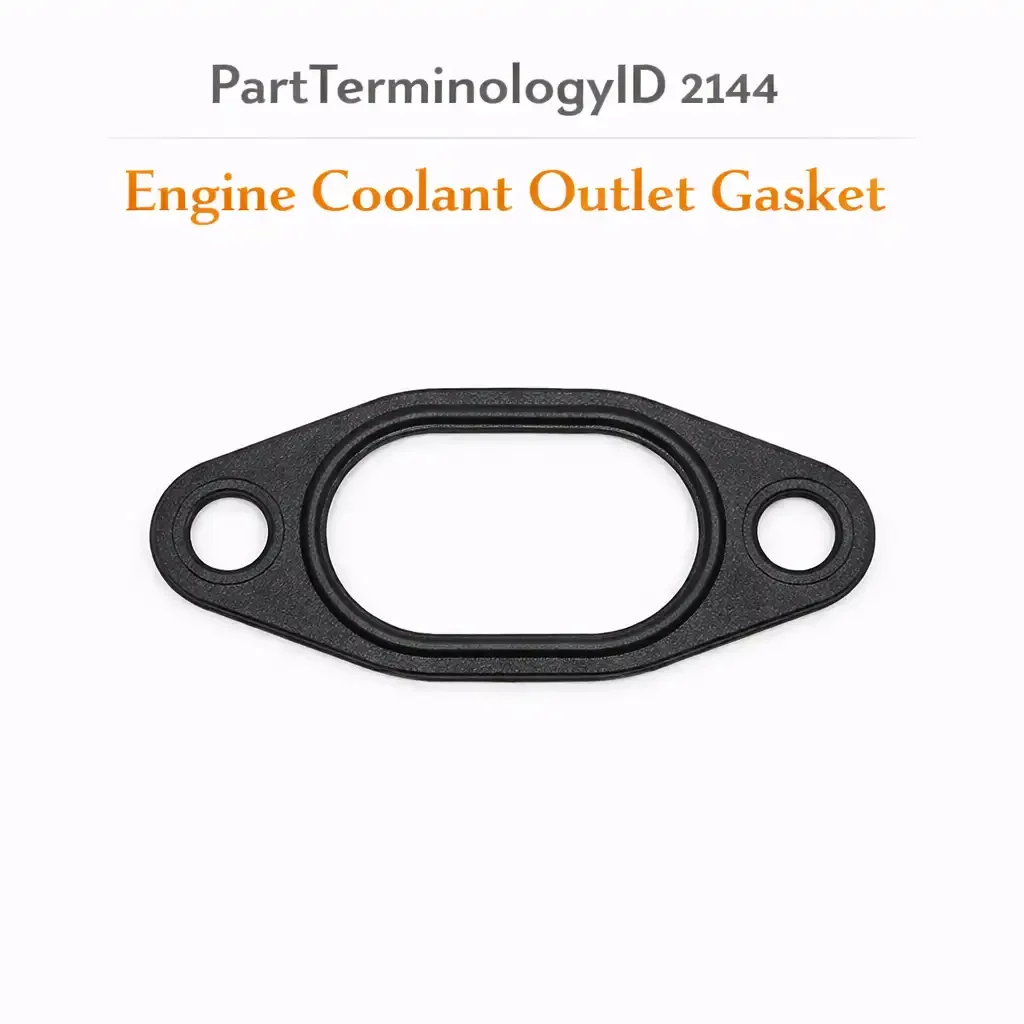
PartTerminologyID 2144, Engine Coolant Outlet Gasket, is a gasket that seals a coolant outlet to the engine. That definition narrows the location to an outlet rather than a connector or a housing, but it does not specify which outlet, at which position on the engine, with what bolt pattern, in what material, or for which engine code. A single engine can have multiple coolant outlets: the main outlet at the thermostat housing or water outlet, the coolant outlet to the heater circuit, the outlet to the coolant crossover on a V-configuration engine, and the outlet to an external cooler circuit. Each outlet may require a different gasket. A listing under PartTerminologyID 2144 that does not specify the outlet location and the engine code is asking the buyer to guess which outlet the gasket seals, the same problem that PartTerminologyID 2140 (Engine Coolant Hose Connector Gasket) creates when the connector location is absent, with the additional complication that the word outlet implies a directional flow that can further confuse buyers who conflate the main coolant outlet with a secondary outlet or with the thermostat housing gasket that is already covered under PartTerminologyID 2136.
For sellers, the coolant outlet gasket creates a catalog boundary problem: PartTerminologyID 2136 covers the thermostat housing gasket, PartTerminologyID 2140 covers hose connector gaskets, and PartTerminologyID 2144 covers the coolant outlet gasket. On many engines, the thermostat housing is the coolant outlet. On those engines, the gasket that seals the outlet is also the thermostat housing gasket. A listing under PartTerminologyID 2144 for that application may be a duplicate of a listing under PartTerminologyID 2136, or it may refer to a separate outlet component that is distinct from the housing. Buyers and catalog teams who do not understand this overlap will either list the wrong PartTerminologyID or order the wrong part. The listing must address this distinction.
For sellers, the listing under this PartTerminologyID is only useful if it specifies the outlet location, the engine code, the gasket form, the gasket material, and how this gasket relates to PartTerminologyID 2136 for applications where the thermostat housing is the coolant outlet.
What the Engine Coolant Outlet Gasket Does
Sealing the primary coolant outlet to atmosphere
The primary coolant outlet on most passenger vehicle engines is the connection point where heated coolant leaves the engine and enters the upper radiator hose on its way to the radiator for cooling. On engines where the thermostat sits in a separate housing bolted to the block or head, the gasket at the outlet is the thermostat housing gasket and is covered under PartTerminologyID 2136. On engines where the thermostat sits in a dedicated outlet housing or water outlet casting that is a separate component from the thermostat housing, the gasket sealing that water outlet to the engine is the coolant outlet gasket under PartTerminologyID 2144.
The distinction is architectural. On some engines the thermostat and the outlet are in the same casting. On others they are in separate castings bolted in series. The gasket between the water outlet casting and the engine is PartTerminologyID 2144. The gasket between the thermostat housing and the water outlet casting, if one is present, may be a separate part again. The listing must clearly identify which interface the gasket seals.
Sealing secondary coolant outlets
Beyond the primary outlet to the radiator, engines have secondary coolant outlets that direct coolant to the heater core, to an auxiliary cooler, to the throttle body on cold-start enrichment systems, to the intake manifold on engines that use coolant to warm the intake for fuel atomization, and to the EGR cooler on diesel applications. Each of these outlets may have its own gasket. Secondary outlet gaskets are smaller than the primary outlet gasket, use different bolt patterns, and are at different temperatures in the cooling circuit depending on their location.
A listing for PartTerminologyID 2144 that covers a secondary outlet must specify which secondary outlet. The heater outlet gasket, the throttle body coolant gasket, the intake manifold coolant outlet gasket, and the EGR cooler coolant gasket are all coolant outlet gaskets in the functional sense, but they are dimensionally different parts at different locations that are not interchangeable.
The water outlet versus the thermostat housing
This is the catalog boundary that creates the most confusion for both sellers and buyers ordering under PartTerminologyID 2144 and 2136 on the same engine. On engines where the thermostat and the water outlet are in the same casting, PartTerminologyID 2136 and PartTerminologyID 2144 may refer to the same gasket under different PartTerminologyID assignments by different data suppliers. On engines where the thermostat housing and the water outlet are separate castings, PartTerminologyID 2136 covers the housing gasket and PartTerminologyID 2144 covers the water outlet gasket, and both may be required for a complete thermostat service on that engine.
The listing must clarify this relationship for the specific engine code it covers. A buyer who replaces only the water outlet gasket when both the housing gasket and the water outlet gasket are required will have a leak at the interface they did not address.
The Outlet Locations This Gasket May Serve
Primary water outlet gasket
Seals the water outlet casting to the engine block or cylinder head at the main coolant outlet to the upper radiator hose. This is the highest-temperature gasket location in the cooling circuit after the thermostat housing. The gasket must be rated for continuous exposure to coolant temperatures that can reach 220 degrees Fahrenheit at this location under load. Material selection follows the same logic as the thermostat housing gasket: rubber-coated steel or formed rubber seals are preferred on aluminum water outlet castings over compressed fiber.
Heater circuit coolant outlet gasket
Seals the heater supply outlet on the engine block or cylinder head to the heater hose connector or the heater supply pipe. This outlet is at a mid-temperature location in the circuit. The gasket is typically small with a two-bolt oval or round flange. It is one of the most frequently overlooked gaskets in a cooling system service because the heater circuit connectors are not disturbed unless the heater hose, the heater core, or the heater supply pipe is being serviced.
Throttle body coolant outlet gasket
On engines that route coolant through the throttle body for cold-start idle stabilization or throttle body de-icing, there is a coolant inlet and outlet at the throttle body. The outlet gasket seals the coolant return connection at the throttle body to the coolant circuit. This gasket is specific to the throttle body design and is replaced when the throttle body is serviced or the coolant circuit at the throttle body develops a leak.
Intake manifold coolant outlet gasket
On engines with coolant passages in the intake manifold, a coolant outlet gasket seals the coolant return from the intake manifold back into the main cooling circuit. This gasket is part of the intake manifold gasket set on many engines and may not be sold separately under PartTerminologyID 2144 on those applications. If the coolant outlet from the intake manifold is sealed by a separate dedicated gasket rather than by the intake manifold gasket, it falls under PartTerminologyID 2144.
EGR cooler coolant outlet gasket
On diesel engines with exhaust gas recirculation coolers, the EGR cooler uses engine coolant to reduce the temperature of recirculated exhaust gases. The coolant circuit has an inlet and outlet at the EGR cooler. The outlet gasket seals the coolant return from the cooler. This gasket is engine-code-specific and is relevant primarily to diesel passenger vehicle and commercial vehicle applications.
Why This Part Generates Returns
Buyers order the wrong engine coolant outlet gasket because:
the outlet location is not specified and the buyer has multiple coolant outlet gasket locations on their engine and cannot determine which one the listing covers
buyers confuse PartTerminologyID 2144 with PartTerminologyID 2136 on engines where the thermostat housing and the water outlet are in the same casting, and receive a duplicate of the housing gasket rather than a separate outlet gasket
the engine code is not specified and the same platform uses different water outlet casting designs on different engine variants with different gasket profiles
the gasket form is not stated and the buyer receives a flat cut gasket for an outlet that uses an O-ring groove, or vice versa
buyers on two-gasket applications where both a thermostat housing gasket and a water outlet gasket are required receive only the outlet gasket and cannot complete the repair without the housing gasket, which is listed under a different PartTerminologyID
the coolant passage bore diameter is not stated and the replacement gasket has an undersized bore that restricts flow at the outlet
Status in New Databases
PIES/PCdb: PartTerminologyID 2144, Engine Coolant Outlet Gasket
PIES 8.0 / PCdb 2.0: No change
Top Return Scenarios
Scenario 1: "This is the same gasket as the thermostat housing gasket"
The buyer's engine uses a combined thermostat housing and water outlet casting. The listing under PartTerminologyID 2144 and the listing under PartTerminologyID 2136 for the same engine both refer to the same gasket at the same interface. The buyer received a duplicate of what they already ordered under 2136.
Prevention language: "On [engine code] engines, the thermostat housing and the coolant outlet are combined in a single casting. The gasket at this interface is the same part listed under PartTerminologyID 2136 (thermostat housing gasket). This listing covers that interface. If you have already ordered under PartTerminologyID 2136 for the same engine, you do not need this part in addition."
Scenario 2: "I needed the water outlet gasket, this is the heater outlet gasket"
The buyer's primary water outlet gasket at the upper radiator hose connection was leaking. They ordered under PartTerminologyID 2144 and received the heater circuit outlet gasket for the same engine, which is a smaller part with a different bolt pattern. The listing did not specify the outlet location.
Prevention language: "Outlet location: [primary water outlet, upper radiator hose connection / heater supply outlet / throttle body coolant outlet / EGR cooler coolant outlet]. This gasket seals the [specific outlet] only. Verify the leaking outlet location before ordering."
Scenario 3: "Both the water outlet gasket and the thermostat housing gasket are required, only one was listed"
On some engines the thermostat housing and the water outlet are separate castings in series. Both casting interfaces require gaskets. The buyer serviced the thermostat and replaced only the water outlet gasket under PartTerminologyID 2144, not knowing that the thermostat housing gasket under PartTerminologyID 2136 was also required. The thermostat housing interface leaked on the first startup.
Prevention language: "On [engine code] engines, the thermostat housing and the water outlet are separate castings. This gasket seals the water outlet-to-engine interface. The thermostat housing-to-water outlet interface requires a separate gasket (PartTerminologyID 2136). Both gaskets must be replaced when the thermostat is serviced. Verify whether your application requires both before ordering."
Scenario 4: "Wrong engine variant, bolt holes do not align"
Same vehicle platform, different engine code. The V6 water outlet has a three-bolt pattern. The four-cylinder uses a two-bolt oval outlet. The listing did not specify the engine code. The two-bolt gasket arrived for a three-bolt outlet.
Prevention language: "Engine code: [specific engine code]. This gasket fits the [engine variant] only. The same vehicle platform may use a different water outlet casting with a different bolt pattern on a different engine variant. Engine code is required for correct fitment."
Scenario 5: "Outlet uses an O-ring, flat gasket will not work"
The buyer's water outlet casting has a machined O-ring groove on the flange face. The listing shipped a flat cut gasket. The flat gasket seats over the groove but does not compress into it, which prevents a seal and prevents the outlet flange from seating flush against the engine.
Prevention language: "Gasket form: [flat cut gasket / O-ring]. Verify whether your coolant outlet flange uses flat sealing surfaces or an O-ring groove before ordering. Flat cut gaskets and O-ring seals are not interchangeable between outlet designs."
What to Include in the Listing
Core essentials
PartTerminologyID: 2144
component: Engine Coolant Outlet Gasket
outlet location: primary water outlet, heater supply outlet, throttle body outlet, intake manifold coolant outlet, EGR cooler outlet (mandatory)
engine code (mandatory)
relationship to PartTerminologyID 2136: same gasket, separate gasket, or companion gasket required (mandatory on engines where the distinction is relevant)
gasket form: flat cut or O-ring (mandatory)
gasket material: compressed fiber, rubber-coated steel, multi-layer steel, EPDM rubber (mandatory)
single-use or reusable designation (mandatory)
coolant passage bore diameter in mm (mandatory)
quantity: 1 or specify if multiple outlet gaskets are included
Fitment essentials
year/make/model/submodel
engine code (mandatory, non-negotiable)
outlet casting material: aluminum, cast iron, plastic
OE part number cross-reference when available
companion gasket cross-reference for engines requiring both PartTerminologyID 2136 and PartTerminologyID 2144
Dimensional essentials
coolant passage bore diameter in mm
gasket outer profile dimensions in mm
bolt hole count, diameter, and center-to-center spacing in mm
gasket compressed thickness in mm for flat gaskets
O-ring cross-sectional diameter in mm for O-ring seals
O-ring outer diameter in mm for O-ring seals
Image essentials
gasket in isolation showing full profile, bolt holes, and coolant passage bore with dimensional callouts
gasket positioned on the water outlet casting showing fit relationship
for O-ring applications, the O-ring with cross-sectional diameter callout
installed context showing the gasket at the water outlet location on the engine
for applications requiring companion gaskets, both gaskets shown together identifying each interface
Catalog Checklist for ACES/PIES Teams
PartTerminologyID = 2144
require outlet location attribute (mandatory, non-negotiable)
require engine code (mandatory, non-negotiable)
require relationship clarification to PartTerminologyID 2136 for engines where the thermostat housing and water outlet are in the same or adjacent castings
require companion gasket cross-reference for engines where both 2136 and 2144 are required for a complete thermostat service
require gasket form: flat or O-ring
require gasket material
require single-use or reusable designation
require coolant passage bore diameter in mm
require bolt hole count and spacing
differentiate from engine coolant thermostat housing gasket (PartTerminologyID 2136): on combined housing and outlet castings, the two PartTerminologyIDs may refer to the same gasket; on engines with separate castings, both gaskets are required; this relationship must be stated in the listing
differentiate from engine coolant hose connector gasket (PartTerminologyID 2140): the connector gasket seals a hose connector fitting; the outlet gasket seals the outlet casting itself; both are at coolant outlet locations but at different interfaces in the assembly stack
differentiate from intake manifold gasket set (PartTerminologyID varies): on engines where the coolant outlet from the intake manifold is sealed by the intake manifold gasket rather than a separate outlet gasket, PartTerminologyID 2144 does not apply
flag the combined housing and outlet architecture: on engines where the thermostat housing and water outlet are one casting, listings under both 2136 and 2144 should clearly state they refer to the same gasket to prevent duplicate orders
flag the separate casting architecture: on engines with separate thermostat housing and water outlet castings, both gaskets are required for a thermostat service; the listing for each must cross-reference the other
FAQ (Buyer Language)
What is the difference between the coolant outlet gasket and the thermostat housing gasket?
On many engines, the thermostat housing and the coolant outlet are the same casting. In that case, the thermostat housing gasket and the coolant outlet gasket are the same part listed under two different PartTerminologyIDs by different data suppliers. On some engines, the thermostat sits in a housing and the coolant outlet is a separate water outlet casting bolted downstream of the housing. In that case, the thermostat housing gasket (PartTerminologyID 2136) seals the housing to the engine, and the coolant outlet gasket (PartTerminologyID 2144) seals the separate water outlet casting. Both may be required for a complete thermostat service on engines with that architecture.
How do I know if my engine has a separate water outlet casting or a combined thermostat housing and outlet?
Look at the component the upper radiator hose connects to. If that component also contains the thermostat and is the only casting between the engine and the radiator hose, it is a combined thermostat housing and outlet. If the upper radiator hose connects to a small separate fitting that is bolted downstream of a thermostat housing, your engine has a separate water outlet casting and may require both gaskets.
My coolant outlet uses an O-ring. Where is the groove?
On most current-production engines with O-ring sealed water outlets, the groove is machined into the outlet casting flange rather than into the engine surface. The O-ring sits in the groove on the casting. When the casting bolts to the engine, the O-ring is compressed against the flat engine surface and seals the interface. Inspect the outlet casting for the groove before ordering a replacement seal to confirm the form and measure the groove dimensions for cross-referencing to the correct O-ring.
I replaced the coolant outlet gasket but the engine still leaks at that location. What else could it be?
Inspect the mating surfaces for warping, corrosion pitting, or scratches that prevent a flat seal. A warped outlet casting or a pitted engine surface will not seal reliably with any gasket. Also confirm the original gasket was fully removed before the new one was installed. A new gasket installed over an old one that is stuck to the engine surface will not compress evenly. Finally, verify the bolt torque was within the specified range. Undertorquing allows the gasket to move under pressure. Overtorquing on an aluminum casting can strip threads or warp the casting.
Do I need to replace the water outlet bolts when I replace the gasket?
Inspect the bolts. If the engine uses stretch-to-yield fasteners at the water outlet, they must be replaced. If the bolts are standard hex fasteners, they can be reused if the threads are clean and undamaged. Consult the factory service manual for your engine code to confirm fastener type and the specified torque before reassembly.
Cross-Sell Logic
Engine Coolant Thermostat Housing Gasket (PartTerminologyID 2136: on engines with separate thermostat housing and water outlet castings, both gaskets are required for a thermostat service; these two PartTerminologyIDs are the most important companion cross-sell in the cooling gasket series)
Thermostat (PartTerminologyID varies: the coolant outlet is disturbed during every thermostat service; if the outlet gasket is being replaced, the thermostat should be inspected and replaced if it is at the end of its service life)
Water Outlet Casting (PartTerminologyID varies: if the outlet casting is cracked, warped, or corroded, the gasket replacement will not seal; the casting itself must be replaced)
Engine Coolant Hose Connector Gasket (PartTerminologyID 2140: on engines where a separate hose connector fits downstream of the water outlet, the connector gasket may also need replacement at the same service event)
Upper Radiator Hose (the upper radiator hose connects to the water outlet; inspect the hose and clamp when the outlet is disturbed and replace the hose if it shows cracking or softness)
Engine Coolant (the cooling circuit must be partially drained when the outlet is serviced; verify coolant level and bleed air from the system after reassembly)
Engine Cooling System Pressure Tester Adapter (PartTerminologyID 2054: pressure test the system after replacing the outlet gasket to confirm the new gasket seals at full operating pressure before returning the vehicle to service)
Frame as "the outlet gasket seals the casting. The thermostat is inside or upstream of the casting. The radiator hose connects to the casting. All three are inspected or replaced at the same service event. The pressure test confirms the seal before the engine runs."
Final Take for PartTerminologyID 2144
Engine Coolant Outlet Gasket (PartTerminologyID 2144) sits at a catalog boundary shared with PartTerminologyID 2136 and PartTerminologyID 2140. On some engines it is the same gasket as the thermostat housing gasket. On others it is a distinct gasket that must be ordered alongside the thermostat housing gasket for a complete repair. On engines with multiple coolant outlets, it may refer to any one of several outlet locations that use different gasket profiles.
None of that is communicated by the PartTerminologyID alone. The outlet location tells the buyer which outlet the gasket seals. The engine code tells the buyer which engine architecture is involved and whether a companion gasket is required. The gasket form tells the buyer whether the outlet uses a flat surface or an O-ring groove. The material tells the buyer whether the gasket is appropriate for the outlet casting material and the temperature at that location.
State the outlet location. State the engine code. Address the relationship to PartTerminologyID 2136. State the gasket form and material. State the bore diameter. That is the same listing strategy as every other PartTerminologyID in this series: the generic PartTerminologyID requires specific attributes at every level to become a listing buyers can act on without guessing.