
Written by Arthur Simitian | PartsAdvisory
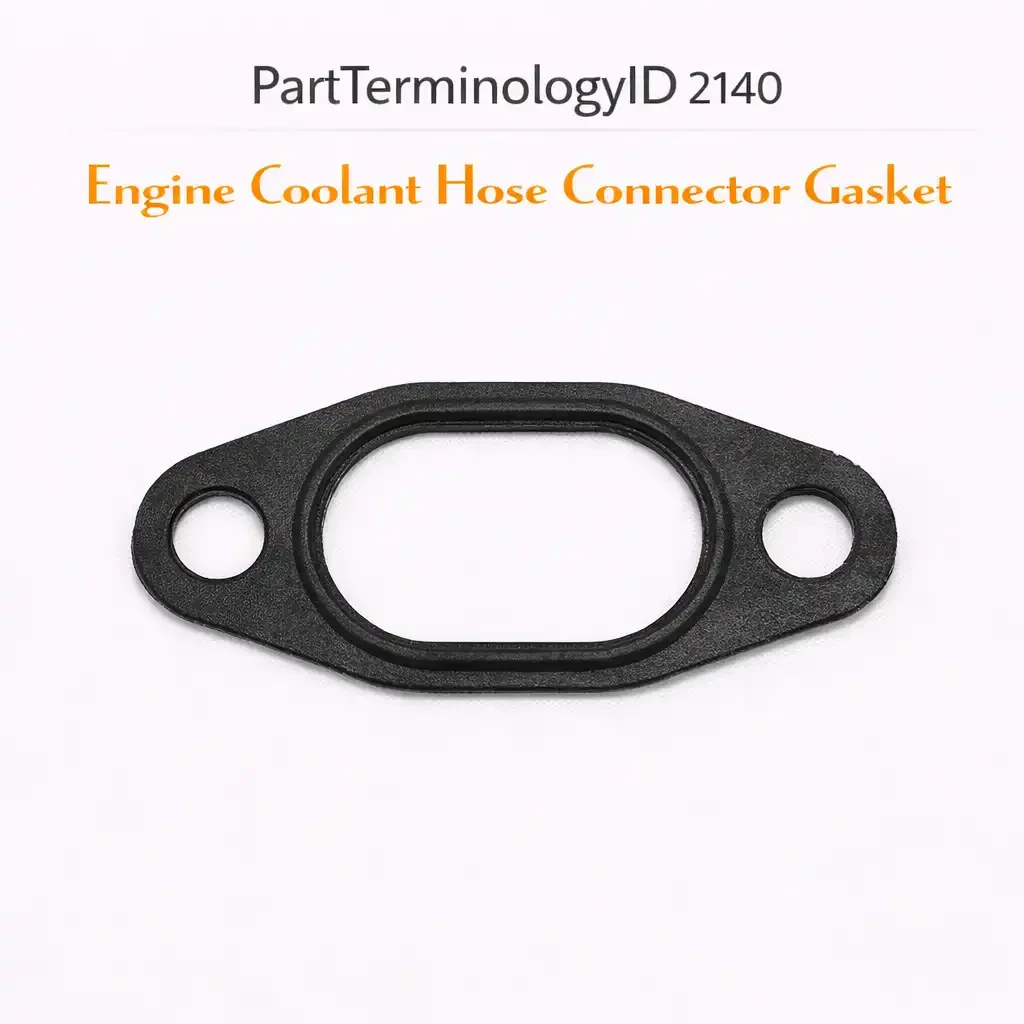
PartTerminologyID 2140, Engine Coolant Hose Connector Gasket, is a gasket that seals a coolant hose connector to an engine component. That definition locates the gasket at the interface between a rigid hose connector fitting and the surface it bolts to. It does not specify which connector, at which location on the engine, with what bolt pattern, in what material, or for which engine. A listing under PartTerminologyID 2140 that does not specify the connector location and the engine code is asking the buyer to guess which interface the gasket seals, the same problem that PartTerminologyID 2136 (Engine Coolant Thermostat Housing Gasket) creates when the engine code is absent, with the additional complication that a single engine may have multiple hose connector gasket locations that use different gasket profiles at each one.
For sellers, the hose connector gasket is frequently ordered as a repair part when a coolant hose connector is replaced or reseated after a coolant leak diagnosis. The buyer is in repair mode, often under time pressure, and is more likely to order from an incomplete listing because the part looks simple. A gasket that appears simple is still dimensionally specific. It must seal the correct bore, match the bolt hole count and spacing, and be made from a material that is appropriate for the coolant temperature and chemistry at that connector location. A wrong gasket at a hose connector produces the same outcome as a wrong thermostat housing gasket: coolant on the accessories below and a repair that must be done twice.
For sellers, the listing under this PartTerminologyID is only useful if it includes the engine code, the connector location on the engine, the gasket outer profile, and the gasket material. Without those four attributes, the listing can only be acted on by buyers who already know enough about their specific connector to verify the gasket independently, which is a small fraction of the buyer population.
What the Engine Coolant Hose Connector Gasket Does
Sealing the rigid connector-to-engine interface
Coolant hoses on many engines do not connect directly to ports cast into the block or head. Instead, they connect to rigid metal or plastic fittings that are themselves bolted to the engine. These fittings, which are the coolant hose connectors covered by PartTerminologyID 2076, direct coolant from the engine casting into the hose. The gasket under PartTerminologyID 2140 seals the interface between the base flange of that rigid connector and the machined surface on the engine it bolts to.
This interface is in the cooling circuit and is subject to full system operating pressure. The gasket must seal against coolant pressure from 13 to 18 PSI on most passenger vehicles and against coolant temperatures that vary by location on the engine. A connector gasket at the water pump inlet is exposed to lower-temperature coolant than a connector gasket at the cylinder head coolant outlet. The temperature difference affects the appropriate gasket material selection.
The multiple connector locations on a single engine
Many engines have more than one bolted hose connector, each at a different location and each requiring its own gasket. Common locations include the water pump inlet connector, the cylinder head coolant outlet connector, the heater circuit supply and return connectors on the block or the head, the coolant crossover pipe connectors on V-configuration engines, and the coolant bridge connectors on engines with separated bank cooling circuits. Each location may use a different gasket profile because the connector flange shape, the bolt hole pattern, and the bore diameter are determined by the connector design at that location and not standardized across locations on the same engine.
A listing under PartTerminologyID 2140 that does not identify the connector location cannot be matched to a specific interface on the engine by the buyer. A buyer who needs the gasket for the heater supply connector and receives the gasket for the cylinder head outlet connector has two wrong parts and one incomplete repair.
Gasket versus O-ring at the connector interface
Not all hose connector interfaces use a flat gasket. Some connectors seal with an O-ring that seats in a groove on the connector base flange or on the mating surface on the engine. On engines with plastic thermostat housings and plastic coolant bridge components, molded O-ring seals are more common than flat cut gaskets because the plastic components do not provide the rigid clamping surface that flat gaskets require.
The gasket form at the connector interface must be identified in the listing. A buyer who orders a flat gasket for a connector that uses an O-ring groove has a part that cannot be installed. The connector will not seat flush over a flat gasket if the connector base is designed for an O-ring, and the flat gasket will not compress correctly against a surface that has a groove rather than a flat face.
Single-use and reusable designations
The same single-use versus reusable distinction that applies to thermostat housing gaskets applies here. Compressed fiber gaskets at hose connectors are single-use. Rubber-coated steel gaskets may be reusable in some applications if undamaged. O-rings are sometimes reusable if the seal shows no compression set or cracking. The listing must specify the single-use or reusable designation so the buyer does not reinstall an original gasket expecting a replacement to be unnecessary, or discard a reusable original O-ring expecting a replacement to arrive.
The Connector Locations This Gasket May Serve
Water pump inlet connector gasket
The water pump inlet on many engines has a separate bolted connector fitting that connects the lower radiator hose to the water pump. The gasket at this interface seals a high-flow, low-temperature section of the cooling circuit. The connector flange is typically oval or rectangular with two bolts. This gasket is often disturbed when the water pump is replaced because the inlet connector must be removed or repositioned to access the pump mounting bolts on some engine layouts.
Cylinder head coolant outlet connector gasket
The coolant outlet from the cylinder head, which feeds the upper radiator hose on many engines, may use a bolted connector rather than a directly cast outlet. The gasket at this location is at the highest-temperature point in the cooling circuit. Material selection is critical: a compressed fiber gasket that is adequate at lower-temperature locations in the circuit may not sustain reliable sealing at the cylinder head outlet temperature over repeated heat cycles.
Heater circuit connector gasket
Heater supply and return connectors are typically located on the engine block or the cylinder head and feed the heater core. These connectors are small-bore fittings with two-bolt flanges. The gasket at the heater circuit connector is at a mid-temperature location in the cooling circuit. It is one of the most commonly overlooked gaskets during a coolant system service because the heater circuit connectors are rarely disturbed unless the heater hoses are replaced or the heater core requires service.
Coolant crossover pipe connector gasket
On V6 and V8 engines, a coolant crossover pipe connects the cooling circuits of the two cylinder banks. The crossover pipe bolts to connectors on each bank, and each connector interface requires a gasket. Crossover pipe connector gaskets are engine-specific and frequently engine-code-specific within the same engine family because different displacement or power output variants of the same engine architecture may use different crossover pipe designs.
Coolant bridge or inlet manifold coolant connector gasket
On some engines, particularly those with intake manifolds that carry coolant passages, coolant connectors bolt to the intake manifold or to a coolant bridge that spans the valley of a V-configuration engine. These connectors and their gaskets are specific to the intake manifold design and the engine code.
Why This Part Generates Returns
Buyers order the wrong engine coolant hose connector gasket because:
the connector location is not stated and the buyer has multiple connector gasket locations on their engine and cannot determine which one the listing covers
the engine code is not stated and the buyer's engine variant uses a different connector flange profile than the other engine variant on the same vehicle platform
the gasket form is not stated and the buyer receives a flat gasket for a connector that uses an O-ring groove
the gasket material is not appropriate for the connector location: a low-temperature-rated gasket is used at the cylinder head outlet location and fails under repeated thermal cycling
the bolt hole count or spacing does not match the connector flange, and the gasket bolts cannot be installed
the coolant passage bore diameter in the gasket is undersized for the connector bore, which restricts coolant flow through the connector
the listing does not specify single-use and the buyer reinstalls the original gasket, which leaks on reassembly
Status in New Databases
PIES/PCdb: PartTerminologyID 2140, Engine Coolant Hose Connector Gasket
PIES 8.0 / PCdb 2.0: No change
Top Return Scenarios
Scenario 1: "Wrong connector location, gasket profile does not match"
The buyer has a heater supply connector gasket location and a water pump inlet connector gasket location on the same engine. The listing did not specify the location. The buyer received the water pump inlet gasket. The profile and bolt hole spacing do not match the heater supply connector flange.
Prevention language: "Connector location: [water pump inlet / cylinder head outlet / heater supply connector / heater return connector / coolant crossover pipe / coolant bridge]. This gasket seals the [specific location] connector only. Verify your connector location before ordering. One engine may have multiple coolant hose connector gasket locations with different profiles."
Scenario 2: "Wrong engine code, bolt holes do not line up"
Same vehicle, different engine variant. The four-cylinder uses a two-bolt oval connector flange. The V6 uses a three-bolt round connector flange. The buyer did not specify the engine code. The two-bolt gasket arrived for a three-bolt application.
Prevention language: "Engine code: [specific engine code]. This gasket fits the [X] engine variant only. Verify your engine code before ordering. Different engine variants on the same vehicle platform may use different connector flange designs with different bolt hole counts and spacing."
Scenario 3: "Connector uses an O-ring groove, flat gasket will not seal it"
The buyer's coolant crossover pipe connector has a machined O-ring groove on the flange face. The listing shipped a flat cut gasket. The flat gasket cannot compress into the groove and the connector will not seat flush.
Prevention language: "Gasket form: [flat cut gasket / O-ring]. Verify your connector interface uses [flat sealing surfaces / an O-ring groove] before ordering. A flat gasket cannot seal an O-ring groove application and an O-ring cannot seal a flat gasket application."
Scenario 4: "Coolant passage bore in the gasket is too small"
The replacement gasket has a coolant passage bore that is smaller than the connector bore. The restriction reduces coolant flow through that section of the circuit. On a heater supply connector, the restriction reduces heater output. On a larger flow connector, the restriction increases thermal load on the water pump and reduces overall cooling capacity.
Prevention language: "Coolant passage bore diameter: [X]mm. Verify the gasket bore diameter matches or exceeds the connector bore diameter at the sealing interface. An undersized gasket bore restricts coolant flow through the connector."
Scenario 5: "Gasket leaked immediately, original was still in place"
The buyer received a flat gasket but did not remove the original gasket before installing the replacement. The original gasket was stuck to the engine surface and the buyer installed the new gasket over it. Double-gasketing prevents the connector from seating flush and produces an immediate leak.
Prevention language: "Remove all traces of the original gasket from both the connector flange and the engine mating surface before installing the replacement. Installing a new gasket over an old gasket prevents the connector from seating flush and will cause an immediate coolant leak. Use a plastic scraper to remove old gasket material without damaging the aluminum sealing surfaces."
What to Include in the Listing
Core essentials
PartTerminologyID: 2140
component: Engine Coolant Hose Connector Gasket
connector location on engine: water pump inlet, cylinder head outlet, heater supply, heater return, coolant crossover, coolant bridge (mandatory)
engine code (mandatory)
gasket form: flat cut or O-ring (mandatory)
gasket material: compressed fiber, rubber-coated steel, multi-layer steel, EPDM rubber (mandatory)
single-use or reusable designation (mandatory)
coolant passage bore diameter in mm (mandatory)
quantity: 1 or specify if multiple gaskets are included for a multi-connector application
Fitment essentials
year/make/model/submodel
engine code (mandatory, non-negotiable)
housing or connector material at the mating surface: aluminum, cast iron, plastic (for gasket material compatibility reference)
OE part number cross-reference when available
Dimensional essentials
gasket outer profile dimensions in mm
coolant passage bore diameter in mm
bolt hole count, diameter, and center-to-center spacing in mm
gasket compressed thickness in mm for flat gaskets
O-ring cross-sectional diameter in mm for O-ring seals
O-ring outer diameter in mm for O-ring seals
Image essentials
gasket in isolation against a white background showing the full profile, bolt holes, and coolant passage bore
dimensional callout image showing bore diameter, bolt hole spacing, and outer profile
gasket positioned on the connector flange showing fit relationship
for O-ring applications, the O-ring shown in isolation with cross-sectional diameter callout
installed context showing the gasket at the correct connector location on the engine
Catalog Checklist for ACES/PIES Teams
PartTerminologyID = 2140
require connector location attribute (mandatory, non-negotiable)
require engine code (mandatory, non-negotiable)
require gasket form: flat or O-ring
require gasket material
require single-use or reusable designation
require coolant passage bore diameter in mm
require bolt hole count and spacing
require quantity when a multi-connector application includes multiple gaskets in one listing
differentiate from engine coolant thermostat housing gasket (PartTerminologyID 2136): the thermostat housing gasket seals the housing-to-engine interface; the hose connector gasket seals a separate hose connector fitting to the engine; both may be required on the same service event but they are different parts at different locations
differentiate from coolant hose connector (PartTerminologyID 2076): the connector is the rigid fitting; the gasket is the seal between that fitting and the engine surface
differentiate from water pump gasket (PartTerminologyID varies): the water pump gasket seals the pump body to the engine block; the hose connector gasket seals a separate connector fitting that may be at or near the water pump but is a different interface
flag that a single engine may have multiple coolant hose connector gasket locations with different profiles: the connector location attribute must identify which interface the listing covers
flag that coolant passage bore diameter must match or exceed the connector bore: an undersized bore restricts coolant flow
FAQ (Buyer Language)
How do I know which coolant hose connector gasket I need?
Identify the connector that is leaking or that was disturbed during the repair. Common connector locations include the water pump inlet, the cylinder head outlet, the heater supply and return connectors on the block or head, and the coolant crossover connectors on V-configuration engines. Once you have identified the connector location, look up the gasket by engine code and connector location rather than by vehicle model alone. A single engine may have gaskets at multiple connector locations that are not interchangeable.
Can I reuse the original gasket when I reinstall the connector?
It depends on the gasket form and material. Compressed fiber flat gaskets are single-use and must not be reused. Rubber-coated steel gaskets may be reused if the coating is undamaged and the gasket shows no compression set or cracking. O-ring seals may be reused if the rubber is not cracked, hard, or flattened. When in doubt, replace the gasket. A new connector gasket costs significantly less than the labor to repeat the repair after a reused gasket fails.
The connector I removed has no separate gasket. It uses a bead of sealant. Do I need this part?
No. Some coolant hose connectors are sealed with room temperature vulcanizing sealant rather than a separate gasket. On those applications, the correct procedure is to clean both sealing surfaces and apply a fresh bead of the specified RTV sealant rather than installing a cut gasket. Installing a cut gasket on an RTV-sealed interface will change the gap between the connector flange and the engine surface and may prevent the connector from seating or may cause a leak. Follow the factory service manual for your engine to confirm the sealing method before ordering a gasket.
My engine has two heater hose connectors on the block. Do I need one gasket or two?
One for each connector you are servicing. The supply and return heater connectors may use identical or different gasket profiles depending on the engine. Identify which connector is being replaced or reseated and order the correct gasket for that location. If both connectors are being serviced at the same time, order two gaskets and confirm both are the correct profile before starting the repair.
Does the coolant hose connector gasket come with the connector when I buy a replacement connector?
Sometimes. Some coolant hose connector listings include the gasket. Others do not. Verify the connector listing before assuming the gasket is included. If the connector listing does not include the gasket, order PartTerminologyID 2140 separately before beginning the repair. Attempting to source the gasket after the connector is already removed and the cooling system is open extends the repair time and risks coolant loss.
Cross-Sell Logic
Coolant Hose Connector (PartTerminologyID 2076: the connector is the rigid fitting the gasket seals; if the connector is cracked or damaged, both the connector and the gasket must be replaced together)
Thermostat Housing Gasket (PartTerminologyID 2136: on engines where the thermostat housing and a coolant hose connector are serviced at the same repair event, both gaskets are needed; listing proximity between 2136 and 2140 in the catalog reflects this common co-purchase)
Water Pump (PartTerminologyID varies: the water pump inlet connector gasket is disturbed on most water pump replacements; the gasket is a low-cost item that should always be replaced when the water pump is replaced rather than reusing the original)
Engine Coolant (the cooling circuit must be partially or fully drained when any hose connector is serviced; coolant level verification and air bleeding are required after reassembly)
Engine Cooling System Pressure Tester Adapter (PartTerminologyID 2054: after the connector and gasket are replaced and the system is refilled, pressure test to confirm the new gasket seals at operating pressure before returning the vehicle to service)
RTV Sealant (on applications where the factory service manual specifies an RTV bead at specific points on the gasket perimeter in addition to the gasket itself, the correct sealant must be on hand at installation time)
Upper or Lower Radiator Hose (if the hose at the connector being serviced is the original hose, inspect it for deterioration and replace it at the same time if it shows cracking, softness, or swelling)
Frame as "the gasket seals the connector. The connector carries the hose. The hose is inspected when the connector is serviced. The water pump is upstream of the inlet connector and is a concurrent replacement when the pump is the root cause of the service event. The pressure test confirms the repair."
Final Take for PartTerminologyID 2140
Engine Coolant Hose Connector Gasket (PartTerminologyID 2140) seals a rigid hose connector fitting to the engine at a specific location that varies by engine design, by connector design, and by position on the engine. The PartTerminologyID name communicates the product category. It does not communicate the connector location, the engine code, the gasket form, the material, or the bore diameter, all of which determine whether the gasket can be installed and whether it will seal the interface it is meant to seal.
A single engine can have five or more coolant hose connector locations with different gasket profiles at each one. A listing that does not identify the connector location is a listing that the buyer on a multi-connector engine cannot match to any specific interface. A listing that does not specify the engine code on a platform with multiple engine variants is a listing that fits one variant and generates a return from every buyer on the other.
State the connector location. State the engine code. State the gasket form. State the material. State the bore diameter. That is the same listing strategy as every other PartTerminologyID in this series: the generic PartTerminologyID requires specific attributes at every level to become a listing buyers can act on without guessing.