
Engine Coolant Thermostat Housing Gasket (PartTerminologyID 2136): Why the Engine Code Is the Only Fitment Attribute That Matters First
Written by Arthur Simitian | PartsAdvisory
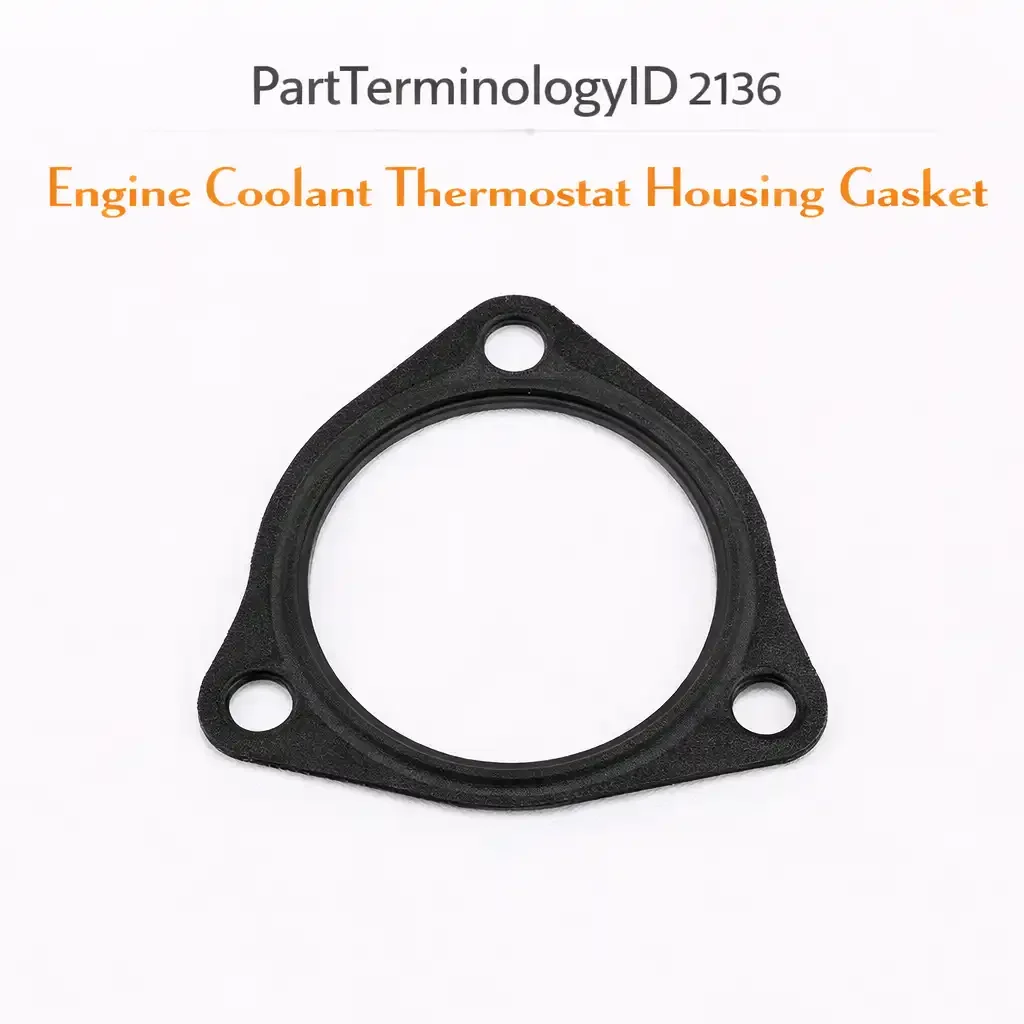
PartTerminologyID 2136, Engine Coolant Thermostat Housing Gasket, is a gasket that seals the thermostat housing to the engine block or cylinder head. That definition identifies the location and the function. It does not identify the engine the housing belongs to, the housing bore diameter the gasket must seal, the bolt pattern that secures the housing, the gasket material, whether the gasket is a flat cut gasket or a formed rubber seal, whether the application requires one gasket or two, or whether the gasket is sold individually or as part of a housing kit. A listing under PartTerminologyID 2136 that does not specify the engine code, the gasket material, and the gasket form is asking the buyer to guess whether the gasket seals the interface on their engine, the same problem that PartTerminologyID 2069 (Engine Coolant Thermostat Housing Cap) creates when the engine code is absent.
For sellers, the thermostat housing gasket has a deceptively simple appearance that creates overconfidence in buyers who select by vehicle year, make, and model without specifying the engine. On many vehicle platforms, the same body is offered with two or three different engines that use different thermostat housing designs with different gasket profiles, different bolt patterns, and different gasket materials. A gasket that fits the four-cylinder variant of a given platform will not seal the V6 variant, even though both engines occupy the same vehicle and the same catalog year/make/model fitment row. The engine code resolves this ambiguity. Without it, the listing resolves nothing.
For sellers, the listing under this PartTerminologyID is only useful if it includes the engine code, the gasket form, the gasket material, and whether the listing covers one or two gaskets for the application. Without those four attributes, the return rate is determined by how many buyers on the correct engine happen to order before buyers on the wrong engine variant generate a return wave.
What the Thermostat Housing Gasket Does
Sealing the housing-to-engine interface under pressure and temperature
The thermostat housing sits at the top of the cooling circuit, at the outlet point where hot coolant leaves the engine and enters the upper radiator hose on its way to the radiator. On most engines, the housing bolts directly to the engine block or the cylinder head. The gasket between the housing flange and the mating surface on the engine must seal the coolant passage under full system operating pressure, which ranges from 13 to 18 PSI on most passenger vehicles, and at the highest coolant temperatures in the circuit, which can reach 220 degrees Fahrenheit or more at the thermostat housing outlet on a warmed engine under load.
A thermostat housing gasket that fails does not produce a subtle symptom. Coolant exits the housing at the leak point and drips or streams onto the exhaust manifold or the engine accessories below. On many transversely mounted engines, the thermostat housing leak path leads directly onto the alternator. A failed gasket that is not addressed immediately can destroy an alternator through coolant ingestion and create a secondary electrical repair alongside the cooling system repair. The gasket is inexpensive. The consequence of the wrong gasket is not.
The two-gasket application
On some engines the thermostat housing uses two separate gaskets: one at the interface between the housing and the engine, and one at the interface between a thermostat housing inlet pipe or coolant bridge and the housing itself. Both gaskets are in the coolant circuit. Both must seal. On applications where two gaskets are required, a listing that ships only one gasket produces a housing that the buyer cannot fully reassemble without sourcing the second gasket separately, which delays the repair and generates a return request.
The listing must specify whether the application requires one gasket or two, and whether both are included. This attribute is absent in most listings for this PartTerminologyID.
The reusable housing versus the single-use gasket
Some thermostat housing designs on current-production engines use a formed rubber O-ring or a molded rubber seal that integrates with the housing itself rather than a separate flat gasket. When the housing is removed for thermostat service, the seal condition must be inspected. Some of these seals are designed to be reused if undamaged. Others are designed for single use and must be replaced every time the housing is removed. A listing that does not specify whether the gasket is single-use or reusable creates a return when the buyer discards the original seal expecting a replacement in the kit and no replacement is included, or when the buyer reuses the original seal because no replacement was available and the seal leaks on reassembly.
The relationship to the thermostat
The thermostat housing gasket is always serviced when the thermostat is replaced because the housing must be removed to access the thermostat. In most cases the gasket is damaged or deformed by the removal process or by the compression of previous installation and cannot be reliably reused. The thermostat and the housing gasket are logically purchased together. A listing for the gasket that does not cross-reference the thermostat is a listing that misses the most predictable concurrent purchase in the category.
The Gasket Forms Under This PartTerminologyID
Flat cut gasket
The traditional form. A flat sheet of gasket material is cut to match the housing flange profile, with holes for the coolant passage, the bolt holes, and the thermostat bore if the thermostat seats in the housing rather than in the block. Flat cut gaskets are compressed between the housing flange and the mating surface when the housing bolts are torqued. The compression creates the seal.
Flat cut gaskets are available in several materials: compressed fiber, multi-layer steel, and formed rubber-coated steel. The material determines the torque range the gasket can handle, the temperature it can sustain, and whether it can be reused after removal. Compressed fiber gaskets are generally single-use because the compression set from the first installation deforms the material permanently. Multi-layer steel gaskets are more durable but require precise surface flatness on both mating surfaces. Rubber-coated steel gaskets are forgiving of minor surface irregularities and are the most common OE choice on aluminum thermostat housings.
The listing must specify the gasket material. A compressed fiber gasket installed on an engine that originally used a multi-layer steel gasket will not seal at the same bolt torque and may blow out under operating pressure.
Formed rubber O-ring or seal
On many current-production engines with plastic or aluminum thermostat housings, the housing is sealed with a formed rubber O-ring that sits in a machined groove in the housing flange or the mating surface on the engine. The O-ring is compressed radially when the housing is seated and seals against the groove walls rather than being compressed axially like a flat gasket.
O-ring seals are dimensionally specific. The cross-sectional diameter and the ring outer diameter must match the groove dimensions exactly. An O-ring that is undersized for the groove will not fill the groove and will not seal. An O-ring that is oversized will not seat in the groove and will prevent the housing from seating against the engine, which will prevent the housing bolts from clamping correctly.
The material of the O-ring must be compatible with the coolant formulation. EPDM is the most common material for coolant circuit O-rings because it is compatible with both conventional and OAT extended-life coolants. Nitrile O-rings, which are common in oil circuits, are not appropriate for coolant circuit applications because nitrile degrades in glycol-based coolants.
Integrated housing seal
Some thermostat housing assemblies, particularly on current-production four-cylinder and V6 engines, incorporate a pre-formed seal as an integral part of the housing assembly. When the housing is replaced rather than just the thermostat, the seal comes with the new housing and no separate gasket is required. A listing for a standalone gasket under PartTerminologyID 2136 that is applied to a housing-integrated-seal application creates a return because the buyer cannot install the gasket: the housing has no provision for a separate flat or O-ring seal.
Thermostat housing kit with gasket included
On some applications, the thermostat housing gasket is only available as part of a kit that includes the thermostat, the housing gasket, and in some cases the housing bolts. A listing for the gasket alone under PartTerminologyID 2136 when the application requires the kit creates a return when the buyer orders just the gasket and cannot source it separately. The listing must indicate whether the gasket is available individually or only as part of a kit.
Why This Part Generates Returns
Buyers order the wrong thermostat housing gasket because:
the listing does not specify the engine code and the gasket fits a different engine variant on the same vehicle platform
the gasket form is not stated and the buyer receives a flat cut gasket when their housing uses an O-ring groove, or vice versa
the gasket material is not stated and the buyer installs a fiber gasket on an application that requires a multi-layer steel or rubber-coated steel gasket, which leaks at the designed bolt torque
the listing does not specify whether the application requires one gasket or two, and the buyer installs the single included gasket without sealing the secondary interface
the listing does not indicate that the gasket is only available as part of a kit, and the buyer orders the standalone gasket and cannot locate it
the O-ring cross-sectional diameter is not stated and the buyer receives an O-ring that does not fill the housing groove
the gasket is listed as reusable when it is a single-use compressed fiber part, and the buyer reinstalls the original gasket after reading the listing description and the housing leaks on reassembly
Status in New Databases
PIES/PCdb: PartTerminologyID 2136, Engine Coolant Thermostat Housing Gasket
PIES 8.0 / PCdb 2.0: No change
Top Return Scenarios
Scenario 1: "Wrong engine code, gasket does not match the housing flange"
The buyer ordered by year/make/model without specifying the engine code. The vehicle is available with a four-cylinder and a V6. The four-cylinder thermostat housing has a rectangular two-bolt flange. The V6 housing has a circular three-bolt flange. The gasket for the four-cylinder arrived and does not match the V6 housing shape or bolt pattern.
Prevention language: "Engine code: [specific engine code or codes]. This gasket fits the [X] engine variant only. Verify your engine code before ordering. The same vehicle may use different thermostat housing designs on different engine variants with different gasket profiles and bolt patterns."
Scenario 2: "Housing uses an O-ring groove, no flat gasket fits here"
The buyer's housing has a machined O-ring groove in the flange. The listing shipped a flat cut gasket. The flat gasket cannot seat in the O-ring groove and the housing cannot be sealed with it.
Prevention language: "Gasket form: [flat cut gasket / O-ring / formed rubber seal]. Verify your thermostat housing uses [flat gasket surfaces / an O-ring groove] before ordering. Flat gaskets and O-ring seals are not interchangeable between housing designs."
Scenario 3: "Fiber gasket blew out at operating pressure"
The buyer installed a compressed fiber gasket on an engine that originally used a rubber-coated steel gasket. The fiber gasket compressed correctly at installation torque but extruded under operating pressure because the engine's bolt torque and surface finish were designed for a stiffer gasket material.
Prevention language: "Gasket material: [compressed fiber / rubber-coated steel / multi-layer steel]. Verify the replacement gasket material matches the original specification for your engine. Substituting a softer gasket material may result in extrusion under operating pressure at the designed bolt torque."
Scenario 4: "Second gasket missing, housing leaks at the inlet pipe"
The application requires two gaskets: one at the housing-to-engine interface and one at the coolant inlet pipe-to-housing interface. The listing shipped one gasket. The buyer installed the one gasket at the housing-to-engine joint and torqued the housing. The inlet pipe joint was not sealed and leaked on the first startup.
Prevention language: "Quantity: [1 gasket / 2 gaskets]. This application requires [two] gaskets: one at the thermostat housing-to-engine interface and one at the [inlet pipe / coolant bridge] interface. Both are included. Verify both sealing surfaces are addressed before torquing the housing."
Scenario 5: "O-ring does not fill the groove, housing leaks"
The O-ring cross-sectional diameter is undersized for the housing groove. The O-ring seats in the groove but does not fill it to the depth required for sealing compression. The housing leaks at the groove section where the O-ring is not fully compressed.
Prevention language: "O-ring cross-sectional diameter: [X]mm. O-ring outer diameter: [X]mm. Verify both the cross-sectional diameter and the outer diameter match your housing groove dimensions before installing. An O-ring that is undersized in cross-section will not seal the groove regardless of housing bolt torque."
Scenario 6: "Gasket was listed as reusable, it leaked on the second installation"
The listing described the gasket as reusable. The buyer reinstalled the original compressed fiber gasket after servicing the thermostat. The compressed set from the original installation prevented the gasket from sealing at the same bolt torque on the second installation.
Prevention language: "This is a single-use gasket. Do not reuse after removal. The compression set from the first installation permanently deforms the gasket material. Install a new gasket every time the thermostat housing is removed."
What to Include in the Listing
Core essentials
PartTerminologyID: 2136
component: Engine Coolant Thermostat Housing Gasket
engine code (mandatory)
gasket form: flat cut gasket, O-ring, or formed rubber seal (mandatory)
gasket material: compressed fiber, rubber-coated steel, multi-layer steel, EPDM rubber, silicone (mandatory)
quantity: 1 gasket or 2 gaskets (mandatory when application requires two)
single-use or reusable designation (mandatory)
sold individually or as part of a kit only (mandatory when not available standalone)
Fitment essentials
year/make/model/submodel
engine code (mandatory, non-negotiable)
housing material: plastic, aluminum, cast iron (to confirm gasket material compatibility)
OE part number cross-reference when available
compatible thermostat PartTerminologyID or OE part number for cross-sell reference
Dimensional essentials
gasket outer profile dimensions: length and width in mm for flat rectangular gaskets
coolant passage bore diameter in mm
bolt hole count, spacing, and diameter in mm
O-ring cross-sectional diameter in mm for O-ring seals
O-ring outer diameter in mm for O-ring seals
gasket compressed thickness in mm for flat gaskets
Image essentials
gasket in isolation against a white background showing the full profile, bolt holes, and coolant passage
O-ring shown in isolation with cross-sectional callout for O-ring applications
gasket positioned on the thermostat housing flange showing the fit relationship
for two-gasket applications, both gaskets shown together with callouts identifying which seals which interface
material surface detail distinguishing fiber from rubber-coated steel from multi-layer steel
Catalog Checklist for ACES/PIES Teams
PartTerminologyID = 2136
require engine code (mandatory, non-negotiable: year/make/model is insufficient when the same vehicle uses multiple engine variants with different housings)
require gasket form: flat, O-ring, or formed seal
require gasket material
require quantity: one or two, with interface identification for two-gasket applications
require single-use or reusable designation
require sold-individually or kit-only designation
require O-ring cross-sectional diameter and outer diameter for O-ring applications
require housing material compatibility note when gasket material selection depends on housing material
differentiate from thermostat housing (PartTerminologyID varies): the housing is the casting; the gasket seals the housing to the engine
differentiate from thermostat (PartTerminologyID varies): the thermostat is inside the housing; the gasket is between the housing and the engine; the two are purchased together but are separate parts
differentiate from engine coolant thermostat housing cap (PartTerminologyID 2069): the cap seals a secondary bore in the housing; the gasket seals the housing-to-engine interface
differentiate from water outlet gasket on applications where the thermostat housing doubles as the water outlet: some listings blur the line between the thermostat housing gasket and the water outlet gasket when both are at the same location
flag that O-ring cross-sectional diameter and outer diameter must both be stated: outer diameter alone is insufficient for O-ring fitment
flag that compressed fiber gaskets are single-use: the listing must not describe them as reusable
flag that two-gasket applications require both gaskets to be included or the secondary gasket to be identified and cross-referenced
FAQ (Buyer Language)
How do I know which gasket form my thermostat housing uses?
Remove the thermostat housing and inspect the mating surfaces on the housing flange and the engine. If both surfaces are flat machined faces with no groove, the application uses a flat cut gasket. If one surface has a continuous machined groove running around the coolant passage, the application uses an O-ring that seats in that groove. If the housing has a pre-formed rubber bead on the flange face, the seal is integrated into the housing and a separate gasket is not required. Identify the form before ordering.
Can I reuse the thermostat housing gasket?
It depends on the gasket form and material. Formed rubber O-rings and silicone seals can sometimes be reused if they are undamaged, show no compression set, and seat cleanly in the groove. Compressed fiber flat gaskets are single-use. The compression set from the first installation prevents them from sealing reliably at the same bolt torque on a second installation. Rubber-coated steel gaskets may be reused in some applications if the coating is undamaged, but the general recommendation is to replace the gasket every time the housing is removed. Inspect the original gasket and replace it when in doubt.
My engine code is not listed on the gasket listing. How do I confirm the gasket fits?
Verify the gasket profile, the bolt hole pattern, and the coolant passage bore diameter against your original gasket. Measure the original gasket's outer profile dimensions, the bolt hole spacing, and the bore diameter. Compare those measurements to the replacement gasket's specifications in the listing. If the listing does not provide those dimensions, contact the seller before ordering. A gasket that cannot be confirmed by dimensions cannot be confirmed by vehicle fitment alone when the engine code is absent.
My thermostat housing has two separate mating surfaces that both need sealing. Do I need two gaskets?
Yes. Some thermostat housings have a primary interface at the housing-to-engine mounting face and a secondary interface at an inlet pipe or coolant bridge that bolts to the housing body. Both interfaces require a gasket. Verify whether your application is a two-gasket application before ordering a single gasket. If the listing ships one gasket and your housing requires two, the repair cannot be completed without sourcing the second gasket separately.
What gasket material should I use for an aluminum thermostat housing?
Rubber-coated steel or a formed rubber O-ring are the preferred materials for aluminum thermostat housings. Compressed fiber gaskets can embed into soft aluminum surfaces under bolt torque and are more difficult to remove cleanly at the next service. Multi-layer steel gaskets require very flat, undamaged mating surfaces and are less forgiving of the minor surface irregularities that are common on aluminum housings after multiple service cycles. Rubber-coated steel gaskets seal reliably on aluminum and release cleanly at service.
Do I need to replace the thermostat housing bolts when I replace the gasket?
Inspect the bolts. If the bolts are the stretch-to-yield type, which is common on many current-production aluminum engines, they must be replaced every time they are removed. Stretch-to-yield bolts are designed to elongate permanently on the first installation torque. Reusing them risks undertorquing the housing because the bolt has already reached its yield point. If the bolts are standard hex-head bolts, they can typically be reused if they are undamaged and the threads are clean. Consult the factory service manual for your engine to confirm the bolt type before reusing.
Cross-Sell Logic
Thermostat (PartTerminologyID varies: the thermostat is inside the housing and is almost always replaced at the same time as the gasket; the housing must be removed to access the thermostat, which means the gasket must be replaced regardless of whether the thermostat was the original reason for the repair)
Thermostat Housing Bolts (if the engine uses stretch-to-yield bolts at the thermostat housing, the bolts must be replaced with the gasket; this is a low-cost item with a high return on including it in the same order)
Engine Coolant Thermostat Housing Cap (PartTerminologyID 2069: the cap seals the secondary bore in the same housing; if the housing is being removed and the cap has not been recently replaced, it is worth inspecting and replacing at the same time)
Engine Coolant (the thermostat housing service typically requires partial coolant drainage; the coolant level must be verified and the system bled of air after reassembly; if the coolant is due for replacement, this is the service interval to do it)
Upper Radiator Hose (the upper radiator hose connects to the thermostat housing outlet; the hose clamp is disturbed during thermostat housing removal on most engines; inspect the hose and clamp and replace if the hose is soft, cracked, or swollen)
Engine Cooling System Pressure Tester Adapter (PartTerminologyID 2054: after replacing the gasket and refilling the cooling system, pressure test to confirm the new gasket seals at full system pressure before returning the vehicle to service)
RTV Sealant (on applications where the gasket listing specifies a bead of RTV at specific locations on the gasket perimeter, the correct RTV formulation must be available at installation time; using the wrong RTV or applying it to the wrong location can cause the gasket to leak or can prevent the housing from seating flush)
Frame as "the gasket seals the housing. The thermostat is inside the housing. Both are replaced at the same service event. The bolts may be single-use. The coolant is refilled after the service. The pressure test confirms the repair before the engine returns to service."
Final Take for PartTerminologyID 2136
Engine Coolant Thermostat Housing Gasket (PartTerminologyID 2136) seals the hottest and highest-pressure coolant interface on the engine at the point where any leakage lands on the alternator, the exhaust, or the accessories below. It is dimensionally specific to the engine, not just the vehicle. It comes in forms that are not interchangeable between housing designs. It comes in materials that are not interchangeable between engine specifications. It may be required in quantities of one or two depending on the housing design. And it is always replaced at the same service event as the thermostat, which makes it a predictable concurrent purchase that every listing should cross-reference.
The engine code is the first attribute. The gasket form is the second. The gasket material is the third. The quantity is the fourth. Every one of those attributes determines whether the buyer can complete the repair with what they receive. A listing that omits any of them is a listing that sends the buyer to the engine with a gasket they may not be able to use.
State the engine code. State the gasket form. State the material. State the quantity. Flag single-use parts as single-use. That is the same listing strategy as every other PartTerminologyID in this series: specific attributes at every level, because the generic PartTerminologyID alone tells the buyer nothing actionable about the part in the box.