
Written by Arthur Simitian | PartsAdvisory
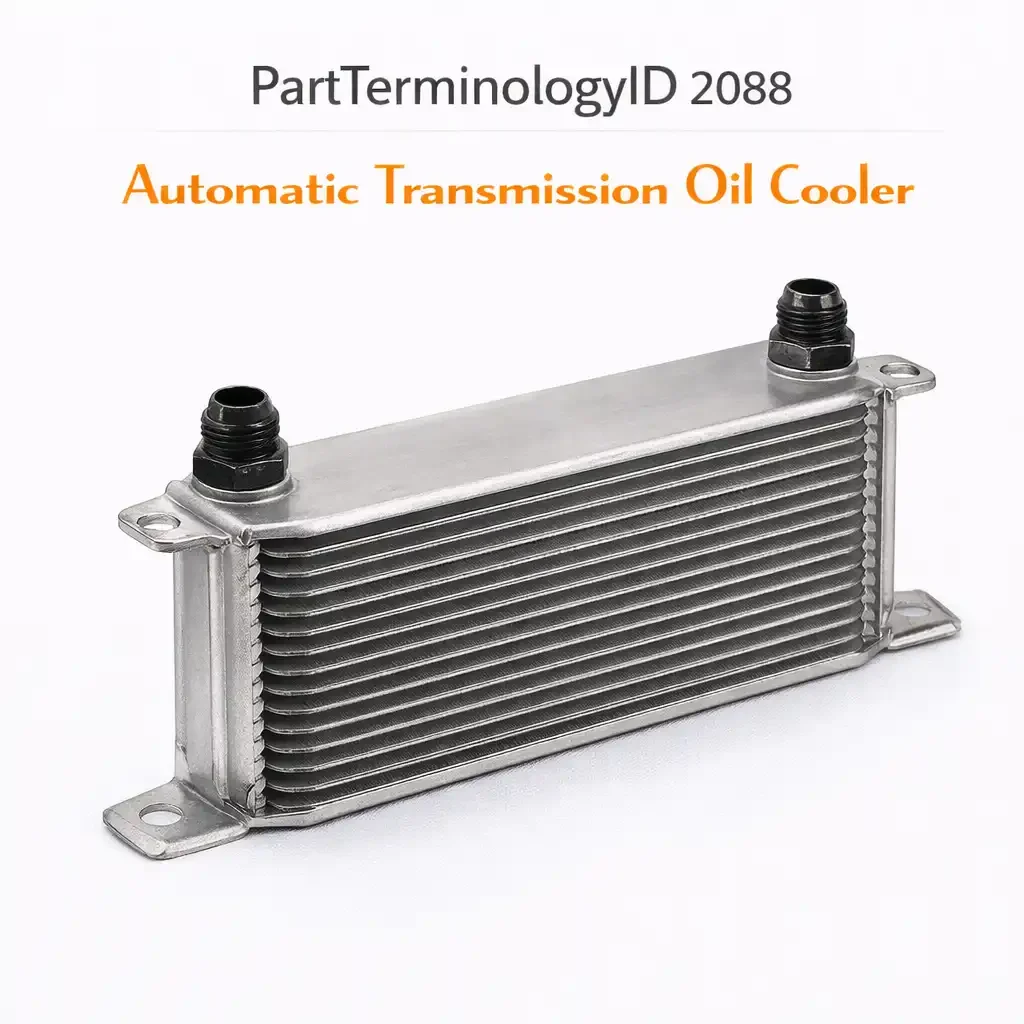
PartTerminologyID 2088, Automatic Transmission Oil Cooler, is a heat exchanger that reduces automatic transmission fluid temperature. That definition identifies the function. It does not identify the mounting location, the line connection type and diameter, the heat exchange capacity, the transmission the cooler is designed for, whether the cooler is the original equipment unit integrated into the radiator end tank or an auxiliary external cooler added to the circuit, or whether the cooler is a direct replacement for an existing unit or an add-on to a system that does not currently have a dedicated transmission cooler. A listing under PartTerminologyID 2088 that does not specify the line connection diameter, the cooler capacity, the mounting configuration, and the fitment by transmission code is asking the buyer to guess whether the cooler connects to their transmission fluid circuit and whether it will exchange enough heat to keep the fluid within its designed operating temperature range.
For sellers, the automatic transmission oil cooler occupies a different position than the engine oil cooler (PartTerminologyID 2084) in the consequence hierarchy. A failed engine oil cooler typically produces an oil and coolant mixing event that announces itself through visible contamination. A transmission cooler that is undersized, incorrectly connected, or leaking may produce a slower degradation of transmission fluid quality that manifests as harsh shifting, delayed engagement, and slipping before the buyer connects the thermal management failure to the cooler. An undersized external cooler may appear to function correctly while allowing fluid temperatures to remain above the designed threshold on long grades, in heavy traffic, or when towing, with the resulting fluid degradation shortening the transmission service life in ways that are not traceable to the cooler at the time of diagnosis.
For sellers, the listing under this PartTerminologyID is only useful if it includes the transmission code or vehicle fitment, the line connection type and diameter, the cooler capacity rating, the mounting configuration, and whether the cooler is a replacement for the radiator-integrated unit or an auxiliary cooler intended to supplement it. Without those five attributes, the return rate is set by how many of those specifications the buyer happens to match correctly without guidance from the listing.
What the Automatic Transmission Oil Cooler Does
Transmission fluid temperature and its effect on transmission life
Automatic transmission fluid serves as a hydraulic medium, a lubricant, and a heat transfer fluid simultaneously. The hydraulic function drives the clutch packs and bands that create gear changes. The lubricating function protects the planetary gear sets, the bushings, and the thrust washers. The heat transfer function carries heat away from the torque converter and the clutch packs to the cooler.
Transmission fluid that operates above its designed temperature degrades faster than any other variable in transmission life. The commonly cited rule in the transmission service industry is that every 20-degree Fahrenheit increase in fluid operating temperature above 175 degrees Fahrenheit cuts the fluid service life approximately in half. At 195 degrees, the fluid lasts half as long as at 175 degrees. At 215 degrees, half as long again. At 240 degrees, a transmission that would have lasted 100,000 miles on controlled-temperature fluid may reach the end of its fluid service life in a fraction of that distance. The fluid becomes oxidized, loses its friction modifier chemistry, and the clutch packs that depend on that chemistry for precise engagement begin to slip.
The transmission oil cooler exists to keep fluid temperature within the designed operating band. On most passenger vehicles, that band is 175 to 200 degrees Fahrenheit under normal driving conditions. Towing, grades, high ambient temperatures, and stop-and-go traffic can push fluid temperatures above that band without a properly sized cooler in the circuit.
The radiator-integrated cooler
The most common original equipment configuration is a transmission oil cooler built into one of the radiator end tanks. Transmission fluid from the transmission enters the cooler through an inlet line, passes through a tube or a stacked-plate core inside the coolant in the end tank, and exits through an outlet line back to the transmission. The coolant in the end tank acts as the cooling medium.
This configuration has an inherent advantage on cold starts: the warm coolant transfers heat to the cold transmission fluid in the early warm-up phase, bringing the fluid to operating temperature faster and reducing cold-start wear in the clutch packs. It has a disadvantage under severe loads: the coolant temperature is controlled by the radiator and the thermostat, and in extreme conditions the coolant itself may be running warm, which reduces the temperature differential between the coolant and the transmission fluid and limits the cooler's heat rejection capacity.
When the radiator-integrated cooler fails due to an internal leak, transmission fluid contaminates the coolant. The contamination appears as a pink or reddish film in the coolant reservoir or as a milky appearance in the transmission fluid. This failure mode requires immediate attention: transmission fluid in the cooling system can damage the water pump seal, and coolant in the transmission fluid disrupts the hydraulic and friction modifier chemistry and can cause rapid clutch pack failure.
The auxiliary external cooler
An auxiliary transmission oil cooler is an oil-to-air heat exchanger mounted in the airflow path, typically in front of the radiator or condenser. It is plumbed in series with the existing cooler circuit: transmission fluid exits the transmission, passes through the auxiliary cooler, then passes through the radiator-integrated cooler or bypasses it depending on the installation configuration, and returns to the transmission.
Auxiliary coolers are used when the original equipment cooler is inadequate for the thermal load of the application. Towing packages, performance builds, and high-mileage vehicles with a history of overheated fluid are the primary applications. The sizing of the auxiliary cooler relative to the transmission's fluid flow rate and the vehicle's thermal load is critical. An undersized auxiliary cooler adds cost and complexity without delivering meaningful temperature reduction. An oversized auxiliary cooler can over-cool the fluid on cold starts, which increases hydraulic pressure and stresses seals.
Auxiliary coolers are also used as replacement coolers on applications where the radiator-integrated cooler has failed and the buyer wants to bypass the radiator unit entirely rather than replace the radiator. In this configuration, a bypass fitting or a replacement radiator with no built-in cooler is used alongside the auxiliary unit.
The transmission-specific cooler versus the universal cooler
Transmission-specific coolers are designed for a particular transmission's fluid flow rate, operating pressure, and line connection configuration. Universal coolers are sold with adjustable mounting brackets and generic line fittings designed to work with adapters across multiple applications. The distinction matters for listing purposes because a universal cooler requires the buyer to source line adapters, determine the correct mounting location, and route lines, while a transmission-specific replacement installs in a defined location with defined connections.
A listing that presents a universal cooler under a specific year/make/model/transmission fitment without disclosing that the installation requires adapter fittings and custom line routing will generate returns when the buyer discovers the installation is not direct-fit.
The Connection Specifications This Cooler Must Match
Transmission line connection type and diameter
Transmission fluid lines connect to the cooler through compression fittings, threaded fittings, or quick-connect fittings depending on the vehicle and the cooler type. Common line outer diameters for transmission cooler lines range from 3/8 inch to 1/2 inch on domestic passenger vehicles. Some vehicles use metric line diameters. The fitting thread specification must match the cooler port threads or the line fitting threads exactly.
A cooler with the correct capacity but mismatched line connections cannot be installed without adapter fittings, which introduce additional leak points in a circuit that operates at pressures between 40 and 100 PSI under loaded conditions. A transmission cooler line that disconnects or leaks under pressure drains the transmission fluid within seconds and can cause catastrophic transmission failure before the driver can stop the vehicle.
Port thread specification
Cooler ports on threaded-connection coolers use thread specifications that must be matched to the line fittings. Common specifications include 1/4-18 NPT, 3/8-18 NPT, and metric equivalents depending on the cooler manufacturer and the vehicle. The listing must state the thread specification at both cooler ports: the inlet and the outlet. If the inlet and outlet thread specifications differ, both must be disclosed.
Quick-connect line fittings
Many current-production vehicles use quick-connect fittings on the transmission cooler lines. These fittings push onto a nipple on the cooler and lock with an internal spring clip. Quick-connect fittings are size-specific: the fitting outer diameter must match the cooler nipple outer diameter. A 3/8-inch quick-connect will not seat correctly on a 5/16-inch cooler nipple, and the internal spring clip will not engage, which produces a fitting that appears connected but is not retained and will pull free under line pressure.
Cooler capacity rating
Transmission cooler capacity is expressed in BTU/hour at a specified fluid flow rate and temperature differential, or as a gross heat rejection rating. Aftermarket coolers are frequently rated by row count or plate count rather than by BTU/hour, which is a less precise specification but more common in consumer-facing listings. A single-row cooler has less heat exchange surface area than a three-row cooler of the same external dimensions. The required capacity is a function of the transmission's fluid flow rate, the expected heat load under the intended use conditions, and the ambient temperature range.
For towing applications, the minimum recommended cooler capacity is typically expressed as 24,000 BTU/hour or larger for full-size truck applications. For passenger car applications without towing demands, a lower-capacity cooler may be sufficient. The listing must provide enough capacity information for the buyer to determine whether the cooler is sized for their use case.
Why This Part Generates Returns
Buyers order the wrong automatic transmission oil cooler because:
the listing does not specify the line connection type and diameter, and the buyer receives a cooler whose ports do not accept their transmission lines without adapter fittings
the cooler capacity is not stated or is stated in row count without a BTU rating, and the buyer installs an undersized cooler that does not adequately reduce fluid temperature under load
the listing does not distinguish between a replacement for the radiator-integrated cooler and an auxiliary external cooler, and the buyer receives the wrong cooler type for their application
the transmission code is not specified and the same vehicle platform uses different transmission cooler configurations with different line connections across transmission variants
the buyer receives a universal cooler when they needed a direct-fit replacement and discovers the installation requires adapter fittings and custom line routing they did not anticipate
the listing does not state the mounting bracket configuration and the cooler cannot be mounted in the available space in front of the radiator
the quick-connect nipple diameter does not match the buyer's line fittings because the listing stated the line outer diameter rather than the cooler nipple outer diameter, and the two differ
Status in New Databases
PIES/PCdb: PartTerminologyID 2088, Automatic Transmission Oil Cooler
PIES 8.0 / PCdb 2.0: No change
Top Return Scenarios
Scenario 1: "Lines do not connect to the cooler"
Line connection mismatch. The buyer's transmission lines use 3/8-inch compression fittings and the cooler ports are sized for a different fitting. The cooler cannot be installed without adapter fittings that were not included and were not mentioned in the listing.
Prevention language: "Line connection type: [compression / threaded / quick-connect]. Cooler port thread specification or nipple outer diameter: [3/8-18 NPT / 3/8-inch quick-connect nipple / other]. Verify your transmission line connection type and diameter before ordering. Adapter fittings are [included / not included / not required for direct-fit applications]."
Scenario 2: "Transmission still overheats when towing"
The cooler capacity is insufficient for the heat load of the application. The buyer selected the cooler by vehicle fitment without verifying that the cooler capacity rating was appropriate for towing. Under tow load on a grade, fluid temperature exceeded the cooler's rejection capacity and the transmission fluid reached temperatures that caused the transmission control module to engage a thermal protection mode.
Prevention language: "Cooler capacity: [X BTU/hour at X GPM / X-row]. This cooler is rated for [standard driving / light towing up to X lbs / heavy towing up to X lbs]. Verify the cooler capacity matches your intended use. Towing applications require a minimum of [X BTU/hour or X-row] for adequate fluid temperature control under load."
Scenario 3: "This is a universal cooler, I needed a direct-fit replacement"
The listing appeared under a specific year/make/model fitment but the cooler required adapter fittings, a custom mounting bracket, and hose routing. The buyer expected a direct-fit replacement and discovered a universal installation on delivery.
Prevention language: "Installation type: universal fit. This cooler requires [adapter fittings for line connections / bracket fabrication or self-tapping hardware for mounting / hose trimming to length]. It is not a direct-fit replacement for the original cooler. For a direct-fit replacement, verify the installation type attribute before ordering."
Scenario 4: "Quick-connect fittings will not lock"
The cooler nipple outer diameter does not match the buyer's quick-connect line fittings. The fittings push onto the nipple but the internal spring clip does not engage, so the lines are not retained. This is a safety failure: a transmission line that is not retained by its spring clip will pull free under line pressure and drain the transmission.
Prevention language: "Quick-connect nipple outer diameter: [X inch / X mm]. Verify your transmission line quick-connect fitting inner diameter matches the cooler nipple outer diameter before installing. A fitting that does not audibly click into engagement is not retained. Do not operate the vehicle with a quick-connect fitting that has not fully engaged."
Scenario 5: "Transmission fluid and coolant are mixing after the radiator cooler failed"
The buyer's radiator-integrated cooler failed internally. They ordered a replacement radiator or a replacement cooler under PartTerminologyID 2088, but the listing was for an auxiliary external cooler rather than a replacement for the radiator-integrated unit. The buyer installed the auxiliary cooler without addressing the failed radiator cooler, and the mixing continued because the radiator cooler was still in the circuit.
Prevention language: "This cooler is an [auxiliary external cooler / replacement for the radiator-integrated cooler]. If your original radiator-integrated transmission cooler has failed and transmission fluid is mixing with coolant, the radiator must be replaced or the cooler ports in the radiator must be bypassed. An auxiliary external cooler does not replace or bypass the radiator-integrated unit unless the radiator lines are rerouted to bypass the radiator."
What to Include in the Listing
Core essentials
PartTerminologyID: 2088
component: Automatic Transmission Oil Cooler
cooler type: radiator-integrated replacement, auxiliary external, or universal (mandatory)
installation type: direct-fit or universal (mandatory)
line connection type: compression, threaded, or quick-connect (mandatory)
line connection diameter or thread specification at both ports (mandatory)
cooler capacity: BTU/hour rating or row count with plate dimensions
transmission code when cooler specification varies by transmission variant
mounting configuration: bracket type, mounting hole pattern, and hardware included
material: aluminum core, brass fittings, steel bracket
quantity: 1
Fitment essentials
year/make/model/submodel for direct-fit coolers
transmission code (mandatory when the same vehicle platform uses multiple transmission variants with different cooler configurations)
engine size or tow rating when cooler capacity recommendations vary by application
compatible with original equipment cooler bypass: yes or no, for auxiliary coolers intended to replace the radiator-integrated unit
Dimensional essentials
cooler core dimensions: height, width, and depth in inches or mm
quick-connect nipple outer diameter in inches or mm
threaded port specification: nominal diameter, pitch, and thread form
mounting bracket hole spacing in inches or mm
overall installed dimensions with bracket in inches or mm
line inlet and outlet port center-to-center spacing in inches or mm
Image essentials
cooler in isolation with dimensional callouts showing core height, width, depth, and port spacing
port detail image showing connection type: compression fitting seat, thread profile, or quick-connect nipple diameter
mounting bracket detail showing hole pattern and bracket profile
installed context image showing the cooler mounted in front of the radiator with lines connected
for kits with included fittings, all hardware laid out in a single image
Catalog Checklist for ACES/PIES Teams
PartTerminologyID = 2088
require cooler type: radiator-integrated replacement, auxiliary external, or universal (mandatory)
require installation type: direct-fit or universal
require line connection type at both ports: compression, threaded, or quick-connect
require line connection diameter or thread specification at both ports
require cooler capacity: BTU/hour or row count with plate area
require transmission code when specification varies by transmission variant on the same platform
require mounting hardware inclusion or exclusion disclosure
differentiate from engine oil cooler (PartTerminologyID 2084): the engine oil cooler is on the engine lubrication circuit; the transmission oil cooler is on the automatic transmission fluid circuit; they are separate heat exchangers on the same vehicle
differentiate from power steering oil cooler (PartTerminologyID varies): some vehicles have a separate power steering fluid cooler; verify the circuit the cooler is designed for
differentiate from radiator (PartTerminologyID varies): the radiator-integrated transmission cooler is a component within the radiator end tank; when it fails, the radiator may need to be replaced, not just the cooler; the listing must clarify this relationship
flag that quick-connect nipple outer diameter and line fitting inner diameter must both be stated and must match: stating only the line outer diameter is insufficient for quick-connect applications
flag that cooler capacity must be matched to the intended use: a cooler adequate for normal driving may be inadequate for towing
FAQ (Buyer Language)
How do I know if my vehicle's transmission cooler is in the radiator or is a separate unit?
On most domestic passenger vehicles without a factory tow package, the transmission cooler is integrated into one of the radiator end tanks. You can identify it by looking for two transmission fluid lines that connect to fittings at the bottom of one radiator end tank. If those lines go to a separate cooler mounted in front of the radiator or condenser, your vehicle has either a factory or aftermarket auxiliary cooler. Some vehicles have both: the radiator-integrated cooler and an auxiliary cooler in series.
What happens if I install a transmission cooler that is too small?
An undersized cooler will not reduce fluid temperature adequately under load. The fluid will continue to operate above its designed temperature threshold during demanding driving conditions. The immediate symptom may be a transmission control module entering a thermal protection mode, which causes harsh shifting or a gear restriction. The long-term consequence is accelerated oxidation of the transmission fluid and premature wear of the clutch pack friction material. An undersized cooler is a slow failure that may not be connected to the cooler until the transmission requires rebuild or replacement.
My transmission fluid looks milky and my coolant is pink. What happened?
The radiator-integrated transmission cooler has failed internally, allowing transmission fluid and coolant to mix. The pink appearance in the coolant is transmission fluid. The milky appearance in the transmission fluid is coolant. Both circuits must be flushed completely before new fluids are introduced. The radiator must be replaced because the internal cooler in the end tank is the source of the contamination and cannot be repaired in the field. Depending on how long the vehicle was driven with contaminated fluid, the transmission should be inspected for clutch pack damage before it is returned to service.
Can I install an auxiliary transmission cooler myself?
Yes, if you can identify the transmission cooler lines, connect the line fittings correctly, and mount the cooler securely in the airflow path. The most common installation connects the auxiliary cooler in series between the transmission outlet line and the inlet of the radiator-integrated cooler. Verify line connection type and diameter before ordering. Use new clamps or fittings at every connection point. Confirm every quick-connect fitting has fully engaged before operating the vehicle. After installation, check the fluid level and inspect all connections after the first heat cycle.
Should I bypass the radiator cooler when I add an auxiliary cooler?
It depends on the application. Bypassing the radiator-integrated cooler removes the cold-start warming benefit: on a cold day, the warm coolant in the radiator would have warmed the transmission fluid faster. For most towing applications in moderate climates, keeping both coolers in series provides the best performance: the auxiliary cooler reduces temperature under load, and the radiator cooler manages cold-start warming. In extreme cold climates where transmission fluid over-cooling is a concern, a thermostatically controlled bypass valve between the two coolers prevents the fluid from being over-cooled below its minimum operating temperature.
How often should I replace the transmission cooler lines when installing a new cooler?
Whenever the lines show cracking, corrosion, or hardening of the rubber sections. Transmission cooler lines are under constant hydraulic pressure and vibration. A line that appears intact may have internal degradation at the rubber-to-metal crimped connections. If the original cooler failed due to age rather than physical damage, the lines are typically at the same service age and should be replaced at the same time. Reusing a 15-year-old line on a new cooler transfers the leak risk from the cooler to the line.
Cross-Sell Logic
Transmission Cooler Lines (PartTerminologyID varies: replace the lines at the same time as the cooler when lines are at the same age or show signs of cracking or corrosion)
Transmission Fluid (the fluid must be drained, the system flushed, and fresh fluid added after any cooler replacement, and especially after a coolant contamination event)
Radiator (PartTerminologyID varies: if the radiator-integrated cooler failed and transmission fluid contaminated the coolant, the radiator requires replacement; the auxiliary cooler is not a substitute for a replaced radiator in a contamination event)
Transmission Filter and Gasket (replace the transmission filter and pan gasket as part of the fluid service during cooler replacement to ensure the new fluid is introduced into a clean circuit)
Engine Cooling System Pressure Tester Adapter (PartTerminologyID 2054: after replacing a radiator with an integrated cooler, pressure test the cooling system to confirm the new radiator seals before returning the vehicle to service)
Cooler Line Fittings and Adapters (if the auxiliary cooler line connections require adapter fittings, these must be sourced before installation and must be rated for the line pressure of the transmission fluid circuit)
Transmission Cooler Thermostat or Bypass Valve (for auxiliary cooler installations in cold climates where fluid over-cooling is a concern, a thermostatically controlled bypass valve prevents the fluid from dropping below minimum operating temperature)
Frame as "the cooler controls the temperature. The lines carry the fluid to the cooler. The fluid is the medium the cooler protects. The radiator is involved when the original cooler is in the end tank. The filter and the flush complete the circuit refresh after a contamination event."
Final Take for PartTerminologyID 2088
Automatic Transmission Oil Cooler (PartTerminologyID 2088) is the component that determines whether the automatic transmission fluid operates within its designed temperature range under the loads the vehicle will encounter. An undersized cooler allows fluid temperature to exceed that range. An incorrectly connected cooler leaks fluid under pressure. A cooler installed in response to a radiator-integrated cooler failure that does not address the radiator allows the contamination source to remain in the circuit.
The listing must specify the cooler type: radiator-integrated replacement or auxiliary external. It must specify the installation type: direct-fit or universal. It must specify the line connection type and both port dimensions. It must specify the capacity. It must specify the transmission code when the vehicle platform uses multiple transmission variants. A listing that omits any of these attributes sends the buyer to their vehicle with a cooler they may not be able to connect, a cooler that may not exchange enough heat for their use case, or a cooler that does not address the actual failure source.
State the cooler type. State the installation type. State the line connection dimensions at both ports. State the capacity. State the transmission code. That is the same listing strategy as every other PartTerminologyID in this series. The consequence of guessing wrong on a transmission cooler is a transmission that runs hot, slips, and eventually fails, with a repair cost that is measured in thousands rather than in the cost of the cooler.