
Written by Arthur Simitian | PartsAdvisory
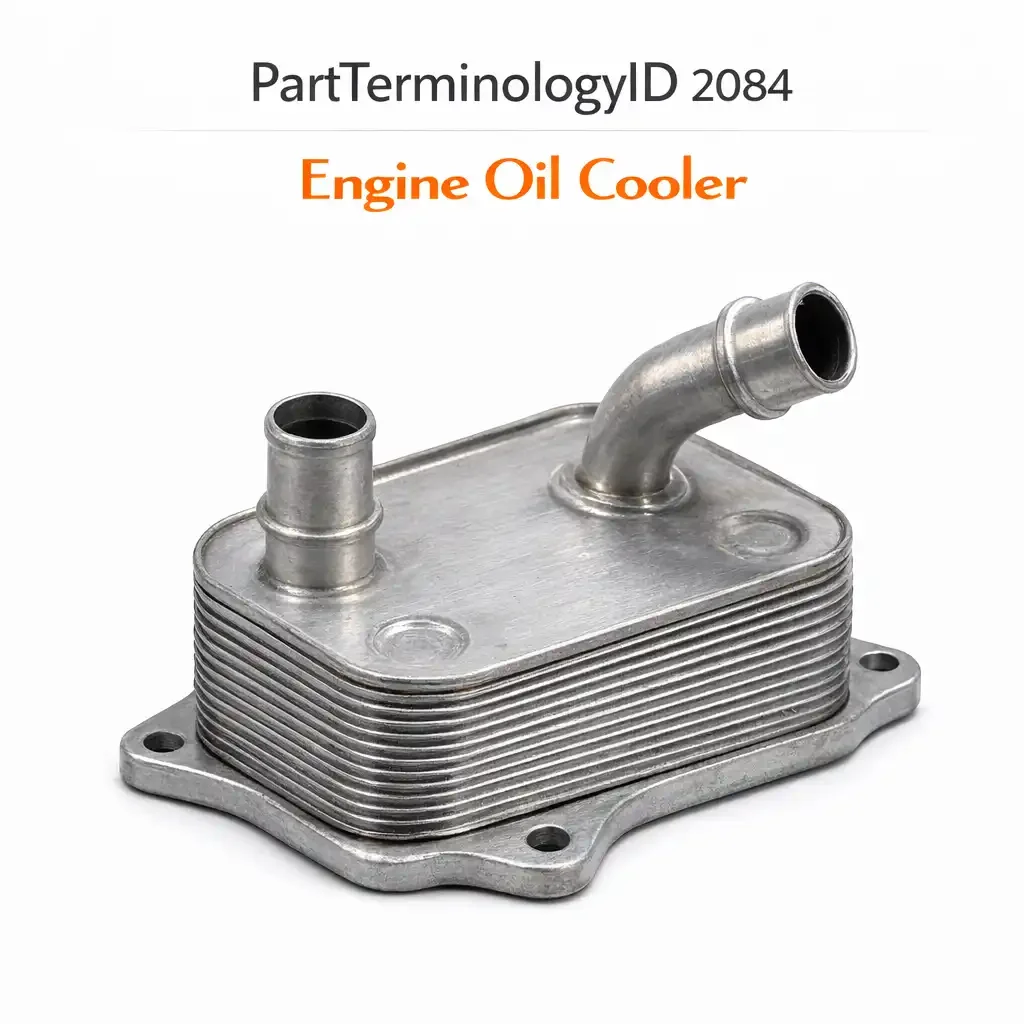
PartTerminologyID 2084, Engine Oil Cooler, is a heat exchanger that reduces engine oil temperature. That definition is accurate and useless for ordering purposes. It does not specify the cooler type, the mounting location, the oil port thread specification, the coolant port dimensions, the heat exchange capacity, the oil flow rate the cooler is designed for, the engine family the cooler was designed for, or whether the cooler is an integral unit within the engine block or a remotely mounted external unit. A listing under PartTerminologyID 2084 that does not include the engine code, the cooler type, and the port specifications is asking the buyer to guess whether the part fits their engine, whether it connects to their oil and coolant circuits, and whether it will exchange heat at the rate their engine requires. A wrong guess on an engine oil cooler does not produce a vehicle that fails to start. It produces a vehicle that starts, runs, and contaminates its oil with coolant, or its coolant with oil, for however many miles it takes for the mixing to reach a detectable concentration.
For sellers, the engine oil cooler is one of the highest-consequence fitment errors in the engine thermal management category. The damage from a failed or incorrectly installed oil cooler is not limited to the cooler itself. Coolant contamination of the engine oil destroys bearing surfaces, degrades piston ring seals, and can hydrolock a cylinder if the contamination reaches the combustion chamber. Oil contamination of the coolant foams the coolant, reduces heat transfer capacity, and accelerates water pump seal wear. Neither contamination scenario announces itself with an immediate failure. Both develop over miles, which means the buyer may drive on the incorrect part for weeks before the damage is diagnosed.
For sellers, the listing under this PartTerminologyID is only useful if it includes the engine code, the cooler type, the oil port thread specification, the coolant port dimensions, and the heat exchange capacity rating. Without those five attributes, the listing is not a usable engine oil cooler listing. It is a component that may or may not connect to the buyer's engine and oil circuit, with consequences that extend well beyond the cost of the cooler if it does not.
What the Engine Oil Cooler Does
The thermal management function of engine oil
Engine oil serves two primary functions: lubrication and heat transfer. The lubrication function is well understood. The heat transfer function is less discussed but equally critical. Engine oil absorbs heat from the crankshaft bearings, the connecting rod bearings, the camshaft lobes, the valve train components, the piston underside, and the cylinder walls. In an engine without an oil cooler, all of that absorbed heat is eventually rejected through the oil pan to the surrounding air, which is a passive and relatively inefficient process. In high-load applications, turbocharged engines, engines with tight bearing clearances, and engines used in high-ambient-temperature environments, the passive rejection through the oil pan is insufficient to keep oil temperature within the designed operating range.
Engine oil that operates above its designed temperature threshold degrades faster. The base oil viscosity drops with temperature, which reduces the oil film thickness at bearing interfaces. Additives that provide anti-wear, detergent, and anti-oxidation functions deplete faster at elevated temperatures. An engine that consistently operates with oil temperatures above 250 to 260 degrees Fahrenheit will show accelerated bearing wear, accelerated sludge formation, and reduced oil service intervals compared to an identical engine operating with oil temperatures in the 180 to 230 degree Fahrenheit range that an oil cooler helps maintain.
The oil cooler transfers heat from the oil circuit to the coolant circuit or to the ambient air, depending on the cooler type. The coolant circuit on a warmed-up engine operates at a controlled temperature of 185 to 210 degrees Fahrenheit, which is below the oil temperature in a loaded engine. The temperature differential drives heat transfer from the oil through the cooler core to the coolant. The coolant then carries that heat to the radiator, where it is rejected to the ambient air in the same loop that manages engine combustion heat.
Why oil temperature matters for the cooling system
The relationship between the oil cooler and the cooling system is bidirectional. On a cold engine, the coolant temperature may be below the oil temperature setpoint. In that condition, the oil cooler can actually warm the oil by transferring heat from the coolant to the oil, which brings the oil to operating viscosity faster on cold starts and reduces cold-start wear. This bidirectional heat transfer is one of the reasons oil-to-coolant heat exchangers are used rather than oil-to-air coolers on many passenger vehicle applications: the coolant circuit acts as a thermal regulator for the oil circuit in both directions.
A failed oil cooler disrupts this regulation. If the cooler develops an internal leak, oil and coolant mix at the internal passages. If the cooler develops an external leak at a port fitting or a gasket surface, the oil or coolant escapes to the outside of the engine. Both failure modes require immediate attention. The internal mixing failure is more consequential because it is less visible and continues to damage the engine while the vehicle is being driven.
The Cooler Types Under This PartTerminologyID
Oil-to-coolant heat exchanger (engine-mounted)
The most common type on passenger vehicles. This cooler is mounted within the engine lubrication circuit and uses engine coolant as the cooling medium. The cooler body typically bolts to the engine block, the oil filter housing, or a dedicated bracket. Oil from the engine passes through one side of the heat exchanger. Coolant from the engine cooling circuit passes through the other side. The two fluids are separated by the cooler core but thermally coupled through it.
Engine-mounted oil-to-coolant coolers are closely integrated with the engine architecture. The bolt pattern, the oil port thread specification, the coolant port size, and the flow path geometry are all engine-specific. A cooler from a different engine family with the same nominal oil port thread specification may have a different bolt pattern, a different coolant port orientation, a different internal flow path, or a different heat exchange surface area that is inadequate for the oil flow rate of the target engine. The engine code is the primary fitment attribute, not the thread specification.
Oil filter housing-integrated cooler
On many current-production engines, the oil cooler is integrated into the oil filter housing assembly. The housing accepts the oil filter, routes oil through the cooler, and connects to both the oil circuit and the coolant circuit through ports in the housing body. When this assembly fails, it is replaced as a unit: housing, cooler, and gaskets together. A listing for the cooler alone without the housing, or for the housing without the cooler, will not address the complete failure on these engines. The listing must specify whether the cooler is sold as a standalone unit or as part of a housing assembly.
Remote-mounted oil-to-air cooler (external)
A cooler mounted away from the engine in an airflow path, typically in front of the radiator or in a dedicated opening in the bumper fascia. This type uses ambient air as the cooling medium rather than engine coolant. Remote oil-to-air coolers are connected to the engine oil circuit through oil lines, typically with an adapter that threads into the oil filter mounting location or a port in the oil filter housing.
The fitment attributes for a remote cooler are different from an engine-mounted cooler. The oil line thread specification at the adapter, the cooler core dimensions, the mounting bracket configuration, and the oil flow rate capacity are the primary specifications. Remote coolers are more common on performance, heavy-duty, and racing applications than on standard passenger vehicles. A listing that does not distinguish between an engine-mounted oil-to-coolant cooler and a remote oil-to-air cooler will generate returns when the buyer's application requires one type and the listing ships the other.
Transmission oil cooler within the radiator
Some radiators include an integrated transmission oil cooler in one of the end tanks. That cooler is a separate part from the engine oil cooler under PartTerminologyID 2084. Engine oil coolers and transmission oil coolers are different PartTerminologyIDs, different part families, and different circuit connections. A listing that conflates the two in the same PartTerminologyID listing, or a buyer who confuses the two when ordering, generates a return that the listing could have prevented with explicit clarification.
Plate-and-fin cooler core
The internal construction of many engine oil coolers uses a plate-and-fin design: alternating plates create separated oil and coolant passages, and fins on the coolant side increase the heat transfer surface area. The plate count, the fin density, and the overall core dimensions determine the heat exchange capacity. An undersized cooler installed on a high-output engine will not reduce oil temperature sufficiently. The oil temperature will remain elevated, oil degradation will accelerate, and the buyer will not connect the accelerated oil consumption and bearing wear to the undersized cooler until significant engine damage has occurred.
The heat exchange capacity is expressed as a BTU/hour rating or as a temperature differential across the cooler at a specified oil flow rate. Most aftermarket listings do not express the rating in those terms, but the OE cooler's capacity is implied by the engine code fitment. A cooler listed for a specific engine code is assumed to match or exceed the OE heat exchange capacity for that engine. A universal or undersized replacement listed without engine code fitment data cannot provide that assurance.
The Port Specifications This Cooler Must Match
Oil inlet and outlet thread specification
The oil circuit connections on an engine-mounted cooler are threaded ports that accept oil fittings, oil lines, or the oil filter adapter. The thread specification must match the engine's oil circuit threads exactly. Common specifications include M20x1.5, M22x1.5, M18x1.5, and 3/4-16 UNF. A cooler with the correct nominal thread diameter but wrong pitch will cross-thread the oil circuit fitting. A cross-threaded oil port on the engine block or the cooler body is a machine damage failure, not just a part return.
The listing must state the full oil port thread specification: nominal diameter, pitch, and thread form. Stating the nominal diameter alone is insufficient, as it is for PartTerminologyID 2069 (Engine Coolant Thermostat Housing Cap) threaded port configurations.
Coolant port dimensions and connection type
The coolant ports on an engine-mounted oil-to-coolant cooler connect to the engine cooling circuit. Connection types include threaded ports, hose barbs, and quick-connect fittings. The coolant port diameter and connection type must match the coolant circuit connections in the engine cooling system. A cooler with the correct oil ports but mismatched coolant ports cannot be installed without fabricating intermediate connections, which introduces leak points and is not an acceptable installation on a cooling system that operates at 15 to 18 PSI.
Gasket interface dimensions
Engine-mounted coolers seal against a machined surface on the engine block or the oil filter housing with a gasket. The gasket interface dimensions, including the bolt pattern, the bolt spacing, and the sealing surface profile, must match the mounting surface on the engine. A cooler with the correct oil ports that does not bolt to the engine mounting surface is not a usable replacement, and a cooler that bolts to the surface but uses a different gasket profile will leak at the sealing interface.
Gasket inclusion must be disclosed in the listing. An engine oil cooler that requires a gasket and is shipped without one cannot be installed without sourcing the gasket separately, which delays the repair and generates a return request if the buyer cannot identify and source the correct gasket.
Oil filter thread specification (for filter-housing-integrated coolers)
When the oil cooler is integrated into the oil filter housing, the housing must accept the correct oil filter. The oil filter thread specification, typically 3/4-16 UNF for domestic applications or M20x1.5 for metric applications, must be disclosed in the listing. A housing replacement that does not accept the buyer's existing oil filter brand forces an oil filter change at the same time, which the buyer may not have anticipated or may not be able to complete with the tools on hand.
Why This Part Generates Returns
Buyers order the wrong engine oil cooler because:
the listing does not include the engine code and the same vehicle platform uses different oil cooler configurations on different engine variants or different production years
the oil port thread specification is not stated in full: nominal diameter is disclosed without pitch, and the buyer assumes a common pitch that does not match
the coolant port dimensions are not disclosed and the buyer discovers the coolant connections do not match after the oil cooler is removed and the engine is open
the gasket is not included and the listing does not state that the gasket must be ordered separately, so the buyer attempts installation without a gasket and leaks at the sealing surface on first startup
buyers confuse the engine oil cooler with the transmission oil cooler in the radiator and order the wrong cooler type entirely
the listing does not specify whether the cooler is sold standalone or as part of a housing assembly, and the buyer receives the cooler without the housing when their application requires both
the heat exchange capacity is not stated and the cooler is undersized for the engine's oil thermal load
the listing describes a remote oil-to-air cooler as a direct-fit replacement for an engine-mounted oil-to-coolant cooler
Status in New Databases
PIES/PCdb: PartTerminologyID 2084, Engine Oil Cooler
PIES 8.0 / PCdb 2.0: No change
Top Return Scenarios
Scenario 1: "Wrong engine code, cooler does not bolt to the block"
The buyer ordered by vehicle model without specifying the engine code. The same vehicle was available with two different engine options that use different oil cooler mounting configurations. The cooler bolt pattern does not match the block.
Prevention language: "Engine code: [specific engine code or codes]. This cooler fits the [X] engine variant only. Verify your engine code before ordering. The same vehicle platform may use a different oil cooler configuration on a different engine variant. Engine code is the primary fitment attribute for this part."
Scenario 2: "Oil and coolant are mixing after installation"
The replacement cooler did not include a gasket, or the buyer reused the original gasket. The original gasket was compressed and hardened and did not seal the cooler interface. Oil and coolant mixed internally at the failed gasket surface. The buyer noticed a mayonnaise-like residue in the oil fill cap and a brown discoloration in the coolant reservoir.
Prevention language: "Includes gasket: [yes / no]. A new gasket is required for installation. Reusing the original gasket risks a failed seal at the cooler interface, which allows oil and coolant to mix internally. If the gasket is not included in this listing, order the replacement gasket before installing the cooler."
Scenario 3: "Oil port thread cross-threaded on installation"
The buyer installed a cooler with the correct nominal oil port diameter but the wrong thread pitch. The fitting started on a few threads and cross-threaded. The oil port on the engine block is now damaged and requires thread repair before any replacement cooler can be installed.
Prevention language: "Oil port thread specification: [M20x1.5 / M22x1.5 / 3/4-16 UNF / other]. Verify the full thread specification of your engine oil circuit connections before installing. Do not force a fitting that does not start smoothly. Thread diameter and pitch must both match. Incorrect pitch will cross-thread and damage the oil circuit port."
Scenario 4: "I received the cooler only, I needed the housing assembly"
The buyer's oil filter housing was cracked and required replacement along with the cooler. The listing showed the cooler as a standalone unit without specifying that the oil filter housing was sold separately. The buyer received the cooler, could not install it without the housing, and the vehicle remained unrepaired.
Prevention language: "This listing is for the engine oil cooler only. The oil filter housing is [included / not included / sold separately as part number X]. If your oil filter housing is damaged or cracked, verify whether you need the housing assembly or the cooler alone before ordering."
Scenario 5: "Cooler does not fit between the block and the oil filter"
The replacement cooler has different overall dimensions than the original. It physically contacts the oil filter when the filter is installed, preventing the filter from seating correctly. The original cooler's compact dimensions were specific to the space envelope on that engine.
Prevention language: "Overall dimensions: [length X mm, width X mm, height X mm]. Verify clearance between the cooler and the oil filter in the installed position. Replacement coolers with different dimensions than the original may contact the oil filter or adjacent components in tight engine bays."
Scenario 6: "This is an air cooler, I needed a coolant cooler"
The buyer's vehicle uses an engine-mounted oil-to-coolant heat exchanger. The listing was for a remote oil-to-air cooler. The buyer received a cooler with oil line fittings and no coolant connections, which is not a direct replacement for their engine-mounted unit.
Prevention language: "Cooler type: [oil-to-coolant, engine-mounted / oil-to-air, remote-mounted]. Engine-mounted oil-to-coolant coolers use engine coolant as the cooling medium and bolt to the engine block or oil filter housing. Remote oil-to-air coolers use ambient airflow and connect via oil lines. These types are not interchangeable."
Scenario 7: "Coolant ports do not match my cooling circuit connections"
The oil port specification matched but the coolant ports on the replacement cooler use a different connection type than the original: the original used hose barbs and the replacement uses threaded ports, or the port diameter is different. The buyer cannot connect the coolant circuit to the replacement cooler without fabricating adapter fittings.
Prevention language: "Coolant port connection type: [hose barb, [X]mm outer diameter / threaded, [thread specification] / quick-connect]. Verify your cooling circuit connection type matches before ordering. Coolant port type and oil port type must both match your engine's connections."
What to Include in the Listing
Core essentials
PartTerminologyID: 2084
component: Engine Oil Cooler
cooler type: oil-to-coolant engine-mounted, oil filter housing-integrated, or remote oil-to-air (mandatory)
sold as: cooler only, or cooler with housing assembly (mandatory)
engine code (mandatory)
oil port thread specification: nominal diameter, pitch, and thread form (mandatory)
coolant port connection type and diameter (mandatory for oil-to-coolant coolers)
includes gasket: yes or no (mandatory)
overall dimensions in mm
material: aluminum core, steel core, plastic housing
quantity: 1
Fitment essentials
year/make/model/submodel
engine code (mandatory, non-negotiable)
engine displacement and configuration when multiple engine variants are covered
OE part number cross-reference when available
transmission type if the oil cooler specification differs between manual and automatic transmission applications on the same engine
Dimensional essentials
overall cooler dimensions: length, width, and height in mm
oil port thread specification: nominal diameter, pitch, and thread form at both inlet and outlet
coolant port outer diameter in mm for hose barb connections
coolant port thread specification for threaded coolant connections
bolt pattern for engine-mounted coolers: bolt count, bolt spacing, bolt thread specification
gasket sealing surface outer and inner diameter in mm
oil filter thread specification for housing-integrated coolers
Image essentials
cooler in isolation with dimensional callouts showing overall length, width, and height
oil port detail showing thread profile and port diameter
coolant port detail showing connection type and diameter
gasket sealing surface detail showing bolt hole pattern and sealing profile
gasket shown separately if included, to confirm it is in the kit
cooler installed on engine showing the oil circuit and coolant circuit connections in context
Catalog Checklist for ACES/PIES Teams
PartTerminologyID = 2084
require engine code (mandatory, non-negotiable)
require cooler type: oil-to-coolant engine-mounted, housing-integrated, or remote oil-to-air
require sold-as attribute: cooler only or cooler with housing assembly
require oil port thread specification in full: nominal diameter, pitch, and thread form
require coolant port connection type and diameter for oil-to-coolant coolers
require gasket inclusion or exclusion disclosure
require overall dimensions
require year/make/model/submodel fitment
differentiate from transmission oil cooler (PartTerminologyID varies): the transmission cooler exchanges transmission fluid heat; the engine oil cooler exchanges engine oil heat; both may be present on the same vehicle and must not be conflated in the listing
differentiate from oil filter housing (PartTerminologyID varies): when the cooler is integrated into the housing, both parts are affected by a housing failure; the listing must specify what is included
differentiate from engine oil cooler adapter (PartTerminologyID varies): the adapter routes oil to and from an external cooler; the cooler itself is a separate part
flag that engine code is the primary fitment attribute: vehicle model and year alone are insufficient when the same platform used multiple engine variants with different cooler configurations
flag that oil and coolant mixing is the primary consequence of a failed or incorrect cooler installation: this consequence must inform the urgency of accurate fitment disclosure
flag that gasket exclusion must be stated explicitly: buyers should not have to assume whether a gasket is included
FAQ (Buyer Language)
How do I know if my engine has an oil cooler?
Look for a heat exchanger bolted to the engine block near the oil filter location, or an additional module between the oil filter and the block. On many current-production four-cylinder and V6 engines, the oil cooler is integrated into the oil filter housing and is not immediately visible as a separate component. Consult the factory service manual for your engine code, which will show the oil cooler location and configuration in the lubrication system diagram. If the listing asks for an engine code, that is the specification you need to locate before ordering.
What are the symptoms of a failed engine oil cooler?
The most common symptom is oil and coolant mixing, which appears as a creamy or mayonnaise-like residue on the underside of the oil fill cap, a brown or oily film on the coolant reservoir cap, or a milky appearance in the oil on the dipstick. A failed external seal produces an external oil or coolant leak at the cooler body, the gasket surface, or the port fittings. Elevated oil temperature on a vehicle with a temperature gauge or an oil temperature display is a symptom of a cooler that is not exchanging heat effectively, which may indicate a failed cooler or a blocked coolant passage through the cooler.
Can I drive the vehicle with a failed oil cooler?
Not if oil and coolant are mixing. Coolant contamination of the engine oil reduces the oil's lubricating capability and can destroy bearing surfaces within tens of miles of the contamination reaching a significant concentration. Oil contamination of the coolant foams the coolant and reduces heat transfer. Neither condition is safe to operate in. A vehicle with a confirmed oil and coolant mixing event from a failed cooler should be towed to the repair location rather than driven.
Do I need to flush the cooling system and the oil circuit after replacing the oil cooler?
Yes, if oil and coolant were mixing. Coolant that has been contaminated with oil must be completely flushed from the cooling circuit before new coolant is introduced, because oil-contaminated coolant does not transfer heat effectively and can leave deposits in the cooling passages. Engine oil that has been contaminated with coolant must be completely drained and the system flushed before new oil is introduced, because coolant-diluted oil will not protect bearings on the first start after the repair. Depending on the severity and duration of the contamination, additional inspection of the cooling passages, the water pump, the radiator, and the engine bearings may be warranted.
My oil and coolant were mixing. After I replace the cooler, do I need to do anything else to the engine?
Inspect the engine oil for emulsification severity before assuming the bearing surfaces are undamaged. If the oil has a thick emulsified appearance throughout, the engine ran on contaminated oil for a significant period. Have the main and rod bearing clearances checked before returning the vehicle to service. Coolant in oil is caustic to bearing metals and removes the bearing surface material faster than normal oil film breakdown. An engine that ran on highly contaminated oil may show accelerated bearing wear even after the cooler is replaced and the oil is refreshed.
What is the difference between an engine oil cooler and a transmission oil cooler?
The engine oil cooler cools the engine's lubrication oil circuit. The transmission oil cooler cools the transmission fluid, which is a separate circuit. On vehicles with automatic transmissions, the transmission cooler is often integrated into one of the radiator end tanks, not mounted on the engine. The oil lines from the transmission connect to the cooler ports on the radiator. The engine oil cooler is mounted on the engine block or integrated into the oil filter housing and is on a different circuit entirely. They are different parts, different PartTerminologyIDs, and not interchangeable.
How long does an engine oil cooler last?
Under normal operating conditions with correct coolant chemistry and regular coolant changes, an engine oil cooler can last the life of the engine. Failures are most commonly caused by electrolytic corrosion from depleted coolant inhibitors, which corrodes the internal passages and eventually creates a pinhole leak that allows oil and coolant to mix. Extended coolant service intervals beyond the manufacturer's recommendation accelerate this failure mode. Replacing the coolant on schedule and using the correct coolant formulation for the engine are the most effective preventive measures for oil cooler longevity.
Cross-Sell Logic
Engine Oil Cooler Gasket (PartTerminologyID varies: a new gasket is required for every engine oil cooler replacement; this is the most important concurrent cross-sell for this PartTerminologyID)
Oil Filter Housing (PartTerminologyID varies: if the housing is cracked or damaged in addition to the cooler, both must be replaced together on housing-integrated designs)
Engine Oil (the oil must be drained and replaced after the cooler is installed; if coolant contamination occurred, a flush is required before the fresh oil fill)
Coolant (the cooling system must be drained and refilled with fresh coolant after any cooler replacement, and especially after oil contamination of the coolant)
Engine Cooling System Pressure Tester Adapter (PartTerminologyID 2054: after replacing the cooler and refilling both circuits, pressure test the cooling system to confirm the new cooler seals at full operating pressure before returning the vehicle to service)
Oil Filter (the oil filter should be replaced whenever the oil is changed; after a contamination event, the filter is replaced as part of the oil system flush)
Radiator (if oil contamination of the coolant was severe enough to leave oil deposits in the radiator passages, the radiator may require flushing or replacement to restore cooling capacity)
Thermostat (inspect the thermostat for contamination deposits on the valve and the seat during the coolant flush after a mixing event)
Frame as "the cooler is the repair. The gasket is the seal that the repair depends on. The oil and coolant are the circuits that must be refreshed after the repair. The pressure test confirms the seal before the engine runs. If contamination was severe, the bearing inspection and the radiator flush are the downstream consequences of a failure that ran longer than it should have."
Final Take for PartTerminologyID 2084
Engine Oil Cooler (PartTerminologyID 2084) is a safety-critical thermal management component where a wrong fitment does not produce an immediate and obvious failure. It produces an internal contamination of the engine oil or the coolant circuit that develops over miles, damages bearing surfaces, and reduces the service life of the engine before the buyer connects the symptom to the part. That consequence makes the accuracy of the listing more important for this PartTerminologyID than for most others in the cooling system series.
The engine code is the primary fitment attribute, not the vehicle model. The oil port thread specification must be stated in full: nominal diameter and pitch. The coolant port type and dimensions must be disclosed. The gasket inclusion or exclusion must be stated. The cooler type must distinguish between an oil-to-coolant engine-mounted unit, an oil filter housing-integrated unit, and a remote oil-to-air unit. The sold-as attribute must specify whether the cooler is shipped alone or with the housing assembly.
State the engine code. State the cooler type. State the sold-as configuration. State the oil port thread specification in full. State the coolant port dimensions. State the gasket inclusion. That is the same listing strategy as every other PartTerminologyID in this series: the generic PartTerminologyID requires specific attributes at every level to become a listing buyers can act on without guessing. For PartTerminologyID 2084, the consequence of guessing wrong is paid by the engine bearings, not by the buyer's return shipping account.