
Written by Arthur Simitian | PartsAdvisory
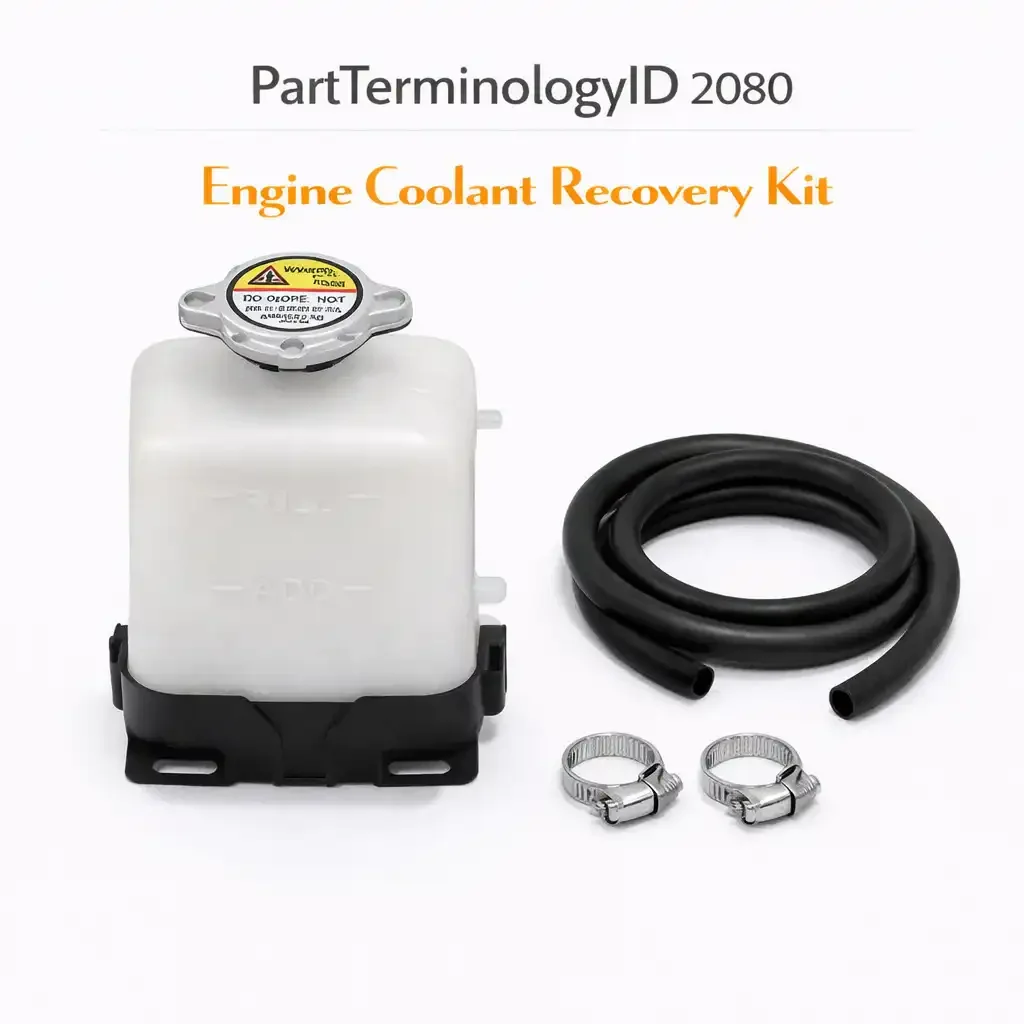
PartTerminologyID 2080, Engine Coolant Recovery Kit, is a kit that relates to coolant recovery. That is the complete definition the PartTerminologyID provides. It does not specify what components the kit contains, whether it is a complete coolant recovery system or a repair kit for an existing reservoir, what reservoir capacity the kit is designed for, what hose diameter and length are included, whether the kit includes a reservoir cap, what the cap pressure rating is if one is included, or what vehicle fitment the kit is designed for. A listing under PartTerminologyID 2080 that does not disclose the component list is asking the buyer to guess whether the kit contains what they need, which is the defining failure of kit listings across every PartTerminologyID category and is compounded here by the fact that coolant recovery kits range from a two-piece hose-and-grommet repair set to a complete reservoir-and-bracket assembly with a cap, hose, and hardware.
For sellers, kit listings are the highest-return category within any PartTerminologyID series because the buyer cannot determine what they are ordering from the kit name alone. A kit listing without a component manifest is a listing that generates a return every time the buyer's expectation of kit contents does not match what the box contains. For PartTerminologyID 2080, the range of possible kit configurations is wide enough that two buyers can order from the same listing with completely opposite expectations and both be wrong.
For sellers, the listing under this PartTerminologyID is only useful if it includes the complete component manifest, the reservoir capacity if a reservoir is included, the cap pressure rating if a cap is included, the hose inner diameter and length, and the vehicle fitment. Without those attributes, the listing is not a kit listing. It is a guess.
What Falls Under This PartTerminologyID
Complete coolant recovery system kit
A kit that includes everything required to install a coolant overflow and recovery system on a vehicle that does not have one, or to replace a complete failed system. A complete kit typically contains a coolant reservoir or overflow tank, a mounting bracket and hardware, a recovery hose, a grommet or fitting for the hose connection at the radiator cap neck overflow tube, and in some configurations a non-pressurized reservoir cap. The reservoir capacity is expressed in ounces or milliliters. The hose length and inner diameter are specific to the kit. A buyer who needs a complete system and receives only a partial kit faces a vehicle that still cannot function as a closed cooling system.
Reservoir repair and replacement kit
A kit that provides a replacement reservoir without the full mounting hardware, intended for vehicles where the bracket and mounting points are intact but the reservoir is cracked or missing. This kit typically contains the reservoir tank, the cap, and the overflow hose connection fitting. It does not include a bracket. A buyer who needs a complete kit including bracket hardware and receives a reservoir-only kit cannot complete the installation without sourcing additional hardware separately.
Hose and fitting repair kit
A minimal kit containing a replacement overflow hose, a grommet or fitting that connects the overflow tube at the radiator cap to the reservoir, and hardware. This kit does not include a reservoir or a bracket. It is ordered when the reservoir is intact but the hose has split, collapsed, or disconnected. A buyer who needs the full system receives a hose kit and has no reservoir. A buyer who needed only the hose receives a complete system kit and has parts they did not need.
Universal recovery system kit
A kit not specific to a single vehicle application, designed to be adapted to multiple vehicles through adjustable mounting hardware or universal hose fittings. Universal kits typically require the buyer to trim the hose to length, select a mounting location, and drill or use self-tapping hardware for bracket attachment. The reservoir capacity and the hose diameter are the primary specifications. A buyer expecting a vehicle-specific drop-in kit who receives a universal kit requiring fabrication will return it.
Cap-included versus cap-not-included configurations
Some coolant recovery kits include a reservoir cap. If the cap is included, the cap pressure rating must be stated in the listing. A non-pressurized overflow reservoir uses a non-pressurized cap rated at 0 PSI or atmospheric. A sealed-reservoir system uses a pressurized cap rated at the system pressure. Including a pressurized cap in a kit for a non-pressurized overflow reservoir, or including a non-pressurized cap in a kit where the reservoir will be used as the primary fill point on a sealed system, creates an immediate system pressure failure on installation. The presence or absence of the cap and its pressure rating are not optional disclosure attributes for this kit.
Why This Part Generates Returns
Buyers order the wrong engine coolant recovery kit because:
the listing does not disclose the component manifest and the buyer's expectation of kit contents does not match what is included
the buyer needed a complete system with bracket hardware and received a reservoir-only replacement kit, or vice versa
the buyer needed a hose and fitting repair kit and received a complete system kit with redundant parts they did not need and cannot return opened
the reservoir capacity is not stated and the buyer's overflow volume requirement exceeds the kit reservoir capacity, causing overflow on every heat cycle
the cap pressure rating is not stated for kits that include a cap, and the cap is wrong for the system type
the hose inner diameter is not stated and the hose does not fit the overflow tube at the radiator cap neck
the kit is listed as vehicle-specific but requires modification or drilling for installation because the bracket is not a direct-fit for the stated application
the hose length is not stated and the kit hose is too short to reach the reservoir at the mounting location for the stated vehicle
Status in New Databases
PIES/PCdb: PartTerminologyID 2080, Engine Coolant Recovery Kit
PIES 8.0 / PCdb 2.0: No change
Top Return Scenarios
Scenario 1: "Kit does not include a bracket, I cannot mount the reservoir"
The buyer needed a complete installation kit with mounting hardware. They received a reservoir and hose without a bracket because the listing did not disclose the component manifest. The reservoir cannot be installed without a mounting point.
Prevention language: "Kit includes: [reservoir tank, mounting bracket, hardware, overflow hose, grommet / reservoir tank, overflow hose, grommet / overflow hose and grommet only]. Verify the kit includes the components you need before ordering. Bracket hardware is [included / not included]. If your mounting bracket is intact, order the reservoir-only or hose-only configuration."
Scenario 2: "Reservoir capacity is too small, coolant overflows every time"
The listing did not state the reservoir capacity. The buyer's cooling system overflow volume on a full heat cycle exceeds the reservoir capacity. Coolant exits the overflow hose to the ground instead of being captured by the reservoir.
Prevention language: "Reservoir capacity: [X] oz / [X] ml. Verify this capacity is sufficient for your cooling system overflow volume. Larger engines and high-performance applications may require higher-capacity reservoirs. The minimum recommended capacity for most passenger vehicle applications is [X] oz."
Scenario 3: "Hose does not fit the overflow tube at the radiator cap"
The overflow tube at the radiator cap neck has a specific outer diameter. The kit hose inner diameter does not match. The hose fits loosely and will not seal with the included clamp or grommet.
Prevention language: "Overflow hose inner diameter: [X] inch / [X] mm. Verify your radiator cap overflow tube outer diameter matches the hose inner diameter before ordering. The overflow tube is the small downward-facing tube on the radiator cap neck below the cap seating surface."
Scenario 4: "Universal kit requires drilling, I needed a direct-fit"
The listing was under a vehicle-specific year/make/model fitment. The kit required drilling for bracket attachment and hose trimming to length. The buyer expected a direct-fit installation with no modification.
Prevention language: "Installation type: [direct-fit, no modification required / universal fit, hose trimming and bracket mounting required]. Direct-fit kits include a bracket pre-configured for your vehicle's mounting points. Universal kits require hose trimming to length and bracket mounting via [self-tapping hardware / drilling]. Verify installation type before ordering."
Scenario 5: "Cap pressure rating is wrong for my system"
The kit included a reservoir cap. The cap was pressurized at a rating intended for a sealed-reservoir system, but the buyer's vehicle uses a traditional radiator cap as the pressure cap and the reservoir is a non-pressurized overflow tank. The pressurized cap on the overflow reservoir prevents coolant from entering the reservoir on overflow events.
Prevention language: "Included cap pressure rating: [non-pressurized, 0 PSI / pressurized, X PSI]. Non-pressurized caps are for vehicles where the radiator cap is the system pressure cap and the reservoir is a passive overflow tank. Pressurized caps are for sealed-reservoir systems where the reservoir is the primary fill point. Verify your system type before ordering."
What to Include in the Listing
Core essentials
PartTerminologyID: 2080
component: Engine Coolant Recovery Kit
kit type: complete system, reservoir replacement, hose and fitting repair, or universal (mandatory)
complete component manifest listing every part included (mandatory, non-negotiable)
reservoir capacity in oz and ml if reservoir is included
cap pressure rating in PSI if cap is included
overflow hose inner diameter in mm or inches
overflow hose length in inches or mm
installation type: direct-fit or universal
material: reservoir material (plastic, translucent nylon, polypropylene), hose material (rubber, silicone, EPDM)
quantity: 1 kit
Fitment essentials
year/make/model/submodel for direct-fit kits
universal application statement with recommended capacity range for universal kits
compatible radiator cap overflow tube outer diameter for hose sizing verification
engine size or displacement range when reservoir capacity recommendation varies by engine
Dimensional essentials
reservoir capacity in oz and ml
reservoir overall dimensions in inches or mm (height, width, depth) for packaging and fitment verification
overflow hose inner diameter in mm or inches
overflow hose length in inches or mm (before trimming for universal kits)
overflow tube connection fitting outer diameter in mm
mounting bracket hole spacing in mm for direct-fit kits
Image essentials
all kit components laid out together in a single image so the buyer can see every included piece before ordering
reservoir with capacity marking visible if capacity is marked on the tank
hose detail showing inner diameter
cap detail showing pressure rating stamp if a cap is included
installed view showing the complete system mounted on a representative vehicle
Catalog Checklist for ACES/PIES Teams
PartTerminologyID = 2080
require complete component manifest: every part in the kit must be listed (mandatory, non-negotiable)
require kit type: complete system, reservoir replacement, hose and fitting, or universal
require reservoir capacity in oz and ml if reservoir is included
require cap pressure rating in PSI if cap is included
require overflow hose inner diameter
require overflow hose length
require installation type: direct-fit or universal
require year/make/model/submodel for direct-fit kits
differentiate from engine coolant reservoir (PartTerminologyID varies): the reservoir alone is a separate PartTerminologyID; the kit includes the reservoir plus additional components
differentiate from engine coolant reservoir cap (PartTerminologyID 2067): the cap alone is a separate PartTerminologyID; when included in the kit the cap specification must still be disclosed
differentiate from radiator cap (PartTerminologyID 2068): coolant recovery kits use non-pressurized caps on traditional overflow systems; a pressurized cap in the kit indicates a sealed-reservoir application
flag that kit component manifests must be complete: partial manifests are a primary driver of kit returns across all PartTerminologyID categories
FAQ (Buyer Language)
What is in an engine coolant recovery kit?
It depends on the kit type, which is why the listing must disclose every component. A complete system kit includes a reservoir tank, a mounting bracket, hardware, an overflow hose, and a grommet or fitting. A reservoir replacement kit includes the tank, a cap, and the overflow hose connection. A hose and fitting repair kit includes only the hose and fitting without the tank or bracket. Verify the component manifest before ordering to confirm the kit contains what you need and does not include parts you already have.
What reservoir capacity do I need?
Reservoir capacity is a function of your engine's cooling system volume and the amount of coolant that overflows on a typical heat cycle. For most four-cylinder passenger vehicles, a reservoir capacity of 16 to 24 oz is sufficient. For six-cylinder and eight-cylinder engines, 32 oz or larger is recommended. High-performance and turbocharged applications may require 48 oz or more. If you are replacing an existing reservoir, match the capacity of the original reservoir as a minimum.
How do I know what hose inner diameter I need?
Measure the outer diameter of the overflow tube on your radiator cap neck. The overflow tube is the small downward-facing tube below the cap seating ledge on the radiator neck. The hose inner diameter must match the overflow tube outer diameter for a secure connection. Common overflow tube outer diameters range from 3/8 inch to 5/8 inch on domestic passenger vehicles. Measure before ordering.
My overflow reservoir is cracked but my bracket is in good condition. Do I need a complete kit?
No. Order a reservoir replacement kit that includes the tank, the cap if needed, and the overflow hose fitting. You do not need a complete kit with a bracket if the bracket is undamaged and the mounting points are intact. Ordering a complete kit when you only need the reservoir results in unused bracket hardware that cannot be returned once the kit is opened.
Can I use a universal coolant recovery kit on my vehicle?
Yes, if you are willing to trim the hose to length and mount the bracket using the provided hardware. Universal kits require more installation effort than direct-fit kits but work on a wider range of vehicles. Verify the reservoir capacity meets your engine's requirements and the overflow hose inner diameter matches your overflow tube outer diameter before ordering a universal kit.
Cross-Sell Logic
Radiator Cap (PartTerminologyID 2068: if the recovery kit is being installed because the radiator cap failed and caused coolant loss, the cap is the concurrent replacement; the recovery system recaptures overflow but the cap must hold pressure correctly for the system to function)
Engine Coolant Reservoir Cap (PartTerminologyID 2067: if the kit reservoir cap is not included or the included cap requires replacement, the standalone reservoir cap is the cross-sell)
Coolant (the consumable that fills the system after the recovery kit installation; verify the coolant formulation is compatible with the reservoir material and the hose material)
Radiator Hose, upper (inspect for cracking and softness while the cooling system is open for recovery kit installation)
Engine Cooling System Pressure Tester Adapter (PartTerminologyID 2054: after installing the recovery kit and refilling the system, pressure test to confirm no leaks at the hose connections and at the overflow fitting)
Hose Clamp (sized for the overflow hose outer diameter at both connection ends; always replace clamps when replacing the overflow hose)
Frame as "the recovery kit restores the closed-loop coolant system. The radiator cap controls the pressure that determines when the system overflows into the kit. The coolant fills the system the kit now retains. The pressure test confirms the entire assembly is sealed before the vehicle returns to service."
Final Take for PartTerminologyID 2080
Engine Coolant Recovery Kit (PartTerminologyID 2080) is a kit listing, and kit listings fail at a higher rate than individual part listings across every PartTerminologyID category for one reason: the buyer cannot see what is in the box from the name alone. Every component in the kit must be disclosed in the listing. The reservoir capacity, the cap pressure rating, the hose diameter, the hose length, and the installation type must all be stated. The kit type must be identified so the buyer who needs a hose-and-fitting repair does not order a complete system, and the buyer who needs a complete system does not receive a hose-only kit.
State every component. State the reservoir capacity. State the cap pressure rating if a cap is included. State the hose diameter and length. State the installation type. That is the same listing strategy as every other PartTerminologyID in this series: the generic PartTerminologyID requires specific attributes at every level to become a listing buyers can act on without guessing. For kit PartTerminologyIDs, the component manifest is the first and most important attribute, and it is the one most commonly absent.