
Written by Arthur Simitian | PartsAdvisory
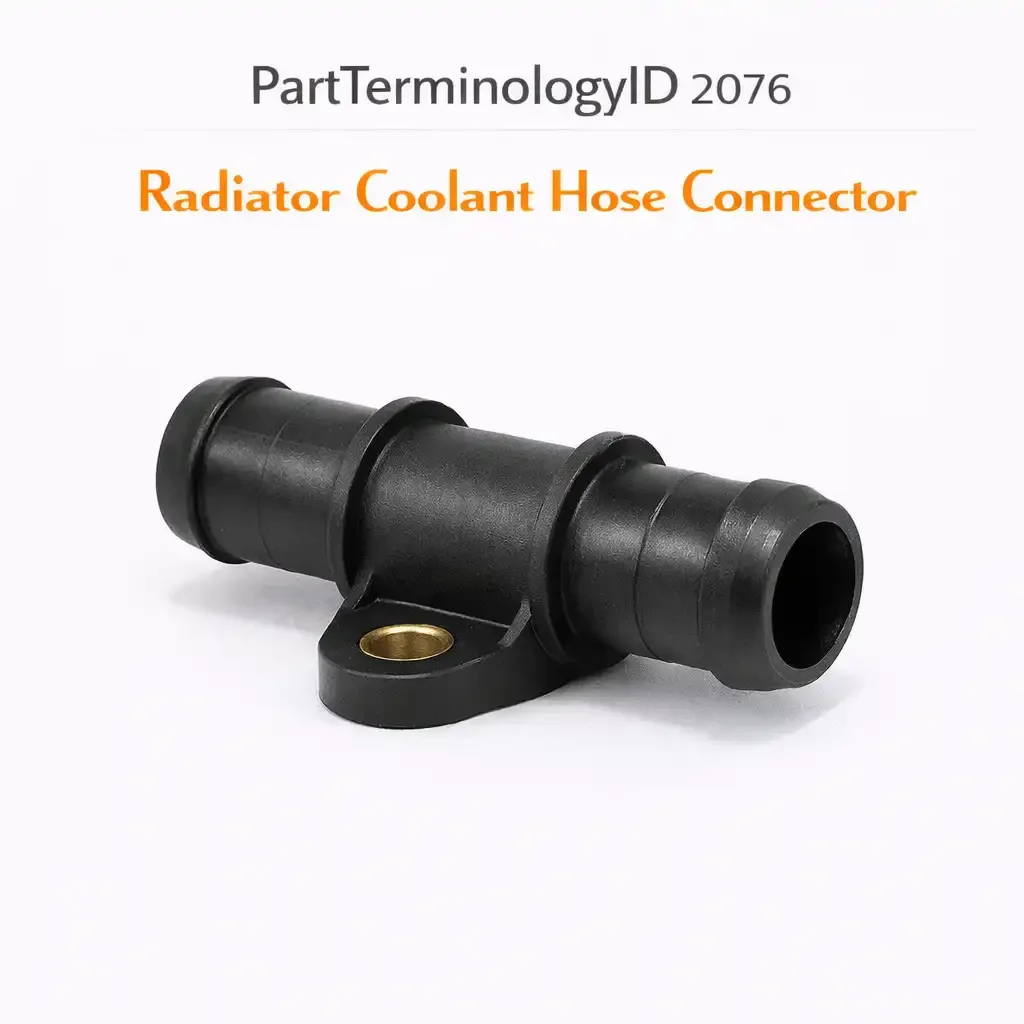
PartTerminologyID 2076, Radiator Coolant Hose Connector, is a fitting that connects a coolant hose to the radiator inlet or outlet port, bridging the hose end to the radiator neck and providing the sealing surface against which the hose clamp compresses the hose to form a pressure-tight joint. That definition covers the function correctly and leaves unresolved every question that determines whether the replacement connector fits the hose, fits the radiator port, routes the hose correctly, seals under operating pressure, and survives the coolant formulation in the system. It does not specify the connector position, whether it is an upper or lower hose connector, the connector geometry, whether it is straight, a 45-degree elbow, a 90-degree elbow, or an S-curve, the hose end inner diameter, the radiator port end outer diameter, whether the two end diameters are equal or different making it a reducer connector, the connector material, whether it is plastic, aluminum, brass, or steel, what coolant formulations the material is compatible with, the wall thickness, the hose clamp bead position, whether the connector is a separate fitting or an integral part of the radiator end tank, or whether the listing addresses the upper hose position, the lower hose position, or an auxiliary coolant circuit position on a vehicle with multiple radiator connections. A listing under PartTerminologyID 2076 that provides vehicle year, make, and model without the position, the geometry, both end diameters, and the material cannot be evaluated by any buyer who has a cracked or missing connector and is measuring the original before ordering the replacement.
For sellers, PartTerminologyID 2076 is a lower-volume listing with an above-average urgency profile. A split or cracked radiator coolant hose connector is not a slow-developing symptom. It is a coolant loss event that immobilizes the vehicle the day it fails. The buyer ordering under PartTerminologyID 2076 is typically doing so under time pressure: the vehicle is parked, the coolant has drained, and the repair needs to happen today. Urgency increases the likelihood that the buyer orders on partial information and accepts a close-enough specification rather than waiting to verify every dimension. A listing that provides complete dimensional information reduces the urgency-driven assumption errors that produce same-day returns on an already-stressful repair event.
The additional complexity specific to this PartTerminologyID compared to most cooling system fittings is the reducer connector problem. On many applications, the hose inner diameter and the radiator port outer diameter are not the same. The connector must step from one diameter to the other. A reducer connector has two different bore dimensions at its two ends, and a listing that states only one of those dimensions has communicated half the fitment requirement. The buyer verifies the dimension that was stated, finds it matches, orders with confidence, and discovers at installation that the unstated end does not fit. That is a return on a part that was correctly manufactured, correctly stocked, and correctly shipped, caused entirely by a listing omission.
For sellers, the listing under this PartTerminologyID is only useful if it specifies the position, the geometry, both end diameters explicitly, the material, and the coolant compatibility. Without those five attribute categories as the foundation of every listing, the urgency profile of this buyer population will continue to generate returns at a rate that is disproportionate to the unit volume.
What the Radiator Coolant Hose Connector Does
Bridging the hose end to the radiator port
The radiator coolant hose connector is the rigid or semi-rigid fitting that occupies the interface between the flexible coolant hose and the rigid radiator inlet or outlet port. The upper radiator hose runs from the thermostat housing outlet on the engine to the upper radiator inlet. The lower radiator hose runs from the lower radiator outlet to the water pump inlet on the engine. At the radiator end of each hose, the hose must transition from the flexible rubber tube to the rigid radiator neck, and the connector is the component that makes that transition possible when the radiator neck geometry requires an angle, a diameter change, or a specific material at the interface.
On many vehicles the radiator outlet port is a straight tubular neck that the hose slides directly over without any separate connector. On those applications there is no separate PartTerminologyID 2076 component. On vehicles where the radiator outlet port exits at an angle that the hose cannot follow without kinking, or where the port outer diameter differs from the hose inner diameter, a separate connector is required. PartTerminologyID 2076 covers that separate connector.
The connector's sealing function depends on two surfaces: the outer surface of the connector where the hose clamps against it, and the inner surface of the connector where it seals against the radiator port. Both surfaces must be undamaged, dimensionally correct, and free of corrosion or deterioration for the joint to hold pressure at the system's operating pressure, typically 14 to 18 PSI on most passenger vehicle cooling systems.
Why connector failure grounds the vehicle immediately
A cooling system operating at 14 to 18 PSI with a coolant temperature of 90 to 105 degrees Celsius loses coolant rapidly through even a small crack in a connector fitting. A hairline crack that seeps at idle becomes a spray at operating pressure as the system warms and pressure builds. A connector that has cracked from UV degradation, thermal cycling fatigue, or impact damage typically fails progressively: a small seep that the owner notices as a coolant smell or a wet spot under the hood becomes a full rupture within a short interval as the crack propagates under cyclic thermal and pressure stress.
The vehicle must be parked when coolant loss is detected because continuing to drive with insufficient coolant rapidly overheats the engine. A cracked head gasket, a warped cylinder head, or a seized engine from overheating costs orders of magnitude more to repair than the connector that failed. This is why the connector buyer is under time pressure and why listing completeness matters more for this PartTerminologyID than for a part that fails gradually.
Straight versus angled connector geometry
The geometry of the connector is determined by the radiator outlet port orientation and the hose routing path to the next component. If the radiator port exits vertically and the hose must run horizontally to reach the water pump inlet, the connector must provide a 90-degree bend. If the port exits at a slight angle and the hose path requires only minor direction change, a 45-degree elbow is correct. If the port exits straight in line with the hose path, a straight connector is correct.
A straight connector installed where a 90-degree elbow is required forces the hose to make the required bend immediately after the connector. A rubber hose bent sharply at the radiator outlet contacts the fan shroud, collapses under suction from the water pump, or cracks at the bend point from the combined mechanical and thermal stress. None of those outcomes is immediately obvious at installation: the hose appears to route correctly and the system fills and holds pressure on a cold static test. The failure appears at operating temperature and operating pressure when the hose collapses under the water pump suction load it was not designed to sustain at that bend radius.
A 90-degree elbow connector installed where a straight connector is required pushes the hose away from its designed routing path, creating interference with adjacent components including the fan shroud, the radiator core, the battery tray, or the chassis structure depending on the engine bay layout. Common connector geometries include straight, 45-degree elbow, 90-degree elbow, and S-curve. The listing must state the geometry with the elbow angle in degrees.
Reducer connectors and the two-diameter problem
When the hose inner diameter does not match the radiator port outer diameter, the connector must step between the two dimensions. This is a reducer connector. It has a larger bore at one end to accept the hose and a smaller outer diameter at the other end to fit the radiator port, or the reverse depending on which end is larger.
A reducer connector appears dimensionally correct to a buyer who measures only one end. The end they measure most easily is typically the hose end, because the hose is present and they can measure the inner diameter directly. The radiator port end is measured by checking the outer diameter of the radiator neck stub, which requires the vehicle to be accessible and the area to be clean enough for a caliper reading. A buyer under time pressure may skip the radiator port measurement and assume the connector will fit based on the hose end match.
The listing must state both end diameters as explicit separate attributes. Hose end inner diameter: 38mm. Radiator port end outer diameter: 32mm. That format makes both dimensions independently verifiable before the order is placed.
Material selection and coolant formulation compatibility
Radiator coolant hose connectors are manufactured from several materials, each with different thermal resistance, chemical compatibility, and longevity characteristics.
Plastic connectors, typically nylon or glass-filled nylon, are the most common on current-production vehicles with plastic-tank aluminum-core radiators. Plastic connectors are lightweight, corrosion-resistant, and inexpensive to manufacture. Their limitation is UV degradation over time, which makes them brittle and prone to cracking when impacted or stressed. A plastic connector on a vehicle in a high-UV environment may become brittle within 8 to 12 years regardless of coolant condition.
Aluminum connectors are used on performance and heavy-duty applications where greater mechanical strength is preferred. Their limitation is galvanic corrosion in coolant systems that have depleted inhibitor packages or that use coolant formulations not compatible with aluminum alloys.
Organic acid technology coolants, which are the extended-life formulations used on most post-2000 domestic and European vehicles, are formulated to inhibit corrosion of aluminum cooling system components. Hybrid organic acid technology coolants, common on many Asian market vehicles, have their own compatibility requirements that must be verified against the connector material before installation.
The listing must specify the connector material and the compatible coolant formulations. A connector installed in an incompatible coolant system will degrade at the sealing surfaces and produce a slow seep that appears after one cooling season.
Integrated versus separate connectors
On many current-production radiators, the coolant hose connector is molded as an integral part of the plastic end tank. When that molded neck cracks, the damage is in the end tank structure, not in a separate replaceable fitting. PartTerminologyID 2076 covers only the separate replaceable connector. A buyer who has a cracked integrated radiator neck and orders a separate replacement connector will install the connector and find that the leak continues because the crack is in the tank structure behind the connector. The listing must state explicitly that it is a separate fitting and that it does not repair cracks in the radiator end tank itself.
Why This Part Generates Returns
Buyers order the wrong radiator coolant hose connector because:
the listing states one diameter and the connector is a reducer with two different diameters; the buyer verifies the stated diameter, finds it matches, and the other end does not fit
the connector geometry is not stated and the buyer receives a straight connector when their application requires an elbow, or the reverse
the material is not specified and the connector is not compatible with the coolant formulation or the operating temperature of the application
the listing does not specify upper or lower hose position and the upper and lower connectors on the same vehicle are different shapes or different diameters
the buyer orders for a cracked integrated radiator end tank and receives a separate fitting that does not address the source of the leak
the hose inner diameter is stated but the radiator port outer diameter is not, and the radiator port is outside the connector's designed range
Status in New Databases
PIES/PCdb: PartTerminologyID 2076, Radiator Coolant Hose Connector
PIES 8.0 / PCdb 2.0: No change in PartTerminologyID or terminology label. Internal systems keyed to 2076 do not require remapping at the PIES 8.0 transition.
Top Return Scenarios
Scenario 1: "One end fits, the other does not"
The listing stated a single diameter for a reducer connector. The buyer measured the hose inner diameter, found it matched the stated dimension, and ordered. The radiator port end of the connector has a different outer diameter that was never disclosed. The radiator port outer diameter is 6mm smaller than the connector's radiator end bore. The connector slides onto the radiator port with 6mm of radial slop and the hose clamp cannot seal the loose fit.
Prevention language: "Hose end inner diameter: [X]mm. Radiator port end outer diameter: [Y]mm. This is a reducer connector with different dimensions at each end. Both dimensions must match your application before ordering. Verify the hose inner diameter at the radiator end and the radiator port outer diameter independently before placing the order."
Scenario 2: "Wrong geometry, hose collapses under water pump suction"
The connector is a straight fitting. The application requires a 45-degree elbow because the radiator upper outlet exits at 45 degrees from the hose routing path to the thermostat housing. With a straight connector, the upper radiator hose must make a 45-degree bend immediately after the connector. At operating temperature, the hose softens and the bend collapses inward under water pump suction, reducing coolant flow and causing intermittent overheating under sustained high-load operation.
Prevention language: "Connector geometry: 45-degree elbow. This application requires a 45-degree elbow connector at the upper radiator outlet. A straight connector forces the hose to make the required angle change immediately after the connector, reducing the bend radius below the minimum and causing partial hose collapse under water pump suction at operating temperature."
Scenario 3: "Plastic connector, OAT coolant system, seep appeared after one cooling season"
The replacement connector is manufactured from a glass-filled nylon not formulated for extended-life organic acid technology coolants. Within one cooling season, the OAT coolant had begun to soften the outer surface of the connector at the hose contact zone, reducing the sealing surface rigidity. The hose clamp lost its sealing force as the connector surface compressed. A seep appeared at the hose-to-connector interface that worsened progressively over the following two months.
Prevention language: "Connector material: glass-filled nylon, compatible with [conventional silicate coolant / OAT extended-life coolant / HOAT coolant]. Verify your coolant formulation against the connector material specification before installing. A connector material not compatible with your coolant formulation will degrade at the sealing surface within one to two cooling seasons, producing a progressive seep at the hose clamp interface."
Scenario 4: "Upper and lower connectors confused, wrong position received"
The vehicle has a 38mm upper hose connector and a 32mm lower hose connector, both with different elbow geometries. The listing specified the vehicle year, make, and model without stating the position. The buyer needed the upper connector. The lower connector arrived. The lower connector is 6mm smaller than the upper hose inner diameter and will not accept the upper hose.
Prevention language: "Position: upper radiator hose connector. Upper hose inner diameter: 38mm. Upper connector geometry: 45-degree elbow. Note: the lower radiator hose connector for this vehicle is a different diameter and a different geometry. Upper and lower connectors are not interchangeable. Verify the position before ordering."
Scenario 5: "Integrated end tank crack, separate connector installed, leak continued"
The buyer's leak was at the base of the radiator neck where the molded plastic end tank had cracked from thermal cycling fatigue. The crack was approximately 20mm behind the hose connection point, in the end tank wall. The buyer ordered a replacement connector and installed it over the cracked neck. The connector covered the hose connection point but did not seal the crack in the end tank wall behind it. The leak continued after installation.
Prevention language: "This listing is for a separate replaceable hose connector fitting. It does not repair cracks in the radiator end tank wall or in the molded neck structure behind the hose connection point. If the coolant leak originates from the end tank or the radiator neck behind the hose fitting, the radiator requires repair or replacement. Inspect the end tank and neck structure before ordering a connector replacement."
Scenario 6: "Deformed original hose clamp reused on new connector, seep at pressure test"
The replacement connector was installed correctly but the buyer reused the original hose clamp, which had developed a deformation at the worm gear housing from multiple tightening cycles. After the system was filled and pressure tested to 15 PSI, a seep appeared at the 7 o'clock position on the clamp where the deformation had reduced the clamping force below the sealing threshold.
Prevention language: "Hose clamp: [included / not included]. Replace the hose clamp at every connector replacement. A hose clamp that has been tightened and removed multiple times develops deformation at the worm gear housing that reduces clamping uniformity. A deformed clamp on a new connector will seep at the pressure test even when the connector is correctly installed."
What to Include in the Listing
Core essentials
PartTerminologyID: 2076
component: Radiator Coolant Hose Connector
position: upper hose or lower hose (mandatory)
connector type: straight or reducer (mandatory)
connector geometry: straight, elbow angle in degrees, or S-curve (mandatory)
hose end inner diameter in mm (mandatory, stated as a separate attribute)
radiator port end outer diameter in mm (mandatory, stated as a separate attribute even for straight connectors)
material: plastic by formulation, aluminum alloy, brass, or steel (mandatory)
coolant formulation compatibility: conventional, OAT, HOAT (mandatory)
wall thickness at hose contact zone in mm (mandatory)
hose clamp bead position from hose end in mm (mandatory)
integrated versus separate fitting disclosure (mandatory)
end tank repair limitation note (mandatory)
hose clamp included: yes or no (mandatory)
quantity: 1
Fitment essentials
year/make/model/submodel
engine code when connector specification varies by engine within the same model
radiator manufacturer or OE radiator part number when connector fitment is radiator-specific rather than vehicle-specific
Dimensional essentials
hose end inner diameter in mm
radiator port end outer diameter in mm
overall connector length in mm
elbow angle in degrees for angled connectors
wall thickness at hose contact zone in mm
hose clamp bead position from hose end in mm
hose clamp bead width in mm
Image essentials
connector in isolation with dimensional callouts at both ends showing hose end inner diameter and radiator port end outer diameter labeled separately
angled connectors shown with elbow angle marked in degrees
both ends shown in separate close-up images for reducer configurations
hose clamp bead shown with position callout from the hose end
connector installed at the radiator outlet with the hose clamp in the correct position
Catalog Checklist for ACES/PIES Teams
PartTerminologyID = 2076
require position attribute: upper hose or lower hose (mandatory)
require connector type: straight or reducer (mandatory)
require connector geometry with elbow angle in degrees (mandatory)
require hose end inner diameter in mm as a separate attribute (mandatory)
require radiator port end outer diameter in mm as a separate attribute (mandatory)
require material with coolant formulation compatibility (mandatory)
require integrated versus separate fitting disclosure (mandatory)
require end tank repair limitation note (mandatory)
require hose clamp inclusion status (mandatory)
prevent single diameter specification for reducer connectors: a reducer listed with one diameter is an incomplete listing
differentiate from radiator hose (PartTerminologyID varies): the hose is the flexible tube; the connector is the rigid fitting at the radiator end; both may require replacement when a connector fails from brittleness
differentiate from thermostat housing outlet connector: PartTerminologyID 2076 covers the radiator end connector; the engine end fitting on the thermostat housing is a separate component
flag reducer connector dual-diameter requirement as mandatory: stating one diameter for a reducer connector is the single most consistent return driver for this PartTerminologyID and is fully preventable by adding one attribute line to the listing
flag integrated end tank note as mandatory: a buyer who orders a separate connector for an integrated end tank crack will find the leak continues and will return the connector as ineffective
FAQ (Buyer Language)
How do I measure my radiator coolant hose connector correctly?
With the original connector removed, measure the inner diameter of the coolant hose at the radiator end with a caliper across the widest point of the bore. That is the hose end inner diameter. Then measure the outer diameter of the radiator outlet port stub. That is the radiator port end outer diameter. If those two measurements are different, you need a reducer connector and both dimensions must match the replacement. Also note the connector geometry: observe the angle at which the connector changes direction, if any.
Can I use a universal coolant hose connector?
Only if the hose inner diameter falls within the universal connector's stated range, the radiator port outer diameter falls within the stated port range, and the connector geometry matches your hose routing path. Universal connectors are typically straight fittings at a fixed diameter. If your application requires a reducer or an elbow, a universal straight connector will produce the hose collapse or routing interference failures described above.
My plastic connector cracked. Can I replace it with an aluminum one for better durability?
Yes on most applications, with two verifications. First, confirm the outer diameter of the aluminum replacement matches your original connector at both ends. Second, confirm the aluminum alloy is compatible with your coolant formulation. Most aluminum alloys are compatible with OAT extended-life coolants when the inhibitor package is fresh, but verify the compatibility statement in the listing before substituting aluminum for plastic.
How do I confirm the leak is from the connector and not from the radiator end tank?
Slide the hose back from the radiator outlet. Inspect the connector fitting for visible cracks and sealing surface deterioration. Then inspect the radiator neck between the end of the connector and the end tank for cracks or coolant seepage tracks. Then inspect the end tank seam and the area where the neck joins the end tank molding. If cracks are found in the neck or end tank areas, a replacement connector will not stop the leak.
My connector sealed correctly on a cold pressure test but began seeping after the first heat cycle. What went wrong?
Three causes produce this symptom in order of frequency. The first is a hose clamp that was correctly torqued cold but lost sealing force as the assembly expanded and contracted through the first heat cycle: retorque the clamp after the first heat cycle on all new connector installations. The second is a connector material not compatible with the coolant formulation that began softening at the sealing surface at operating temperature. The third is a hose marginally oversized for the connector that seals under cold clamp compression but loses the seal as the hose relaxes at operating temperature.
Does the hose clamp come with the connector?
Verify the listing. Most connector listings do not include a hose clamp. If the original clamp was deformed during removal or shows corrosion at the worm gear housing, order a replacement clamp sized for the hose outer diameter at the connector end.
Cross-Sell Logic
Radiator Hose, upper or lower (if the connector failed from brittleness or UV degradation, the hose connected to it is the same age and likely at a similar degradation stage; replace both at the same service event)
Hose Clamp (sized for the hose outer diameter at the connector sealing surface: replace at every connector replacement)
Radiator (if the leak originates from the end tank or the molded neck behind the connector, the radiator is the correct repair)
Cooling System Pressure Test Kit (pressure test the system after connector replacement to confirm the seal before the first heat cycle)
Coolant (refill to the correct level with the correct formulation after connector replacement if coolant was lost)
Thermostat Housing Outlet Fitting (if the leak is at the engine end of the upper hose rather than the radiator end, this is the corresponding component)
Frame as "the connector bridges the hose to the radiator. The hose and clamp are the concurrent replacements. The pressure test confirms the repair before the first heat cycle. If the radiator end tank is cracked, the connector is not the repair."
Final Take for PartTerminologyID 2076
Radiator Coolant Hose Connector (PartTerminologyID 2076) is ordered urgently because a failed connector parks the vehicle on the day it fails. A listing that does not provide both end diameters, the geometry, the position, and the material will generate a return on the same day the buyer discovers the mismatch, which is typically the same day they need the vehicle running again. The urgency that makes this buyer motivated to order quickly is the same urgency that converts a listing omission into an immediate negative experience rather than a deferred one.
State the position. State the geometry with the elbow angle in degrees. State both end diameters as separate attributes. State the connector type as straight or reducer. State the material and the compatible coolant formulations. Include the end tank limitation note. Include the hose clamp inclusion status. For reducer connectors, stating one end diameter is half a listing. The buyer needs both to order correctly, and they will not discover the mismatch until the connector is in hand and one end will not fit what they measured.
That is the same listing strategy as every other PartTerminologyID in this series: specific attributes at every level to become a listing buyers can act on without guessing. For PartTerminologyID 2076, the reducer connector dual-diameter requirement is the attribute that no urgency substitutes for, because a buyer who skips the radiator port measurement under time pressure and orders on the hose diameter alone will discover the error at the radiator, not at the computer.