
Written by Arthur Simitian | PartsAdvisory
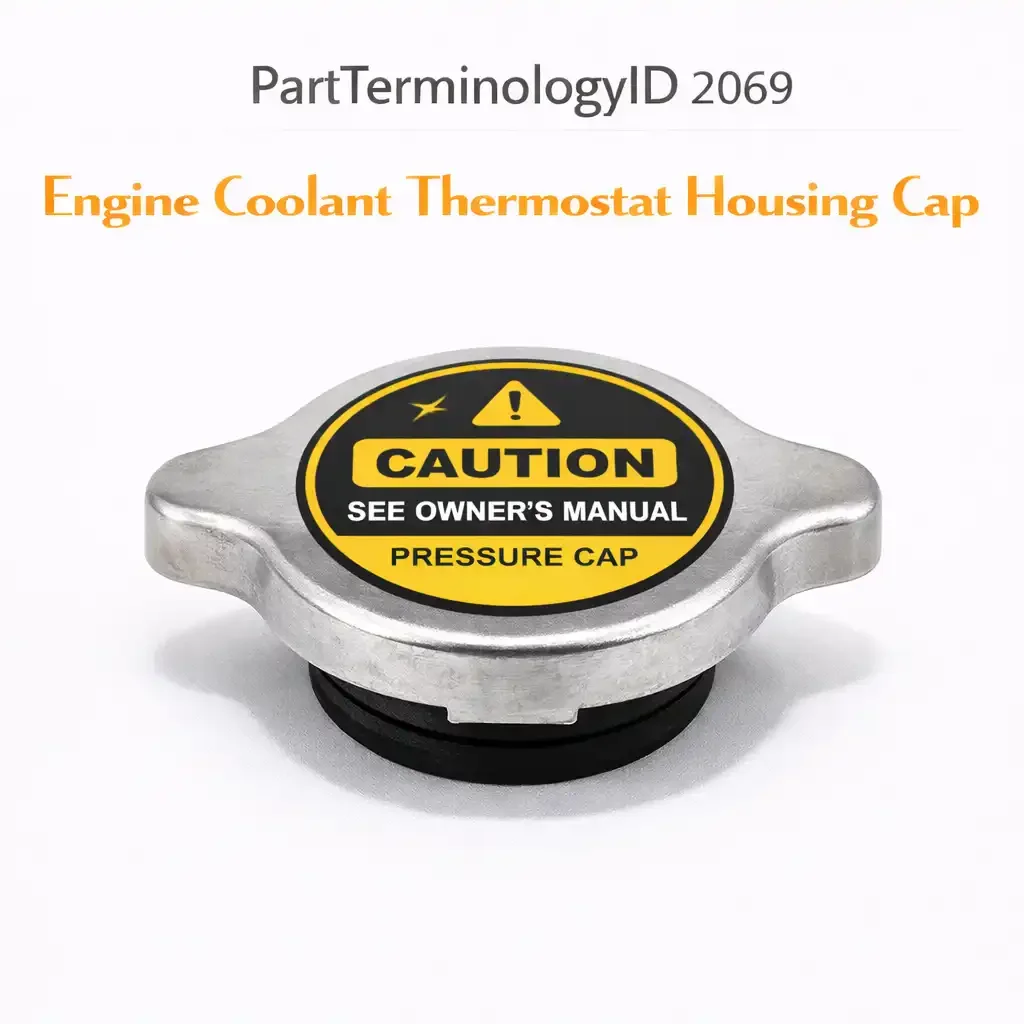
PartTerminologyID 2069, Engine Coolant Thermostat Housing Cap, is a cap that covers an opening on the thermostat housing. That definition tells the buyer the location. It does not tell them the bore diameter the cap seals, the thread specification or press-fit diameter the cap uses to secure to the housing, whether the cap is a threaded plug, a press-fit cover, a bolted plate, or a snap-fit cap, what material the cap is made from, or which engine family the housing belongs to. A listing under PartTerminologyID 2069 that does not specify the engine code, the cap type, and the bore dimensions is asking the buyer to guess whether the part fits the housing on their engine, the same problem that PartTerminologyID 2068 (Radiator Cap) creates when the pressure rating is stated without the neck diameter.
For sellers, the thermostat housing cap is a lower-volume part than a radiator cap but a higher-consequence fitment error. A wrong radiator cap is usually discovered before it causes damage because the system either visibly fails to seal or the engine overheats on the first drive. A wrong thermostat housing cap may appear to fit, may hold static pressure when the engine is cold, and may fail under thermal cycling when the cap material is incompatible with the coolant formulation or the housing expansion rate. The failure is slower and the diagnosis is less obvious.
For sellers, the listing under this PartTerminologyID is only useful if it includes the engine code, the cap type, the bore diameter, and the sealing method. Without those four attributes, the return rate is governed by how many buyers happen to own the engine the cap was designed for.
What the Thermostat Housing Cap Does
Sealing a secondary opening on the thermostat housing
The thermostat housing on most engines is a cast or machined component bolted to the engine block or cylinder head at the point where the upper coolant outlet connects to the upper radiator hose. The housing contains the thermostat and provides a sealed coolant passage. On many housing designs, a secondary opening exists opposite the thermostat bore, at the top of the housing, or along the side of the housing. This opening may have been used during the manufacturing process for casting access, core removal, or machining alignment. It may also serve as a bleed port, a sensor port, or a heater circuit connection on some engine configurations and not others within the same engine family.
On engine configurations where the secondary opening serves no active function, it is sealed with the thermostat housing cap. The cap must seal the opening against the full system operating pressure, which ranges from 10 PSI to 18 PSI on most passenger vehicles, and against coolant temperatures that can reach 230 degrees Fahrenheit in the vicinity of the thermostat housing. A cap that seals at cold pressure but weeps at operating temperature is a cap with a seal material that is not compatible with the thermal cycling of that location.
The bleed function on some configurations
On some engine configurations, the secondary housing opening functions as an air bleed port during coolant fill. The cap on those configurations may incorporate a small bleed passage or a needle valve that allows air to escape when the system is filled and closes under pressure once all air has been purged. A solid cap installed on a bleed port configuration traps air in the thermostat housing, which causes irregular thermostat function, erratic temperature gauge behavior, and potential overheating from an air-locked cooling circuit.
A listing that does not distinguish between a solid cap and a bleed-valve cap for the same housing will generate returns when a buyer on a bleed port configuration receives a solid cap, installs it, and experiences air lock symptoms on the first fill.
Freeze plug function in some housing designs
On some engine designs, the secondary housing opening is a core hole plug location and the cap is functionally a freeze plug pressed or threaded into the housing bore. The freeze plug function is to provide a weak point that yields before the engine block casting cracks if coolant freezes and expands. On a thermostat housing, the bore dimensions, the material, and the installation method of the cap matter for this reason: an oversized, undersized, or wrong-material cap in a freeze plug bore does not provide the designed yield point and does not seal reliably against coolant pressure.
The cap type matters as much as the bore diameter for this configuration. A threaded plug in a press-fit bore will not install correctly. A press-fit plug in a threaded bore will seat but will not be retained and will blow out under pressure. The listing must specify the installation method.
The Cap Configurations Under This PartTerminologyID
Threaded plug cap
A cap that threads into a tapped bore in the thermostat housing. Thread specification, which includes nominal diameter, pitch, and thread form, is the primary fitment attribute. Common specifications include M16x1.5, M18x1.5, M22x1.5, and 1/2-NPT depending on the engine family and the housing manufacturer. A plug with the correct nominal diameter but wrong pitch will either not start or will cross-thread. The listing must state the full thread specification.
Press-fit cup plug
A shallow cup pressed into a smooth bore in the thermostat housing. The outer diameter of the cup plug must match the bore diameter within a close tolerance for a correct press fit and pressure seal. Cup plugs that are undersized will not seal. Cup plugs that are oversized will distort the housing bore. Bore diameters for thermostat housing press-fit plugs range from approximately 20mm to 38mm depending on the engine. The material is typically stamped steel, brass, or stainless steel. Stainless steel is preferred for aluminum housings because steel cup plugs can corrode and bond to the bore, making future removal destructive.
Snap-fit or push-in cap
A polymer or rubber cap that pushes into the housing bore and seals through an interference fit or a lip seal against the bore wall. These are common on plastic thermostat housings found on many current-production four-cylinder and V6 engines. The cap outer diameter and the lip seal profile must match the housing bore exactly. A cap that is 1mm oversized will not seat. A cap that is 1mm undersized will seat but will not seal under pressure. The material must be compatible with the coolant formulation in the system.
Bolted cover plate
On some larger engines, the secondary housing opening is large enough that a cup plug or threaded plug is not used. Instead, a small cover plate is bolted over the opening with a gasket. This cap type requires the correct bolt pattern, the correct bolt thread specification, and a gasket. A listing for a bolted cover plate under PartTerminologyID 2069 that does not specify the bolt pattern and include the gasket, or note that the gasket is sold separately, will generate returns when the buyer installs the plate without a gasket and the housing leaks.
Integrated sensor port cap
On some housings, the secondary opening accepts a coolant temperature sensor on equipped configurations and is capped on non-sensor configurations. The cap must match the sensor port thread specification, which is typically M12x1.5 or 3/8-NPT for passenger vehicle applications. If the buyer needs to install a sensor and receives a solid cap, or needs a cap and receives a sensor port plug with the wrong thread form, the listing has failed both use cases.
Why This Part Generates Returns
Buyers order the wrong thermostat housing cap because:
the listing does not include the engine code, and the same vehicle platform uses different housing designs with different cap specifications across production years or engine variants
the listing does not specify the cap type: threaded, press-fit, snap-fit, bolted cover, or sensor port cap
the thread specification is incomplete: nominal diameter is stated without pitch, and the buyer assumes a common pitch that does not match their housing
buyers on bleed port configurations receive a solid cap and experience air lock on first fill after the repair
the material is not specified and the buyer installs a steel press-fit plug in an aluminum housing bore, which corrodes and seizes before the next service interval
the listing does not distinguish between a cap for a cast iron housing and a cap for an aluminum housing, and the cap material is not compatible with the housing material or the coolant formulation
the listing does not include the gasket for a bolted cover plate application, and the buyer installs the plate dry
Status in New Databases
PIES/PCdb: PartTerminologyID 2069, Engine Coolant Thermostat Housing Cap
PIES 8.0 / PCdb 2.0: No change
Top Return Scenarios
Scenario 1: "Wrong thread pitch, stripped the housing"
The buyer installed a threaded plug with the correct nominal diameter but a different pitch than the housing bore. The plug started on a few threads and then cross-threaded. The housing bore is now damaged. This is the highest-consequence return scenario in the category because the damage is to the housing, not to the cap.
Prevention language: "Thread specification: [M16x1.5 / M18x1.5 / M22x1.5 / other]. Verify the full thread specification of your thermostat housing bore before installing. Do not estimate pitch from thread diameter alone. Thread diameter and pitch must both match. An incorrect pitch will cross-thread and damage the housing bore."
Scenario 2: "Engine air locks after filling coolant"
The buyer replaced a bleed-valve cap with a solid cap because the listing did not distinguish between the two configurations. The system trapped air in the thermostat housing on refill. The thermostat operated irregularly, the temperature gauge fluctuated, and the heater output was intermittent.
Prevention language: "Cap type: [solid / bleed valve]. Engines with a bleed port at the thermostat housing require a bleed-valve cap to purge air during coolant fill. Installing a solid cap on a bleed port housing traps air in the thermostat circuit. Verify your original cap type before ordering."
Scenario 3: "Press-fit plug blew out under pressure"
The buyer installed a press-fit cup plug that was slightly undersized for the housing bore. The plug seated without resistance, which the buyer interpreted as a correct fit. The plug blew out at operating pressure on the first full heat cycle.
Prevention language: "Cup plug outer diameter: [X]mm. Press-fit plugs must match the bore diameter within close tolerance for a correct interference fit. A plug that seats without resistance is undersized and will not hold pressure. Verify the bore diameter of your thermostat housing before ordering."
Scenario 4: "Steel plug corroded into the aluminum housing bore"
The buyer installed a steel cup plug in an aluminum thermostat housing. The dissimilar metal contact with coolant present created galvanic corrosion at the interface. At the next service interval, the plug could not be removed without drilling out the bore.
Prevention language: "Material: [brass / stainless steel / stamped steel]. For aluminum thermostat housings, brass or stainless steel plugs are recommended to prevent galvanic corrosion at the plug-to-bore interface. Verify your housing material before selecting plug material."
Scenario 5: "Bolted cover plate leaks, no gasket was included"
The buyer installed the cover plate without a gasket because the listing did not include one and did not state that a gasket was required. The plate leaked at the housing face immediately on first startup.
Prevention language: "Includes: cover plate and gasket. A gasket is required between the cover plate and the thermostat housing face. Do not install the cover plate without the gasket. If ordering a replacement plate only, verify your existing gasket condition and replace it if hardened or damaged."
What to Include in the Listing
Core essentials
PartTerminologyID: 2069
component: Engine Coolant Thermostat Housing Cap
cap type: threaded plug, press-fit cup plug, snap-fit cap, bolted cover plate, or sensor port cap (mandatory)
engine code (mandatory)
bore diameter or thread specification (mandatory)
bleed valve function: solid or bleed-valve (mandatory when application includes bleed port configurations)
material: brass, stainless steel, stamped steel, polymer, rubber
includes gasket: yes or no (for bolted cover plate applications)
quantity: 1
Fitment essentials
year/make/model/submodel
engine code (mandatory, non-negotiable: the same vehicle platform uses different housing designs across engine variants)
housing material: cast iron, aluminum, plastic (to confirm plug material compatibility)
OE part number cross-reference when available
Dimensional essentials
bore diameter in mm for press-fit and snap-fit caps
full thread specification for threaded plugs: nominal diameter, pitch, thread form (NPT, metric, BSP)
cup plug outer diameter in mm and cup depth in mm for press-fit plugs
cover plate bolt pattern for bolted cover applications: bolt count, bolt spacing, bolt thread specification
seal outer diameter in mm for snap-fit caps
overall cap height or depth in mm
Image essentials
cap in isolation with dimensional callouts showing bore diameter or thread specification
cap installed in thermostat housing showing seating depth and seal engagement
for bleed valve caps, close-up of the bleed passage or needle valve
for bolted cover plates, the plate with gasket and hardware shown together
material finish detail distinguishing brass from stainless steel from stamped steel
Catalog Checklist for ACES/PIES Teams
PartTerminologyID = 2069
require engine code (mandatory, non-negotiable)
require cap type: threaded plug, press-fit, snap-fit, bolted cover, or sensor port cap
require bore diameter or full thread specification
require bleed valve function attribute: solid or bleed-valve
require material
require housing material compatibility note for metal plug in aluminum housing applications
require gasket inclusion or exclusion note for bolted cover plate applications
require year/make/model/submodel fitment
differentiate from thermostat housing (PartTerminologyID varies): the housing is the casting that contains the thermostat; the cap seals an opening in the housing
differentiate from thermostat (PartTerminologyID varies): the thermostat controls coolant flow; the cap seals the secondary bore in the housing
differentiate from coolant temperature sensor (PartTerminologyID varies): the sensor occupies a threaded port in the housing; the cap seals the same port on non-sensor configurations
flag that thread diameter alone is not sufficient for threaded plug listings: pitch must be specified
flag that press-fit plugs must be listed with outer diameter in mm, not as a nominal size designation
FAQ (Buyer Language)
How do I find the correct thermostat housing cap for my engine?
Look up the part by engine code, not by vehicle model alone. The same vehicle platform may use different thermostat housings on different engine variants, and the secondary bore on those housings may have different diameters, different cap types, or different thread specifications. Identify your engine code from the vehicle identification label in the engine bay or from the vehicle registration documents. Then match the engine code to a catalog listing that specifies cap type, bore diameter or thread specification, and material.
How do I measure the bore for a press-fit cap?
Use a bore gauge or the inner measurement jaw of a caliper. Measure the bore diameter at the sealing surface, which is the portion of the bore the cup plug presses against. Measure in at least two perpendicular directions to confirm the bore is round and not oval from a previous plug removal. The cup plug outer diameter must be within close tolerance of the bore diameter for a correct interference fit. A plug that slides in without resistance is undersized and will not hold pressure.
Can I use a standard freeze plug from a hardware or parts store?
Only if the outer diameter, material, and cup depth match the thermostat housing bore specification exactly. Generic freeze plugs are sized to standard bore diameters. If your thermostat housing bore is a standard dimension, a matching generic plug may work. If the bore is a non-standard size, a vehicle-specific plug is required. Verify the material: steel plugs in aluminum housings will corrode at the interface and create removal problems at the next service interval.
My thermostat housing cap has a small hole or valve in it. What does that do?
That is a bleed valve. The small passage allows air to escape from the thermostat housing when the cooling system is filled with coolant. Air trapped in the thermostat housing prevents the thermostat from sensing coolant temperature accurately and can cause the thermostat to cycle erratically or remain closed, which causes overheating. If your original cap has a bleed valve, the replacement must also have one. A solid cap on a bleed port housing will trap air on every coolant fill.
My housing uses a bolted cover plate. Does the gasket come with the cap?
Verify the listing. Some cover plate listings include the gasket. Some do not. If the gasket is not included, order it separately before installing the plate. Installing a cover plate without a gasket will cause an immediate coolant leak at the housing face. If your existing gasket is in place but has been compressed by the previous plate, replace it. A previously compressed gasket will not seal reliably when re-torqued to a new plate.
Cross-Sell Logic
Thermostat (PartTerminologyID varies: the thermostat is in the same housing; if the housing is being opened to replace the cap, inspect the thermostat for correct operation and replace it if mileage or symptoms warrant)
Thermostat Housing Gasket (PartTerminologyID varies: the gasket between the thermostat housing and the engine block or cylinder head should be inspected when the housing is disturbed; a weeping housing gasket is a common concurrent failure)
Engine Coolant Temperature Sensor (PartTerminologyID varies: on housings with a sensor port, the sensor threads into the same housing; inspect the sensor seal and threads when the housing is open)
Coolant (if the cap replacement requires draining the thermostat housing, the system will need to be refilled and the coolant level verified)
Engine Cooling System Pressure Tester Adapter (PartTerminologyID 2054: after replacing the housing cap, pressure test the cooling system to confirm the new cap is sealing at full system pressure before returning the vehicle to service)
Radiator Hose, upper (connects to the thermostat housing outlet; inspect the hose and clamp condition while the housing is accessible)
Frame as "the housing cap is the starting point. The thermostat, the housing gasket, and the sensor are in the same location and should all be inspected when the housing is open. The pressure test after reassembly confirms the repair before the vehicle returns to service."
Final Take for PartTerminologyID 2069
Engine Coolant Thermostat Housing Cap (PartTerminologyID 2069) seals a secondary opening in the thermostat housing against full cooling system pressure and temperature. It is not a generic plug. It is a dimensionally specific, material-specific, configuration-specific component. The same vehicle platform can use different housings with different cap specifications on different engine variants, which means the engine code is not optional fitment data for this PartTerminologyID. It is the primary fitment attribute.
The cap type determines the installation method. The bore diameter or thread specification determines the fitment. The material determines the compatibility with the housing material and the coolant formulation. The bleed valve attribute determines whether the cooling system can be filled without air lock. A listing that omits any of these attributes is a listing that asks the buyer to guess in a location where a wrong guess damages the housing or causes an air-locked cooling circuit.
State the engine code. State the cap type. State the bore diameter or thread specification in full. State the material. State whether the cap is solid or includes a bleed valve. That is the same listing strategy as every other PartTerminologyID in this series: the generic PartTerminologyID requires specific attributes at every level to become a listing buyers can act on without guessing.