
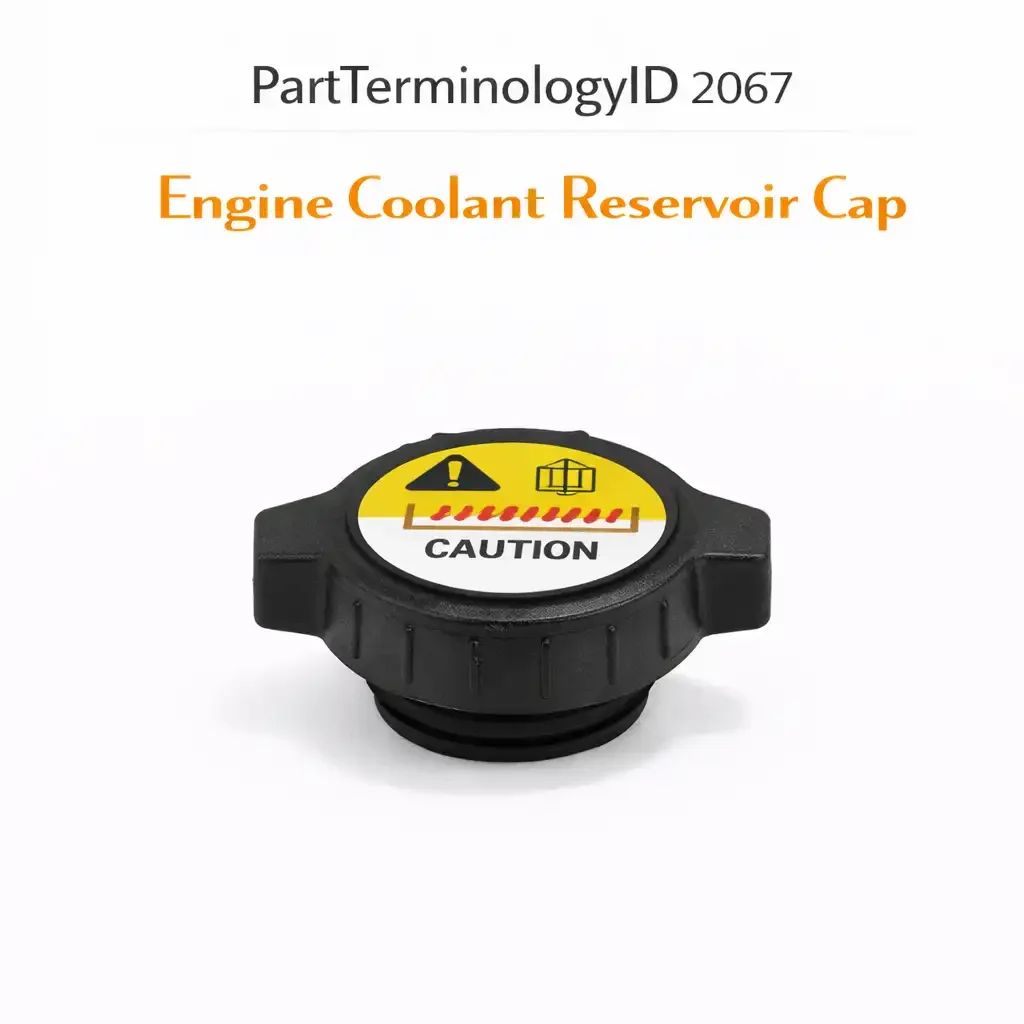
Engine Coolant Reservoir Cap (PartTerminologyID 2067): The Cap That Controls System Pressure
Written by Arthur Simitian | PartsAdvisory
PartTerminologyID 2067, Engine Coolant Reservoir Cap, is the pressure cap on a sealed coolant reservoir. That definition sounds specific. It is not. It does not tell you what pressure the cap is rated to hold, what diameter neck it fits, what locking style it uses, whether the cap has an integrated overflow valve, whether it has a single-valve or dual-valve design, or whether it is designed for a remote reservoir on a traditional radiator system or for a pressurized overflow-style reservoir that is the primary fill point for the entire cooling system. A listing under PartTerminologyID 2067 that does not include the cap pressure rating and the neck outer diameter is asking the buyer to guess two of the most critical specifications on a safety-relevant cooling system component.
The stakes for this PartTerminologyID are higher than they are for a tool adapter. A wrong adapter means the test cannot be performed. A wrong reservoir cap means the cooling system cannot hold its rated operating pressure. The consequences range from chronic coolant loss and overheating to a blown head gasket on a sustained highway run. For sellers, the return for a wrong reservoir cap is the best possible outcome. The worst outcome is a return that never happens because the vehicle overheats before the buyer connects the symptom to the cap.
For sellers, the listing under this PartTerminologyID is only useful if it includes the pressure rating in PSI or bar, the neck outer diameter in mm, the locking style, and the valve configuration. Without those four attributes, the listing is a guess the buyer is being asked to make about a part that controls pressure in a closed loop operating at 200 degrees Fahrenheit or more.
What the Engine Coolant Reservoir Cap Does
Pressure regulation in the sealed cooling system
The primary function of the reservoir cap on a sealed pressurized system is the same as a traditional radiator cap: it maintains the cooling system at a pressure above atmospheric. Raising the system pressure raises the boiling point of the coolant. A system pressurized to 15 PSI raises the effective boiling point of a 50/50 ethylene glycol and water mixture by approximately 45 degrees Fahrenheit above its atmospheric boiling point. A cap that cannot hold the rated system pressure allows the coolant to boil at lower temperatures, which produces vapor pockets in the cooling passages, which causes localized overheating and the head gasket and cylinder head damage that follows.
The cap holds this pressure during normal operation and releases it when pressure exceeds the rated opening pressure through the pressure relief valve. On a cold engine, the cap seals the system completely. As the engine warms, coolant expands and pressure rises. The cap holds that pressure until it reaches the relief threshold, at which point the excess pressure and coolant are vented to the reservoir overflow tube or back into the reservoir itself depending on the cap design.
The pressure relief valve
Every reservoir cap with a pressure function contains a pressure relief valve. The valve is a spring-loaded seal that opens at the rated cap pressure and closes when pressure drops below it. The spring rate determines the opening pressure. A fatigued or broken spring causes the cap to open below its rated pressure. An overstiff spring, which is rare but can occur with an incorrect replacement cap, causes the cap to hold pressure above its rating, which places the hoses, reservoir tank, and radiator tanks under stress they were not designed to sustain continuously.
The rated opening pressure is stamped or molded on most caps as a PSI value, a bar value, or both. Common ratings for passenger vehicles range from 10 PSI to 18 PSI. Heavy-duty applications reach 20 PSI and above. A cap rated at 13 PSI installed on a system designed for 16 PSI will vent three PSI early on every heat cycle, which results in chronic coolant loss from the overflow and gradual coolant depletion. A cap rated at 16 PSI installed on a system designed for 13 PSI will allow the system to exceed its designed operating pressure, which stresses hose clamps, hose material, reservoir walls, and radiator end tanks.
The vacuum relief valve
Most reservoir caps contain a second valve: a vacuum relief valve that allows coolant to be drawn back from the overflow reservoir into the system as the engine cools and coolant contracts. Without the vacuum relief valve, the cooling system would develop a negative pressure as it cools, which collapses hoses and prevents the reservoir from returning coolant to the system. A collapsed upper radiator hose on a cold startup is a common symptom of a failed vacuum relief valve on a cap that still appears to hold pressure.
The vacuum relief valve is a rubber seal or a small spring-loaded check valve on the underside of the cap. It opens at a very low negative pressure, typically 1 PSI or less, to allow coolant return flow. A cap without a functional vacuum relief valve produces the collapsed hose symptom and the slow coolant level drop in the radiator on a system that otherwise appears to hold pressure. A listing that does not specify whether the cap includes a vacuum relief valve will generate returns when a buyer replaces a dual-valve cap with a single-valve cap.
Sealed reservoir versus overflow reservoir
This is the distinction that most listings under PartTerminologyID 2067 fail to make, and it is the most consequential omission in the category.
On a traditional cooling system, the radiator cap is the pressure cap. The reservoir is a passive overflow catch tank with a non-pressurized cap. If coolant overflows from the radiator cap pressure relief, it collects in the overflow tank. As the system cools, the vacuum relief in the radiator cap draws coolant back from the tank. The overflow tank cap on a traditional system does not hold pressure and does not require a pressure cap. Listing a pressure-rated cap under PartTerminologyID 2067 for a traditional overflow tank application will generate returns because the buyer's original cap had no pressure rating and no pressure function.
On a sealed cooling system, the reservoir is the primary fill point and the reservoir cap is the pressure cap. There is no separate radiator cap. The reservoir is plumbed directly to the cooling system and operates at full system pressure. The reservoir cap must hold the full rated system pressure and must have a functional vacuum relief valve for coolant return. Replacing a sealed-reservoir cap with a non-pressurized overflow tank cap, which is an easy mistake when the listing does not distinguish between the two, causes immediate and complete loss of system pressure and rapid overheating.
The seller cannot list both applications under the same PartTerminologyID 2067 listing without explicitly stating which system the cap is designed for. They are different parts with different functions installed in similar-looking locations.
The Neck Profiles This Cap Must Fit
Standard two-lug bayonet neck
The most common reservoir cap neck profile on domestic vehicles. The cap seats on the neck with two lugs that engage bayonet slots and lock with a quarter-turn. Neck outer diameters for domestic two-lug bayonet reservoir necks range from approximately 38mm to 44mm depending on the manufacturer and the model year. A cap with the correct pressure rating but the wrong neck diameter will not seal. A cap with the correct neck diameter but the wrong lug count will not lock.
Three-lug bayonet neck
Common on European vehicles and some Asian market vehicles. Three lugs provide a more secure engagement and a smaller rotation angle to lock. European reservoir cap necks frequently use larger outer diameters than domestic applications at the same pressure rating. An adapter or a vehicle-specific cap is required to bridge a domestic two-lug cap to a European three-lug neck, which is where the PartTerminologyID 2059 (Radiator Cap Adapter) may enter the cross-sell.
Threaded neck
Some reservoir caps thread onto the neck rather than using a bayonet locking system. The thread pitch and diameter are specific to the manufacturer and the reservoir design. Common thread specifications include M38x4.0 and M44x3.0 for passenger vehicle applications. A threaded cap cannot be substituted for a bayonet cap or vice versa regardless of pressure rating or outer diameter.
Proprietary neck profiles
Several manufacturers use neck profiles that deviate from the standard two-lug or three-lug bayonet form. These caps are vehicle-specific and require catalog data that explicitly identifies the make, model, model year, and in some cases the engine code, because the same vehicle platform may have used different reservoir tank suppliers in different production years with different neck profiles.
Why This Part Generates Returns
Buyers order the wrong engine coolant reservoir cap because:
the listing does not state the cap pressure rating in PSI or bar, so buyers order based on neck diameter or visual match alone
the listing does not state the neck outer diameter, so buyers order based on pressure rating alone and receive a cap that does not seat on their neck
the listing does not distinguish between a pressurized sealed-reservoir cap and a non-pressurized overflow tank cap, and the buyer installs a non-pressurized cap on a sealed-reservoir system
buyers replace a dual-valve cap (pressure relief and vacuum relief) with a single-valve cap (pressure relief only) because the listing did not specify the valve configuration
buyers on European vehicles order a cap sized for domestic neck profiles because the listing did not specify the market application
buyers select the cap by PSI rating without verifying the neck outer diameter, because the listing implies that PSI rating is the primary fitment attribute
the locking style is not stated, so buyers receive a threaded cap when their neck is bayonet-style or vice versa
the cap is listed as a universal fit without sufficient attribute disclosure, and the buyer's neck profile is outside the cap's actual range
Status in New Databases
PIES/PCdb: PartTerminologyID 2067, Engine Coolant Reservoir Cap
PIES 8.0 / PCdb 2.0: No change
Top Return Scenarios
Scenario 1: "Wrong pressure rating, my system is overheating"
The buyer replaced the cap with one at a lower PSI rating. The system vents early on every heat cycle, loses coolant to the overflow, and the coolant level in the reservoir drops over time. The engine runs hotter than normal on highway driving. The buyer eventually connects the symptom to the cap after replacing the thermostat and the coolant.
Prevention language: "Cap pressure rating: [X] PSI / [X] bar. Verify your system's required cap pressure rating before ordering. Installing a cap with a lower rating than the system requires will cause premature venting and chronic coolant loss. The required rating is stamped on the original cap or listed in the vehicle service manual."
Scenario 2: "The cap does not fit my reservoir neck"
Neck outer diameter mismatch. The cap is the correct pressure rating but seats loosely or not at all on the neck. The buyer selected the cap by PSI rating and did not verify the neck outer diameter.
Prevention language: "Fits reservoir cap necks with [X]mm outer diameter. Cap PSI rating does not determine neck outer diameter. Verify your reservoir neck outer diameter before ordering. Measure the neck O.D. or look up the specification for your vehicle by year, make, model, and engine."
Scenario 3: "My hoses collapsed after replacing the cap"
The replacement cap has a pressure relief valve but no functional vacuum relief valve, or the vacuum relief valve seal is damaged. As the engine cools, coolant contracts and the system develops a slight vacuum. Without the vacuum relief function, the upper radiator hose collapses and coolant is not drawn back from the overflow.
Prevention language: "Cap valve configuration: pressure relief valve and vacuum relief valve. This cap returns coolant from the reservoir to the system as the engine cools. Verify your original cap includes a vacuum relief function before ordering a single-valve replacement."
Scenario 4: "This is a non-pressurized cap, my system needs a pressure cap"
The buyer's vehicle has a sealed pressurized reservoir. They ordered a cap listed under PartTerminologyID 2067 without reading that the listing was for a traditional overflow tank cap with no pressure rating. The cooling system immediately lost pressure after installation and the engine overheated within one drive cycle.
Prevention language: "This cap is designed for [non-pressurized coolant overflow reservoir / pressurized sealed coolant reservoir]. Sealed-reservoir systems require a pressure-rated cap with a pressure relief valve. Overflow reservoir caps have no pressure function. Verify your system type before ordering. If your vehicle has no separate radiator cap and the reservoir is the primary fill point, your system requires a pressure-rated reservoir cap."
Scenario 5: "Wrong locking style, cap will not engage"
The buyer's reservoir neck is a two-lug bayonet and the replacement cap is threaded, or the lug count does not match and the cap partially engages but does not lock.
Prevention language: "Locking style: [two-lug bayonet / three-lug bayonet / threaded]. Verify your reservoir neck locking style and lug count before ordering. Bayonet and threaded caps are not interchangeable. A cap with the wrong lug count will not fully engage or seal on the neck."
Scenario 6: "My vehicle is European and this cap does not fit"
The buyer's vehicle uses a European reservoir neck with a larger outer diameter and a three-lug profile. The listing was for a domestic two-lug cap. The buyer selected the cap by PSI rating, which was correct, but the neck profile was incompatible.
Prevention language: "Designed for [domestic / European / Asian] market reservoir neck profiles. European reservoir necks commonly use larger outer diameters and three-lug bayonet profiles. Verify neck outer diameter and lug count and profile before ordering."
What to Include in the Listing
Core essentials
PartTerminologyID: 2067
component: Engine Coolant Reservoir Cap
system type: pressurized sealed reservoir or non-pressurized overflow reservoir (mandatory)
cap pressure rating in PSI and bar (mandatory for pressurized caps)
neck outer diameter in mm (mandatory)
locking style: two-lug bayonet, three-lug bayonet, threaded (mandatory)
valve configuration: pressure relief only, or pressure relief and vacuum relief (mandatory)
material: plastic body with rubber seal, metal spring
quantity: 1
Fitment essentials
year/make/model/submodel
engine code when cap specification varies by engine within the same model
market application: domestic, European, Asian
OE part number cross-reference when available
Dimensional essentials
neck outer diameter in mm (the diameter the cap seats against)
cap outer diameter in mm
cap height in mm
pressure relief opening pressure in PSI and bar
vacuum relief opening pressure in PSI or in H2O
seal outer diameter in mm
lug count and lug engagement angle for bayonet caps
thread specification for threaded caps: nominal diameter, pitch, thread form
Image essentials
cap top view showing pressure rating stamp and locking lugs
cap bottom view showing pressure relief valve spring and vacuum relief seal
cap seated on neck showing lug engagement and seal contact
pressure rating callout visible in at least one image
dimensional callout image showing neck outer diameter the cap fits
Catalog Checklist for ACES/PIES Teams
PartTerminologyID = 2067
require system type attribute: pressurized sealed reservoir or non-pressurized overflow reservoir (mandatory, non-negotiable)
require pressure rating in PSI and bar for pressurized caps
require neck outer diameter in mm
require locking style with lug count for bayonet caps
require full thread specification for threaded caps
require valve configuration: single valve or dual valve with vacuum relief
require market application: domestic, European, or Asian
require year/make/model/submodel fitment data
require engine code when specification varies within the same model
differentiate from radiator cap (PartTerminologyID varies): the radiator cap sits on the radiator neck; the reservoir cap sits on the reservoir neck; on sealed systems there is no separate radiator cap and the reservoir cap performs both functions
differentiate from non-pressurized overflow tank cap: a non-pressurized cap installed on a pressurized reservoir causes immediate system pressure loss and overheating
differentiate from coolant reservoir / overflow tank (PartTerminologyID varies): the tank is a separate part from the cap; both may be listed in proximity and buyers may order one when they need the other
flag that cap PSI rating and neck outer diameter are independent specifications: the same PSI rating appears on caps of multiple neck diameters
flag that vacuum relief valve function must be confirmed when replacing a cap on a system with a single reservoir fill point
FAQ (Buyer Language)
How do I know what pressure rating my reservoir cap needs?
The required pressure rating is typically stamped or molded on the original cap. It is also listed in the vehicle owner's manual cooling system section and in the factory service manual under cooling system specifications. If the original cap is missing or unreadable, the rating can be found by year, make, model, and engine code in the service manual or a reputable cooling system parts catalog. Do not estimate the pressure rating. Installing a cap below the specified rating causes chronic coolant loss. Installing a cap above the rating stresses hoses and the reservoir tank.
How do I measure my reservoir neck outer diameter?
Remove the cap and measure the outer diameter of the neck lip that the cap seals against using a caliper. Measure at the sealing surface, not at the top of the neck where the lugs engage. If a caliper is not available, the specification can be found by year, make, model, and engine code in a cooling system parts catalog or by comparing the original cap's inner bore diameter to the replacement cap's inner bore diameter.
What happens if I install a non-pressurized cap on my sealed cooling system?
The cooling system loses all pressure immediately. Without system pressure, the boiling point of the coolant drops to its atmospheric boiling point, which is below normal engine operating temperatures for most vehicles. The coolant boils in the cooling passages, produces vapor pockets, and the engine overheats within one or two drive cycles. The damage from a single overheat event on a modern aluminum engine can include a warped cylinder head, a blown head gasket, and damaged piston rings. The non-pressurized cap failure is fast and severe.
What is the difference between a single-valve and a dual-valve reservoir cap?
A single-valve cap has only a pressure relief valve. It opens to vent excess pressure and closes when pressure drops. A dual-valve cap adds a vacuum relief valve on the underside that opens when the cooling system develops a slight vacuum as the engine cools, allowing coolant to be drawn back from the overflow reservoir into the cooling system. Most passenger vehicle reservoir caps are dual-valve. A single-valve replacement on a system designed for a dual-valve cap results in collapsed hoses on cold startups, a declining coolant level in the radiator on a system that otherwise appears sealed, and eventual overheating from low coolant.
My vehicle has both a radiator cap and a coolant reservoir. Which one is PartTerminologyID 2067?
PartTerminologyID 2067 is the reservoir cap. The radiator cap is a separate PartTerminologyID. On a traditional system with both a radiator cap and a passive overflow reservoir, the reservoir cap has no pressure function and does not require a pressure rating. The radiator cap is the pressure cap on that system. On a sealed system where the reservoir is the primary fill point, the reservoir cap is the pressure cap and there is no separate radiator cap. If your vehicle has both a radiator cap and a reservoir cap and your reservoir cap does not have a pressure rating stamped on it, your reservoir is a passive overflow tank and PartTerminologyID 2067 on a pressurized cap listing is not the right part.
Can I use a higher pressure cap to stop a small leak?
No. A higher pressure cap raises the system pressure above its designed operating ceiling. This stresses hose walls, clamps, radiator end tanks, reservoir walls, and any other sealed joint in the cooling system. A small leak that seeps at 15 PSI becomes a larger leak faster at 18 PSI, and the hoses and tanks that were borderline at 15 PSI fail sooner at 18 PSI. The correct repair for a cooling system leak is identifying the leak source and replacing the leaking component, not increasing the pressure to force a better seal.
How often should a reservoir cap be replaced?
The rubber seal on the underside of the cap degrades with heat cycling over time. Most manufacturers recommend inspecting the cap seal and the pressure relief function at every coolant service interval, typically every 30,000 to 50,000 miles or every two to five years depending on the coolant type. A pressure tester with a cap tester adapter (PartTerminologyID 2055) can verify whether the cap holds pressure to its rating and vents at the correct pressure. A cap that vents below its rating or does not seal at all requires replacement regardless of age or appearance.
Cross-Sell Logic
Engine Cooling System Pressure Tester Adapter (PartTerminologyID 2054: after replacing the reservoir cap, pressure test the cooling system to confirm no other leaks are present)
Radiator Cap Tester Adapter (PartTerminologyID 2055: test the new reservoir cap before installation to confirm it holds to its rated pressure; test the old cap to confirm it was the source of the pressure loss)
Engine Coolant Reservoir / Overflow Tank (PartTerminologyID varies: if the cap is damaged from an overpressure event or physical impact, inspect the reservoir tank for cracks at the neck, the seam, and the tank walls)
Radiator Hose, upper and lower (inspect for softness, cracking, and swelling while the system is depressurized for cap replacement)
Thermostat (chronic overheating from a failed cap may also mask a failing thermostat that was holding the engine at higher temperatures than normal; replace both when the history of overheating is uncertain)
Head Gasket Test Kit (if the coolant shows discoloration, a brown or oily film, or if bubbles appear in the reservoir on a warm engine, a combustion gas test confirms whether the overheating from the failed cap caused head gasket damage before the cap was identified as the problem)
Coolant (if the system lost coolant through the failed cap's premature venting, the reservoir and the cooling system will be low and will need to be topped off or refilled after the cap replacement)
Frame as "the cap is the first and cheapest part to test and replace when the system loses pressure. The cross-sell parts address what the pressure loss may have revealed or caused before the cap was identified as the problem."
Final Take for PartTerminologyID 2067
Engine Coolant Reservoir Cap (PartTerminologyID 2067) controls the operating pressure of the cooling system on every sealed-reservoir vehicle on the road. It is not a passive cover. It is a calibrated pressure relief and vacuum relief device that maintains system pressure within a designed operating range through thousands of heat cycles. A wrong cap installed by a buyer who could not determine the correct specifications from the listing is not a minor inconvenience. It is a cooling system that cannot hold its designed pressure, on an engine that will overheat, in a vehicle that will need repair far more expensive than the cost of the cap.
The listing must state the pressure rating. The listing must state the neck outer diameter. The listing must state the locking style. The listing must distinguish between a pressurized sealed-reservoir cap and a non-pressurized overflow tank cap. The listing must state the valve configuration. None of these attributes are optional. Every one of them is a specification the buyer must match to their vehicle before the part can be ordered correctly.
State the pressure rating. State the neck diameter. State the locking style. State the system type. State the valve configuration. That is the same listing strategy as PartTerminologyID 2052 (Transmission Clutch Spring): the generic PartTerminologyID requires specific attributes at every level to become a listing buyers can act on without guessing. For PartTerminologyID 2067, the cost of guessing is paid by the engine.