
Written by Arthur Simitian | PartsAdvisory
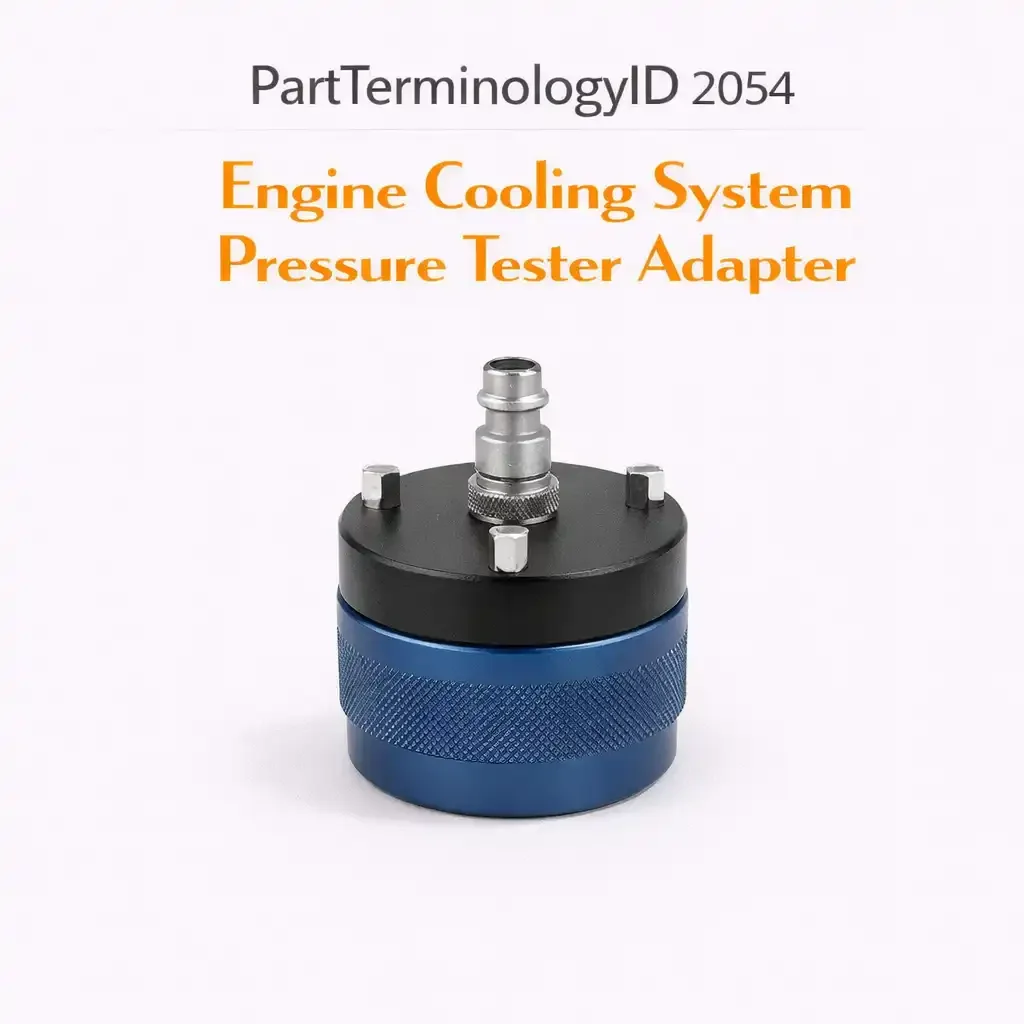
PartTerminologyID 2054, Engine Cooling System Pressure Tester Adapter, is an adapter used to connect a pressure testing pump to a vehicle cooling system. That is all the PartTerminologyID tells you. It does not specify which opening the adapter connects to, what diameter neck it fits, what locking style it requires, or whether it is designed for a radiator cap neck, a coolant reservoir neck, a heater hose, or a block test port. A listing under PartTerminologyID 2054 that does not specify the application and the neck outer diameter is asking the buyer to guess which adapter fits their vehicle, the same problem that PartTerminologyID 2052 (Transmission Clutch Spring) creates when the location attribute is missing.
For sellers, the listing under this PartTerminologyID is only useful if it includes the application and the cap neck outer diameter. Without those attributes, the return rate is determined by whether the buyer happens to own a vehicle with the same neck profile the adapter was designed for.
The Openings This Adapter Must Fit
Radiator cap neck (pressurized)
The most common target for a pressure tester adapter. The radiator cap is removed and the adapter seats in its place. Radiator cap necks are not standardized across manufacturers. Neck outer diameters typically range from 32mm to 52mm depending on the vehicle. Cap locking styles include two-lug bayonet, three-lug bayonet, and threaded. An adapter for a 38mm two-lug bayonet neck will not seal on a 48mm three-lug bayonet neck from a different manufacturer. European vehicle cap necks frequently use larger diameters and different lug profiles than domestic applications at the same nominal cap pressure rating.
Coolant reservoir neck (sealed system)
On sealed cooling systems where the reservoir is the primary fill point, the reservoir cap performs the pressure-holding function. These necks are smaller in diameter than traditional radiator cap necks and use a different sealing profile. An adapter designed for a radiator cap neck will not fit a reservoir cap neck. Reservoir necks typically range from 38mm to 44mm for domestic applications but differ by manufacturer and model year. A listing that does not distinguish between a radiator cap neck adapter and a reservoir neck adapter will generate returns on every sealed-system vehicle in the fitment guide.
Heater hose inline adapter
When the radiator cap neck or reservoir neck is inaccessible or damaged, technicians can pressurize the system through a heater hose by installing an inline adapter between the hose end and the heater core fitting. This adapter type is not a cap-style fitting. It is a barbed or slip-fit inline fitting that splices into the hose. It is a distinct product configuration from a cap-style adapter and may be listed under the same PartTerminologyID 2054. A buyer ordering a cap-style adapter who receives a hose-inline adapter faces a mismatch that the listing created.
Engine block test port adapter
On some heavy-duty engines, a threaded port in the engine block or cylinder head allows direct pressure testing of internal passages. Adapters for these ports are pipe-thread fittings rather than cap-style bayonet fittings. Thread size and pitch are specific to the engine family. Common specifications include 1/8-NPT, 1/4-NPT, M12x1.5, and M14x1.5. A listing that does not specify thread type and pitch for a port adapter produces the same outcome as the spring listing without a location attribute: the PartTerminologyID says adapter, but the buyer cannot determine fitment.
Why This Part Generates Returns
Buyers order the wrong cooling system pressure tester adapter because:
the listing does not specify whether the adapter is for a radiator cap neck, a reservoir cap neck, a heater hose connection, or a block port
the listing does not specify the cap neck outer diameter, so buyers order based on cap pressure rating alone, which does not determine neck diameter
they order an adapter for a domestic cap neck and receive an adapter sized for a European cap neck, or vice versa
the locking style does not match: the adapter is a two-lug bayonet and the vehicle requires a three-lug bayonet or a threaded neck adapter
they order a cap-style adapter when their vehicle requires a reservoir-neck adapter or an inline hose adapter
the listing does not state whether the part is a single adapter or a set, so buyers purchasing to expand a kit receive a set, or buyers purchasing a complete solution receive a single adapter
Status in New Databases
PIES/PCdb: PartTerminologyID 2054, Engine Cooling System Pressure Tester Adapter
PIES 8.0 / PCdb 2.0: No change
Top Return Scenarios
Scenario 1: "This adapter does not fit my radiator neck"
Diameter mismatch. The buyer's radiator cap neck is 38mm and the adapter is designed for a 48mm neck, or the buyer's neck is 48mm and the adapter is undersized.
Prevention language: "Fits radiator cap necks with [X]mm outer diameter. Verify your radiator cap neck outer diameter before ordering. Not compatible with [smaller / larger] diameter necks."
Scenario 2: "I needed the reservoir adapter, not the radiator adapter"
The buyer's vehicle uses a sealed reservoir as the primary pressure point. The listing did not specify which opening the adapter fits. The buyer assumed the adapter was for their vehicle's only accessible cap, which is the reservoir cap.
Prevention language: "For use on [radiator cap neck / coolant reservoir cap neck]. Not interchangeable between applications. Vehicles with a sealed reservoir system require the reservoir-neck adapter. Verify which cap is the pressure-bearing cap on your vehicle before ordering."
Scenario 3: "Wrong locking style, adapter will not seat"
Correct diameter, wrong bayonet configuration. The adapter is a two-lug bayonet and the vehicle requires a three-lug bayonet, or the neck is threaded and the adapter is bayonet-style.
Prevention language: "Cap neck locking style: [two-lug bayonet / three-lug bayonet / threaded]. Verify your cap neck locking profile before ordering. Bayonet and threaded adapters are not interchangeable."
Scenario 4: "My vehicle is European and this adapter does not fit"
European and domestic cap neck dimensions and locking profiles differ. An adapter specified for domestic applications will not fit many European vehicles even at the same cap pressure rating. The buyer selected the adapter by PSI rating rather than neck diameter.
Prevention language: "Designed for [domestic / European / Asian market] cap neck profiles. Fitment is determined by neck outer diameter and locking style, not by cap pressure rating. Verify neck outer diameter and lug profile before ordering."
Scenario 5: "I received a single adapter but expected a complete set"
The listing did not specify quantity or context. Buyers expanding an existing tester kit expect individual adapters. Buyers purchasing for the first time expect a complete set. The listing said adapter without clarifying.
Prevention language: "Quantity: 1 adapter. This is a single replacement or expansion adapter, not a complete pressure tester kit. Compatible with [brand / model] pump handles. Verify pump compatibility before ordering."
What to Include in the Listing
Core essentials
PartTerminologyID: 2054
component: Engine Cooling System Pressure Tester Adapter
application: radiator cap neck, coolant reservoir cap neck, heater hose inline, or block port (mandatory)
cap neck outer diameter in mm (mandatory for cap-style adapters)
locking style: two-lug bayonet, three-lug bayonet, threaded, friction-fit
material: aluminum, brass, reinforced plastic
quantity: 1 or specify adapter count if sold as a set
Fitment essentials
year/make/model/submodel when vehicle-specific
compatible tester pump brand and model if the adapter is brand-specific
market application: domestic, European, Asian
cap pressure rating range the adapter is designed to test (PSI or bar)
Dimensional essentials
cap neck outer diameter in mm (the diameter the adapter seals against)
adapter outer diameter and inner diameter in mm
sealing surface type: rubber O-ring, flat gasket, conical seat
thread pitch and diameter for threaded neck or block port adapters
adapter height or depth to confirm the adapter clears the tank neck flange
Image essentials
adapter in isolation with dimensional callouts showing outer diameter, inner diameter, and height
sealing surface and O-ring detail
bayonet lug or thread detail showing locking profile
adapter installed on target neck showing correct seating and seal engagement
adapter connected to pump with system pressurized showing the complete test setup
Catalog Checklist for ACES/PIES Teams
PartTerminologyID = 2054
require application attribute: radiator cap neck, reservoir cap neck, hose inline, or block port (mandatory, non-negotiable)
require cap neck outer diameter in mm
require locking style with lug count or thread specification
require sealing surface type
require market application: domestic, European, or Asian
require compatible tester pump brand and model if not universal
require quantity: single adapter or set
differentiate from radiator cap (PartTerminologyID varies by cap type): this is the tester adapter, not the operating pressure cap
differentiate from coolant reservoir cap: the operating cap is a separate part from the tester adapter that connects to the same neck
flag that cap pressure rating in PSI does not determine adapter fitment: neck outer diameter and locking style determine fitment
FAQ (Buyer Language)
How do I find the right adapter for my vehicle?
Remove the radiator cap or reservoir cap and measure the outer diameter of the neck, which is the opening the cap seals onto. Note the locking style: does the cap twist-lock with lugs (bayonet) or thread on? Count the bayonet lugs if applicable. Match the neck outer diameter and locking style to the adapter specification. Do not select an adapter based on the cap pressure rating in PSI alone. The PSI rating does not determine the neck diameter.
Can I use any pressure tester adapter with any pump?
Only if the pump connection end of the adapter is compatible with your pump handle. Some tester brands use a proprietary pump connection and the adapter must be specified for that brand. Verify both ends of the adapter: the end that connects to the pump and the end that seals to the cooling system neck.
My vehicle has a sealed coolant reservoir with no traditional radiator cap. What adapter do I need?
A reservoir-neck adapter sized to the reservoir cap neck outer diameter. On sealed cooling systems, the reservoir cap is the pressure-bearing cap. Radiator cap neck adapters will not seal correctly on a reservoir neck and will give false or no pressure readings. Reservoir necks are typically smaller in diameter than traditional radiator cap necks.
My radiator neck is damaged. Can I still pressure test the cooling system?
Yes, using an inline heater hose adapter. Disconnect a heater hose at the heater core inlet, insert the inline adapter between the hose and the fitting, and pressurize through the adapter. The inline method bypasses the cap neck entirely and does not require an undamaged radiator neck. Verify the inline adapter's hose barb diameter matches your heater hose inner diameter before use.
Should I test at higher than the cap pressure rating to find slow leaks?
No. Pressure test at or slightly below the rated cap pressure. Exceeding the cap rating risks damaging hoses, the heater core, radiator tanks, and the coolant reservoir. The pressure test is a leak detection test conducted at the pressure the system already holds during normal operation, not a stress test.
Cross-Sell Logic
Radiator Cap (inspect and verify cap pressure rating while the system is depressurized and the adapter is installed)
Coolant Reservoir Cap (inspect while the adapter is removed from the reservoir neck)
Radiator Hose, upper and lower (inspect for cracks and soft spots under test pressure)
Heater Hose (inspect under test pressure for pinhole leaks at the hose ends and along the length)
Thermostat Housing Gasket (common leak point revealed by pressure testing, inspect the housing seam under pressure)
Water Pump Gasket (inspect the pump weep hole and gasket seam under test pressure)
Head Gasket Test Kit (pressure testing alone does not detect internal combustion gas leaks into the coolant; a combustion gas test is required when the coolant has a brown or oily appearance or when bubbles appear in the reservoir under pressure)
Frame as "pressure testing shows where the system leaks. The repair parts match the leak location." The adapter sells diagnostic clarity. The cross-sell parts close the repair once the leak is located.
Final Take for PartTerminologyID 2054
Engine Cooling System Pressure Tester Adapter (PartTerminologyID 2054) is a generic PartTerminologyID that covers every adapter type used to connect a pressure tester to a cooling system: radiator cap neck, coolant reservoir cap neck, heater hose inline, and engine block port. The PartTerminologyID does not specify the application, the cap neck outer diameter, the locking style, or the market. Without those attributes, the listing is not usable.
The buyer cannot determine fitment from PartTerminologyID 2054 alone. They need the application, the neck outer diameter in millimeters, the locking style, and whether the adapter is compatible with their existing tester pump. A listing that provides those four attributes has no ambiguity. A listing that omits them is selling an adapter the buyer can only verify after it arrives.
State the application. State the neck outer diameter. State the locking style. State the compatible pump. That is the same listing strategy as PartTerminologyID 2052 (Transmission Clutch Spring): the generic PartTerminologyID requires specific fitment attributes to become a listing buyers can act on without guessing.