
Transmission Clutch Spring (PartTerminologyID 2052): The Vague PartTerminologyID That Maps to Six Different Springs in Six Different Locations
Written by Arthur Simitian | PartsAdvisory
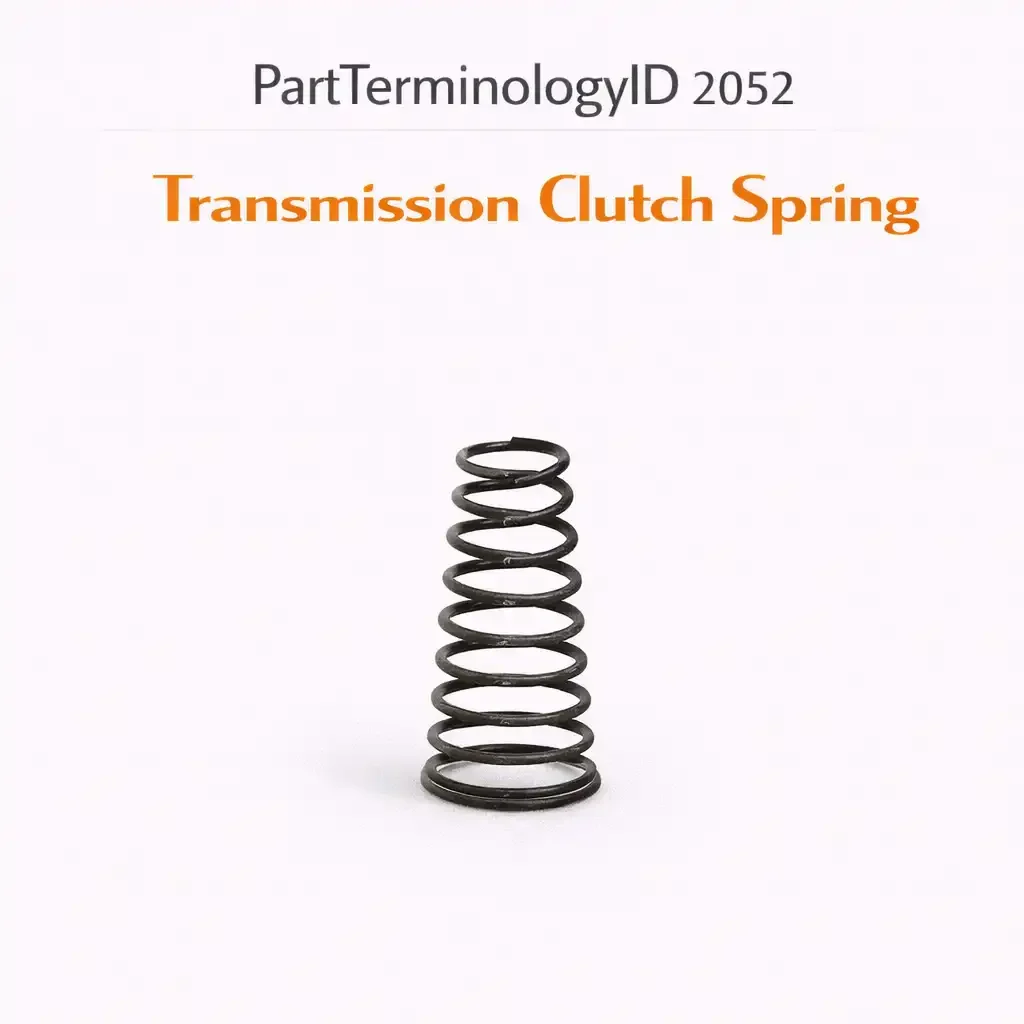
PartTerminologyID 2052, Transmission Clutch Spring, is a spring used somewhere in the clutch system. That is all the PartTerminologyID tells you. It does not specify which spring, where it is installed, what it does, or what it acts on. The clutch system contains multiple springs, each with a different function, a different size, a different spring rate, and a different location. A listing under PartTerminologyID 2052 that does not specify the location is asking the buyer to guess which spring they are ordering, the same problem that PartTerminologyID 2032 (Clutch Retaining Ring) creates for snap rings.
For sellers, the listing under this PartTerminologyID is only useful if it includes a location attribute. Without it, the return rate is determined by the probability that the buyer guesses correctly, which decreases with every additional spring type that exists for their vehicle.
The Springs in the Clutch System
Pressure plate diaphragm spring
The conical Belleville spring inside the pressure plate (PartTerminologyID 1988) that provides the clamping force. This is the largest and most critical spring in the clutch system. It is not sold separately on passenger vehicles because the diaphragm spring is an integral part of the pressure plate assembly. If the diaphragm spring fails (cracks, loses tension, breaks a finger), the entire pressure plate is replaced.
On heavy-duty commercial vehicles with rebuildable pressure plates, the diaphragm spring may be available as a separate service part. If PartTerminologyID 2052 is listed for a commercial vehicle application, it may refer to this spring.
Pressure plate coil springs (Borg and Beck / Long-style)
On older pressure plate designs that use coil springs instead of a diaphragm spring, the individual coil springs are arranged in a circle between the cover and the pressure ring. These springs can be replaced individually if one breaks or loses tension (causing uneven clamping and clutch chatter). On classic vehicle applications, individual coil springs for Borg and Beck and Long-style pressure plates are legitimate service parts under this PartTerminologyID.
Clutch disc torsion springs (hub damper springs)
The small coil springs mounted in windows in the clutch disc's hub plate (the sprung hub discussed in PartTerminologyID 2012). These springs absorb engine torsional vibrations and provide smooth engagement. If the torsion springs break (a failure that causes a metallic rattling noise from the bellhousing and harsh engagement), the clutch disc is replaced as a unit. The torsion springs are not typically sold separately for passenger vehicles.
On heavy-duty clutch discs, individual damper springs may be available as service parts for disc rebuilding.
Clutch fork return spring
The spring that pulls the clutch fork back to its rest position when the clutch pedal is released. This spring ensures the release bearing retracts away from the pressure plate. Without the return spring, the fork may not fully return, leaving the bearing in partial contact with the spinning diaphragm fingers (continuous bearing wear and heat).
The fork return spring is a common service part. It hooks to the fork on one end and to the bellhousing or a bracket on the other end. The spring rate, hook configuration, free length, and mounting points are specific to the fork and bellhousing combination (transmission code).
Release bearing return spring
On some designs, a separate spring pulls the release bearing back on its guide sleeve when the fork retracts. This spring is distinct from the fork return spring and is specific to the bearing and guide sleeve configuration.
Slave cylinder return spring
The spring inside the external slave cylinder (PartTerminologyID 2044) that assists in returning the piston to its rest position. This spring is typically included in slave cylinder rebuild kits (PartTerminologyID 2048) but may also be sold separately under PartTerminologyID 2052.
Clutch pedal return spring
The spring that returns the clutch pedal to the fully up position when the driver removes foot pressure. On some vehicles this is a torsion spring on the pedal pivot. On others it is a coil spring mounted between the pedal arm and the firewall or pedal bracket.
Self-adjusting cable mechanism spring
On vehicles with self-adjusting clutch cables (PartTerminologyID 1972), a spring is part of the self-adjusting mechanism (quadrant-and-pawl, ratcheting sleeve, or spring-loaded adjuster). This spring maintains cable tension as the clutch disc wears.
Why This Part Generates Returns
Buyers order the wrong transmission clutch spring because:
the listing does not specify which spring in the clutch system the part is for
they order a fork return spring and receive a slave cylinder piston spring (or any other cross-match between the six or more spring types)
they do not verify the spring rate, free length, wire diameter, hook type, or coil diameter
they do not verify the transmission code (which determines the fork, the bellhousing, and therefore the fork return spring specification)
they confuse a clutch system spring with a transmission internal spring (detent springs, shift rail springs, synchronizer springs are internal transmission components)
Status in New Databases
PIES/PCdb: PartTerminologyID 2052, Transmission Clutch Spring
PIES 8.0 / PCdb 2.0: No change
Top Return Scenarios
Scenario 1: "This is the wrong spring for my application"
Location mismatch. The buyer needed the fork return spring and received a pedal return spring (or any other combination).
Prevention language: "Location: [clutch fork return spring / release bearing return spring / slave cylinder piston return spring / clutch pedal return spring / pressure plate coil spring / self-adjusting cable spring]. Verify the spring location matches your need."
Scenario 2: "Spring rate is wrong"
Correct location but wrong spring rate for the specific application.
Prevention language: "Spring rate: [X lbs/in or X N/mm]. Free length: [X mm]. Wire diameter: [X mm]. Coil O.D.: [X mm]. Verify specifications match your original spring."
Scenario 3: "Hook configuration doesn't match"
Spring hooks or end configurations do not match the mounting points on the fork, bellhousing, or pedal bracket.
Prevention language: "End type: [hook / loop / straight / closed and ground]. Hook orientation: [parallel / perpendicular]. Verify end configuration matches your mounting points."
Scenario 4: "My vehicle has a CSC, there is no fork return spring"
CSC-equipped vehicle has no fork and therefore no fork return spring.
Prevention language: "[If fork return spring:] For vehicles with mechanical clutch fork. Not for vehicles with concentric slave cylinder (CSC). CSC-equipped vehicles have no clutch fork and do not use a fork return spring."
What to Include in the Listing
Core essentials
PartTerminologyID: 2052
component: Transmission Clutch Spring
location: specific spring and position (mandatory)
spring type: coil, torsion, Belleville, extension, compression
material: spring steel, stainless steel
quantity: 1 (or specify quantity per vehicle)
Fitment essentials
year/make/model/submodel
transmission code (mandatory for fork and bellhousing springs)
engine code (if spring differs by engine)
Dimensional essentials
free length
installed length (if compression or extension spring)
spring rate (lbs/in or N/mm)
wire diameter
coil O.D. and I.D.
end type (hook style, loop, closed, ground)
number of active coils
Image essentials
spring with dimensional callouts (free length, wire diameter, coil diameter)
end/hook detail
installed context showing where the spring mounts and what it acts on
Catalog Checklist for ACES/PIES Teams
PartTerminologyID = 2052
require location attribute (mandatory, non-negotiable)
require spring type
require free length and spring rate
require wire diameter and coil diameter
require end/hook configuration
require transmission code for fork and bellhousing springs
differentiate from transmission internal springs (detent, shift rail, synchronizer)
differentiate from clutch retaining ring (PartTerminologyID 2032)
differentiate from release bearing clip (PartTerminologyID 2024)
flag CSC-equipped vehicles where fork return springs do not apply
FAQ (Buyer Language)
How do I know which clutch spring I need?
Identify the specific location where the spring is missing, broken, or weakened. Common clutch system springs include the fork return spring (external, visible on the bellhousing), the pedal return spring (under the dash at the clutch pedal), and the slave cylinder piston spring (inside the slave cylinder bore). Match the location to the listing and verify the spring dimensions.
Can I use a generic spring from a hardware store?
If the dimensions (free length, wire diameter, coil diameter, spring rate, end configuration) match exactly, a generic spring may work temporarily. However, clutch springs are specified for a particular load and deflection range. A generic spring with the wrong rate can cause the fork to not fully return (too weak), the pedal to feel excessively stiff (too strong), or the slave cylinder to not retract properly.
My clutch fork doesn't return fully. Is it the spring?
Likely. A broken, stretched, or fatigued fork return spring will not pull the fork back to its rest position, leaving the release bearing in partial contact with the pressure plate. Replace the spring. Also inspect the fork pivot (PartTerminologyID 2010 ball stud or 1960 shaft bearing) for binding that could resist the spring's return force.
My clutch pedal doesn't return fully. Is it the spring?
Possibly. A weak or broken pedal return spring will leave the pedal partially depressed. But the same symptom can be caused by a binding clutch pedal pivot bearing (PartTerminologyID 1961) or a seized master cylinder pushrod. Inspect all three before ordering.
Cross-Sell Logic
Clutch Fork (PartTerminologyID 1992, if ordering fork return spring)
Clutch Pivot Ball (PartTerminologyID 2010, inspect with fork spring)
Clutch Release Bearing Clip (PartTerminologyID 2024, inspect with fork hardware)
Clutch Slave Cylinder Kit (PartTerminologyID 2048, if ordering slave piston spring)
Clutch Pedal Bearing (PartTerminologyID 1961, if ordering pedal return spring)
Clutch Cable (PartTerminologyID 1972, if ordering self-adjuster spring)
Frame as "match the spring to the location. Each spring in the clutch system serves a different component."
Final Take for PartTerminologyID 2052
Transmission Clutch Spring (PartTerminologyID 2052) is a generic PartTerminologyID that covers every spring in the clutch system without specifying which one. The listing is only useful with a location attribute. Without it, the buyer is choosing between a fork return spring, a pedal return spring, a slave cylinder piston spring, a pressure plate coil spring, a release bearing return spring, or a self-adjusting cable spring, with no way to verify which one the listing sells.
State the location. State the spring type. State the dimensions and spring rate. State the end configuration. That is the same listing strategy as PartTerminologyID 2032 (Clutch Retaining Ring): the generic PartTerminologyID requires a specific location attribute to become a usable listing.