
Clutch Slave Cylinder Kit (PartTerminologyID 2048): The Fourth Hydraulic Rebuild Kit in This Series and the Same Bore Diameter Problem With a Different Complication
Written by Arthur Simitian | PartsAdvisory
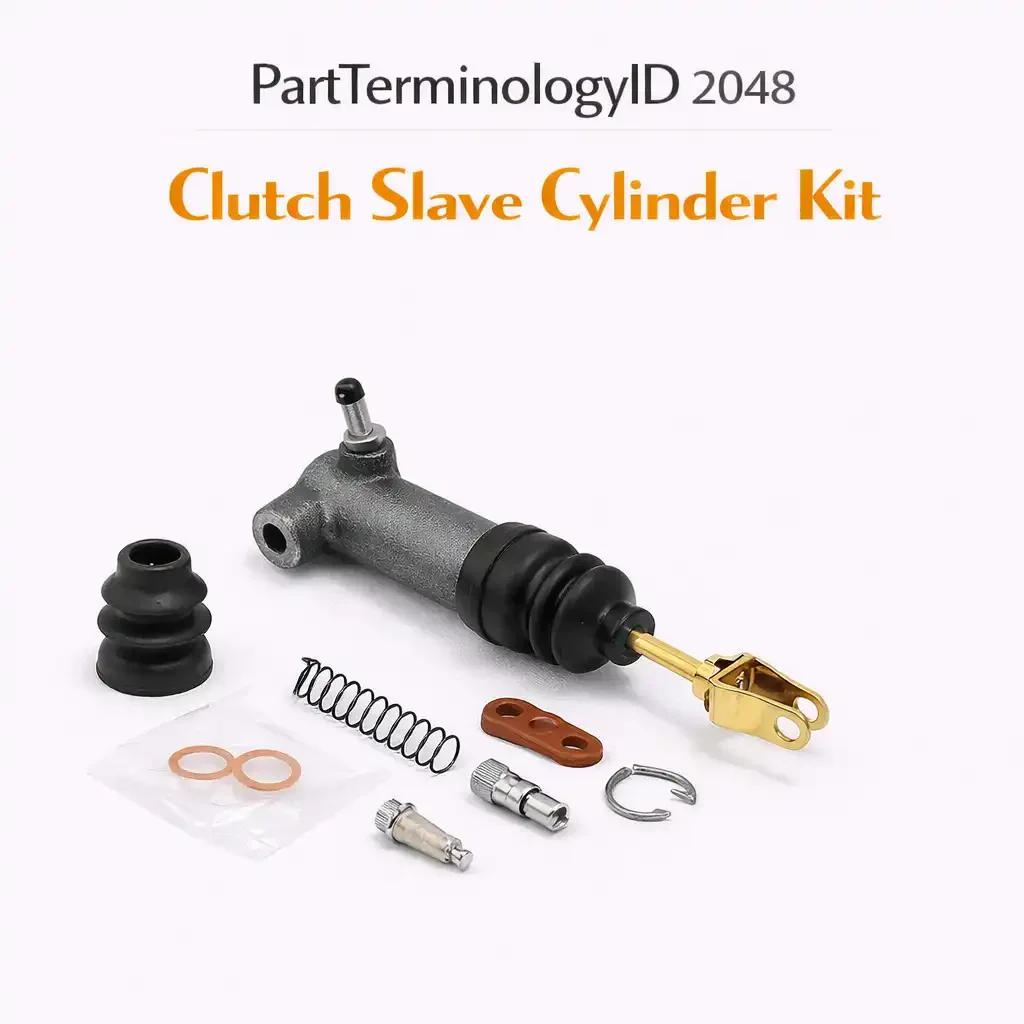
PartTerminologyID 2048, Clutch Slave Cylinder Kit, is a seal and piston rebuild package for the external clutch slave cylinder (PartTerminologyID 2044). It contains the internal wear items needed to restore a leaking slave cylinder to serviceable condition without replacing the entire unit: piston seal, dust boot, return spring, and in some kits the piston itself. The operating logic is identical to every other hydraulic cylinder rebuild kit in this blog series: the brake master cylinder repair kit (PartTerminologyID 1840), the drum brake wheel cylinder kit (PartTerminologyID 1956), and the clutch master cylinder repair kit (PartTerminologyID 2000). If the bore is smooth and undamaged, new seals restore a leak-free seal. If the bore is scored, pitted, or corroded, no seal in any kit will fix it, and the cylinder must be replaced.
The bore diameter is the primary fitment variable. The seals are manufactured to a specific bore tolerance. If the bore does not match, the seals do not seal. This has been the throughline of every rebuild kit post in this series, and it applies here without modification.
But the clutch slave cylinder kit carries a complication that the other three rebuild kits do not: the external slave cylinder is the one hydraulic cylinder in the clutch system that the buyer can access without removing the transmission. This accessibility changes the rebuild-vs.-replace calculus. On the master cylinder (firewall-mounted, accessible), the economics favor replacement because new master cylinders are cheap ($30 to $80). On the slave cylinder (bellhousing-mounted, accessible without transmission removal), the economics still generally favor replacement because new slave cylinders are also cheap ($25 to $120). But the slave cylinder's external position means the buyer can remove it, inspect the bore, rebuild it on the bench, and reinstall it in an afternoon, without committing to a full clutch job.
This accessibility makes the slave cylinder rebuild kit more practically useful than the master cylinder rebuild kit. The buyer does not need to plan a transmission removal to attempt the rebuild. If the bore is bad, they have lost an afternoon, not a weekend. And for the fleet, commercial, classic vehicle, and international markets where rebuilding is standard practice, the slave cylinder kit is a routine maintenance item.
For sellers, the return problem is the same: bore diameter determines seal size, and the listing must state it. But the slave cylinder kit also carries the external-vs.-CSC confusion, the pushrod inclusion question, and the "is the bore rebuildable" uncertainty that drives returns across all hydraulic rebuild kits.
Why This Part Generates Returns
Buyers order the wrong clutch slave cylinder kit because:
they do not know the bore diameter of their slave cylinder, and bore diameter varies by transmission, engine, clutch type, and vehicle weight class (all the splits covered in PartTerminologyID 2044)
they assume all slave cylinders for their vehicle year/make/model have the same bore, when the bore may differ across submodels and drivetrain configurations
they confuse the clutch slave cylinder kit with the clutch master cylinder repair kit (PartTerminologyID 2000), which uses different seals sized for a different bore
they confuse the external slave cylinder kit with a rebuild kit for the concentric slave cylinder (CSC, PartTerminologyID 2020), but CSCs are non-serviceable assemblies with no repair kit available
they order the kit for a vehicle that uses a CSC rather than an external slave cylinder, and discover there is nothing to rebuild (the CSC is replaced as a complete unit)
they expect the kit to include the piston when it only includes seals, or expect the kit to include the pushrod, dust boot, or bleeder valve cap
they order the kit and discover during disassembly that the bore is scored, pitted, or corroded beyond serviceability, making the kit useless and a new slave cylinder necessary
they do not verify the specific slave cylinder manufacturer or part number the kit is designed for (aftermarket slave cylinders from different manufacturers may have slightly different bore dimensions or seal groove locations than OE, even for the same vehicle application)
Sellers get caught because the listing says "clutch slave cylinder kit" with a vehicle fitment and does not specify the bore diameter, the compatible slave cylinder part numbers, or the kit contents. The buyer orders, receives seals sized for a 22mm bore, and discovers their slave cylinder has a 25mm bore. The seals are too small. The kit goes back.
Status in New Databases
PIES/PCdb: PartTerminologyID 2048, Clutch Slave Cylinder Kit
PIES 8.0 / PCdb 2.0: No change
What This Kit Contains
Primary piston seal (cup seal)
The main seal that rides on the piston and prevents pressurized fluid from bypassing the piston during actuation. This is the seal that fails when the pedal sinks or when fluid leaks from the slave cylinder body. On the slave cylinder, the primary seal faces forward (toward the pushrod end) because the pressurized fluid pushes the piston forward. The seal lip is loaded by hydraulic pressure during every clutch actuation cycle.
The seal's outer diameter must match the bore within tight tolerances (typically plus or minus 0.1mm). The seal material (EPDM rubber, nitrile, or silicone compound) must be compatible with DOT 3/DOT 4 brake fluid. Using a seal made for DOT 5 silicone fluid in a DOT 3/4 system (or vice versa) will cause the seal to swell, shrink, or deteriorate rapidly.
Secondary seal (rear seal)
The seal behind the piston that prevents fluid from leaking out the rear of the cylinder bore (toward the hydraulic inlet end). On some slave cylinder designs, the secondary seal is a simple O-ring or lip seal. On others, it is a cup seal identical in form to the primary seal but facing the opposite direction.
Not all slave cylinders have a separate secondary seal. Some designs rely on a single seal on the piston and a static seal at the hydraulic inlet fitting. The kit must match the specific cylinder's seal configuration.
Dust boot
The rubber or silicone boot that covers the pushrod exit from the cylinder body. The boot keeps dirt, water, road spray, and debris out of the bore. Given the slave cylinder's exposed position on the bellhousing (directly in the path of road spray, engine heat, and undercar contamination), the dust boot is critical to bore life. A cracked or missing boot allows contamination that corrodes the bore surface, which causes seal failure, which causes the leak that prompted the rebuild.
On the external slave cylinder, the dust boot takes more environmental abuse than on any other hydraulic cylinder in the clutch or brake system. It is exposed to heat radiation from the exhaust, chemical exposure from road salt and de-icing compounds, and physical damage from road debris. The boot should be replaced with every rebuild, which is why it is included in the kit.
Return spring
The spring inside the bore that pushes the piston back to its rest position when hydraulic pressure drops (pedal released). On some slave cylinder designs, the piston is returned entirely by the fork's return spring force transmitted through the pushrod, and there is no internal return spring. On other designs, a light spring inside the bore assists the return.
If the kit includes a return spring and the original cylinder has no spring (or vice versa), the kit is for a different slave cylinder variant. This is another reason the compatible slave cylinder part number must be cross-referenced.
Piston (in some kits)
Higher-end kits include a new piston. Budget kits include seals only. A piston with scoring, pitting, or corrosion on its sealing surface will damage new seals during installation or within the first few hundred cycles. If the kit does not include a piston, the original piston must be inspected carefully and discarded if damaged.
Pushrod (rarely included)
Most slave cylinder rebuild kits do not include the pushrod. The pushrod is a wear item (the tip wears where it contacts the fork), but it is typically a durable steel rod that outlasts multiple seal sets. If the pushrod tip is significantly worn (cupped, flat-spotted, or mushroomed), it should be replaced, but it is ordered separately.
Bleeder valve cap (occasionally included)
Some kits include a new bleeder valve dust cap. The cap prevents dirt from entering the bleeder valve threads and clogging the bleed passage.
What the kit does NOT include
the slave cylinder body (housing)
the pushrod (usually)
the mounting bracket or hardware
the hydraulic inlet fitting
the hydraulic line to the master cylinder
the bleeder valve itself
What the kit assumes
The bore is in rebuildable condition. This is the same assumption that applies to every rebuild kit in this series. If the bore has visible scoring, pitting, rust, or corrosion that does not clean up with light honing, the cylinder must be replaced with a new unit (PartTerminologyID 2044).
On the external slave cylinder, bore damage is more common than on the master cylinder because the slave is exposed to the undercar environment. Road spray carrying salt, sand, and chemicals enters through a cracked dust boot and attacks the bore surface. The slave cylinder's position near the exhaust subjects it to higher operating temperatures than the firewall-mounted master cylinder, accelerating seal degradation and fluid breakdown.
The buyer should be warned that bore condition is unpredictable until the cylinder is disassembled, and they should have a replacement slave cylinder (PartTerminologyID 2044) available as a backup in case the bore is not serviceable.
Bore Diameter: The Entire Fitment Story (Again)
Every fitment variable that creates bore diameter splits on the complete slave cylinder (PartTerminologyID 2044) applies identically to the rebuild kit. The bore diameter is determined by the transmission, the engine, the clutch type, and the vehicle weight class.
Common bore sizes
External clutch slave cylinder bores typically range from 19mm to 32mm depending on the application. Common sizes include 19.05mm (3/4"), 22.22mm (7/8"), 25.4mm (1"), and 28.57mm (1-1/8"). Heavy-duty and commercial vehicle slave cylinders may have larger bores.
A seal kit for a 22mm bore will not seal a 25mm bore. The seals will slide into the bore (they are too small to resist entry), and they will appear to install correctly. But under hydraulic pressure, fluid will bypass the undersized seal lip, and the system will not hold pressure. The pedal sinks. The buyer returns the kit as "defective seals."
Conversely, a seal kit for a 25mm bore will not install in a 22mm bore. The seals are too large to enter the bore without being forced, which damages the seal lip. Even if the buyer manages to push the oversized seal into the bore, the compressed seal will drag against the bore wall, creating excessive friction and preventing smooth piston movement.
The aftermarket bore variation problem
This is a complication unique to the slave cylinder kit that does not apply to the master cylinder kit (or applies less frequently).
OE slave cylinders have a specific bore diameter. Aftermarket replacement slave cylinders from different manufacturers may have slightly different bore diameters, even for the same vehicle application. Manufacturer A produces a slave cylinder with a 22.00mm bore. Manufacturer B produces one with a 22.20mm bore. Both fit the same vehicle (the external dimensions, mounting, and hydraulic fittings are the same). But the seals from a rebuild kit designed for the 22.00mm bore will be slightly loose in the 22.20mm bore, and the seals from a kit designed for the 22.20mm bore will be slightly tight in the 22.00mm bore.
This means the rebuild kit must be matched to the specific slave cylinder, not just the vehicle. The listing must cross-reference compatible slave cylinder part numbers, not just vehicle fitment. A buyer who installed an aftermarket slave cylinder five years ago and now wants to rebuild it must identify which manufacturer's cylinder they have and order the corresponding kit.
The Rebuild vs. Replace Decision for the External Slave Cylinder
When rebuilding makes sense
The slave cylinder is accessible without transmission removal. Unlike the CSC (which requires pulling the transmission to access), the external slave cylinder can be removed in 15 to 30 minutes. The buyer can remove the cylinder, take it to a bench, disassemble it, inspect the bore, and make a rebuild-or-replace decision without committing to a major disassembly. If the bore is good, they rebuild. If the bore is bad, they drive to the parts store with the old cylinder in hand and buy a new one. Either way, the car is back together the same day.
Classic and vintage vehicles. OE slave cylinders for vehicles from the 1960s through the 1980s may be discontinued or available only as low-quality reproductions. Rebuilding the original OE cylinder with quality seals may produce a better and more reliable result than installing a reproduction cylinder with loose bore tolerances.
European vehicles with expensive OE slave cylinders. On some German and British vehicles, the OE slave cylinder is an integrated unit with specific mounting geometry, pushrod configuration, and bleeder location that is difficult to replicate in the aftermarket. A new OE slave may cost $80 to $150. A seal kit costs $10 to $20.
Fleet and commercial operations. Shops that maintain fleets of work vehicles (delivery vans, utility trucks, fleet cars with manual transmissions) rebuild slave cylinders in volume. The cylinders are inspected, honed if needed, resealed, bench-tested, and returned to inventory as exchange units.
International markets. In markets where new replacement cylinders are expensive relative to local wages, rebuilding is the economic standard.
When replacing makes sense
Most passenger vehicles in the U.S. market. A new aftermarket slave cylinder for a passenger car or light truck costs $25 to $80. A rebuild kit costs $8 to $20. The time to disassemble, clean, inspect, hone, reseal, reassemble, and test the old cylinder exceeds the time to bolt on a new one. The certainty of a factory-fresh bore eliminates the risk of a rebuild that fails in three months because of a bore defect the buyer did not see.
Any cylinder with a visible bore defect. Scoring, pitting, corrosion, or discoloration in the bore that does not clean up with light honing means new seals will not hold. Replace the cylinder.
Any cylinder where the bore has been exposed to contamination. If the dust boot was missing or cracked and road debris has been entering the bore for months or years, the bore surface is likely compromised even if it looks acceptable. The contamination creates microscopic abrasion patterns that eat seals.
DIY buyers without hydraulic rebuild experience. Installing seals in a slave cylinder bore without nicking them on port edges, without rolling the seal lip, and without contaminating the bore with fingerprint oils or debris requires care and a clean workspace. A buyer rebuilding a single cylinder on a garage floor has a higher failure rate than a shop rebuilding twenty cylinders a week on a clean bench.
The CSC Confusion
This is the most critical differentiation for the kit listing. A buyer searching for "clutch slave cylinder kit" may have either an external slave cylinder (PartTerminologyID 2044, rebuildable) or a concentric slave cylinder (PartTerminologyID 2020, NOT rebuildable).
CSCs are non-serviceable. There is no repair kit for a CSC. The CSC is a sealed assembly with integrated bearings, seals, and pistons that is replaced as a complete unit when any component fails. A buyer who orders a "clutch slave cylinder kit" for a CSC-equipped vehicle will receive a bag of seals that they cannot use, because there is no way to disassemble and reseal a CSC.
The listing must state: "This kit is for external clutch slave cylinders (PartTerminologyID 2044) that mount on the outside of the bellhousing and push a mechanical clutch fork. This kit is NOT for concentric slave cylinders (CSC, PartTerminologyID 2020). CSCs are non-serviceable and must be replaced as a complete assembly."
This is the single most important sentence in the listing. Without it, every CSC-equipped buyer who searches for "slave cylinder kit" orders a product they cannot use.
Top Return Scenarios
Scenario 1: "Seals don't fit my bore"
Bore diameter mismatch.
Prevention language: "Designed for slave cylinders with [X mm / X inch] bore diameter. Verify bore size by measuring your slave cylinder bore with a caliper or by cross-referencing your slave cylinder part number: [list compatible part numbers]."
Scenario 2: "My bore is scored, the kit is useless"
Buyer disassembled the cylinder and found an unrebuildable bore.
Prevention language: "This kit requires a slave cylinder bore in serviceable condition (no scoring, pitting, or corrosion that cannot be removed with light honing). If the bore is damaged, replace the slave cylinder (PartTerminologyID 2044). We recommend having a replacement slave cylinder available before beginning disassembly."
Scenario 3: "Kit doesn't include the piston"
Buyer expected a complete rebuild and received seals only.
Prevention language: "Kit includes: [itemized list]. This kit [includes / does not include] a replacement piston. If the piston is not included, the original piston must be undamaged for reuse."
Scenario 4: "My vehicle has a CSC, there is no external slave to rebuild"
CSC-equipped vehicle.
Prevention language: "For external clutch slave cylinders only (PartTerminologyID 2044). Not for concentric slave cylinders (CSC, PartTerminologyID 2020). CSCs are non-serviceable and cannot be rebuilt. If your vehicle has no clutch fork and the hydraulic line enters the bellhousing directly, your vehicle uses a CSC."
Scenario 5: "I have an aftermarket slave cylinder and these seals are slightly too small"
Kit designed for OE bore, buyer has aftermarket cylinder with different bore dimension.
Prevention language: "This kit is compatible with slave cylinder part numbers: [list OE and specific aftermarket part numbers]. Aftermarket slave cylinders from different manufacturers may have different bore diameters. Verify your slave cylinder's bore diameter or part number before ordering."
Scenario 6: "I thought this was a master cylinder repair kit"
Buyer confused slave cylinder seals with master cylinder seals.
Prevention language: "Clutch slave cylinder rebuild kit. For the slave cylinder mounted on the bellhousing (PartTerminologyID 2044). Not for the clutch master cylinder (PartTerminologyID 1996, repair kit PartTerminologyID 2000). Master and slave cylinders have different bore sizes and seal dimensions."
Scenario 7: "Kit includes a return spring but my cylinder doesn't have one"
Kit designed for a different slave cylinder variant that uses an internal return spring.
Prevention language: "Kit includes: [itemized list including/excluding return spring]. Verify kit contents match your specific slave cylinder configuration. Not all slave cylinders use an internal return spring."
Scenario 8: "Rebuilt cylinder leaked within weeks"
Seal nicked during installation, bore has hidden defect, or contaminated fluid degraded the new seal.
Prevention language: "Install seals carefully to avoid nicking on bore edges. Flush the system with fresh DOT 3 or DOT 4 fluid after rebuild. If the rebuilt cylinder leaks within the first 1,000 miles, the bore may have a defect not visible during inspection, or the seal was damaged during installation. Replace the cylinder (PartTerminologyID 2044)."
What to Include in the Listing
Core essentials
PartTerminologyID: 2048
component: Clutch Slave Cylinder Kit (Rebuild Kit)
complete kit contents list (every seal, spring, boot, piston itemized)
piston included: yes/no
pushrod included: yes/no (typically no)
compatible slave cylinder part numbers (OE and aftermarket cross-reference)
type: for external slave cylinders only (NOT for CSC)
quantity: 1 kit (per cylinder)
Fitment essentials
year/make/model/submodel
transmission code (if bore size varies by transmission)
engine code (if bore size varies by engine)
clutch actuation: external hydraulic slave with fork only (exclude CSC and cable vehicles)
Dimensional essentials
bore diameter (mandatory, primary attribute)
primary seal O.D.
secondary seal O.D. (if applicable)
dust boot I.D. and O.D.
spring free length (if included)
piston diameter and length (if included)
Image essentials
all kit contents laid out and labeled
seal diameter callout
cross-section or exploded view showing where each component installs in the slave cylinder bore
bore diameter reference
comparison photo showing this kit relative to the complete slave cylinder it services
Catalog Checklist for ACES/PIES Teams
PartTerminologyID = 2048
require bore diameter attribute (mandatory, non-negotiable)
require kit contents as structured attribute
require piston-included attribute (yes/no)
require compatible slave cylinder part number cross-reference (OE and aftermarket)
require transmission code where bore varies
differentiate from clutch master cylinder repair kit (PartTerminologyID 2000)
differentiate from brake master cylinder repair kit (PartTerminologyID 1840)
differentiate from drum brake wheel cylinder kit (PartTerminologyID 1956)
explicitly state NOT for CSC (PartTerminologyID 2020)
flag cable-actuated vehicles as non-applicable
flag applications where multiple bore sizes exist for the same year/make/model
flag applications where aftermarket slave cylinders have different bore dimensions than OE
FAQ (Buyer Language)
Is it better to rebuild the slave cylinder or replace it?
For most passenger vehicles, replacing is more practical. New slave cylinders cost $25 to $80, and the labor is the same either way. Rebuilding makes sense on classic vehicles (discontinued cylinders), expensive European OE cylinders, fleet operations rebuilding in volume, or when a high-quality aftermarket replacement is not available.
How do I know if my bore is rebuildable?
Remove the piston and seals. Inspect the bore with a bright light. Run your fingernail along the bore wall. Any groove, scratch, or pit you can feel means the bore needs honing at minimum. If the bore has deep pitting, rust below the surface, or scoring that does not clean up with a fine bore hone, the cylinder must be replaced.
Can I use this kit for the master cylinder?
No. The clutch master cylinder (PartTerminologyID 1996) and the clutch slave cylinder (PartTerminologyID 2044) have different bore diameters and different seal dimensions. Their repair kits are not interchangeable.
Can I use this kit for a concentric slave cylinder (CSC)?
No. CSCs (PartTerminologyID 2020) are non-serviceable assemblies. They cannot be disassembled and rebuilt. When a CSC fails, the entire unit is replaced. This kit is only for external slave cylinders.
My slave cylinder has an aftermarket part number I don't recognize. Will this kit fit?
Measure the bore diameter with a caliper. If the bore diameter matches the kit's specified bore diameter, the seals will fit. If the bore is different (even by 0.2mm), the seals may not seal correctly. The safest approach is to match the kit to the slave cylinder part number, not just the vehicle.
Do I need to bleed the system after rebuilding?
Yes. Any time the slave cylinder is removed or opened, air enters the system. Flush with fresh DOT 3 or DOT 4 fluid and bleed thoroughly after reinstallation.
My dust boot keeps cracking. Is there a better material option?
Standard dust boots are EPDM rubber. Some aftermarket kits offer silicone boots, which are more resistant to heat and chemical exposure. If your slave cylinder is in a high-heat location (near the exhaust manifold or catalytic converter), a silicone boot may last longer. However, the boot material must be compatible with DOT 3/4 brake fluid.
Should I rebuild both the master and slave at the same time?
If you are already rebuilding one, inspect the other. Both cylinders contain the same seals in the same fluid and degrade at the same rate. If one has failed, the other is likely near end of life. Rebuilding or replacing both as a pair is the recommended approach.
Cross-Sell Logic
Clutch Slave Cylinder (PartTerminologyID 2044, for buyers whose bore is not rebuildable)
Clutch Master Cylinder Repair Kit (PartTerminologyID 2000, rebuild the master at the same time)
Clutch Master Cylinder (PartTerminologyID 1996, replace the master if not rebuilding)
Brake Fluid (DOT 3 or DOT 4, for flushing and filling after rebuild)
Clutch Bleeder Kit / Pressure Bleeder
Bore Hone (for light bore conditioning before seal installation)
Seal Installation Tool
Clutch Fork Dust Boot (inspect while the slave cylinder is off the bellhousing)
Clutch Fork (PartTerminologyID 1992, inspect pushrod contact surface)
Frame as "rebuild or replace: order the kit if you plan to rebuild, but have a new slave cylinder (PartTerminologyID 2044) available in case the bore is not serviceable. Rebuild or replace the master cylinder at the same time."
The Hydraulic Rebuild Kit Series: A Pattern Across Four PartTerminologyIDs
PartTerminologyID 2048 is the fourth hydraulic cylinder rebuild kit in this blog series. The pattern is now unmistakable:
PartTerminologyID 1840 (Brake Master Cylinder Repair Kit): Seals for the brake master cylinder bore. Bore diameter is the primary attribute. Bore must be serviceable.
PartTerminologyID 1956 (Drum Brake Wheel Cylinder Kit): Seals for the wheel cylinder bore. Bore diameter is the primary attribute. Bore must be serviceable.
PartTerminologyID 2000 (Clutch Master Cylinder Repair Kit): Seals for the clutch master cylinder bore. Bore diameter is the primary attribute. Bore must be serviceable.
PartTerminologyID 2048 (Clutch Slave Cylinder Kit): Seals for the external clutch slave cylinder bore. Bore diameter is the primary attribute. Bore must be serviceable.
The listing formula is the same across all four:
State the bore diameter.
State the kit contents.
Cross-reference compatible cylinder part numbers.
Warn that the bore must be serviceable.
Differentiate from other hydraulic rebuild kits in the catalog.
The bore diameter is the only dimension that changes between the four kits. The listing strategy does not change. The return prevention approach does not change. The catalog checklist does not change. If a catalog team can list one hydraulic rebuild kit correctly, they can list all four correctly, because the fitment logic is identical.
Final Take for PartTerminologyID 2048
Clutch Slave Cylinder Kit (PartTerminologyID 2048) completes the hydraulic rebuild kit quartet. It shares the bore-diameter-is-everything fitment logic with its three predecessors. It adds two complications: the aftermarket bore variation problem (aftermarket slave cylinders from different manufacturers may have different bore dimensions than OE, making the cylinder part number more important than the vehicle fitment) and the CSC confusion (the buyer searching for "slave cylinder kit" may have a non-serviceable CSC that cannot be rebuilt).
State the bore diameter. State the kit contents. Cross-reference compatible slave cylinder part numbers (both OE and aftermarket). State explicitly that this kit is for external slave cylinders, not CSCs. Warn that the bore must be serviceable. Have a replacement cylinder recommendation ready for buyers whose bore does not pass inspection.
Four kits, four bores, one listing formula. The hydraulic rebuild kit is the simplest product in the aftermarket to list correctly, and the most frequently listed without the one attribute that matters.