
Written by Arthur Simitian | PartsAdvisory
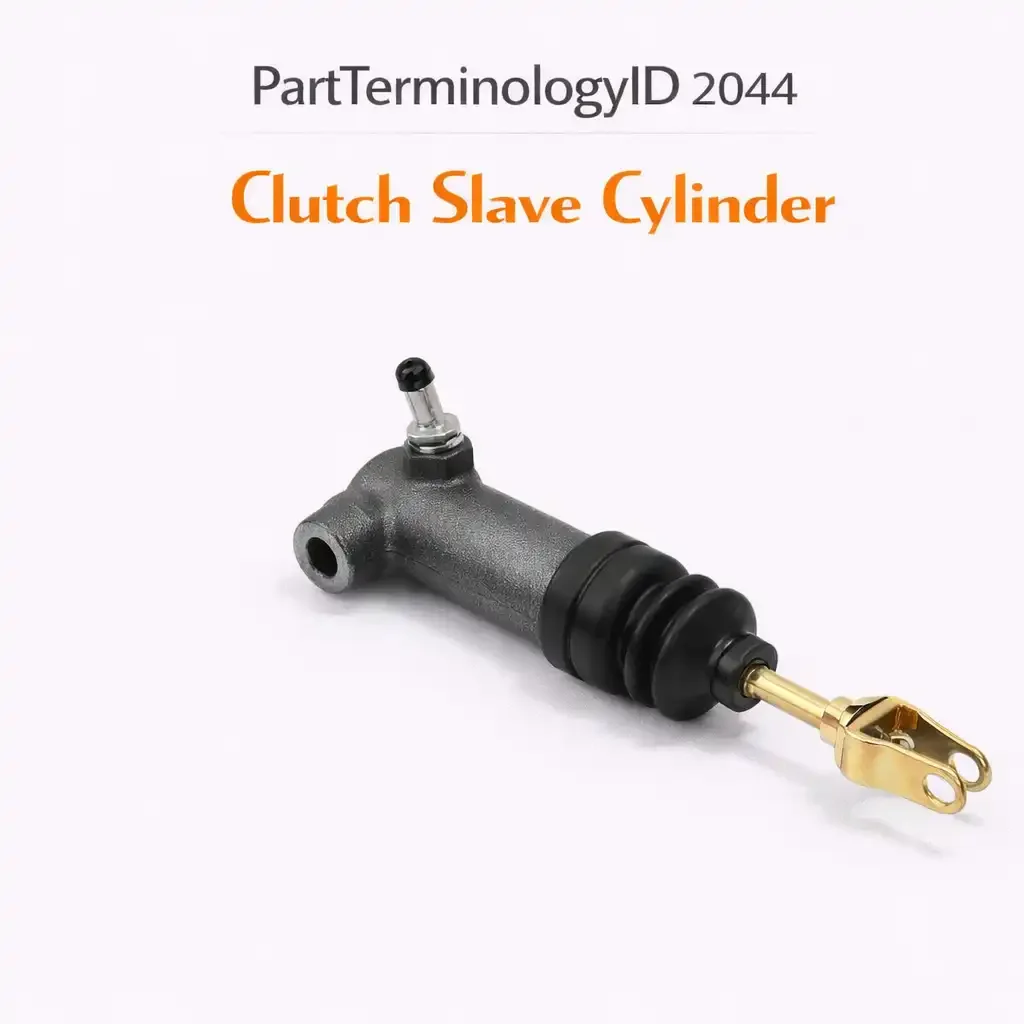
PartTerminologyID 2044, Clutch Slave Cylinder, is the hydraulic actuator mounted on the outside of the transmission bellhousing that converts hydraulic pressure from the clutch master cylinder (PartTerminologyID 1996) into mechanical force to push the clutch fork (PartTerminologyID 1992). The master cylinder sends pressurized brake fluid through a hydraulic line to the slave cylinder. The slave cylinder's internal piston extends, pushes the fork, the fork pushes the release bearing (PartTerminologyID 1968) into the pressure plate's diaphragm spring fingers, and the clutch disengages.
This is the external slave cylinder. It mounts on the outside of the bellhousing. It pushes a mechanical clutch fork. It is a separate component from the concentric slave cylinder (CSC, PartTerminologyID 2020), which is an integrated bearing-and-slave-cylinder assembly that mounts inside the bellhousing and has no fork. The two are not interchangeable. They are different products with different mounting interfaces, different hydraulic specifications, different prices, and different service requirements. The existence of both in the same vehicle catalog is the first and most fundamental listing trap in this category.
When the external slave cylinder fails, the symptom is identical to a failed clutch master cylinder (PartTerminologyID 1996): the clutch pedal sinks under sustained pressure because fluid bypasses the internal piston seal. The driver cannot hold the clutch pedal down at a traffic light without the pedal slowly sinking to the floor. If the failure is an external leak rather than an internal bypass, brake fluid drips from the slave cylinder body onto the bellhousing and the ground, and the reservoir level drops visibly.
For sellers, the external slave cylinder is a moderate-dollar replacement part ($25 to $120) with a fitment matrix that mirrors the master cylinder's in complexity: bore diameter, mounting configuration, pushrod interface, and hydraulic fitting must all match. And it carries additional variables that the master cylinder does not: the pushrod length and tip geometry that interface with the clutch fork, the bleeder valve location, and the mounting position on the bellhousing.
How the External Slave Cylinder Works
The hydraulic circuit position
The external slave cylinder sits at the end of the clutch hydraulic circuit. The circuit flows: clutch pedal, master cylinder, hydraulic line, slave cylinder, clutch fork, release bearing, pressure plate. The slave cylinder is the last hydraulic component in the chain. Everything downstream of it is mechanical.
When the driver presses the pedal, the master cylinder pressurizes fluid. That fluid flows through the hydraulic line (rigid steel tube and/or flexible rubber hose) to the slave cylinder's inlet fitting. The pressure acts on the slave cylinder's internal piston, extending it outward. The piston's pushrod contacts the clutch fork. The fork pivots on its ball stud (PartTerminologyID 2010) or shaft (supported by PartTerminologyID 1960), and the fork pushes the release bearing into the pressure plate.
When the driver releases the pedal, the master cylinder piston retracts, pressure drops, the pressure plate's diaphragm spring pushes the release bearing back, the fork returns, and the slave cylinder piston retracts (pulled back by the fork's return spring force and/or the slave cylinder's internal return spring, depending on the design). Fluid flows back through the line to the master cylinder.
The bore and the hydraulic ratio
The slave cylinder bore diameter, combined with the master cylinder bore diameter, creates the hydraulic ratio that determines pedal feel. The slave cylinder bore is typically larger than the master cylinder bore on clutch systems (the opposite of brake systems, where the master bore is often larger than individual wheel cylinder bores). This is because the clutch system needs the slave cylinder to generate high force over a relatively short stroke to overcome the pressure plate's clamp load.
The hydraulic ratio works like this:
A smaller master cylinder bore pushes a smaller volume of fluid at higher pressure. A larger slave cylinder bore receives that fluid and converts the high pressure into high force over a shorter stroke (because the larger piston area means less linear travel per unit of fluid volume but more force per unit of pressure).
If the slave cylinder bore is wrong, the hydraulic ratio changes. Too large a slave bore: the piston generates more force (good) but less travel (bad, the fork may not push the release bearing far enough to fully disengage the clutch). Too small a slave bore: the piston generates less force (the clutch may not fully release against a stiff pressure plate spring) but more travel (the pushrod over-extends, potentially bottoming out against the fork or bellhousing).
The bore diameter is the primary fitment variable, just as it is for every other hydraulic cylinder in this blog series.
Common bore diameter splits
Transmission type: Different transmissions use different clutch assemblies with different release bearing travel requirements. The slave cylinder bore must be matched to the required travel and force for the specific transmission's clutch.
Clutch type and clamp load: Vehicles available with different clutch options (standard vs. performance, or different pressure plate clamp loads for different engines) may use different slave cylinder bores. A higher-clamp-load pressure plate requires more release force, which may require a larger slave bore or a different hydraulic ratio.
Master cylinder pairing: The slave cylinder bore is specifically matched to the master cylinder bore. If the master has been replaced with a different bore (aftermarket, incorrect replacement, or a master from a different application), the original slave cylinder may no longer provide the correct pedal feel or travel.
Engine type: Heavier engines may use different clutch specifications that require different slave cylinder bores.
The Mounting Configuration
The external slave cylinder mounts to the bellhousing (or to a bracket on the bellhousing) with one or two bolts. The mounting location positions the slave cylinder's pushrod in line with the clutch fork's actuation end. The mounting bolt pattern (bolt count, bolt spacing, bolt thread size) and the cylinder's orientation on the bellhousing must match the bellhousing's provisions.
Mounting variables
Bolt pattern: One-bolt or two-bolt mounting, with specific bolt spacing and thread sizes. The bolt holes on the cylinder must align with the threaded bosses or through-holes on the bellhousing.
Cylinder orientation: The cylinder body may be angled, offset, or rotated relative to the mounting bolts to accommodate the bellhousing's geometry and the fork's position. A cylinder that bolts on but points the pushrod in the wrong direction will not contact the fork, or will contact it at the wrong angle, causing uneven force application and premature fork wear.
Mounting bracket: Some slave cylinders mount directly to the bellhousing casting. Others mount to a separate bracket that is bolted to the bellhousing. The bracket provides flexibility in positioning but adds a variable: the bracket must match the bellhousing, and the slave cylinder must match the bracket.
Transmission code requirement: The bellhousing casting, the fork position, the fork angle, and the mounting boss locations are all determined by the transmission. Different transmissions have different bellhousings with different slave cylinder mounting provisions. The transmission code is a mandatory fitment attribute.
The Pushrod Interface
The slave cylinder's pushrod extends from the cylinder body and contacts the clutch fork's actuation end. The pushrod interface is where the slave cylinder's hydraulic output becomes mechanical force on the fork. The pushrod's length, tip geometry, and contact method must match the fork.
Pushrod length
The pushrod length determines the rest position of the fork and the total travel available. If the pushrod is too long, the fork is pre-loaded against the release bearing, keeping the bearing in constant contact with the spinning pressure plate (bearing wears prematurely, clutch may slip). If the pushrod is too short, there is excessive free play between the pushrod and the fork, and the piston must travel farther before it contacts the fork, reducing the effective bearing travel and potentially preventing full clutch release.
Some slave cylinders have a fixed-length pushrod. Others have an adjustable pushrod (threaded, with a lock nut). Adjustable pushrods allow the technician to set the correct free play during installation. Fixed-length pushrods must be the correct length for the application.
Pushrod tip geometry
The pushrod tip contacts the fork's actuation end. Common tip geometries include:
Flat tip: A flat face on the pushrod contacts a flat or cupped surface on the fork. Simple, common on many applications.
Spherical (ball) tip: A rounded tip that contacts a cupped surface on the fork. Allows angular misalignment between the slave cylinder axis and the fork actuation point.
Cupped tip: A concave tip that receives a spherical ball on the fork end. The inverse of the ball tip design.
Booted tip: A tip covered by a rubber or silicone boot that seals the pushrod exit from the cylinder body, keeping dirt and moisture out of the bore.
If the pushrod tip geometry does not match the fork's receiving surface, the force is applied off-center or at a point contact instead of a surface contact. This accelerates wear on both the pushrod tip and the fork actuation surface, and introduces slop in the pedal feel.
What ships with the slave cylinder
Some slave cylinders ship with the pushrod pre-installed. Some ship with the pushrod as a separate piece in the box. Some ship without a pushrod (the buyer reuses the OE pushrod from the fork). The listing must specify whether the pushrod is included.
The Hydraulic Inlet Fitting
The slave cylinder's hydraulic inlet connects to the clutch hydraulic line. The fitting must match the line's end fitting in thread size, pitch, and flare type.
Thread and flare variables
Common inlet fitting threads include M10 x 1.0, M12 x 1.0, 3/8"-24, and 7/16"-24. The flare type must match the line: double flare (SAE/domestic) or bubble flare (ISO/metric). A thread mismatch prevents connection. A flare mismatch allows connection but causes a leak at the joint.
Fitting orientation
The inlet fitting may point upward, rearward, downward, or at an angle, depending on the cylinder's mounting orientation and the line routing on the bellhousing. If the fitting orientation does not match the line routing, the line will not reach, will kink at the connection, or will interfere with other components.
Banjo fitting vs. flare fitting
Some slave cylinders use a banjo bolt fitting (a hollow bolt through a banjo-style line end) rather than a conventional flare fitting. Banjo fittings require crush washers (copper or aluminum) on both sides of the banjo to seal. A slave cylinder with a banjo fitting port cannot accept a flare-type line, and vice versa.
The Bleeder Valve
The slave cylinder has a bleeder valve (bleed screw) that allows air to be purged from the hydraulic circuit after installation or service. The bleeder valve must be at the highest point of the slave cylinder when installed, so air rises to the bleeder and can be expelled.
Why bleeder position matters for listings
If the slave cylinder is designed for a specific mounting orientation (e.g., mounted horizontally on the bellhousing with the bleeder pointing upward), and the buyer's vehicle mounts the slave at a different angle (rotated 90 degrees, or mounted vertically), the bleeder may end up at the bottom or side of the cylinder instead of the top. Air cannot rise to a bleeder that is not at the highest point, and the system cannot be fully bled. The buyer ends up with a spongy pedal and blames the slave cylinder.
Some slave cylinders have the bleeder on the body of the cylinder. Others have the bleeder integrated into the inlet fitting. Others rely on a remote bleeder in the hydraulic line. The listing should specify the bleeder location so the buyer can verify it will be at the highest point when installed on their vehicle.
The External Slave vs. CSC Confusion
This is the most important differentiation in the slave cylinder category. Two fundamentally different products serve two fundamentally different actuation systems:
External slave cylinder (PartTerminologyID 2044): Mounts on the outside of the bellhousing. Pushes a mechanical clutch fork through a pushrod. Connected by a hydraulic line to the master cylinder. The buyer can see and access the slave cylinder without removing the transmission. Replacement is straightforward: disconnect the hydraulic line, remove the mounting bolts, install the new slave, reconnect the line, bleed the system. No transmission removal required.
Concentric slave cylinder / CSC (PartTerminologyID 2020): Mounts inside the bellhousing, concentric with the input shaft. Integrates the release bearing. No fork. No pushrod. Replacement requires removing the transmission. Cannot be accessed from outside the bellhousing.
A buyer who orders an external slave cylinder for a CSC-equipped vehicle receives a part with a pushrod and a mounting bracket that have no interface inside the bellhousing (there is no fork to push). A buyer who orders a CSC for a vehicle with an external slave receives a $200 hydraulic bearing assembly that has no mounting point on the outside of the bellhousing and no fork to connect to.
The listing must unambiguously state which type is being sold. "Clutch slave cylinder" alone is insufficient. "External clutch slave cylinder, mounts on bellhousing exterior, pushes clutch fork" is clear. "Concentric slave cylinder with integrated release bearing, mounts inside bellhousing" is clear. The product type must be in the title or the first line of the description.
Why This Part Generates Returns
Buyers order the wrong external slave cylinder because:
they do not verify bore diameter
they do not verify the mounting bolt pattern and orientation
they do not verify the pushrod length and tip geometry
they do not verify the hydraulic inlet fitting (thread, flare type, orientation, banjo vs. flare)
they do not verify the bleeder valve location relative to their mounting orientation
they confuse the external slave cylinder with the CSC (PartTerminologyID 2020)
they order for a vehicle with a cable-actuated clutch (no hydraulic system, no slave cylinder)
they do not verify the transmission code (different transmissions have different bellhousing mounting provisions)
they miss the pushrod inclusion (included vs. not included)
they order the slave cylinder without ordering the master cylinder, and the old master fails weeks later (see the "replace as a pair" recommendation)
Status in New Databases
PIES/PCdb: PartTerminologyID 2044, Clutch Slave Cylinder
PIES 8.0 / PCdb 2.0: No change
Diagnostic Returns: The Slave Cylinder That Works but Gets Blamed
The master cylinder is the actual failure
The sinking pedal symptom is identical for master cylinder and slave cylinder internal seal failure. The buyer replaces the slave (it is easier to access) and the symptom persists because the master is the actual failure. The slave cylinder gets returned as "defective."
Listing mitigation: "If your clutch pedal sinks under sustained pressure, the failure may be in the master cylinder, the slave cylinder, or both. Replacing both as a pair eliminates diagnostic guesswork."
Air in the system
The system was not properly bled after the last service. Air compresses under pressure, producing a soft or sinking pedal. The buyer replaces the slave cylinder, fills with fresh fluid, bleeds the system, and the symptom resolves. The fix was the bleeding, not the new slave. The old slave was fine.
Listing mitigation: "Before replacing the slave cylinder, verify the system has been properly bled. Air in the hydraulic circuit causes a soft or sinking pedal that mimics slave cylinder failure."
Contaminated fluid
Moisture-laden fluid produces vapor bubbles under heat. The pedal goes soft intermittently, particularly in hot weather or after sustained clutch use. The buyer replaces the slave, fills with fresh fluid, and the symptom resolves because the fluid change was the fix.
Listing mitigation: "Flush and replace the clutch hydraulic fluid with fresh DOT 3 or DOT 4 brake fluid when installing a new slave cylinder."
Pushrod misadjustment
If the slave cylinder has an adjustable pushrod and the technician sets the length incorrectly, the symptom mimics a failing slave (insufficient release, spongy pedal, or clutch slip). The buyer replaces the slave cylinder when the actual fix is adjusting the pushrod to the correct length.
Listing mitigation: "If this slave cylinder has an adjustable pushrod, set the pushrod length per the vehicle service manual specification before condemning the slave cylinder."
Top Return Scenarios
Scenario 1: "Bore is the wrong size"
Hydraulic ratio mismatch.
Prevention language: "Bore diameter: [X mm]. Verify bore size matches your original slave cylinder. Bore diameter varies by transmission, clutch type, and engine."
Scenario 2: "Mounting bolts don't line up with my bellhousing"
Mounting pattern mismatch.
Prevention language: "Mounting: [bolt count, bolt spacing, thread size]. For vehicles with [transmission code]. Verify mounting pattern matches your bellhousing."
Scenario 3: "Pushrod is too long / too short"
Pushrod length mismatch affecting fork free play and release travel.
Prevention language: "Pushrod: [included (fixed X mm / adjustable X-X mm range) / not included]. Verify pushrod length matches your fork interface. Incorrect length causes clutch slip (too long) or incomplete release (too short)."
Scenario 4: "Hydraulic fitting doesn't match my line"
Fitting thread, flare type, or orientation mismatch.
Prevention language: "Hydraulic inlet fitting: [thread size, pitch, flare type (double/bubble/banjo), orientation]. Verify fitting matches your clutch hydraulic line."
Scenario 5: "My vehicle uses a CSC, not an external slave"
Actuation system mismatch.
Prevention language: "External clutch slave cylinder. Mounts on the outside of the bellhousing and pushes the clutch fork. Not for vehicles with concentric slave cylinder (CSC, PartTerminologyID 2020). If your vehicle has no clutch fork and the hydraulic line enters the bellhousing directly, your vehicle uses a CSC."
Scenario 6: "My vehicle has a cable clutch"
No hydraulic system.
Prevention language: "For vehicles with hydraulic clutch actuation only. Not for vehicles with cable-actuated clutch."
Scenario 7: "Bleeder is on the bottom when installed, can't bleed the system"
Bleeder position incorrect for the vehicle's mounting orientation.
Prevention language: "Bleeder valve location: [position on cylinder body]. The bleeder must be at the highest point when installed. Verify the bleeder location is correct for your vehicle's slave cylinder mounting orientation."
Scenario 8: "Pedal still sinks after replacing the slave"
Master cylinder is the actual failure.
Prevention language: "If the pedal continues to sink after slave cylinder replacement, the master cylinder's internal seal may be the actual failure. Replace the master cylinder and slave cylinder as a pair for complete system restoration."
What to Include in the Listing
Core essentials
PartTerminologyID: 2044
component: Clutch Slave Cylinder (External)
type: external, mounts on bellhousing exterior, pushes clutch fork
condition: new or remanufactured
pushrod: included (fixed/adjustable with length) or not included
quantity: 1
Fitment essentials
year/make/model/submodel
transmission code (mandatory)
engine code (if bore size or mounting varies by engine)
clutch actuation: external hydraulic slave with fork (exclude CSC and cable vehicles)
production date split (if slave cylinder changed mid-year)
Dimensional essentials
bore diameter (mandatory)
pushrod length and tip type (if included)
mounting bolt pattern (count, spacing, thread)
mounting orientation (horizontal, vertical, angled)
overall body length and diameter
Hydraulic essentials
hydraulic inlet fitting (thread size, pitch, flare type, orientation)
banjo vs. flare fitting type
bleeder valve location (position on body)
bleeder valve thread size
fluid type (DOT 3 / DOT 4)
Image essentials
full cylinder showing pushrod, mounting flange, inlet fitting, and bleeder
mounting flange detail with bolt pattern callout
inlet fitting close-up with thread callout
pushrod tip detail
bleeder valve location marked
installed context showing position on bellhousing with fork contact visible
Catalog Checklist for ACES/PIES Teams
PartTerminologyID = 2044
require bore diameter (mandatory)
require transmission code (mandatory)
require mounting bolt pattern
require hydraulic fitting specification (thread, flare type, orientation)
require bleeder valve location
require pushrod inclusion and type (fixed/adjustable/not included)
differentiate from CSC (PartTerminologyID 2020) in listing title and description
differentiate from clutch master cylinder (PartTerminologyID 1996)
flag CSC-equipped vehicles as non-applicable for PartTerminologyID 2044
flag cable-actuated vehicles as non-applicable
flag the external-to-CSC transition year for vehicles that changed mid-generation
cross-reference to compatible master cylinder (PartTerminologyID 1996) bore specification
FAQ (Buyer Language)
Is this the same as a concentric slave cylinder (CSC)?
No. The external slave cylinder (PartTerminologyID 2044) mounts on the outside of the bellhousing and pushes a mechanical clutch fork. The CSC (PartTerminologyID 2020) mounts inside the bellhousing, surrounds the input shaft, and integrates the release bearing with no fork. They serve the same function (converting hydraulic pressure into clutch release force) but are completely different products. They are not interchangeable.
Can I replace the slave cylinder without removing the transmission?
Yes. The external slave cylinder is accessible from outside the bellhousing. Disconnect the hydraulic line, remove the mounting bolts, install the new slave, reconnect the line, and bleed the system. This is one of the key advantages of the external slave over the CSC.
Should I replace the master cylinder at the same time?
It is strongly recommended. The master and slave cylinders contain the same type of seals, are immersed in the same fluid, and experience the same thermal cycling and contamination. If the slave has failed, the master is likely near end of life. Replacing both as a pair eliminates the risk of a master cylinder failure weeks after the slave replacement.
Do I need to bleed the system after replacing the slave cylinder?
Yes. Any time the hydraulic circuit is opened, air enters. The system must be fully bled after slave cylinder replacement. Start by bleeding at the slave cylinder's bleeder valve (with the bleeder at the highest point). Use fresh DOT 3 or DOT 4 fluid. A pressure bleeder or vacuum bleeder produces more reliable results than manual pedal-pump bleeding.
My slave cylinder is leaking externally. Is that the only problem?
An external leak means the piston seal has failed completely enough that fluid is escaping past the seal and out of the cylinder body. Replace the slave cylinder. Also inspect the clutch fork and bellhousing for fluid contamination. If brake fluid has reached the clutch disc (dripped through the fork opening into the bellhousing), the disc friction material may be contaminated and should be replaced.
Can I rebuild the slave cylinder instead of replacing it?
Slave cylinder rebuild kits exist for some applications. The kit includes new piston seals, a dust boot, and a return spring. If the bore is smooth and undamaged, new seals will restore function. However, given the low cost of a new slave cylinder ($25 to $120), most technicians replace rather than rebuild. Rebuilding makes more sense on commercial vehicles or applications where the slave cylinder is expensive or discontinued.
My pushrod keeps popping out of the fork. What is wrong?
The pushrod tip geometry may not match the fork's receiving surface. A flat-tipped pushrod in a concave fork socket may not self-center and can walk off the fork under vibration. Or the pushrod is too short, barely contacting the fork at the extreme end of piston travel, and any vehicle vibration pops the pushrod off the fork. Verify pushrod length and tip geometry match the fork.
The slave cylinder works fine but the clutch pedal is spongy. What else could it be?
A spongy pedal with a functioning slave cylinder is usually air in the system. Re-bleed the system thoroughly. If the sponginess persists, check for a soft (swelling) hydraulic hose that expands under pressure instead of transmitting the pressure to the slave. A swollen hose absorbs hydraulic energy, producing a spongy feel without any cylinder failure.
Cross-Sell Logic
Clutch Master Cylinder (PartTerminologyID 1996, replace as a pair)
Clutch Hydraulic Line / Hose (inspect for swelling, cracking, or corrosion)
Brake Fluid (DOT 3 or DOT 4, for flushing and filling)
Clutch Bleeder Kit / Pressure Bleeder
Clutch Fork (PartTerminologyID 1992, inspect fork contact surface for pushrod wear)
Clutch Pivot Ball (PartTerminologyID 2010, inspect if fork is removed)
Clutch Release Bearing (PartTerminologyID 1968, inspect if bellhousing is opened)
Clutch Fork Dust Boot (inspect seal condition while slave is off)
Slave Cylinder Pushrod (if sold separately and the original is worn)
Copper Crush Washers (for banjo fitting applications)
Frame as "replace master and slave as a pair. Flush the fluid. Bleed the system. Inspect the fork and hydraulic line while the slave is off the bellhousing."
Final Take for PartTerminologyID 2044
Clutch Slave Cylinder (PartTerminologyID 2044) is the receiving end of the clutch hydraulic circuit and the part the buyer can replace without pulling the transmission, which is its primary advantage over the CSC (PartTerminologyID 2020) and the reason many aftermarket buyers and fleet operators prefer the external slave configuration.
The listing must make three things clear. First, this is the external slave, not the CSC. State it in the title, state it in the description, and state what the product does (mounts outside bellhousing, pushes fork). Second, the bore diameter is the primary fitment variable, and it must be specified. Third, the pushrod, the mounting pattern, and the hydraulic fitting must all match the vehicle's transmission and bellhousing.
State the bore. State the mounting pattern. State the pushrod (included, length, tip type). State the fitting (thread, flare, orientation). State the bleeder location. And differentiate from the CSC in language that the buyer cannot misread. Those six attributes prevent the buyer from receiving a cylinder that does not bolt on, does not connect to the line, does not push the fork correctly, or belongs inside a bellhousing they never opened.