
Written by Arthur Simitian | PartsAdvisory
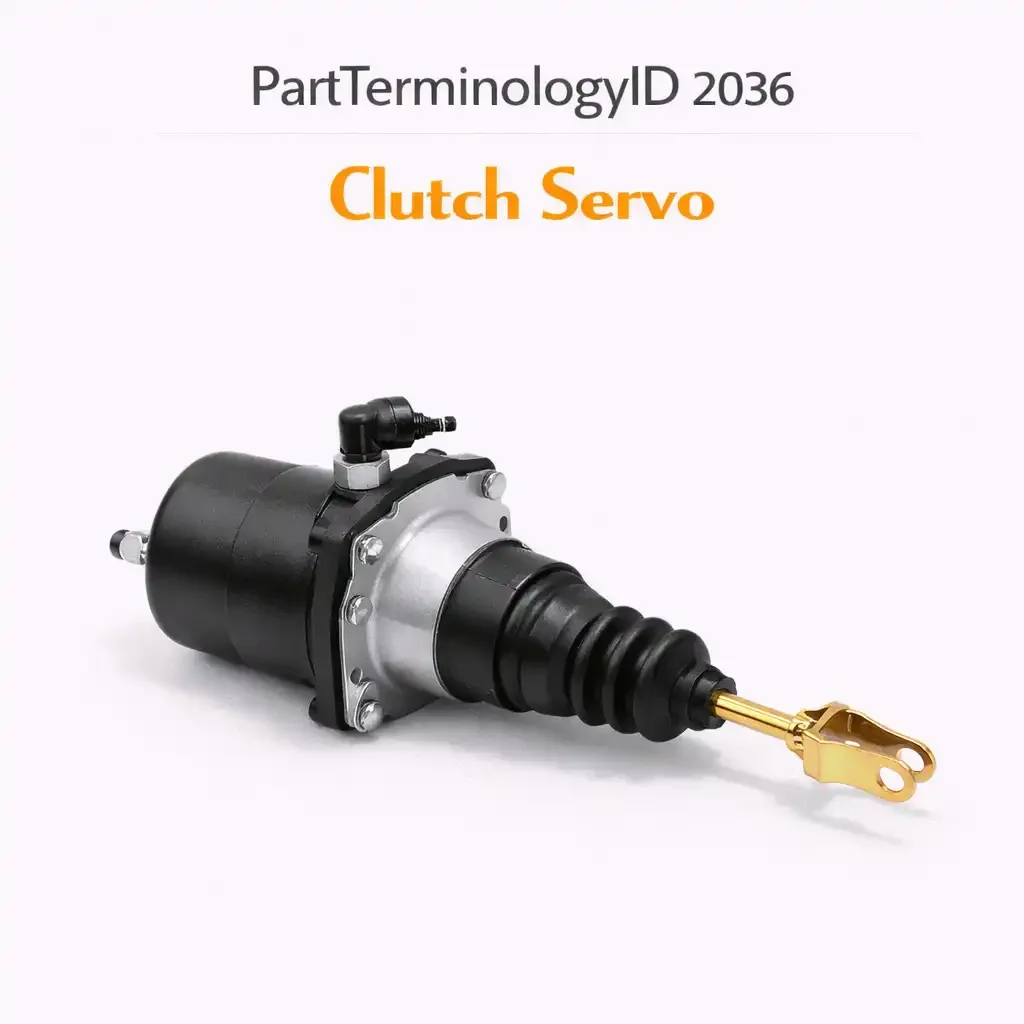
PartTerminologyID 2036, Clutch Servo, is a power-assist device that amplifies the driver's pedal force to actuate the clutch on heavy-duty commercial vehicles. On a Class 6, 7, or 8 truck with a 14-inch or 15.5-inch clutch, the pressure plate clamp load can exceed 3,000 pounds. No driver can generate that kind of release force with leg power alone through a simple hydraulic master-slave circuit. The clutch servo sits between the clutch master cylinder and the release mechanism, using compressed air from the vehicle's air brake system (or in some cases, hydraulic boost from the power steering system) to multiply the driver's pedal force by a factor of three to six, making it physically possible to disengage a clutch that would otherwise require superhuman effort.
The clutch servo is to a heavy-duty clutch what the brake booster is to a passenger vehicle brake system: a force multiplier that makes the system operable with normal human effort. Without it, the driver cannot disengage the clutch. With a failed servo, the pedal becomes impossibly stiff, the clutch does not fully release, the driver cannot shift gears without grinding, and the vehicle is effectively disabled.
This is a commercial vehicle component. It does not appear on passenger cars, light-duty pickup trucks, or SUVs. It appears on medium-duty and heavy-duty trucks (Freightliner, Kenworth, Peterbilt, International, Volvo, Mack, Western Star), buses, and heavy commercial equipment with manual transmissions. The aftermarket for this part is served by commercial vehicle parts distributors, fleet maintenance operations, and heavy-duty specialty retailers. It is not a part that appears in the typical passenger vehicle parts catalog, and its fitment variables are fundamentally different from anything else in this blog series.
For sellers, the clutch servo is a high-dollar replacement part ($200 to $800) with a fitment matrix determined by the vehicle's air system pressure, the clutch type and size, the transmission, and the mounting configuration. The listing must speak to a commercial vehicle buyer or fleet maintenance technician who understands air systems, hydraulic circuits, and heavy-duty clutch specifications but who still needs the listing to specify the exact servo model, the boost ratio, the port configuration, and the mounting dimensions to confirm compatibility with their vehicle.
How the Clutch Servo Works
The basic circuit
On a heavy-duty vehicle with a pneumatic clutch servo, the clutch actuation circuit has four major components:
Clutch master cylinder: Mounted on the firewall at the clutch pedal, identical in principle to the passenger vehicle clutch master cylinder (PartTerminologyID 1996). The driver's pedal force pushes the master cylinder piston, generating hydraulic pressure.
Clutch servo (booster): Mounted on the transmission or the vehicle frame, between the master cylinder and the release mechanism. The servo receives the hydraulic signal from the master cylinder and uses compressed air to amplify the force. The output is either a mechanical pushrod that actuates the clutch release fork or a hydraulic output that pressurizes a slave cylinder at higher force than the master cylinder alone could generate.
Air supply: Compressed air from the vehicle's air brake system reservoir, regulated to the servo's operating pressure (typically 100 to 120 PSI on highway trucks). The air supply enters the servo through an air inlet port and is controlled by an internal valve that modulates air pressure proportionally to the hydraulic input signal.
Release mechanism: The clutch release fork, release bearing, and cross shaft (or yoke) that physically disengage the clutch. On heavy-duty vehicles, the release mechanism is often a cross shaft assembly that provides additional mechanical advantage beyond what the servo provides.
The proportional amplification
The key engineering feature of the clutch servo is proportional control. The servo does not simply apply full air pressure when the pedal is pressed. It modulates the air boost proportionally to the driver's pedal input. Light pedal pressure produces light servo boost. Full pedal pressure produces full servo boost. The driver maintains feel and modulation despite the massive force multiplication, which is critical for smooth clutch engagement when launching a fully loaded tractor-trailer at low speed.
The proportional control is achieved by a balance valve inside the servo. The hydraulic pressure from the master cylinder acts on one side of the balance valve. The air pressure acts on the other side. The valve opens proportionally to the hydraulic input, admitting air to the boost chamber in proportion to the pedal force. When the driver holds the pedal at a partial position, the air pressure stabilizes at a proportional level, and the clutch is held at a corresponding partial release.
Servo types by output
Air-over-hydraulic servo: The most common type on modern heavy-duty vehicles. The servo receives hydraulic input from the master cylinder, uses air pressure to amplify the force, and delivers an amplified hydraulic output to a slave cylinder at the clutch. The entire circuit from pedal to clutch is hydraulic, with the servo providing the air-powered force multiplication in the middle of the hydraulic line.
Air-assisted mechanical servo: An older design where the servo receives hydraulic input and delivers a mechanical pushrod output. The pushrod directly actuates the clutch release fork or cross shaft. This design is simpler but less common on modern vehicles because the hydraulic-output design provides smoother modulation and easier routing.
Hydraulic boost servo: Less common. Instead of compressed air, the servo uses hydraulic pressure from the power steering pump to amplify the clutch actuation force. This design is used on some vehicles that do not have a compressed air system (medium-duty trucks with hydraulic brakes rather than air brakes). The operating principle is the same (proportional force amplification) but the boost source is different.
The air supply dependency
The clutch servo depends on the vehicle's air system for boost pressure. If the air system pressure drops below the servo's minimum operating threshold (typically 60 to 80 PSI), the servo cannot provide full boost. The clutch pedal becomes heavy, and the driver may not be able to fully disengage the clutch. This is why heavy-duty vehicles have low air pressure warning systems and why drivers are trained to build air pressure before moving the vehicle.
On vehicles with air-over-hydraulic servos, a complete loss of air pressure makes the clutch pedal extremely stiff but does not make the clutch completely inoperable. The driver can still actuate the clutch with brute force through the hydraulic circuit alone (the servo passes the hydraulic signal through even without boost), but the pedal effort is extreme and the driver cannot sustain it for normal driving. This is a limp-home capability, not a normal operating mode.
Why This Part Generates Returns
Buyers order the wrong clutch servo because:
they do not verify the servo type (air-over-hydraulic, air-assisted mechanical, or hydraulic boost)
they do not verify the boost ratio (which determines how much the servo amplifies the input force and must match the clutch size and pressure plate clamp load)
they do not verify the hydraulic port configuration (inlet and outlet port thread sizes, port locations, and the number of ports)
they do not verify the air inlet port size and location
they do not verify the mounting configuration (bolt pattern, mounting bracket, and orientation on the transmission or frame)
they do not verify the pushrod length and tip configuration (on mechanical-output servos)
they do not verify the hydraulic output pressure rating (on air-over-hydraulic servos)
they do not verify compatibility with their vehicle's air system pressure (some servos are rated for 100 PSI systems, others for 120 PSI or higher)
they order based on the truck make and model without specifying the clutch type (a Freightliner with an Eaton Fuller transmission and a 14-inch Eaton clutch uses a different servo than the same truck with a 15.5-inch Spicer clutch)
they confuse the clutch servo with the air brake booster, the exhaust brake servo, or other pneumatic actuators on the vehicle
they order a servo for a vehicle that has been converted from a manual to an automated manual transmission (AMT), which may use a different actuation system
Sellers get caught because the clutch servo is a commercial vehicle part where the vehicle "make and model" is insufficient for fitment. Heavy-duty trucks are configured to order. The same Kenworth T680 can have three different engines, four different transmissions, two different clutch sizes, and multiple servo configurations depending on the spec sheet. Year/make/model narrows the field but does not resolve the fitment.
Status in New Databases
PIES/PCdb: PartTerminologyID 2036, Clutch Servo
PIES 8.0 / PCdb 2.0: No change
Fitment Variables Unique to Commercial Vehicles
Clutch size and type
Heavy-duty clutches are classified by diameter (14-inch, 15.5-inch) and by type (pull-type or push-type). The clutch type determines the direction of force the release mechanism applies to the pressure plate.
Pull-type clutch: The release bearing pulls the pressure plate's release mechanism toward the transmission (away from the engine). This is the dominant design on modern heavy-duty vehicles (Eaton, Dana/Spicer). The servo's output must be calibrated for pull-type actuation: the force direction, the travel distance, and the release bearing movement are all specific to pull-type geometry.
Push-type clutch: The release bearing pushes the pressure plate's diaphragm spring toward the engine (the same direction as passenger vehicle clutches). Push-type is less common on modern Class 8 trucks but is still found on some medium-duty and older heavy-duty applications. The servo's output calibration is different from pull-type.
A servo calibrated for a 14-inch pull-type clutch produces the wrong force and travel for a 15.5-inch push-type clutch. The clutch size and type are mandatory fitment attributes.
Transmission type
The transmission determines the release mechanism geometry (cross shaft position, release bearing travel, fork or yoke configuration) and the servo mounting location. Common heavy-duty transmissions include Eaton Fuller (9, 10, 13, 15, 18-speed), Allison (manual and AMT), Meritor, and ZF. Each transmission family has specific servo mounting provisions and release mechanism interfaces.
Engine type and air system
The engine determines the air compressor capacity and the regulated air pressure available to the servo. Detroit Diesel, Cummins, PACCAR, Volvo, and Navistar engines produce different air system configurations. The servo must be compatible with the available air pressure and volume.
Cab configuration
On cab-over-engine (COE) vehicles vs. conventional cab vehicles, the master cylinder-to-servo hydraulic line length and routing differ. The servo may mount in a different location (frame rail vs. transmission case) depending on the cab configuration. Some servos include specific hydraulic line fittings for the cab configuration.
Self-adjusting clutch compatibility
Modern heavy-duty self-adjusting clutches (Eaton Advantage, Dana Solo, etc.) maintain consistent release bearing position as the clutch disc wears. The servo must be compatible with the self-adjusting mechanism's operating characteristics. Some self-adjusting clutches require a servo with a specific output travel range to avoid interfering with the adjuster mechanism.
The Rebuild vs. Replace Decision
Unlike passenger vehicle clutch components where replacement is almost always more economical than rebuilding, heavy-duty clutch servos occupy a price range ($200 to $800 new, some OE units over $1,000) where rebuilding is a legitimate and common practice.
Rebuilding
Servo rebuild kits are available from major heavy-duty aftermarket suppliers. A rebuild kit typically includes the internal seals (hydraulic piston seals, air piston seals, balance valve seals), the dust boots, the return springs, and sometimes the balance valve assembly. The servo housing, the air cylinder, and the hydraulic cylinder are reused if they are not scored, corroded, or cracked.
Fleet maintenance shops routinely rebuild clutch servos on a bench as part of their preventive maintenance cycle. The servo is removed, disassembled, inspected, rebuilt with new seals, tested on a bench, and returned to the shelf as a ready-to-install exchange unit.
The rebuild kit's fitment is determined by the servo model number, not by the vehicle. The servo model number identifies the bore sizes, the seal dimensions, the spring rates, and the valve configuration. The listing for a rebuild kit must specify the compatible servo model numbers.
Replacing
For independent shops, owner-operators, and operations without bench-rebuild capability, a new or remanufactured servo is the standard repair. New servos from aftermarket suppliers typically cost 40 to 60 percent less than OE units. Remanufactured servos (factory-rebuilt with new seals, tested, and warranted) are an intermediate option.
The replacement servo must match the original in every specification: type, boost ratio, port configuration, mounting, and clutch compatibility.
Top Return Scenarios
Scenario 1: "Hydraulic ports don't match my lines"
Port thread size, count, or location mismatch.
Prevention language: "Hydraulic inlet port: [thread size, location]. Hydraulic outlet port: [thread size, location]. Air inlet port: [thread size, location]. Verify all port configurations match your vehicle's hydraulic and air lines."
Scenario 2: "Servo is for a push-type clutch, I have pull-type"
Clutch type mismatch affecting output direction and calibration.
Prevention language: "For vehicles with [pull-type / push-type] clutch. Verify your clutch actuation type. Pull-type and push-type servos are not interchangeable."
Scenario 3: "Mounting bracket doesn't fit my transmission"
Mounting bolt pattern or bracket configuration mismatch.
Prevention language: "Mounting configuration: [bolt count, bolt spacing, bracket type]. For [transmission type]. Verify servo mounting matches your transmission or frame mounting provisions."
Scenario 4: "Boost ratio is wrong, pedal is too heavy / too light"
Servo boost ratio does not match the clutch's clamp load.
Prevention language: "Boost ratio: [X:1]. Designed for [14-inch / 15.5-inch] [pull-type / push-type] clutch with [X lbs] clamp load. Verify servo boost ratio matches your clutch specification."
Scenario 5: "Servo is air-over-hydraulic but I need mechanical output"
Output type mismatch.
Prevention language: "Output type: [hydraulic / mechanical pushrod]. Verify your vehicle's clutch release mechanism matches this servo's output type."
Scenario 6: "Not compatible with my self-adjusting clutch"
Servo travel range interferes with the clutch's self-adjusting mechanism.
Prevention language: "Compatible with [self-adjusting / non-adjusting] clutch systems. Verify compatibility with your clutch's adjustment mechanism. Self-adjusting clutches may require specific servo travel specifications."
Scenario 7: "Air system pressure too low for this servo"
Vehicle's air system operating pressure is below the servo's minimum.
Prevention language: "Minimum air supply pressure: [X PSI]. Maximum air supply pressure: [X PSI]. Verify your vehicle's regulated air system pressure is within this range."
Scenario 8: "I need a rebuild kit, not a complete servo"
Buyer wanted to rebuild their existing servo and received a complete new unit (or vice versa).
Prevention language: "This listing is for a [complete clutch servo assembly / clutch servo rebuild kit (seals and internal components only)]. If you need a [rebuild kit / complete servo], see [alternative listing]."
What to Include in the Listing
Core essentials
PartTerminologyID: 2036
component: Clutch Servo (Clutch Booster)
servo type: air-over-hydraulic, air-assisted mechanical, or hydraulic boost
output type: hydraulic or mechanical pushrod
condition: new, remanufactured, or rebuild kit
OE part number cross-reference
quantity: 1
Fitment essentials
vehicle make/model/year (truck, bus, or equipment)
engine type
transmission type and model
clutch size (14-inch, 15.5-inch)
clutch type (pull-type or push-type)
clutch manufacturer and model (Eaton, Dana/Spicer, etc.)
self-adjusting clutch: yes/no
cab configuration (COE vs. conventional, if servo or line routing differs)
Performance essentials
boost ratio
minimum and maximum air supply pressure (PSI)
hydraulic input pressure range
hydraulic output pressure (or mechanical output force)
piston travel (stroke length)
Dimensional and port essentials
hydraulic inlet port: thread size, location (top, bottom, side, rear)
hydraulic outlet port: thread size, location
air inlet port: thread size, location
bleeder valve location and thread size (if equipped)
mounting bolt pattern (bolt count, spacing, thread size)
mounting bracket type and orientation
pushrod length and tip type (mechanical output servos)
overall dimensions (length, width, height)
weight
Image essentials
full servo showing all ports labeled (hydraulic in, hydraulic out, air in)
mounting bracket detail with bolt pattern callout
port thread close-ups
pushrod end detail (mechanical output type)
installed context showing position relative to transmission and air system
dimensional callouts (overall length, width, height)
Catalog Checklist for ACES/PIES Teams
PartTerminologyID = 2036
require servo type (air-over-hydraulic, air-assisted mechanical, hydraulic boost)
require output type (hydraulic, mechanical)
require clutch size and type (pull/push)
require transmission type
require boost ratio
require air pressure range
require all port specifications (thread, location)
require mounting configuration
require OE part number cross-reference (essential for commercial vehicle parts)
differentiate from air brake boosters, exhaust brake servos, and other pneumatic actuators
differentiate rebuild kits from complete servo assemblies
flag self-adjusting clutch compatibility
flag AMT-converted vehicles where the servo may not apply
FAQ (Buyer Language)
What happens if the clutch servo fails while driving?
The clutch pedal becomes extremely stiff. The driver may still be able to disengage the clutch with maximum leg force (the hydraulic circuit passes through the servo even without boost), but the effort required is not sustainable for normal driving. The vehicle should be driven to the nearest safe location and the servo should be replaced before resuming normal operation. Do not attempt to drive in heavy traffic or mountainous terrain with a failed servo.
Can I drive without the clutch servo?
In an emergency, the driver can sometimes actuate the clutch without servo boost by applying maximum force to the pedal. This is a limp-home capability, not a normal operating mode. The pedal effort without boost can exceed 150 pounds of force on a heavy-duty clutch. Sustained driving without servo boost will fatigue the driver and may cause the driver to under-release the clutch, leading to grinding on shifts and accelerated clutch wear.
How do I know if my servo is failing?
Common symptoms include gradually increasing pedal effort (the servo is losing boost capacity due to internal seal wear), inconsistent pedal feel (the balance valve is sticking or not modulating proportionally), air hissing from the servo during pedal actuation (air seal leak), or hydraulic fluid leaking from the servo body (hydraulic seal failure). Any of these symptoms should be investigated promptly.
Can I rebuild the servo myself?
If you have experience rebuilding hydraulic and pneumatic cylinders, the process is straightforward: disassemble, inspect all bore surfaces and pistons, replace all seals and springs per the rebuild kit, reassemble to torque specifications, and bench-test before installation. If you do not have this experience, purchase a new or remanufactured servo. Incorrectly rebuilt servos can fail catastrophically (loss of clutch control on a loaded heavy-duty vehicle is a safety-critical event).
My truck has an automated manual transmission (AMT). Does it use a clutch servo?
Some AMTs use a conventional clutch servo with an electronic actuator controlling the servo instead of the driver's pedal. Others use a completely different actuation system (electric motor, dedicated hydraulic actuator) that does not use a traditional servo. If your vehicle has been converted from a manual transmission to an AMT, or if the vehicle was factory-equipped with an AMT, verify the actuation system type before ordering a servo.
What is the difference between a clutch servo and a brake booster?
Both are pneumatic force multipliers, but they serve different systems. The clutch servo amplifies force in the clutch actuation circuit. The brake booster (or air brake actuator) amplifies force in the braking circuit. They have different boost ratios, different port configurations, different mounting locations, and different internal calibrations. They are not interchangeable.
How often should the clutch servo be replaced?
There is no fixed replacement interval. The servo should be inspected during every clutch service (which on a heavy-duty vehicle may occur every 200,000 to 500,000 miles depending on the clutch type and operating conditions). If the servo shows any signs of seal leakage, inconsistent boost, or excessive pedal effort, rebuild or replace it during the clutch service. Many fleet operations rebuild the servo as a preventive measure with every clutch replacement to avoid an in-service failure between clutch jobs.
My servo is leaking air. Can I just replace the seals?
Yes, if the servo bore surfaces are in good condition. Order a rebuild kit for your specific servo model number (not just the vehicle make/model). The rebuild kit will include the air seals, hydraulic seals, and springs needed to reseal the servo. If the bore surfaces are scored or corroded, the servo must be replaced because new seals will not hold in a damaged bore.
Is the clutch servo the same as the clutch booster?
Yes. "Clutch servo" and "clutch booster" are two names for the same component. Both terms appear in the aftermarket. European vehicle manufacturers tend to use "servo." North American manufacturers and aftermarket suppliers use both terms interchangeably.
Cross-Sell Logic
Clutch Servo Rebuild Kit (if the buyer prefers to rebuild rather than replace)
Clutch Master Cylinder (heavy-duty, matched to the servo's hydraulic input)
Clutch Release Bearing (heavy-duty, matched to the clutch and cross shaft)
Clutch Cross Shaft / Release Yoke
Air System Components (air lines, fittings, check valves for the servo air supply)
Hydraulic Lines (master cylinder to servo, servo to slave cylinder)
Clutch Disc and Pressure Plate (heavy-duty, 14-inch or 15.5-inch)
Clutch Adjustment Tools (for self-adjusting clutch systems)
Brake Fluid (DOT 3 or DOT 4 for the hydraulic circuit)
Frame as "replace or rebuild the servo during every clutch service. Inspect the air supply lines and hydraulic lines at the same time. A servo that leaks air or fluid between clutch jobs can disable the vehicle."
The Commercial Vehicle Listing Challenge
The clutch servo highlights a fundamental difference between passenger vehicle and commercial vehicle aftermarket catalogs. Passenger vehicles are identified by year/make/model/submodel, and the ACES database maps parts to vehicles at this level. Commercial vehicles are configured to order: the same Peterbilt 579 model year can have dozens of engine/transmission/clutch/axle combinations depending on the fleet's specification sheet.
For commercial vehicle parts, the OE part number cross-reference is often more important than the vehicle fitment. The fleet maintenance technician looks at the part number on the existing servo, cross-references it to an aftermarket equivalent, and orders the match. The listing must include the OE part number and all major aftermarket cross-references to be discoverable by these buyers.
Additionally, commercial vehicle parts buyers expect detailed specifications (boost ratio, port configurations, pressure ratings) that passenger vehicle buyers rarely look for. The listing must provide these specifications because the commercial buyer will use them to verify compatibility with their specific vehicle configuration.
Final Take for PartTerminologyID 2036
Clutch Servo (PartTerminologyID 2036) is a heavy-duty commercial vehicle component that brings an entirely different fitment paradigm to the clutch catalog. Year/make/model is insufficient. The servo must match the clutch size, clutch type (pull vs. push), transmission, air system pressure, and mounting configuration. The boost ratio must match the clutch's clamp load. The port specifications must match the hydraulic and air lines. The output type must match the release mechanism.
This is not a part that fits because the vehicle matches. It is a part that fits because every specification matches. The OE part number cross-reference is the primary identification method. The detailed port, pressure, and dimensional specifications are the verification method. And the clutch size and type are the knockout criteria that prevent the most common mismatch: a servo calibrated for one clutch installed on a vehicle with a different clutch.
State the servo type. State the boost ratio. State the clutch compatibility. State the port configuration. State the mounting pattern. Cross-reference the OE part number. That is the listing strategy for a component where the buyer already knows what they need and is looking for the listing that proves it matches.