
Written by Arthur Simitian | PartsAdvisory
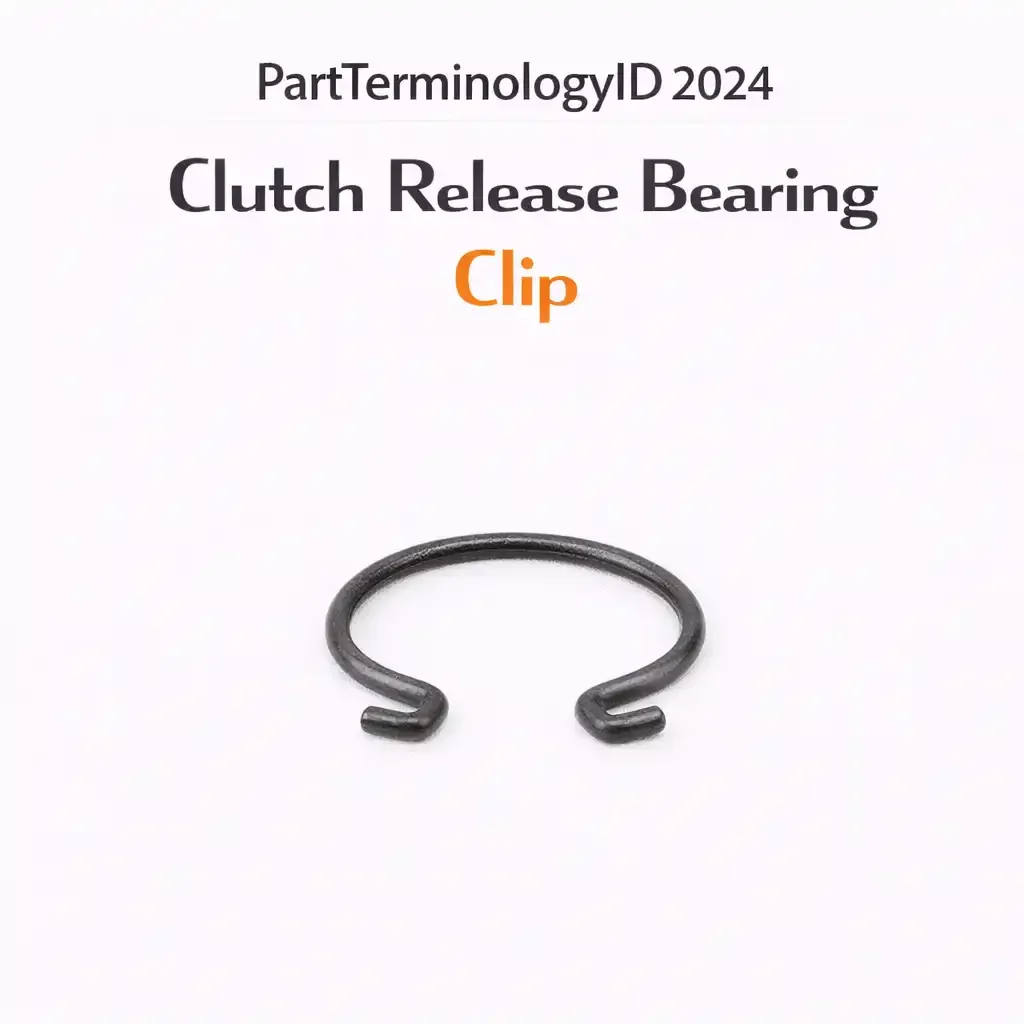
PartTerminologyID 2024, Clutch Release Bearing Clip, is the spring steel retaining clip that secures the clutch release bearing (PartTerminologyID 1968) to the clutch fork (PartTerminologyID 1992). On conventional fork-actuated clutch systems, the release bearing does not simply rest on the fork. It must be positively retained so that when the fork pulls back (pedal released), the bearing pulls back with it, away from the pressure plate's diaphragm spring fingers. Without the clip, the bearing can stay in contact with the spinning pressure plate at all times, spinning continuously, overheating, and failing in thousands of miles instead of tens of thousands.
The clip is a small, formed spring steel piece that snaps onto the fork's bearing contact fingers and engages a groove, ridge, or retaining feature on the release bearing collar. It is a two-dollar part that the technician removes during disassembly, sets on the workbench, and loses under a shop rag. When the new bearing and fork go in, the old clip is missing, the new bearing did not come with a clip, and the technician either installs without one (bearing not retained, premature failure) or scrambles to find a replacement.
This is the catalog reality of PartTerminologyID 2024. It is not a part buyers search for proactively. It is a part buyers need urgently when the old one disappears during a clutch job.
Why This Part Generates Returns
Buyers order the wrong release bearing clip because:
they do not verify the clip style (wire clip, stamped steel clip, C-clip, E-clip, or formed spring retainer, each with different geometry)
they do not verify the fork finger dimensions the clip must engage (finger width, finger spacing, finger thickness)
they do not verify the bearing collar dimensions the clip must engage (collar groove diameter, groove width, ridge height)
they confuse the release bearing clip with other small retaining clips in the clutch system (the fork pivot shaft retaining clip, the pedal pushrod clip, the cable end retaining clip)
they order a clip for a vehicle that uses a concentric slave cylinder (CSC, PartTerminologyID 2020), which has no fork and therefore no fork-to-bearing retaining clip
they assume the clip is included with the new release bearing or the clutch kit and discover it is not (some bearings include the clip, many do not)
Sellers get caught because the clip listing typically provides a vehicle fitment and a thumbnail image of a small metal clip. The clip style, the fork interface dimensions, and the bearing interface dimensions are omitted. The buyer orders based on vehicle match, and the clip arrives with the wrong geometry for their fork and bearing combination.
Status in New Databases
PIES/PCdb: PartTerminologyID 2024, Clutch Release Bearing Clip
PIES 8.0 / PCdb 2.0: No change
Clip Styles
Wire clip (spring wire retainer)
A formed spring wire that wraps around the fork fingers and snaps into a groove on the bearing collar. The most common style on many domestic and Asian applications. The wire diameter, the loop geometry, and the overall width must match the fork and bearing combination.
Stamped steel clip
A flat stamped steel piece with formed tabs that engage the fork fingers on one side and the bearing collar on the other. Common on some European applications. The clip thickness, tab spacing, and engagement geometry are specific to the fork and bearing design.
C-clip or E-clip
A standard retaining ring that fits into a groove on the bearing's guide sleeve collar. The fork fingers straddle the bearing, and the C-clip prevents the bearing from sliding off the fork's engagement area. The clip's inner diameter must match the groove diameter on the bearing.
Integral clip (no separate clip)
Some release bearing designs have an integral spring clip built into the bearing housing that snaps onto the fork fingers during installation. These bearings do not use a separate PartTerminologyID 2024 clip. If a buyer orders a clip for a vehicle whose bearing has an integral retainer, the clip is unnecessary and will be returned.
The Transmission Code Determines the Clip
The clip geometry is determined by the fork and bearing combination, which is determined by the transmission and bellhousing. The same vehicle with different transmissions may use different forks, different bearings, and therefore different clips.
A listing that specifies the vehicle but not the transmission code risks shipping a clip designed for one fork/bearing combination to a buyer who has a different transmission with a different fork/bearing combination. The transmission code is a required attribute.
Top Return Scenarios
Scenario 1: "Clip doesn't fit my fork fingers"
Fork finger width or spacing does not match the clip geometry.
Prevention language: "Clip type: [wire / stamped / C-clip]. Fork finger width: [X mm]. Fork finger spacing: [X mm]. For vehicles with [transmission code]. Verify fork and clip compatibility."
Scenario 2: "Clip doesn't engage my bearing collar"
Bearing collar groove or ridge dimensions do not match the clip.
Prevention language: "Bearing collar engagement: [groove diameter X mm / ridge height X mm]. Verify clip matches your release bearing (PartTerminologyID 1968) collar dimensions."
Scenario 3: "My bearing has a built-in clip, I don't need a separate one"
Bearing uses an integral retainer.
Prevention language: "Separate retaining clip for release bearings that do not have an integral fork retainer. Verify your release bearing requires a separate clip. Some bearings have a built-in spring clip and do not use this part."
Scenario 4: "My vehicle uses a CSC, there is no fork or clip"
CSC-equipped vehicle has no fork and no fork-to-bearing clip.
Prevention language: "For vehicles with fork-actuated clutch release bearing. Not for vehicles with concentric slave cylinder (CSC, PartTerminologyID 2020). CSC-equipped vehicles have no clutch fork and do not use a bearing retaining clip."
Scenario 5: "I thought this was included with my release bearing"
Bearing shipped without a clip.
Prevention language: "The release bearing retaining clip is not always included with replacement release bearings or clutch kits. If your new bearing does not include a clip, order separately."
What to Include in the Listing
Core essentials
PartTerminologyID: 2024
component: Clutch Release Bearing Clip (Retaining Clip)
clip type: wire, stamped steel, C-clip, E-clip
material: spring steel
quantity: 1 (or specify if sold in pairs)
Fitment essentials
year/make/model/submodel
transmission code (mandatory)
compatible release bearing part numbers
compatible clutch fork part numbers
clutch actuation: fork-actuated only (exclude CSC vehicles)
Dimensional essentials
clip overall width (fork finger span)
clip wire diameter or material thickness
fork finger engagement dimensions
bearing collar engagement dimensions (groove diameter, groove width, or ridge specifications)
Image essentials
clip with dimensional callouts
installed context showing clip position on fork and bearing
close-up showing engagement points on both fork and bearing sides
Catalog Checklist for ACES/PIES Teams
PartTerminologyID = 2024
require clip type attribute
require transmission code
require compatible release bearing part number cross-reference
require compatible fork part number cross-reference
flag CSC-equipped vehicles as non-applicable
flag release bearings that use integral retainers (no separate clip needed)
differentiate from other small retaining clips in the clutch system (fork pivot clip, cable clip, pushrod clip)
FAQ (Buyer Language)
Can I install the release bearing without the clip?
It is not recommended. Without the retaining clip, the bearing is not positively connected to the fork. The bearing may stay in contact with the spinning pressure plate when the pedal is released, causing the bearing to spin continuously. Continuous spinning generates heat, destroys the bearing grease, and the bearing fails prematurely. The clip ensures the fork pulls the bearing away from the pressure plate when the pedal is released.
Does my release bearing come with a clip?
Some do, some do not. Check the release bearing contents list or the clutch kit contents list. If the bearing or kit does not include a retaining clip, order one separately before starting the job.
My old clip broke during removal. Can I reuse it?
No. If the clip is bent, deformed, cracked, or broken, it will not retain the bearing reliably. Clips are inexpensive. Use a new one with every clutch job.
Is this the same as the fork pivot retaining clip?
No. The release bearing clip retains the bearing to the fork. The fork pivot retaining clip (if present) retains the fork to the ball stud or shaft. They are different clips in different locations.
How do I know which clip style my vehicle uses?
The clip style is determined by the fork and bearing combination, which is determined by the transmission. Identify your transmission code and match the clip to the compatible fork and bearing part numbers. If you still have the old clip (even if broken), use it as a reference for the replacement style and dimensions.
Cross-Sell Logic
Clutch Release Bearing (PartTerminologyID 1968)
Clutch Fork (PartTerminologyID 1992)
Clutch Pivot Ball (PartTerminologyID 2010)
Clutch Fork Dust Boot
Clutch Kit (PartTerminologyID 1993)
Frame as "included with some release bearings and clutch kits, not with others. Order separately to ensure you have it when the transmission is out."
Final Take for PartTerminologyID 2024
Clutch Release Bearing Clip (PartTerminologyID 2024) is a two-dollar spring clip that nobody searches for until they need it, nobody stocks until they run out of it, and nobody includes in a clutch kit until the buyer discovers it is missing with the car on jack stands.
The clip style is determined by the fork and bearing combination. The fork and bearing combination is determined by the transmission code. State the transmission code. State the clip type. Cross-reference to compatible bearing and fork part numbers. And note whether the corresponding release bearing listing includes the clip or not, because the buyer who discovers the clip is missing mid-job needs to know where to find one before the shop closes.