
Written by Arthur Simitian | PartsAdvisory
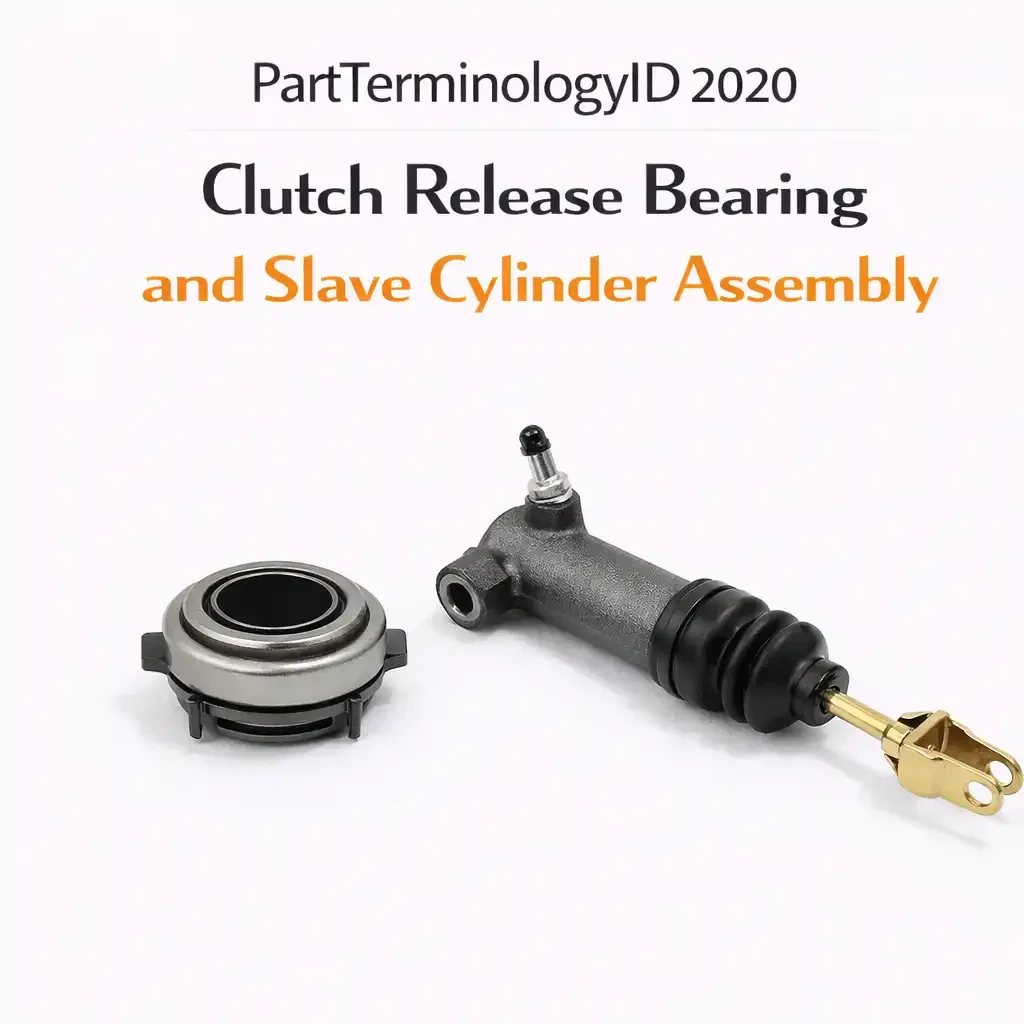
PartTerminologyID 2020, Clutch Release Bearing and Slave Cylinder Assembly, is the concentric slave cylinder (CSC): a single integrated unit that combines the clutch release bearing and the hydraulic slave cylinder into one assembly that mounts concentrically around the transmission input shaft inside the bellhousing. Hydraulic pressure from the clutch master cylinder (PartTerminologyID 1996) acts directly on the CSC's internal piston, which pushes the release bearing forward into the pressure plate's diaphragm spring fingers to disengage the clutch.
There is no mechanical clutch fork. There is no external slave cylinder. There is no pivot ball. There is no cable. The hydraulic line goes into the bellhousing, and the bearing does the rest.
The CSC is the dominant clutch actuation technology on modern manual transmission vehicles. It replaced the fork-actuated system because it eliminates the fork, the pivot ball, the fork shaft bearing, the fork dust boot, the cable or external slave cylinder, and all the mechanical wear points and adjustments those components require. The CSC is self-contained, self-adjusting (hydraulic systems compensate for disc wear automatically as fluid volume changes), and provides consistent pedal feel over the life of the clutch disc. From a manufacturing perspective, it is cheaper to produce one integrated unit than six separate mechanical components.
From a service perspective, it is the most consequential replacement part in the clutch system. When the CSC fails, the transmission must be removed to replace it. The part costs $75 to $250. The labor to access it costs $500 to $2,000 depending on the vehicle. A CSC failure between clutch jobs means a full transmission removal for a part that would have cost the same labor if it had been replaced during the last clutch service.
This is why PartTerminologyID 2020 exists as a dedicated PartTerminologyID separate from the general Clutch Release Bearing (PartTerminologyID 1968): the CSC has hydraulic attributes, a different mounting interface, a different failure mode, a different price tier, and a different service consequence than a conventional fork-actuated release bearing. Mixing the two in a single catalog entry is the most expensive cross-match in the clutch category.
How the CSC Works
The hydraulic circuit
The CSC is the receiving end of the clutch hydraulic circuit. The circuit starts at the clutch master cylinder (PartTerminologyID 1996) mounted on the firewall. When the driver presses the clutch pedal, the master cylinder piston pressurizes brake fluid. That pressurized fluid travels through a hydraulic line (rigid steel tubing and/or flexible rubber hose) to the CSC mounted on the front face of the transmission, inside the bellhousing.
The fluid enters the CSC through a hydraulic inlet fitting. The pressure acts on the CSC's internal annular piston (a ring-shaped piston that surrounds the input shaft). The piston moves forward, pushing the release bearing into contact with the pressure plate's diaphragm spring fingers. The spring fingers deflect, the pressure plate releases its clamp on the disc, and the clutch disengages.
When the driver releases the pedal, the master cylinder piston retracts, pressure drops, the diaphragm spring pushes the release bearing back, the CSC piston retracts, and fluid flows back to the master cylinder. The clutch re-engages.
The annular piston design
Unlike a conventional hydraulic cylinder with a round piston in a round bore, the CSC uses an annular (ring-shaped) piston that rides in an annular bore surrounding the transmission input shaft. The piston's inner edge clears the input shaft. The piston's outer edge is sealed against the outer bore wall. The annular design allows the CSC to mount concentrically around the shaft, which is what eliminates the need for a fork: the bearing is already in line with the pressure plate center, and the hydraulic piston pushes it straight forward without any lever mechanism.
The annular piston bore diameter, the piston ring width, and the seal dimensions are all specific to the CSC design. These dimensions determine how much fluid volume the CSC requires per unit of bearing travel and how much force the CSC generates per unit of hydraulic pressure. The master cylinder bore (PartTerminologyID 1996) is calibrated to the CSC's piston area to achieve the desired pedal feel and bearing travel.
The bearing element
The release bearing is integrated into the front face of the CSC. It is typically a sealed angular contact ball bearing or a deep groove ball bearing pressed into the CSC housing. The bearing's inner race is connected to the piston assembly (moves with the piston). The bearing's outer race presents the flat contact face that presses against the pressure plate's diaphragm spring fingers.
When the pedal is released and the clutch is engaged, the bearing is at rest (not spinning, because the piston is retracted and the bearing is not in contact with the rotating pressure plate). When the pedal is pressed and the piston extends, the bearing contacts the spinning pressure plate and begins to spin. The bearing must transition from stationary to full engine speed instantaneously, every time the driver presses the pedal. This shock loading is what eventually wears the bearing element.
The sealing system
The CSC contains at least two critical seals: one on the inner diameter of the annular piston (sealing against the inner bore wall or guide tube) and one on the outer diameter (sealing against the outer bore wall). These seals prevent pressurized brake fluid from bypassing the piston. When either seal fails, fluid leaks past the piston, the piston cannot maintain pressure, and the clutch pedal sinks under sustained force.
Some CSC designs have additional seals: a dust seal on the front face (preventing contamination from entering the bore from the bellhousing side), a rear seal (preventing fluid from leaking out the back of the assembly), and a static seal at the hydraulic inlet fitting.
The seals are rubber or elastomer compounds compatible with DOT 3/DOT 4 brake fluid. They degrade over time due to heat cycling, fluid contamination, and chemical breakdown of old fluid. Moisture absorption in the brake fluid accelerates seal deterioration, which is why fluid flushing extends CSC life.
Why PartTerminologyID 2020 Exists Separately From 1968
PartTerminologyID 1968 (Clutch Release Bearing) covers all release bearings, including both conventional fork-actuated bearings and CSC units. PartTerminologyID 2020 specifically identifies the integrated bearing-and-slave-cylinder assembly. The dedicated ID exists because:
Different attributes: The CSC has hydraulic specifications (inlet fitting size and thread, piston bore diameter, piston travel, bleeder valve location, operating pressure) that conventional release bearings do not have. A conventional bearing has fork attachment dimensions that the CSC does not have. The two products require different attribute sets in the catalog.
Different price tier: A conventional fork-actuated release bearing costs $15 to $40. A CSC costs $75 to $250. Sending a $15 bearing to a buyer who needs a $200 CSC wastes the buyer's time and the seller's shipping cost. Sending a $200 CSC to a buyer who needs a $15 bearing ties up the buyer's money in a part they cannot use.
Different mounting interface: A conventional bearing slides onto a guide sleeve and is pushed by a fork. A CSC bolts to the transmission front face and surrounds the input shaft. The mounting patterns, the dimensional constraints, and the installation procedures are completely different.
Different failure modes: A conventional bearing fails mechanically (noise, seizure). A CSC can fail mechanically (bearing noise, seizure) or hydraulically (seal leak, piston bypass). The diagnostic and replacement procedures are different.
Different service consequence: A conventional bearing can sometimes be replaced with minimal disassembly on some vehicles (removing the fork through the bellhousing inspection cover). A CSC always requires full transmission removal.
The separate PartTerminologyID prevents the most expensive cross-match in the clutch catalog.
Why This Part Generates Returns
Buyers order the wrong CSC because:
they do not know their vehicle uses a CSC (they search for "release bearing" and order a conventional fork-actuated bearing under PartTerminologyID 1968)
they do not verify the transmission code (different transmissions use different CSC designs with different central bore diameters, mounting patterns, and hydraulic fittings)
they do not verify the central bore diameter (the CSC must clear the transmission input shaft and front bearing retainer, and the diameter varies by transmission)
they do not verify the mounting bolt pattern (the CSC bolts to the transmission front face with a specific bolt count, bolt circle, and thread size)
they do not verify the hydraulic inlet fitting (thread size, pitch, and type must match the clutch hydraulic line)
they do not verify the bleeder valve location and accessibility (some CSCs have the bleeder on the assembly itself, others rely on a bleeder in the hydraulic line or at the master cylinder)
they do not verify the piston travel (different pressure plates require different amounts of bearing travel, and a CSC with insufficient travel will not fully disengage the clutch)
they confuse the CSC with an external slave cylinder (which mounts on the outside of the bellhousing, pushes a clutch fork, and is a completely different component)
they order a CSC for a vehicle that uses a conventional fork-actuated system (the vehicle has a fork, a pivot ball, and an external slave cylinder)
they assume the CSC is included in their clutch kit (PartTerminologyID 1993) and discover it is not
Sellers get caught because CSC listings often state a vehicle fitment and a photo without specifying the transmission code, central bore diameter, mounting pattern, hydraulic fitting, or piston travel. The buyer orders based on vehicle match, and the CSC arrives incompatible with their transmission.
Status in New Databases
PIES/PCdb: PartTerminologyID 2020, Clutch Release Bearing and Slave Cylinder Assembly
PIES 8.0 / PCdb 2.0: No change
The Failure Modes in Detail
Hydraulic seal failure (internal leak)
The most common failure mode. The annular piston seals degrade over time and begin to allow fluid to bypass the piston under sustained pressure. The symptom is a clutch pedal that feels firm on an initial quick press but slowly sinks to the floor when held (identical to a clutch master cylinder seal failure, PartTerminologyID 1996).
The diagnostic challenge is that the buyer cannot see the CSC. It is inside the bellhousing. There is no visible external leak (the fluid leaks past the piston internally, not out of the assembly). The reservoir level may drop very slowly as fluid migrates past the seals, but the drop may be too gradual to notice between checks.
Many buyers replace the clutch master cylinder first (it is on the firewall, accessible without removing the transmission) and discover the symptom persists because the CSC is the actual failure. They then face a transmission removal to replace the CSC, plus the cost of the master cylinder they did not need.
This is why the recommendation throughout this blog series is to replace the master cylinder and the CSC as a pair. Both contain rubber seals immersed in the same fluid, subjected to the same thermal cycling, and degraded by the same moisture contamination. If one has failed, the other is near end of life.
Bearing failure (mechanical)
The release bearing element wears from the shock loading of transitioning from stationary to engine speed every time the pedal is pressed, and from the sustained spinning under pressure plate spring load while the pedal is held down.
Bearing failure produces noise: grinding, squealing, or chirping that appears when the clutch pedal is pressed and disappears when the pedal is released. This is the opposite noise pattern of a failed pilot bearing (PartTerminologyID 1964 or 2008), which chirps when the pedal is released.
In severe cases, the bearing seizes. The bearing face welds to the pressure plate's diaphragm spring fingers (or the bearing inner race locks to the outer race). The clutch cannot be disengaged. The vehicle cannot shift gears. The driver is stranded.
Guide tube wear
The CSC slides on a guide tube or the transmission front bearing retainer. The piston's inner seal rides against this surface. If the guide tube is scored, corroded, or worn, the inner seal cannot maintain a consistent seal. Fluid leaks past the inner seal, and the newly installed CSC fails prematurely.
This is a return scenario where the buyer blames the CSC as "defective out of the box" when the actual cause is the guide tube surface condition. The listing cannot prevent this return, but the cross-sell recommendation can: inspect and replace the guide tube when replacing the CSC. Some aftermarket CSC kits include a replacement guide tube. Most do not.
Contaminated fluid failure
Old brake fluid absorbs moisture from the atmosphere through the reservoir and through microscopic pores in the rubber hydraulic hose. Moisture lowers the fluid's boiling point and creates corrosive conditions inside the hydraulic cylinders. The CSC's seals and bore surfaces corrode, accelerating seal failure.
On vehicles where the clutch hydraulic fluid has never been flushed (common on vehicles where the service manual does not explicitly call for clutch fluid replacement), the fluid may be severely contaminated after five to seven years. Installing a new CSC into a system with old, contaminated fluid shortens the new CSC's life dramatically.
The listing mitigation is a cross-sell recommendation: flush the clutch hydraulic system with fresh DOT 3 or DOT 4 fluid when installing a new CSC. Do not reuse old fluid.
The Labor Consequence: Why the CSC Must Be Replaced With Every Clutch Job
This point cannot be overstated. The CSC is inside the bellhousing. Replacing it requires removing the transmission. The transmission removal labor is $500 to $2,000 depending on the vehicle (FWD vehicles with transverse-mounted transmissions are typically the most labor-intensive).
The CSC itself costs $75 to $250. The labor to access it costs five to twenty times the part cost.
If the buyer performs a clutch job (transmission already out) and reuses the old CSC to save $150, and the CSC fails 10,000 miles later, the buyer faces another $500 to $2,000 labor bill to remove the transmission again and replace a part that was right there the first time.
Every clutch kit listing, every pressure plate listing, every disc listing, and every CSC listing for CSC-equipped vehicles should cross-sell the CSC replacement and should include a note: "Replace the concentric slave cylinder with every clutch service. The CSC is only accessible with the transmission removed, and the part cost is a fraction of the labor to access it."
Vehicle-Specific Considerations
Ford
Ford has used CSC designs across its manual transmission lineup since the mid-1990s. The Ford Mustang (T-45, TR-3650, MT-82 transmissions), Focus (MTX-75, MMT6, B6), Ranger, and F-150 (various Tremec units) all use CSC actuation on most or all manual transmission applications. Ford CSC designs vary significantly by transmission, and multiple Ford transmissions may be available for the same vehicle depending on the model year and engine. The transmission code is mandatory.
Ford CSCs are a high-failure-rate item in the aftermarket, particularly on the Mustang MT-82 transmission, where CSC failures are a known and well-documented issue. Aftermarket CSC options for Ford applications are plentiful but vary in quality.
GM
GM transitioned to CSC actuation on many platforms from the late 1990s onward. The Corvette (T-56, TR-6060), Camaro, and various truck applications use CSCs. GM CSCs use a specific guide tube design that must be inspected and potentially replaced with every CSC change.
Volkswagen / Audi
VW Group vehicles with manual transmissions extensively use CSC actuation. The CSC design is integrated with the transmission's specific bellhousing casting, and the hydraulic fitting orientation and mounting pattern are unique to each transmission family (02M, 02Q, 0A5, etc.). VW/Audi CSCs are often more expensive than domestic equivalents and have tighter tolerance requirements.
BMW
BMW manual transmission vehicles from the E46 generation onward predominantly use CSC actuation. BMW CSCs are known for hydraulic seal failures in the 60,000 to 100,000 mile range, which coincides with second or third clutch disc life on some driving patterns. The labor to access the CSC on BMW vehicles (particularly the E90 and later with increasingly crowded engine bays) is at the higher end of the labor range.
Hyundai / Kia
Many Hyundai and Kia manual transmission vehicles use CSC actuation. The CSC designs are generally reliable but use specific hydraulic fitting configurations that differ from domestic and European applications. Cross-referencing to the correct Hyundai/Kia CSC requires the exact transmission code, as multiple transmissions may be available for the same model.
The CSC-to-Fork Conversion
A meaningful segment of the aftermarket exists around converting CSC-equipped vehicles to conventional fork-actuated clutch systems. The motivation is to eliminate the CSC as a future failure point and to allow release bearing replacement without a full transmission removal.
What the conversion requires
a bellhousing or bellhousing adapter with a fork pivot boss and fork opening (the OE bellhousing on CSC vehicles typically has no provision for a fork)
a clutch fork (PartTerminologyID 1992) matched to the conversion bellhousing
a pivot ball or shaft (PartTerminologyID 2010 or 1960)
a conventional release bearing (PartTerminologyID 1968)
an external slave cylinder mounted to the bellhousing
a hydraulic line from the master cylinder to the external slave (replacing the line that went to the CSC)
potentially a different master cylinder (PartTerminologyID 1996) if the hydraulic ratio needs to change for the external slave's bore size
Who does this
The conversion is popular on Ford Mustangs (particularly the MT-82 transmission, which has a high CSC failure rate), on some truck applications where owners want simpler clutch service, and on race vehicles where quick clutch changes between events are valued.
Why it matters for listings
Sellers of CSC conversion kits should list them clearly as conversion products, not as replacement CSCs. Buyers searching for a CSC replacement should not find a conversion kit in their search results unless they are specifically searching for one. Conversely, sellers of OE-replacement CSCs should note in their listings that the product is for vehicles retaining the OE CSC actuation system, not for vehicles that have been converted to fork actuation.
Top Return Scenarios
Scenario 1: "This is a hydraulic assembly, I need a conventional release bearing"
Vehicle uses a fork-actuated system, not a CSC.
Prevention language: "Concentric slave cylinder with integrated release bearing (CSC). For vehicles with internal hydraulic clutch actuation (no external clutch fork). Not for vehicles with mechanical clutch fork and external slave cylinder. If your vehicle has a clutch fork protruding from the bellhousing, you need a conventional release bearing (PartTerminologyID 1968), not this assembly."
Scenario 2: "Central bore doesn't fit over my input shaft"
Input shaft or front bearing retainer diameter mismatch.
Prevention language: "Central bore I.D.: [X mm]. Fits over transmission input shaft / front bearing retainer O.D.: [X mm]. For vehicles with [transmission code]. Verify transmission type."
Scenario 3: "Mounting bolts don't line up"
CSC mounting flange does not match the transmission face.
Prevention language: "Mounting bolt pattern: [bolt count, bolt circle diameter, thread size]. For [transmission code]. Verify your transmission's CSC mounting face."
Scenario 4: "Hydraulic fitting doesn't match my clutch line"
Line fitting thread or type mismatch.
Prevention language: "Hydraulic inlet fitting: [thread size, pitch, flare type (double/bubble)]. Verify fitting matches your clutch hydraulic line end fitting."
Scenario 5: "Clutch doesn't fully disengage"
CSC piston travel insufficient for the buyer's pressure plate.
Prevention language: "Piston travel: [X mm]. Designed for [OE / specific aftermarket] pressure plates with diaphragm finger height of [X mm]. If using a non-OE pressure plate with different finger height, verify the CSC piston travel provides sufficient release bearing movement."
Scenario 6: "CSC leaked within 1,000 miles of installation"
Guide tube surface damaged, contaminated fluid, or installation error.
Prevention language: "Inspect the guide tube / front bearing retainer for scoring, corrosion, or wear before installing the new CSC. A damaged guide tube surface will destroy the inner piston seal. Flush the entire clutch hydraulic system with fresh DOT 3 or DOT 4 fluid at installation. Do not reuse old fluid."
Scenario 7: "I thought the CSC was included in my clutch kit"
Kit did not include the CSC.
Prevention language: "The CSC is typically not included in standard clutch kits (PartTerminologyID 1993). Order the CSC separately. Replace the CSC with every clutch service."
Scenario 8: "This is an external slave cylinder, not a CSC"
Buyer confused a CSC (internal, concentric) with an external slave cylinder (mounts outside bellhousing, pushes fork).
Prevention language: "This is a concentric slave cylinder (CSC) that mounts inside the bellhousing around the input shaft. It is not an external slave cylinder (which mounts on the outside of the bellhousing and actuates a clutch fork). Verify your vehicle's clutch actuation type."
What to Include in the Listing
Core essentials
PartTerminologyID: 2020
component: Clutch Release Bearing and Slave Cylinder Assembly (CSC)
actuation type: concentric hydraulic (no fork, no external slave)
non-serviceable: replace as complete unit (no repair kit available)
quantity: 1
Fitment essentials
year/make/model/submodel
transmission code (mandatory)
engine code (if CSC differs by engine/transmission combination)
clutch actuation: CSC only (exclude fork-actuated vehicles)
production date split (if CSC design changed mid-year)
Dimensional essentials
central bore I.D. (input shaft / bearing retainer clearance)
mounting bolt pattern (count, bolt circle diameter, thread size)
piston bore diameter (annular bore)
piston travel (stroke length)
overall assembly height (depth from mounting face to bearing contact face)
bearing contact face diameter
guide tube compatibility (O.D. of guide tube the inner seal rides on)
Hydraulic essentials
hydraulic inlet fitting (thread size, pitch, flare type)
bleeder valve location (on assembly, in line, or at master cylinder) and thread size
compatible master cylinder bore size (PartTerminologyID 1996)
fluid type (DOT 3 / DOT 4)
Image essentials
front view showing bearing contact face and contact face diameter
rear view showing mounting flange, bolt pattern, and hydraulic inlet
side profile showing overall height and piston position
central bore visible with diameter callout
hydraulic fitting close-up with thread callout
bleeder valve location marked
installed context showing position on transmission input shaft relative to pressure plate
Catalog Checklist for ACES/PIES Teams
PartTerminologyID = 2020
require transmission code (mandatory)
require central bore I.D.
require mounting bolt pattern
require hydraulic fitting specification (thread, pitch, flare type)
require piston travel
require bearing contact face diameter
require guide tube compatibility dimension
differentiate from conventional release bearing (PartTerminologyID 1968 fork-actuated type)
differentiate from external slave cylinder (separate component, mounts outside bellhousing, pushes fork)
flag fork-actuated vehicles as non-applicable for PartTerminologyID 2020
flag vehicles where both CSC and fork-actuated options existed across the model range
cross-reference to compatible clutch master cylinder (PartTerminologyID 1996) bore specification
note that the CSC is non-serviceable (no repair kit, replace as complete unit)
note guide tube inspection requirement in product description or installation notes
FAQ (Buyer Language)
Is this the same as a release bearing?
It includes a release bearing, but it is much more than a bearing. The CSC integrates the release bearing with a hydraulic slave cylinder, piston, seals, and bleeder valve in one sealed assembly. A conventional release bearing (PartTerminologyID 1968) is a standalone bearing that rides on a clutch fork and has no hydraulic components. They serve the same function (pushing the pressure plate diaphragm spring) but are completely different products with different mounting, different pricing, and different service requirements. They are not interchangeable.
Do I need to bleed the system after replacing the CSC?
Yes. The CSC is part of the clutch hydraulic circuit. Any time the circuit is opened, air enters. The system must be fully bled after CSC replacement. CSC bleeding can be challenging because the bleeder valve may be in a difficult-to-access location inside or near the bellhousing. A pressure bleeder or vacuum bleeder is strongly recommended over manual pedal-pump bleeding.
Some vehicles require a specific bleed sequence (bleed the slave first, then the master, or vice versa). Check the vehicle service manual. Improper bleeding leaves air in the system, producing a spongy pedal and incomplete clutch disengagement that the buyer may blame on the new CSC.
Should I replace the CSC with every clutch job?
This is the single most important recommendation in this post. Yes. Every time. No exceptions. The CSC is inside the bellhousing. The transmission is already out. The part costs $75 to $250. The labor to access it later costs $500 to $2,000. Reusing an old CSC to save $150 is a gamble against a second transmission removal. Replace it every time.
Can I rebuild the CSC instead of replacing it?
No. The CSC is a non-serviceable assembly. There are no repair kits. The seals, bearing, and piston are not designed to be disassembled and reassembled. When any component fails, the entire unit is replaced.
My clutch pedal sinks but I already replaced the master cylinder. Is it the CSC?
Very likely. The pedal-sinking symptom (firm on initial press, sinks under sustained pressure) can be caused by either the master cylinder or the CSC. Both contain piston seals that fail in the same way. If the master cylinder has been replaced and the symptom persists, the CSC's internal seals are the most probable cause. This is why replacing both as a pair is recommended: it eliminates the diagnostic guessing game and the risk of two separate repair events.
Can I convert from CSC to a conventional fork-actuated system?
Conversion kits exist for some vehicles, particularly the Ford Mustang (MT-82), some GM applications, and various other platforms. The conversion requires a different bellhousing or adapter, a clutch fork, a pivot ball, a conventional release bearing, an external slave cylinder, and modified hydraulic lines. It is a significant modification, not a simple swap. The benefit is that future release bearing replacements no longer require transmission removal. The trade-off is the cost and complexity of the conversion itself, and the reintroduction of fork, pivot ball, and fork shaft bearing as wear items.
How long does a CSC typically last?
CSC life varies widely by vehicle, driving conditions, and fluid maintenance. On vehicles with well-maintained fluid (flushed every two to three years), CSC life can match or exceed clutch disc life (80,000 to 120,000 miles). On vehicles with neglected fluid, CSC life can be as short as 40,000 to 60,000 miles. Aggressive driving (frequent clutch use, heavy traffic, performance driving) shortens CSC life due to increased thermal cycling and bearing loading.
My new CSC leaked immediately after installation. Is it defective?
Possibly, but inspect the guide tube first. If the guide tube (the surface the inner piston seal rides on) is scored, corroded, or has a ridge worn into it from the old CSC's seal, the new CSC's seal will leak immediately. Clean or replace the guide tube before concluding the CSC is defective. Also verify the hydraulic fitting was properly tightened and that the system was filled and bled correctly.
Cross-Sell Logic
Clutch Master Cylinder (PartTerminologyID 1996, replace as a pair)
Clutch Disc and Pressure Plate Set (PartTerminologyID 2012) or Complete Kit (PartTerminologyID 1993)
Clutch Pilot Bearing (PartTerminologyID 1964) or Pilot Bushing (PartTerminologyID 2008)
Guide Tube / Front Bearing Retainer (inspect and replace if scored)
Clutch Hydraulic Line / Hose (inspect for swelling, cracking, or corrosion)
Brake Fluid (DOT 3 or DOT 4, for complete system flush)
Clutch Bleeder Kit / Pressure Bleeder
Rear Main Seal (accessible with transmission removed)
Transmission Input Shaft Seal
Frame as "replace the CSC with every clutch job. Replace the master cylinder at the same time. Flush the hydraulic fluid. Inspect the guide tube. All are accessible only with the transmission removed, and the combined cost of the parts is a fraction of the labor to access them twice."
Final Take for PartTerminologyID 2020
Clutch Release Bearing and Slave Cylinder Assembly (PartTerminologyID 2020) is the most expensive, most consequential, and most frequently under-replaced component in the modern manual transmission clutch system. It integrates the release bearing and the hydraulic slave cylinder into one non-serviceable assembly inside the bellhousing. It costs $75 to $250. The labor to access it costs five to twenty times the part cost. And it is the single component most likely to force a second transmission removal if it is not replaced during a clutch job.
The dedicated PartTerminologyID exists to prevent the cross-match between a $15 conventional bearing (PartTerminologyID 1968) and a $200 CSC. The listing must make the distinction unmistakable: this is the concentric slave cylinder, internal to the bellhousing, hydraulically actuated, with no fork, no pivot, and no external slave.
State the transmission code. State the central bore. State the mounting pattern. State the hydraulic fitting. State the piston travel. And state in every clutch-related listing for CSC-equipped vehicles: replace the CSC with every clutch service. The part is cheap. The labor is not. And the buyer who reuses the old CSC to save $150 will spend $1,500 to pull the transmission again when it fails.