
Clutch Pressure Plate and Disc Set (PartTerminologyID 2012): The Matched Pair That Must Satisfy Two Different Interfaces on Two Different Components
Written by Arthur Simitian | PartsAdvisory
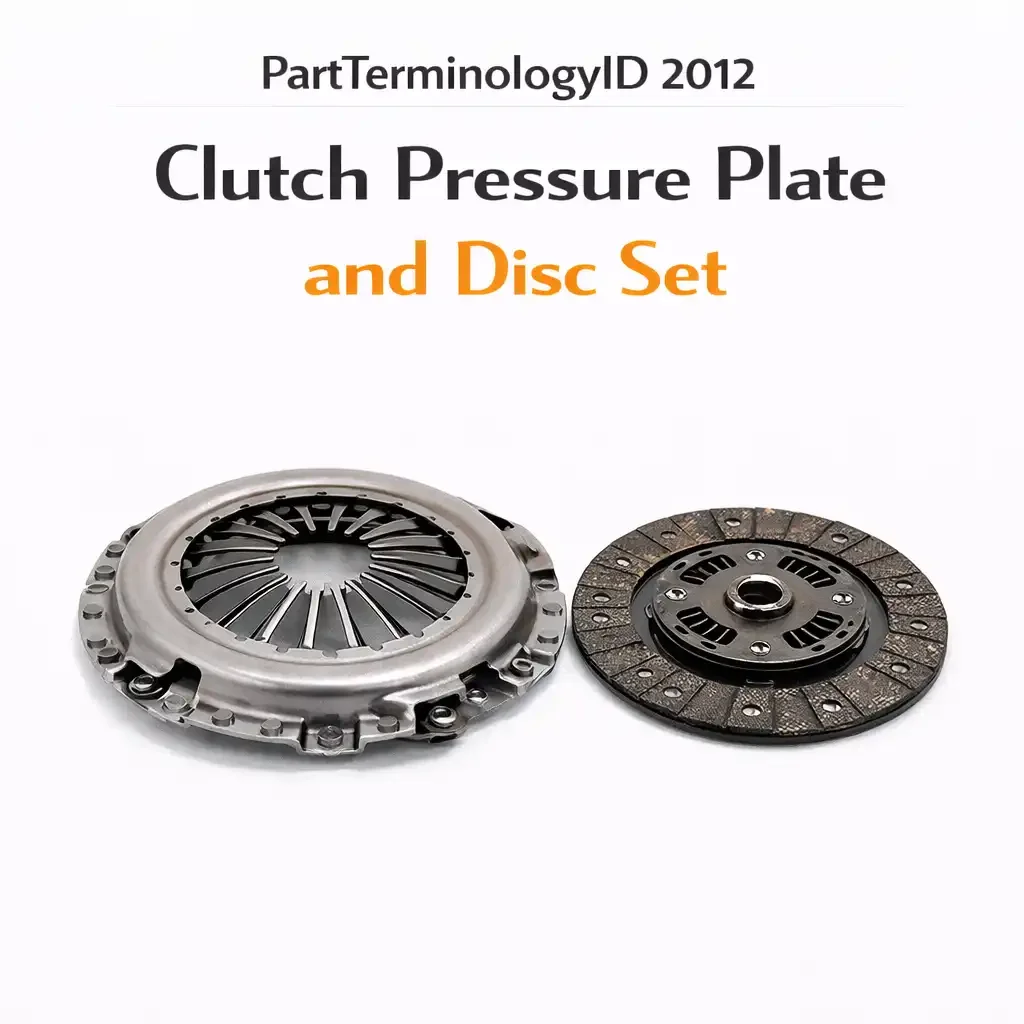
PartTerminologyID 2012, Clutch Pressure Plate and Disc Set, is the two-component package containing a clutch pressure plate and a clutch disc sold as a pre-matched pair. The pressure plate bolts to the flywheel and provides the clamping force. The disc sits between the pressure plate and the flywheel, with friction material on both faces, and its splined hub slides onto the transmission input shaft. Together, they transmit engine torque to the transmission when clamped, and allow the engine and transmission to spin independently when released.
This is the core of the clutch system. Every other clutch component exists to support, actuate, or align these two parts. The release bearing pushes the pressure plate's diaphragm spring to release the clamp. The pilot bearing centers the input shaft so the disc runs true. The fork and cable or hydraulic system transfer pedal force to the release bearing. But the disc and pressure plate are the two components that actually transmit power.
PartTerminologyID 2012 sits between two other catalog entries. It is more than a standalone pressure plate (PartTerminologyID 1988) or a standalone disc. It is less than a complete clutch kit (PartTerminologyID 1993), which typically adds a release bearing, sometimes a pilot bearing, and an alignment tool. The set exists because many buyers want the two primary wear components pre-matched but want to source their release bearing, pilot bearing, and other components separately, either because they already have them, because they are upgrading to a specific bearing, or because the kit available for their vehicle does not include the components they need.
For sellers, the pressure plate and disc set carries every fitment variable from both components simultaneously. The pressure plate must match the flywheel (bolt pattern, flywheel type, finger height). The disc must match the transmission (spline count, spline diameter). Both must match each other (disc diameter equals pressure plate diameter). And on performance sets, the pressure plate clamp load must be compatible with the disc material, and both must be compatible with the buyer's actuation system and driving expectations.
The Disc: The Component That Interfaces With the Transmission
The clutch disc is the friction element that sits between the pressure plate and the flywheel. It has three critical interfaces:
Spline hub (disc-to-transmission interface)
The center of the disc has a splined hub that slides onto the transmission input shaft. The spline count (number of teeth) and spline diameter (major and minor diameters of the spline teeth) must match the input shaft exactly. A disc with 10 splines will not fit a 14-spline input shaft. A disc with the correct spline count but wrong diameter (which occurs when different transmissions use the same spline count but different shaft sizes) will either not slide onto the shaft or will have excessive play.
Common spline counts in the aftermarket include 10, 14, 21, 23, 24, and 26 splines. The spline count is determined by the transmission, not the engine. The same engine paired with different transmissions will require discs with different spline counts.
This is the single most common fitment failure on clutch disc orders, and by extension, on PartTerminologyID 2012 orders. The buyer matches the pressure plate to the flywheel (which they can verify visually by bolt pattern), but the disc spline does not match their transmission because the listing did not specify the transmission code or spline count.
Friction faces (disc-to-flywheel and disc-to-pressure plate interface)
Both faces of the disc are lined with friction material. The outer diameter of the friction lining must match the pressure plate diameter and the flywheel friction surface diameter. If the disc is too small, it does not fill the pressure plate's clamping area, reducing torque capacity and causing uneven wear. If the disc is too large, it extends past the clamping area and the outer edge is unsupported, causing warping and chatter.
Common disc diameters include 215mm, 225mm, 228mm, 240mm, 250mm, 260mm, and 280mm. The diameter is determined by the pressure plate, which is determined by the flywheel, which is determined by the engine and transmission combination.
Friction material types
The disc's friction material determines the engagement characteristics, heat tolerance, wear rate, and torque capacity of the clutch.
Organic (standard street): The most common material for OE and OE-replacement discs. Made from a blend of fibers (glass, rubber, carbon, Kevlar) bound with phenolic resin. Organic linings provide smooth, progressive engagement with excellent modulation. The driver can slip the clutch during starts and low-speed maneuvers without harshness. Organic discs are quiet, gentle on the flywheel surface, and have a long service life under normal driving conditions.
The tradeoff is heat tolerance. Under sustained high-load use (heavy towing, spirited driving, track use), organic linings can overheat, glaze (the surface becomes smooth and glassy, reducing friction), and fade (temporary loss of grip due to heat). For street driving, organic is the correct choice for the vast majority of buyers.
Cerametallic (ceramic/metallic composite): A blend of ceramic and metallic particles in a metalite or sintered matrix. Cerametallic linings tolerate significantly higher temperatures than organic, resist glazing, and maintain grip under sustained load. They are the standard for performance street, weekend track, and towing applications.
The tradeoff is engagement harshness. Cerametallic linings have a more abrupt grab with less modulation than organic. The clutch engages more like a switch (on/off) than a dimmer (gradual). In stop-and-go traffic, the driver fights the grabby engagement at every start. Cerametallic linings also wear the flywheel surface faster than organic and are noisier.
Kevlar (aramid fiber): A friction material using Kevlar fibers as the primary reinforcement. Kevlar discs provide a middle ground between organic and cerametallic: smoother engagement than cerametallic with better heat tolerance than organic. They are gentler on the flywheel surface than cerametallic. Kevlar discs are popular in the light performance and towing market.
Puck-style (segmented): Instead of a full-face lining, the disc has three, four, or six individual friction pads (pucks) riveted to the disc. Puck discs are designed for racing. They clamp with maximum pressure on a reduced area, providing extremely aggressive engagement. They are lighter than full-face discs (lower rotational inertia for faster shifts). But they are miserable on the street: harsh engagement, shuddering at low speed, high noise, and rapid flywheel wear.
Hybrid (dual-face): Some discs use organic material on one face and cerametallic on the other. The organic side faces the flywheel (for smoother engagement on the heavier component), and the cerametallic side faces the pressure plate (for better heat tolerance on the higher-temperature side). Hybrid discs aim to combine the smoothness of organic with the heat tolerance of cerametallic. The result is a compromise that works well for some applications but does not fully satisfy either the comfort or the performance buyer.
Hub type: sprung vs. unsprung
Sprung hub (dampened): The disc hub has torsion springs (coil springs mounted in windows in the hub plate) that absorb torsional vibrations between the engine and the transmission. When the engine fires, each combustion event sends a torque pulse through the crankshaft. Without damping, these pulses transmit directly to the transmission input shaft, causing gear rattle, driveline vibration, and premature synchronizer wear. The sprung hub absorbs these pulses.
Sprung hubs are standard on all OE street discs and are essential for vehicles with solid (single-mass) flywheels. Vehicles with dual-mass flywheels (DMFs) use a disc with a rigid center hub (no torsion springs) because the DMF's internal spring-and-damper system handles the torsional vibration absorption.
Unsprung hub (rigid): The disc hub is solid with no torsion springs. This reduces the disc's rotational inertia (lighter hub) and eliminates a potential failure point (spring breakage). Unsprung hubs are used on racing discs and on discs designed for DMF applications. On a street vehicle with a solid flywheel, an unsprung hub disc will transmit engine torsional vibrations directly to the transmission, causing gear rattle, driveline shudder, and an unpleasant driving experience.
A buyer who orders a disc with an unsprung hub for a solid flywheel application will experience driveline noise and vibration that they did not have before. They will return the set as "defective" when the actual problem is a hub type mismatch.
The Pressure Plate: The Component That Interfaces With the Flywheel
The pressure plate's fitment variables are covered extensively in PartTerminologyID 1988. In the context of the disc set (PartTerminologyID 2012), the key pressure plate variables are:
Bolt pattern
The bolt count, bolt circle diameter, and bolt thread size must match the flywheel. This is a hard physical constraint: if the bolts do not line up, the pressure plate does not install.
Pressure plate type
Diaphragm spring, Borg and Beck (three-finger coil spring), or Long-style (centrifugally assisted). The type determines the release bearing interface. If the buyer has a diaphragm-type release bearing and the set includes a Borg and Beck pressure plate, the bearing will not interface correctly with the release levers.
Flywheel type compatibility
Solid flat, solid step, or dual-mass flywheel (DMF). The pressure plate must be designed for the flywheel that is actually on the vehicle. A DMF pressure plate will not bolt to a solid flywheel (different bolt pattern or mounting face), and a solid-flywheel pressure plate will not bolt to a DMF.
Clamp load
The force the pressure plate applies to the disc against the flywheel. Higher clamp load = more torque capacity = heavier pedal. The clamp load must be appropriate for the disc material, the actuation system (cable vs. hydraulic), and the buyer's driving expectations.
Diaphragm finger height
The distance from the mounting face to the finger tips. This determines the release bearing interface position. If the finger height does not match the release bearing's rest position, the bearing is either pre-loaded (constant spinning, premature failure) or too far away (insufficient travel to fully disengage).
The Matching Requirement: Why the Set Exists
The pressure plate and disc are sold as a set because they must be matched:
Diameter match
The disc diameter must equal the pressure plate's clamping diameter. A 228mm disc in a 240mm pressure plate leaves unclamped area. A 240mm disc in a 228mm pressure plate has unsupported friction material that warps and chatters.
Clamp load to material match
The pressure plate's clamp load must be appropriate for the disc's friction material. A high-clamp-load pressure plate (designed for cerametallic) paired with an organic disc will glaze the organic material under spirited use. A low-clamp-load pressure plate (OE-equivalent) paired with a cerametallic disc will not take advantage of the cerametallic's heat tolerance and may allow the disc to slip under high torque because the cerametallic material's friction coefficient is slightly lower than organic at moderate temperatures.
Release characteristics match
The pressure plate's diaphragm spring rate and the disc's friction material determine how the clutch engages. A progressive diaphragm with organic friction produces smooth, linear engagement. A stiff diaphragm with cerametallic produces abrupt, aggressive engagement. Mixing a progressive diaphragm with cerametallic creates unpredictable engagement (the spring rate says "gradual" but the friction material says "grab"). Mixing a stiff diaphragm with organic creates a heavy pedal that slips the soft material when the clamp load exceeds what the organic can handle.
Selling the disc and pressure plate as a pre-matched set eliminates these mismatch scenarios, provided the set is properly designed and the listing clearly states what the set contains and what it is designed for.
Why This Part Generates Returns
Buyers order the wrong clutch pressure plate and disc set because:
they do not verify the disc spline count and diameter (which is determined by the transmission, not the engine or flywheel)
they do not verify the pressure plate bolt pattern (which is determined by the flywheel)
they do not verify the flywheel type (solid flat, solid step, or DMF)
they order a performance set with aggressive disc material expecting OE-like drivability and return it when the clutch chatters, grabs harshly, or requires excessive pedal effort
they order an OE-replacement set expecting it to hold their modified engine's torque and return it when the clutch slips under boost
they miss the hub type (sprung vs. unsprung) and install an unsprung disc on a solid flywheel, producing gear rattle and driveline vibration
they assume the set includes a release bearing and discover it does not (this is a set, not a kit)
they confuse PartTerminologyID 2012 (pressure plate and disc set) with PartTerminologyID 1993 (complete clutch kit, which includes the release bearing and sometimes the pilot bearing)
they order for a DMF-equipped vehicle but have already converted to a solid flywheel (or vice versa)
they do not verify the engine code or transmission code, and the set ships with the wrong spline count or bolt pattern for their specific drivetrain combination
Sellers get caught because the set listing carries every fitment variable from both components but frequently states only the vehicle year/make/model and the performance tier (OE, Stage 1, Stage 2, etc.) without specifying the spline count, bolt pattern, flywheel type, disc material, hub type, or clamp load.
Status in New Databases
PIES/PCdb: PartTerminologyID 2012, Clutch Pressure Plate and Disc Set
PIES 8.0 / PCdb 2.0: No change
The Performance Set Trap (Revisited)
Everything covered in PartTerminologyID 1988 regarding performance pressure plates applies here, compounded by the disc material variable. The set is where the stage label problem is worst, because the stage combines a pressure plate clamp load with a disc material into a single marketing term.
Stage 1: Typically an OE-equivalent or slightly upgraded clamp load pressure plate with a full-face organic disc. A safe upgrade for mildly modified vehicles. Minimal pedal effort increase. Smooth engagement. This is what most daily drivers should buy.
Stage 2: Varies wildly. Could be a moderate clamp load increase with a full-face cerametallic disc (noticeable pedal increase, grabby engagement). Could be a significant clamp load increase with a Kevlar disc (heavy pedal, moderate engagement improvement). Could be a moderate clamp load increase with a hybrid disc (moderate pedal increase, improved heat tolerance). The buyer has no way to know what "Stage 2" means without reading the fine print.
Stage 3: Typically a high clamp load pressure plate with a segmented cerametallic (puck) disc. Very heavy pedal. Extremely aggressive engagement. Designed for drag racing and track use. Miserable on the street. If the buyer daily drives this set, they will return it within a week.
Stage 4 and beyond: Full metallic puck discs, extreme clamp loads, no pretense of street drivability. These are for dedicated race vehicles.
The listing must state the actual clamp load, the actual disc material, the hub type, and the intended use case. The stage number is a shorthand that communicates nothing specific and causes returns when the buyer's expectation does not match the product's characteristics.
Top Return Scenarios
Scenario 1: "Disc doesn't slide onto my input shaft"
Spline count or diameter mismatch.
Prevention language: "Disc spline count: [X splines]. Spline diameter: [X mm]. For vehicles with [transmission code]. Verify your transmission's input shaft spline specification."
Scenario 2: "Pressure plate bolts don't line up with my flywheel"
Bolt pattern mismatch.
Prevention language: "Pressure plate bolt pattern: [X bolts, X mm bolt circle, MX/X"-X thread]. Flywheel type: [solid flat / solid step / dual-mass]. Verify flywheel type and bolt pattern."
Scenario 3: "Clutch chatters and grabs harshly"
Performance disc material (cerametallic or puck) paired with buyer's expectation of OE-like engagement.
Prevention language: "Disc material: [organic / cerametallic / Kevlar / puck / hybrid]. [Cerametallic and puck discs produce aggressive engagement characteristics that differ significantly from OE organic discs. Not recommended for daily driving in heavy traffic if engagement smoothness is a priority.]"
Scenario 4: "Pedal is too heavy"
High clamp load pressure plate exceeding buyer's comfort or actuation system capacity.
Prevention language: "Pressure plate clamp load: [X lbs / X N] ([X%] above OE). This set increases pedal effort. [Recommended for hydraulic actuation only / compatible with cable and hydraulic]. Not recommended for daily driving if pedal effort is a concern."
Scenario 5: "I have gear rattle and driveline vibration after installation"
Unsprung hub disc installed on a solid flywheel.
Prevention language: "Disc hub type: [sprung (dampened) / unsprung (rigid)]. Sprung hubs are required for solid (single-mass) flywheels to absorb torsional vibrations. Unsprung hubs are for dual-mass flywheel applications or dedicated race vehicles."
Scenario 6: "I thought this included a release bearing"
Buyer expected a complete clutch kit (PartTerminologyID 1993).
Prevention language: "This set includes the pressure plate and clutch disc only. Release bearing, pilot bearing, alignment tool, and flywheel are not included. For a complete clutch kit, see PartTerminologyID 1993."
Scenario 7: "This is for a dual-mass flywheel, I converted to solid"
Flywheel type mismatch.
Prevention language: "For vehicles with [dual-mass flywheel / solid (single-mass) flywheel]. If you have converted from DMF to solid flywheel, verify this set is designed for the solid flywheel configuration."
Scenario 8: "Clutch slips under boost"
OE-replacement set installed on a modified engine exceeding the set's torque capacity.
Prevention language: "Torque capacity: approximately [X ft-lbs / X Nm] (based on clamp load and disc material). For modified engines exceeding [X ft-lbs / X Nm], a higher-capacity set is recommended."
What to Include in the Listing
Core essentials
PartTerminologyID: 2012
component: Clutch Pressure Plate and Disc Set
set contents: pressure plate + disc (explicitly state what is included and what is NOT)
set type: OE replacement or performance (with specific tier)
quantity: 1 set
Disc specifications
disc diameter (mm)
spline count
spline diameter (mm)
hub type: sprung or unsprung
friction material: organic, cerametallic, Kevlar, puck, hybrid
disc thickness
number of friction pads (if puck-style)
Pressure plate specifications
pressure plate type: diaphragm, Borg and Beck, Long-style
bolt count, bolt circle diameter, bolt thread size
clamp load (lbs or N, and percentage above OE)
diaphragm finger height
flywheel type compatibility: solid flat, solid step, DMF
Fitment essentials
year/make/model/submodel
engine code (mandatory)
transmission code (mandatory)
flywheel type: solid flat, solid step, DMF, or solid conversion
clutch actuation type: cable or hydraulic (for performance sets that require hydraulic)
production date split (if disc spline or pressure plate changed mid-year)
Performance set additional specifications
torque capacity estimate (ft-lbs or Nm)
pedal effort impact (approximate percentage increase)
recommended use case (daily, street performance, weekend track, dedicated racing)
cable actuation compatibility (yes/no)
flywheel surface requirements (new, resurfaced, or specific surface finish)
Image essentials
both components laid out showing disc friction face and pressure plate bolt pattern
disc spline hub close-up with spline count visible
pressure plate bolt pattern detail with bolt circle callout
disc friction material detail (showing material type)
pressure plate side profile showing finger height
disc hub detail showing sprung (springs visible) or unsprung (solid hub)
Catalog Checklist for ACES/PIES Teams
PartTerminologyID = 2012
require engine code AND transmission code (both mandatory)
require disc spline count and diameter
require disc diameter
require disc material attribute
require disc hub type (sprung/unsprung)
require pressure plate bolt pattern
require pressure plate type (diaphragm/Borg and Beck/Long)
require clamp load
require flywheel type compatibility
require diaphragm finger height
require set contents declaration (pressure plate + disc, explicitly exclude release bearing, pilot bearing, flywheel)
flag DMF vs. solid flywheel applications
flag performance sets with cable actuation restrictions
flag performance sets with disc material-specific engagement warnings
differentiate from PartTerminologyID 1988 (pressure plate only), PartTerminologyID 1993 (complete clutch kit), and standalone disc listings
FAQ (Buyer Language)
Does this set include a release bearing?
No. PartTerminologyID 2012 is the pressure plate and disc only. The release bearing (PartTerminologyID 1968), pilot bearing (PartTerminologyID 1964 or 2008), alignment tool, and flywheel are not included. If you want all components in one box, order a complete clutch kit (PartTerminologyID 1993).
Why buy the set instead of a complete kit?
Buyers purchase the set when they want to source other components separately: a specific aftermarket release bearing, a specific pilot bearing type (bushing vs. ball bearing), or a CSC from a preferred manufacturer. The set gives you the two primary friction components pre-matched without locking you into the kit manufacturer's choice of bearings.
What stage set should I buy?
Ignore the stage number. Match the set to your actual driving conditions and power level. For daily driving at stock or mildly modified power levels, an OE-replacement set with organic disc and OE-equivalent clamp load is correct. For moderate performance (bolt-on turbo, mild tune, occasional towing), a set with 15 to 25 percent higher clamp load and a full-face cerametallic or Kevlar disc is the sweet spot. For track use, consult the manufacturer's torque capacity chart and select the set that exceeds your engine's peak torque by a comfortable margin.
Can I mix a disc from one manufacturer with a pressure plate from another?
Technically, if the diameters match, the bolt pattern matches, and the clamp load is appropriate for the disc material, it can work. However, the set exists specifically to eliminate the mismatch risk. Mixing manufacturers means you are responsible for verifying every dimensional and performance compatibility variable yourself. If anything does not work, neither manufacturer will warranty the combination.
My clutch slips under boost but engages fine at low RPM. Is the set wrong?
The set may be under-capacity for your engine's torque output. At low RPM and low boost, the torque is within the set's clamping capacity. At high RPM and full boost, the torque exceeds the clamp load, and the disc slips. You need a set with higher clamp load, a more aggressive disc material, or both. Check the set's torque capacity rating against your engine's peak torque at full boost.
I ordered an OE replacement set and the engagement is rougher than my old clutch. Is it defective?
Not necessarily. A new organic disc has a break-in period of 500 to 1,000 miles during which the friction material seats against the flywheel and pressure plate surfaces. During break-in, avoid heavy clutch loading (no towing, no aggressive launches, no high-RPM shifts). After break-in, the engagement should smooth out. If the roughness persists, verify the flywheel surface was resurfaced or replaced before installation. A glazed, heat-spotted, or scored flywheel surface will cause chatter with any new disc.
Does the disc hub type (sprung vs. unsprung) matter for my daily driver?
Yes. If your vehicle has a solid (single-mass) flywheel, you must use a sprung hub disc. The torsion springs in the hub absorb engine combustion pulses that would otherwise transmit to the transmission as gear rattle and driveline vibration. An unsprung disc on a solid flywheel will make the vehicle noticeably noisier and less pleasant to drive. Unsprung discs are only appropriate for DMF-equipped vehicles (where the DMF handles the damping) or dedicated race vehicles where NVH is irrelevant.
My vehicle had a dual-mass flywheel. I converted to a solid flywheel. Which set do I need?
You need a set designed for a solid flywheel: a pressure plate with the correct bolt pattern for the solid flywheel, and a disc with a sprung hub (to replace the torsional damping that the DMF previously provided). Do not order a set designed for the DMF, as the pressure plate bolt pattern may differ and the disc may have an unsprung hub.
Can I resurface my flywheel and reuse it with this new set?
If the flywheel is a solid (single-mass) type and has not been resurfaced beyond its minimum thickness specification, yes. Have a machine shop resurface the friction face to a smooth, flat finish. If the flywheel is a dual-mass type, it cannot be resurfaced in the traditional sense. DMFs must be inspected for internal spring wear and replaced if the secondary mass has excessive play. Resurfacing only addresses the friction surface, not the internal damping mechanism.
Cross-Sell Logic
Clutch Release Bearing (PartTerminologyID 1968, the most critical missing component from the set)
Clutch Pilot Bearing (PartTerminologyID 1964) or Pilot Bushing (PartTerminologyID 2008)
Clutch Fork (PartTerminologyID 1992)
Clutch Pivot Ball (PartTerminologyID 2010)
Clutch Fork Shaft Bearing (PartTerminologyID 1960)
Flywheel (solid replacement, DMF replacement, or solid conversion)
Flywheel Bolt Kit
Clutch Alignment Tool (if not included in the set)
Clutch Cable (PartTerminologyID 1972, for cable-actuated vehicles)
Clutch Master Cylinder (PartTerminologyID 1996) and Slave Cylinder (inspect during service)
Rear Main Seal
Frame as "the set includes the two primary friction components. Order the release bearing, pilot bearing, and fork hardware separately. Resurface or replace the flywheel. Inspect and replace the fork, pivot ball, and fork shaft bearing. All are only accessible with the transmission removed."
The Set vs. the Kit: Clarifying for the Buyer
One of the most common sources of confusion and returns in the clutch category is the difference between PartTerminologyID 2012 (pressure plate and disc set) and PartTerminologyID 1993 (complete clutch kit).
The set (2012) contains two components: the pressure plate and the disc. That is all. No release bearing. No pilot bearing. No alignment tool. The buyer must source every other clutch component separately.
The kit (1993) contains three to six components: the pressure plate, the disc, the release bearing, and sometimes the pilot bearing, alignment tool, and other hardware. The kit is designed to be a one-box solution for a complete clutch replacement.
The listing must clearly state which PartTerminologyID is being sold, what is in the box, and what is not. The most effective way to prevent returns is a bold, prominent statement: "This set includes the pressure plate and clutch disc only. Release bearing, pilot bearing, alignment tool, and flywheel are not included."
Buyers who want the convenience of a complete package should be directed to PartTerminologyID 1993. Buyers who want to select their own bearings or who already have bearings on hand should be directed to PartTerminologyID 2012.
Final Take for PartTerminologyID 2012
Clutch Pressure Plate and Disc Set (PartTerminologyID 2012) is two components that must satisfy interfaces on two different sides of the drivetrain. The disc's spline count comes from the transmission. The pressure plate's bolt pattern comes from the flywheel. Both must match each other in diameter. And on performance sets, the clamp load must match the disc material, and both must match the buyer's actuation system and driving reality.
Two codes resolve the dimensional fitment: engine code (flywheel bolt pattern, pilot bearing bore) and transmission code (disc spline count, release bearing guide sleeve). One attribute resolves the flywheel question: solid flat, solid step, DMF, or conversion. One declaration resolves the "what's in the box" question: pressure plate and disc, nothing else.
State both codes. State the spline count. State the bolt pattern. State the flywheel type. State the disc material and hub type. State the clamp load. State what is and what is not in the box. And for performance sets, state the torque capacity, the pedal effort impact, the use case, and the actuation compatibility.
The buyer who knows what they are ordering and what it will feel like does not return it. The buyer who orders "Stage 2" without knowing what that means returns it the first time they sit in traffic for thirty minutes with a left leg that feels like it ran a marathon.