
Written by Arthur Simitian | PartsAdvisory
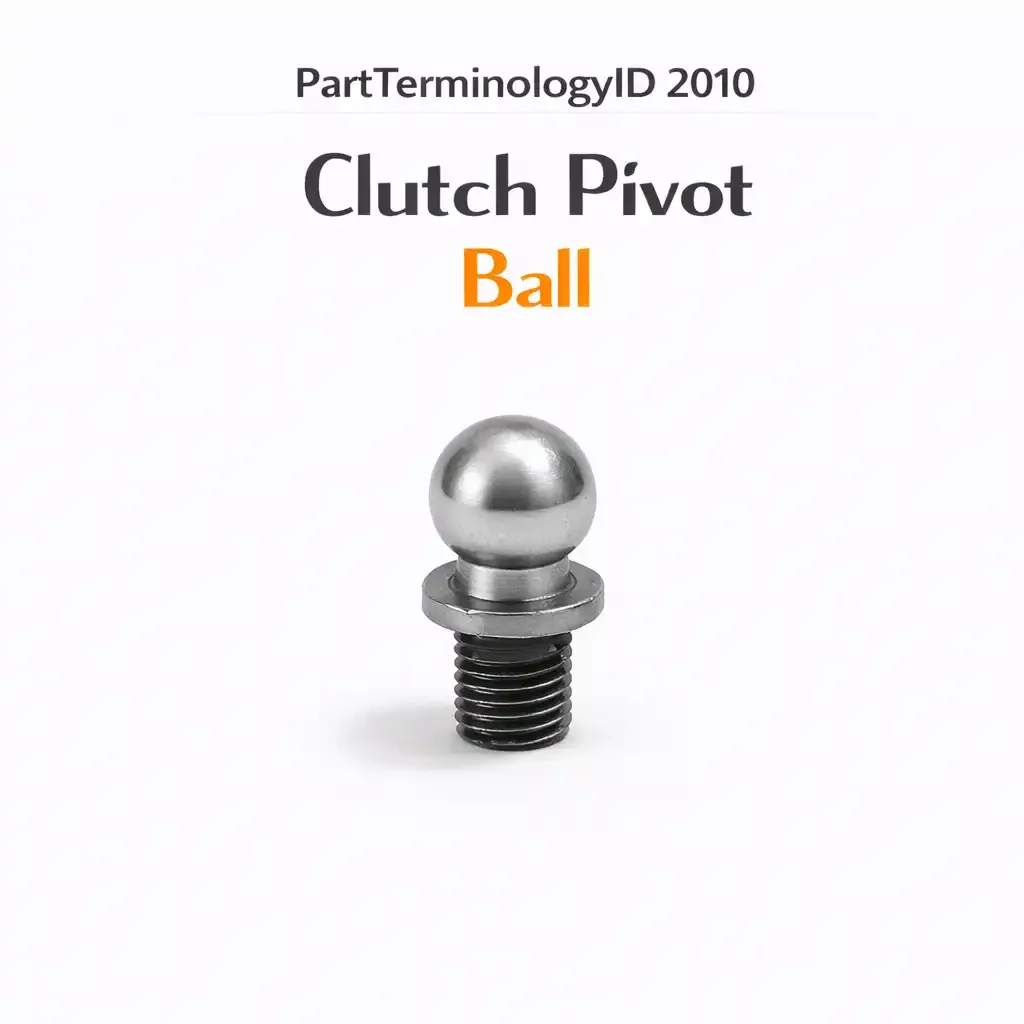
PartTerminologyID 2010, Clutch Pivot Ball, is the hardened steel ball stud pressed or threaded into the transmission bellhousing that serves as the fulcrum point for the clutch fork (PartTerminologyID 1992). The fork's hemispherical socket sits over the ball, and every time the driver presses the clutch pedal, the fork rocks on this ball to push the release bearing into the pressure plate. Every clutch actuation cycle loads the ball stud and the fork socket against each other under spring pressure and pedal force.
It is a three-dollar part that absorbs the full actuation load of the clutch system tens of thousands of times over the life of a clutch disc. It wears a flat spot. The fork develops play. The release bearing no longer tracks straight. And when the clutch is finally replaced, the technician pulls the transmission, installs a new disc, pressure plate, release bearing, pilot bearing, and fork, bolts everything back together, and leaves the original worn ball stud in the bellhousing because nobody told them to replace it or because the clutch kit did not include one and they did not order it separately.
The new fork socket now sits on a ball with a flat spot. The play is back immediately. The buyer blames the new fork.
Why This Part Generates Returns
Buyers order the wrong clutch pivot ball because:
they do not verify the ball diameter (which varies by bellhousing manufacturer and transmission type)
they do not verify the mounting method (pressed in vs. threaded, with different thread sizes and shank lengths)
they do not verify the overall length (ball tip to base or to thread end), which determines how far the ball protrudes into the bellhousing and where the fork pivot point sits
they do not know whether their vehicle uses a ball stud pivot or a shaft pivot (shaft-pivot forks use a fork shaft bearing, PartTerminologyID 1960, not a ball stud)
they confuse the clutch pivot ball with the shift linkage ball stud (a different stud on the transmission that supports the shift lever or linkage)
they order for a vehicle equipped with a concentric slave cylinder (CSC), which has no clutch fork and therefore no pivot ball
Sellers get caught because pivot ball listings are minimal. The listing says "clutch pivot ball" with a vehicle fitment. The ball diameter, mounting type, thread size, and protrusion length are omitted. The buyer orders, and the ball either does not thread into their bellhousing (wrong thread), does not press into the bore (wrong shank diameter), or positions the fork pivot point at the wrong height (wrong overall length), changing the fork geometry and release bearing travel.
Status in New Databases
PIES/PCdb: PartTerminologyID 2010, Clutch Pivot Ball
PIES 8.0 / PCdb 2.0: No change
Mounting Methods
Pressed-in ball stud
The stud has a smooth cylindrical shank that is press-fit into a bore in the bellhousing. The fit is an interference fit: the shank is slightly larger than the bore, and the stud is driven in with a hammer or press. Removal requires a puller or a pry bar.
The shank diameter and the bore diameter must match to within thousandths of an inch. A shank that is too small for the bore will be loose and the ball stud will rock or fall out under fork load. A shank that is too large will not press in without risk of cracking the bellhousing boss.
Threaded ball stud
The stud has a threaded shank that screws into a threaded hole in the bellhousing. Installation is straightforward: thread in, tighten to specification, and apply thread locker. Removal is equally simple: unscrew and replace.
The thread size (diameter and pitch), the thread length, and the overall stud length must match. Common thread sizes include 3/8"-16, M10 x 1.5, and 7/16"-20, but variations exist across transmission manufacturers.
Combination (threaded shank with locking feature)
Some ball studs have a threaded shank with a nylon locking patch, a locking nut, or a staking feature that prevents the stud from backing out under vibration. The locking method is part of the fitment: a stud with a nylon patch will not engage properly in a bellhousing tapped for a locking nut configuration.
Ball Diameter and Fork Socket Match
The ball diameter at the tip of the stud must match the fork's hemispherical socket. Common ball diameters range from approximately 8mm to 12mm. A ball that is too small for the socket allows the fork to wobble. A ball that is too large will not seat into the socket, and the fork will ride on the rim of the socket rather than nesting into it, creating a point-contact fulcrum instead of a surface-contact fulcrum.
The ball surface must be smooth and hardened. A worn ball with a flat spot concentrates the fork's rocking motion onto a reduced contact area, accelerating socket wear. This is why the ball stud and the fork are a matched wear pair: a new fork on a worn ball wears prematurely, and a new ball under a worn fork socket does the same.
The Protrusion Length Problem
The overall length of the ball stud (from the ball tip to the base of the shank, or to the seating surface of the threaded flange) determines how far the ball protrudes into the bellhousing cavity. This protrusion sets the fork's pivot point in three-dimensional space relative to the release bearing and the actuation end of the fork.
If the ball protrudes too far, the fork pivot point moves inward, which changes the lever ratio. The release bearing gets more travel per unit of pedal input (good), but with less force (the mechanical advantage decreases). The clutch may not fully disengage under heavy pressure plate loads.
If the ball does not protrude far enough, the fork pivot point moves outward. The release bearing gets less travel per unit of pedal input. The clutch may not fully disengage because the bearing does not travel far enough to compress the diaphragm spring sufficiently.
On most vehicles, the protrusion length tolerance is tight enough that any correctly specified ball stud will work. But on vehicles where the bellhousing was available from multiple suppliers (common on older GM and Ford vehicles where different casting sources produced bellhousings with slightly different ball stud boss depths), the stud length may need to be verified against the actual bellhousing, not just the vehicle fitment.
Top Return Scenarios
Scenario 1: "Stud doesn't thread into my bellhousing"
Thread size mismatch (threaded stud in wrong thread pitch or diameter).
Prevention language: "Mounting type: threaded. Thread size: [X"-X / MX x X.X]. Thread length: [X mm]. Verify bellhousing thread size."
Scenario 2: "Stud is loose in the bore"
Pressed-in shank diameter is undersized for the bellhousing bore.
Prevention language: "Mounting type: press-fit. Shank diameter: [X mm]. Bellhousing bore: [X mm]. Verify bore diameter for proper interference fit."
Scenario 3: "Ball diameter doesn't match my fork socket"
Ball too large or too small for the fork's hemispherical pocket.
Prevention language: "Ball diameter: [X mm]. Verify fork socket matches this ball diameter. Compatible with clutch fork part numbers: [list]."
Scenario 4: "My vehicle uses a shaft pivot, not a ball stud"
Vehicle has a shaft-pivot fork design with no ball stud.
Prevention language: "For vehicles with ball stud pivot clutch fork design. Not for vehicles with shaft-pivot forks (see PartTerminologyID 1960, Clutch Fork Shaft Bearing). Verify your fork pivot type."
Scenario 5: "My vehicle has a concentric slave cylinder, there is no fork or ball stud"
CSC-equipped vehicle with no fork and no pivot ball.
Prevention language: "For vehicles with external clutch actuation (cable or external slave cylinder) and clutch fork. Not for vehicles with concentric slave cylinder (CSC)."
What to Include in the Listing
Core essentials
PartTerminologyID: 2010
component: Clutch Pivot Ball (Ball Stud)
mounting type: pressed-in or threaded
material: hardened steel
quantity: 1
Fitment essentials
year/make/model/submodel
transmission code (mandatory, determines bellhousing)
fork pivot type: ball stud (applicable) / shaft (not applicable) / CSC (not applicable)
Dimensional essentials
ball diameter
shank diameter (pressed-in) or thread size and pitch (threaded)
overall length (ball tip to base)
thread length (threaded type)
protrusion length (from bellhousing surface to ball tip, when installed)
Image essentials
full stud showing ball end and shank with dimensional callouts
ball diameter detail
thread or shank detail
installed context showing position in bellhousing with fork socket engaged
Catalog Checklist for ACES/PIES Teams
PartTerminologyID = 2010
require mounting type (pressed/threaded)
require ball diameter
require shank diameter or thread size
require overall length
require transmission code
flag shaft-pivot vehicles as non-applicable
flag CSC-equipped vehicles as non-applicable
cross-reference to compatible clutch fork part numbers (PartTerminologyID 1992)
differentiate from shift linkage ball studs and other transmission-mounted studs
FAQ (Buyer Language)
Should I replace the pivot ball with every clutch job?
Yes. The ball stud costs $3 to $8 and absorbs the full load of every clutch actuation. If the ball has a flat spot (inspect by feel), the new fork will wear prematurely. Replace the ball stud every time the fork is replaced.
Can I reuse the old ball stud if it looks fine?
If the ball surface is smooth with no visible flat spot, no scoring, and no pitting, it can technically be reused. But given the cost ($3 to $8) and the labor to access it (the transmission must be removed), replacing it as a precaution is the better practice.
How do I remove a pressed-in ball stud?
Use a pry bar behind the ball head, or use a slide hammer with a ball stud adapter. Do not grip the ball with pliers (this damages the surface and makes the stud unusable even as a temporary reinstall). On threaded studs, simply unscrew with a wrench or socket.
Is this the same as the shift lever ball stud?
No. The clutch pivot ball supports the clutch fork inside the bellhousing. Shift lever ball studs support the gear shift linkage on the transmission case exterior. They are different sizes, different locations, and different parts.
Cross-Sell Logic
Clutch Fork (PartTerminologyID 1992, matched wear pair)
Clutch Release Bearing (PartTerminologyID 1968)
Clutch Fork Dust Boot
Clutch Pilot Bearing (PartTerminologyID 1964) or Pilot Bushing (PartTerminologyID 2008)
Clutch Kit (PartTerminologyID 1993)
Frame as "replace with the clutch fork during every clutch job. The ball stud and fork socket are a matched wear pair. A new fork on a worn ball stud defeats the purpose of replacing the fork."
Final Take for PartTerminologyID 2010
Clutch Pivot Ball (PartTerminologyID 2010) is the cheapest part in the clutch system and the one most often left in place when everything else around it is replaced. It costs three dollars. It wears with every shift. It determines whether the new fork pivots cleanly or wobbles from day one.
State the ball diameter. State the mounting type and thread (or shank diameter). State the overall length. State the transmission code. And cross-sell it with every clutch fork listing, because a new fork without a new ball stud is a five-hundred-dollar clutch job undermined by a three-dollar oversight.