
Written by Arthur Simitian | PartsAdvisory
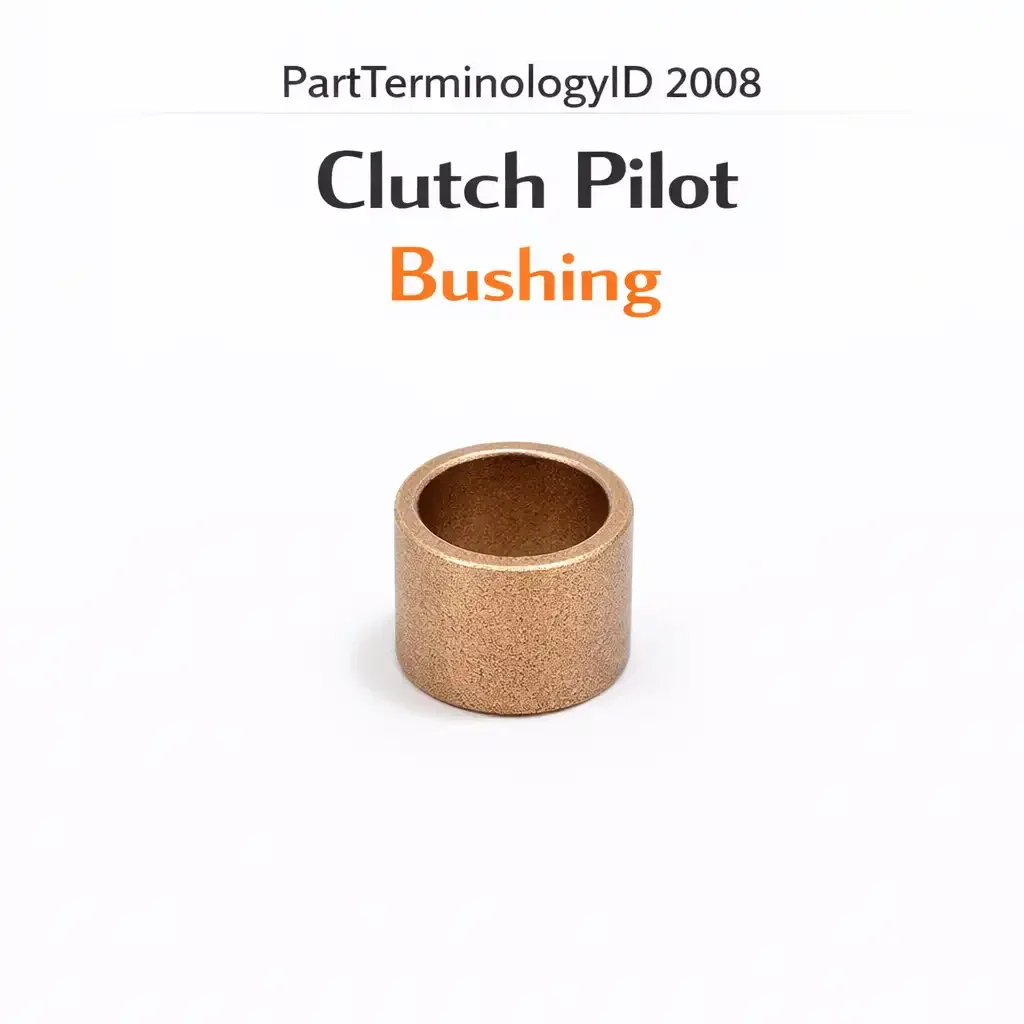
PartTerminologyID 2008, Clutch Pilot Bushing, is a plain cylindrical bushing (typically bronze, brass, or sintered iron) pressed into the center bore of the engine crankshaft's rear flange that supports the tip of the transmission input shaft. It performs exactly the same function as the Clutch Pilot Bearing (PartTerminologyID 1964): it allows the input shaft to rotate independently of the crankshaft when the clutch is disengaged, preventing the transmission from being dragged at engine speed.
The distinction between PartTerminologyID 2008 and PartTerminologyID 1964 is the construction type. PartTerminologyID 1964 covers rolling-element pilot bearings (sealed ball bearings and needle bearings). PartTerminologyID 2008 covers plain bushings with no rolling elements. The bushing relies on a thin oil film between the bushing bore and the input shaft tip for low-friction operation, rather than on balls or needles.
This split exists in the database because the two product types, while functionally interchangeable on many applications, are physically different, are manufactured differently, have different service characteristics, and on some applications are not interchangeable due to bore depth limitations or clearance requirements.
For sellers, the existence of two PartTerminologyIDs for components that fit the same crankshaft bore creates a cross-referencing challenge. A buyer searching for "pilot bushing" may need PartTerminologyID 2008 (the plain bushing) or may actually need PartTerminologyID 1964 (a sealed ball bearing that fits the same bore). The listing must clarify which product type is being sold and whether the other type is a valid alternative for the application.
Why This Part Generates Returns
Buyers order the wrong clutch pilot bushing because:
they do not verify the crankshaft bore diameter (bushing O.D.)
they do not verify the input shaft tip diameter (bushing I.D.), which is determined by the transmission, not the engine
they ordered a plain bushing when their application requires a sealed ball bearing (PartTerminologyID 1964) due to bore depth limitations (the bushing is longer than a bearing and may bottom out in a shallow bore, or the bearing is deeper than a bushing and may protrude from a short bore)
they ordered a plain bushing expecting a sealed ball bearing (or vice versa) because the listing or search result did not distinguish between PartTerminologyID 2008 and 1964
they do not know the transmission code (which determines the input shaft tip diameter and therefore the bushing I.D.)
they confuse the pilot bushing with the release bearing (PartTerminologyID 1968) or the fork shaft bearing (PartTerminologyID 1960)
Sellers get caught because the two PartTerminologyIDs cover products that fit the same bore on the same vehicle, and many sellers list both under the same vehicle fitment without distinguishing the product type. The buyer searching for "pilot bushing" finds two listings, one plain bushing and one sealed bearing, cannot determine which one their vehicle originally had, and guesses. If the guess is wrong on dimensions (the bearing may be slightly different in I.D. or depth than the bushing), the part comes back.
Status in New Databases
PIES/PCdb: PartTerminologyID 2008, Clutch Pilot Bushing
PIES 8.0 / PCdb 2.0: No change
What Makes a Bushing Different From a Bearing
Plain bushing (PartTerminologyID 2008)
A solid cylindrical sleeve with no moving parts. The input shaft tip rotates directly against the bushing bore surface. The bushing material (bronze, brass, or sintered iron with oil impregnation) provides a self-lubricating surface. Sintered bushings are porous and absorb oil during manufacturing, releasing it slowly during operation to maintain a lubricating film.
Advantages: Cheaper. Thinner wall (smaller difference between O.D. and I.D.), which means the bushing works in applications where the crankshaft bore is only slightly larger than the input shaft tip. Easier to remove (can be collapsed inward with a chisel or pulled with a slide hammer). Shorter in length than many bearings, fitting shallow crankshaft bores.
Disadvantages: Higher friction than a rolling element bearing. Shorter service life. Can seize if run dry (oil film breaks down under heat or contamination). Requires periodic lubrication (a dab of grease during installation).
Sealed ball bearing (PartTerminologyID 1964)
A miniature sealed ball bearing with an inner race, outer race, balls, and seals. The input shaft tip rides in the inner race. The outer race presses into the crankshaft bore.
Advantages: Lower friction. Longer service life. Self-contained lubrication (sealed grease). More precise shaft centering.
Disadvantages: Thicker wall (larger difference between O.D. and I.D.), meaning the bearing requires a larger crankshaft bore relative to the input shaft diameter. Deeper (wider) than a bushing, requiring a deeper crankshaft bore. More expensive. Harder to remove (requires a bearing puller or the bread/grease hydraulic extraction technique).
When they are interchangeable
On most applications where the crankshaft bore is deep enough to accept either a bushing or a bearing, and where the bore I.D. and input shaft tip O.D. create enough clearance for either product type, the two are interchangeable. Many clutch kits (PartTerminologyID 1993) include a sealed ball bearing as a direct upgrade replacement for the OE plain bushing.
When they are NOT interchangeable
Shallow crankshaft bore: If the bore is shallow (short depth), a sealed ball bearing may be too deep and protrude past the crankshaft flange face. The protruding bearing will contact the flywheel or interfere with flywheel bolt installation. The plain bushing, being shorter, fits the shallow bore.
Narrow bore-to-shaft clearance: If the crankshaft bore I.D. and the input shaft tip O.D. are close in size, there may not be enough wall thickness to accommodate a sealed bearing's inner and outer races. A thin-wall plain bushing fits where a bearing does not.
Specific OE requirement: Some vehicle manufacturers specify a plain bushing (not a bearing) in their service manual, and the input shaft tip may have a specific surface finish optimized for bushing contact rather than bearing race contact.
Top Return Scenarios
Scenario 1: "Bushing O.D. doesn't fit my crankshaft bore"
Crankshaft bore diameter mismatch.
Prevention language: "Bushing O.D.: [X mm]. Crankshaft bore I.D.: [X mm]. Verify crankshaft bore diameter."
Scenario 2: "Bushing I.D. is wrong for my input shaft"
Transmission input shaft tip mismatch.
Prevention language: "Bushing I.D.: [X mm]. Input shaft tip O.D.: [X mm]. For vehicles with [transmission code]. Verify both engine (crankshaft bore) and transmission (input shaft tip)."
Scenario 3: "I wanted a sealed bearing, not a bushing"
Buyer expected a rolling-element bearing (PartTerminologyID 1964) and received a plain bushing (PartTerminologyID 2008).
Prevention language: "This is a plain pilot bushing (bronze/sintered, no rolling elements). For a sealed ball bearing pilot, see PartTerminologyID 1964. Both fit the same crankshaft bore on most applications, but dimensions may vary."
Scenario 4: "Bushing is too long for my crankshaft bore"
Bushing depth exceeds bore depth.
Prevention language: "Bushing depth (length): [X mm]. Crankshaft bore depth: verify bore depth can accept this bushing. If bore is shallow, a shorter bushing or a sealed ball bearing (PartTerminologyID 1964) may be required."
Scenario 5: "Wrong transmission, I.D. doesn't match"
Same engine with different transmissions using different input shaft tip diameters.
Prevention language: "For vehicles with [engine code] and [transmission code]. Verify both engine and transmission. The same engine paired with different transmissions may require different pilot bushing I.D. dimensions."
What to Include in the Listing
Core essentials
PartTerminologyID: 2008
component: Clutch Pilot Bushing
product type: plain bushing (not sealed ball bearing, not needle bearing)
material: bronze, brass, or sintered iron
quantity: 1
Fitment essentials
year/make/model/submodel
engine code (determines crankshaft bore O.D.)
transmission code (determines input shaft tip I.D.)
Dimensional essentials
bushing O.D. (crankshaft bore diameter)
bushing I.D. (input shaft tip diameter)
bushing depth (length)
wall thickness
material
Image essentials
bushing with O.D., I.D., and depth callouts
installed context showing position in crankshaft bore
comparison reference distinguishing the plain bushing from a sealed ball bearing
Catalog Checklist for ACES/PIES Teams
PartTerminologyID = 2008
require O.D., I.D., and depth as mandatory attributes
require engine code (crankshaft bore)
require transmission code (input shaft tip)
require material attribute
differentiate from PartTerminologyID 1964 (Clutch Pilot Bearing, rolling element)
note interchangeability with PartTerminologyID 1964 where applicable (same O.D. and I.D., sufficient bore depth)
flag applications where only a bushing fits (shallow bore, narrow wall clearance)
flag applications where multiple transmissions pair with the same engine and require different I.D. specifications
FAQ (Buyer Language)
Can I use a sealed bearing instead of a bushing?
On most applications, yes, as long as the bearing O.D. matches the crankshaft bore, the bearing I.D. matches the input shaft tip, and the crankshaft bore is deep enough to accept the bearing without it protruding. A sealed bearing is generally considered an upgrade from a plain bushing.
Which lasts longer, a bushing or a bearing?
A sealed ball bearing typically lasts longer because the rolling elements produce less friction and the sealed grease provides consistent lubrication. A plain bushing relies on residual oil in the sintered material and can wear faster, particularly on vehicles driven in stop-and-go traffic where the clutch is cycled frequently.
Should I grease the bushing before installation?
Yes. Apply a thin coat of high-temperature grease to the bushing bore before installing the input shaft. This provides initial lubrication until the sintered material's oil film establishes. Do not over-grease, as excess grease can contaminate the clutch disc.
When should I replace the pilot bushing?
Every time the transmission is removed for clutch service. The bushing costs a few dollars and is only accessible with the transmission out.
Cross-Sell Logic
Clutch Pilot Bearing (PartTerminologyID 1964, as the rolling-element alternative)
Clutch Disc and Pressure Plate Kit (PartTerminologyID 1988/1993)
Clutch Release Bearing (PartTerminologyID 1968)
Clutch Fork Shaft Bearing (PartTerminologyID 1960)
Rear Main Seal
Clutch Alignment Tool
Frame as "replace with every clutch job, along with the release bearing and fork shaft bearing."
Final Take for PartTerminologyID 2008
Clutch Pilot Bushing (PartTerminologyID 2008) is the plain-bearing counterpart to the Clutch Pilot Bearing (PartTerminologyID 1964). They share a crankshaft bore, they share a function, and they share the same fitment variables: O.D. from the engine, I.D. from the transmission, depth from the crankshaft bore geometry. The listing must distinguish between the two PartTerminologyIDs so the buyer knows whether they are ordering a plain bushing or a sealed bearing, and must state the three dimensions that define the part.
Engine code. Transmission code. O.D., I.D., and depth. Those are the same attributes required for PartTerminologyID 1964, because the fitment problem is the same. The only difference is what the buyer holds in their hand: a bronze sleeve or a miniature ball bearing. The listing must make that difference clear.