
Written by Arthur Simitian | PartsAdvisory
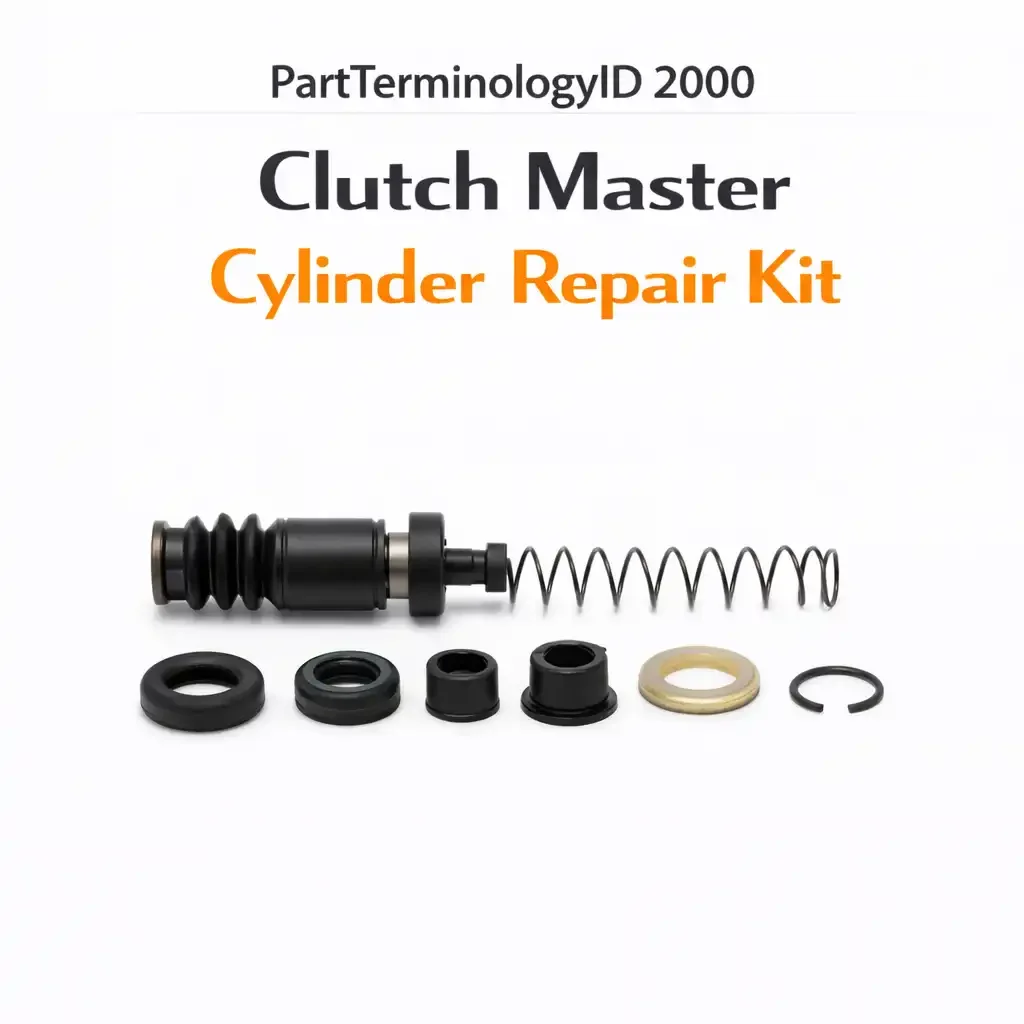
PartTerminologyID 2000, Clutch Master Cylinder Repair Kit, is a seal and piston rebuild package for the clutch master cylinder (PartTerminologyID 1996). It contains the internal wear items needed to restore a leaking master cylinder to serviceable condition without replacing the entire unit. The kit typically includes the piston seal (primary cup), the secondary seal, the return spring, the dust boot, and in some kits the piston itself.
The operating logic is identical to the brake master cylinder repair kit (PartTerminologyID 1840) and the drum brake wheel cylinder kit (PartTerminologyID 1956): if the bore is smooth and undamaged, new seals will restore a leak-free seal and the cylinder can continue in service. The cost of the kit is a fraction of a complete master cylinder.
The practical reality is also identical. A new clutch master cylinder for most passenger vehicles costs $30 to $80. A repair kit costs $8 to $25. The labor to remove the master cylinder, disassemble it, clean the bore, inspect it for scoring and corrosion, install new seals without nicking them on the port edges, reassemble, reinstall, and bleed the system is the same whether the technician is rebuilding the old cylinder or bolting on a new one. The time saved by not having to inspect and hone the bore, and the certainty that a new cylinder does not have hidden bore defects, makes replacement the default choice for most shops and most DIY buyers.
But the repair kit market persists, and for legitimate reasons. It serves the fleet and commercial market where master cylinders are rebuilt in volume on a bench. It serves the classic and vintage vehicle market where OE-style replacement master cylinders may be discontinued, unavailable, or only available as Chinese-manufactured units of questionable quality. It serves markets outside the United States where new replacement cylinders are expensive relative to local wages and where rebuilding is the economic norm. And it serves the DIY buyer who insists on doing everything themselves, has the skill to rebuild hydraulic components, and wants to save twenty dollars.
For sellers, the return problem is the same as every other hydraulic cylinder rebuild kit: bore diameter. The seals in the kit are manufactured to a specific bore tolerance. If the bore does not match, the seals do not seal. And if the bore is damaged, no seal in any kit will fix it.
Why This Part Generates Returns
Buyers order the wrong clutch master cylinder repair kit because:
they do not know the bore diameter of their clutch master cylinder, and bore diameter varies by engine, transmission, slave cylinder type (external vs. CSC), and vehicle weight class (all the splits covered in PartTerminologyID 1996)
they assume all clutch master cylinders for their vehicle year/make/model have the same bore, when the bore may differ across submodels and drivetrain configurations
they confuse the clutch master cylinder repair kit with a brake master cylinder repair kit (PartTerminologyID 1840), which uses different seals sized for a different bore
they confuse the kit with a clutch slave cylinder repair kit, which is a different bore, different seal dimensions, and a different PartTerminologyID
they expect the kit to include the piston when it only includes seals, or vice versa
they order the kit and discover during disassembly that the bore is scored, pitted, or corroded beyond what new seals can fix, making the kit useless and a new master cylinder necessary
they do not realize the kit exists in the first place and order a complete master cylinder when a seal kit would have been sufficient (this is not a return, but it is a missed sale for the seller who could have offered both options)
Sellers get caught because the listing says "clutch master cylinder repair kit" with a vehicle fitment and does not specify the bore diameter the kit is designed for. The buyer orders, receives seals sized for a 19.05mm (3/4") bore, and discovers their master cylinder has a 20.64mm (13/16") bore. The seals are too small. The kit goes back.
Status in New Databases
PIES/PCdb: PartTerminologyID 2000, Clutch Master Cylinder Repair Kit
PIES 8.0 / PCdb 2.0: No change
What This Kit Contains
A standard clutch master cylinder repair kit includes some or all of the following:
Primary piston seal (cup seal)
The main seal that rides on the piston and prevents pressurized fluid from bypassing the piston during actuation. This is the component that fails when the pedal sinks under sustained pressure. The seal is a rubber or elastomer cup with a lip that presses against the bore wall under hydraulic pressure. The lip profile, the material compound, and the outer diameter must match the bore precisely. A seal that is 0.5mm too small will leak under pressure. A seal that is 0.5mm too large will not install into the bore without damage.
Secondary seal (rear seal)
The seal behind the piston that prevents fluid from leaking out the rear of the cylinder (toward the pushrod and pedal). This seal operates at lower pressure than the primary seal but is exposed to more contamination (dirt and moisture enter from the pushrod end despite the dust boot). When the secondary seal fails, brake fluid drips onto the carpet or firewall insulation, and the reservoir level drops.
Return spring
The spring inside the bore that pushes the piston back to its rest position when the clutch pedal is released. Over time, the spring fatigues and loses tension. A weak return spring causes the piston to return slowly, the pedal to return sluggishly, and the replenishment port to open late, which can cause the system to draw air on rapid pedal release.
Dust boot
The rubber or silicone boot that seals the rear opening of the master cylinder where the pushrod enters. The boot keeps dirt, water, and road debris out of the bore. A cracked or missing boot allows contamination that accelerates bore corrosion, which causes seal failure, which causes the leak that prompted the rebuild in the first place. The boot is the first line of defense for the bore surface.
Piston (in some kits)
Higher-end kits include a new piston. Budget kits include seals only, with the expectation that the original piston will be reused if it is not scored or corroded. A piston with visible scoring, pitting, or corrosion on its sealing surfaces will damage new seals during installation or during the first few hundred actuation cycles.
Snap ring / circlip (in some kits)
The retaining ring that holds the piston assembly in the bore. Some kits include a new snap ring. Others assume the original is reused.
What the kit does NOT include
the master cylinder body (housing)
the reservoir (or reservoir cap)
the pushrod
the hydraulic outlet fitting
the mounting hardware
the hydraulic line to the slave cylinder
What the kit assumes
The bore is in rebuildable condition. This is the same assumption discussed in PartTerminologyID 1840 (brake master cylinder repair kit) and PartTerminologyID 1956 (wheel cylinder kit). If the bore has visible scoring (grooves you can catch with a fingernail), pitting (small craters from corrosion), or rust that does not clean up with light honing, new seals will not hold. The cylinder must be replaced with a new unit (PartTerminologyID 1996).
This assumption is the biggest return risk for the kit. The buyer orders the kit, removes the master cylinder, disassembles it, inspects the bore, and discovers it is not rebuildable. The vehicle is now immobile (the clutch hydraulic system is open). The buyer needs a new master cylinder shipped immediately, and the rebuild kit goes back.
Bore Diameter: The Entire Fitment Story
Every fitment variable that creates bore diameter splits on the complete clutch master cylinder (PartTerminologyID 1996) applies identically to the repair kit. The bore diameter is determined by the engine, the transmission, the slave cylinder type (external vs. CSC), and the vehicle weight class.
Common bore sizes in the clutch master cylinder market
Clutch master cylinder bores typically range from 15.87mm (5/8") on light-duty applications to 22.22mm (7/8") on heavy-duty truck applications. Common intermediate sizes include 19.05mm (3/4") and 20.64mm (13/16"). The exact bore size for a specific vehicle depends on the hydraulic ratio between the master and slave cylinders, which the manufacturer calibrates for pedal feel and full clutch release.
A seal kit for a 3/4" bore will not seal a 13/16" bore. The seals are too small. They will install (they will slide into the bore), but they will not create a seal against the bore wall. The system will appear to work during bench testing (no obvious leaks), but under hydraulic pressure during actual clutch actuation, fluid will bypass the undersized seal and the pedal will sink.
Conversely, a seal kit for a 13/16" bore will not install in a 3/4" bore. The seals are too large. The buyer will discover this during assembly when the seal will not enter the bore without excessive force.
The listing must state the bore diameter
This is the same mandate that applies to every hydraulic cylinder rebuild kit in this blog series. The bore diameter is the primary attribute. It is the only dimension the buyer absolutely must match. Everything else in the kit (spring, boot, snap ring) is secondary to the seal diameter.
State the bore diameter prominently. Cross-reference to the master cylinder part numbers the kit is compatible with. This gives the buyer two ways to verify: they can measure their bore, or they can match their master cylinder part number to the kit's compatibility list.
The Rebuild vs. Replace Decision
When rebuilding makes sense
Classic and vintage vehicles: OE-style clutch master cylinders for vehicles from the 1960s and 1970s may be discontinued. The aftermarket replacements available may be poorly manufactured reproductions with loose tolerances and inferior materials. A rebuild of the original OE cylinder using quality seals may produce a better result than a new reproduction cylinder.
European vehicles with expensive OE master cylinders: On some German and British vehicles, the OE clutch master cylinder is an integrated unit with specific reservoir geometry, outlet fitting configuration, and mounting that is difficult to replicate in the aftermarket. A new OE cylinder may cost $150 to $300. A seal kit costs $15 to $25. If the bore is in good condition, rebuilding is economically compelling.
Fleet and commercial operations: Shops that rebuild hydraulic components in volume on a bench can process cylinder rebuilds efficiently. The bore is inspected, honed, and measured in a controlled environment. Seals are installed with proper tools. The rebuilt cylinder is bench-tested before installation. This is a different scenario than a DIY buyer rebuilding a single cylinder on their kitchen table.
Markets with high labor-to-parts ratios: In markets where a new master cylinder is expensive relative to local wages, rebuilding is the economic standard. The repair kit exists to serve this market.
When replacing makes sense
Most passenger vehicles in the U.S. market: A new clutch master cylinder costs $30 to $80. The labor to rebuild vs. replace is the same. The risk of a bore that passes visual inspection but has microscopic pitting that causes seal failure in 6 months is eliminated by installing a new cylinder with a factory-fresh bore.
Any cylinder with a visible bore defect: Scoring, pitting, corrosion, or discoloration in the bore that does not clean up with light honing means the bore will eat seals. Rebuild kits cannot fix bore damage.
DIY buyers without hydraulic rebuild experience: Installing piston seals in a master cylinder bore requires care. The seal lip must not roll over during installation. The seal must not nick on the replenishment port edge (a sharp edge in the bore that can cut the seal lip as the piston is inserted). Experienced rebuilders use seal installation tools and chamfer the port edges. Inexperienced rebuilders push the piston in by hand and nick the seal, which leaks within weeks. For these buyers, a new cylinder is the safer choice.
Top Return Scenarios
Scenario 1: "Seals don't fit my bore"
Bore diameter mismatch.
Prevention language: "Designed for clutch master cylinders with [X mm / X inch] bore diameter. Verify bore size by measuring your master cylinder bore with a caliper or by cross-referencing your master cylinder part number: [list compatible part numbers]."
Scenario 2: "My bore is scored, the kit is useless"
Buyer disassembled the cylinder and found an unrebuildable bore.
Prevention language: "This kit requires a master cylinder bore in serviceable condition (no scoring, pitting, or corrosion that cannot be removed with light honing). If the bore is damaged, replace the master cylinder. See PartTerminologyID 1996."
Scenario 3: "Kit doesn't include the piston"
Buyer expected a complete rebuild kit and received seals only.
Prevention language: "Kit includes: [itemized list]. This kit [includes / does not include] a replacement piston. If the piston is not included, the original piston must be undamaged (no scoring, pitting, or corrosion on sealing surfaces) for reuse."
Scenario 4: "I thought this was a brake master cylinder repair kit"
Buyer confused clutch master cylinder seals with brake master cylinder seals.
Prevention language: "Clutch master cylinder repair kit. For the clutch hydraulic system master cylinder (PartTerminologyID 1996). Not for the brake master cylinder (PartTerminologyID 1836). Clutch and brake master cylinders use different bore sizes and different seal dimensions."
Scenario 5: "I thought this was a slave cylinder repair kit"
Buyer confused master cylinder seals with slave cylinder seals.
Prevention language: "For the clutch master cylinder (firewall-mounted, pedal-actuated). Not for the clutch slave cylinder (bellhousing-mounted or concentric). Master and slave cylinders have different bore sizes and seal dimensions."
Scenario 6: "Pedal still sinks after rebuilding"
Seal was nicked during installation, bore has a hidden defect, or the slave cylinder is the actual failure.
Prevention language: "If the pedal continues to sink after rebuilding the master cylinder, the seal may have been damaged during installation (nicked on the replenishment port edge), the bore may have a defect not visible to the naked eye, or the slave cylinder may be the actual source of the leak. Consider replacing the master cylinder (PartTerminologyID 1996) if the rebuild does not resolve the symptom."
What to Include in the Listing
Core essentials
PartTerminologyID: 2000
component: Clutch Master Cylinder Repair Kit
complete kit contents list (every seal, spring, boot, piston, snap ring itemized)
piston included: yes/no
compatible master cylinder part numbers (OE and aftermarket cross-reference)
quantity: 1 kit (per cylinder)
Fitment essentials
year/make/model/submodel
engine code (if bore size varies by engine)
transmission code (if bore size varies by transmission or slave cylinder type)
slave cylinder type (external/CSC) if master cylinder bore differs between the two
clutch actuation: hydraulic only
Dimensional essentials
bore diameter (mandatory, primary attribute)
primary seal O.D.
secondary seal O.D.
dust boot I.D. and O.D.
spring free length
piston diameter and length (if included)
Image essentials
all kit contents laid out and labeled
seal diameter callout
cross-section or exploded view showing where each component installs in the master cylinder bore
bore diameter reference
Catalog Checklist for ACES/PIES Teams
PartTerminologyID = 2000
require bore diameter attribute (mandatory, non-negotiable)
require kit contents as structured attribute
require piston-included attribute (yes/no)
require compatible master cylinder part number cross-reference
require engine and transmission codes where bore varies
differentiate from brake master cylinder repair kit (PartTerminologyID 1840)
differentiate from clutch slave cylinder repair kit
differentiate from drum brake wheel cylinder kit (PartTerminologyID 1956)
flag cable-actuated vehicles as non-applicable (no master cylinder exists)
flag applications where multiple bore sizes exist for the same year/make/model
FAQ (Buyer Language)
Is it better to rebuild the clutch master cylinder or replace it?
For most passenger vehicle applications in the U.S. market, replacing is more practical. New clutch master cylinders are reasonably priced ($30 to $80), and the labor is the same either way. Rebuilding makes sense when the replacement cylinder is expensive (European vehicles, discontinued applications), when a quality reproduction is not available (classic vehicles), or when you are rebuilding multiple cylinders in a shop environment.
How do I know if my bore is rebuildable?
After removing the piston and seals, inspect the bore with a bright light. Run your fingernail along the bore wall. If you can feel any groove, scratch, or pit, the bore is not rebuildable without honing. If the bore has light haze or staining that cleans up with a fine bore hone and leaves a smooth, cross-hatched surface, it is rebuildable. If the bore has deep pitting, rust that extends below the surface, or scoring that does not clean up with honing, replace the cylinder.
Can I use this kit for the slave cylinder?
No. The clutch master cylinder and the clutch slave cylinder have different bore diameters and different seal dimensions. A master cylinder kit will not fit a slave cylinder, and a slave cylinder kit will not fit a master cylinder. Order the correct kit for the specific cylinder you are rebuilding.
Does this kit fit both the brake and clutch master cylinders?
No. The brake master cylinder (PartTerminologyID 1836) and the clutch master cylinder (PartTerminologyID 1996) are different components with different bore sizes. Their repair kits are not interchangeable. Verify which cylinder you are rebuilding and order the corresponding kit.
My bore looks fine but the new seals leak after a few weeks. What happened?
The most common cause is a seal that was nicked during installation. The replenishment port in the bore has a sharp edge that can cut the seal lip as the piston is pushed past it. Use a seal installation tool or chamfer the port edge slightly with a fine file before installing the piston. Another common cause is microscopic pitting in the bore that is not visible to the naked eye but creates leak paths under hydraulic pressure. If rebuilt cylinders repeatedly fail, replace the cylinder.
Do I need to bleed the system after rebuilding?
Yes. Any time the master cylinder is removed or opened, air enters the system. The system must be fully bled after reassembly and installation. Use fresh DOT 3 or DOT 4 brake fluid. Do not reuse old fluid.
Should I rebuild both the master and slave at the same time?
If you are already rebuilding the master cylinder, it is recommended to at least inspect the slave cylinder. If the slave cylinder shows any signs of seepage, scoring, or seal deterioration, rebuild or replace it at the same time. Both cylinders are exposed to the same fluid, the same contaminants, and the same thermal cycling. If one has failed, the other is likely near the end of its life.
Cross-Sell Logic
Clutch Master Cylinder (PartTerminologyID 1996, for buyers whose bore is not rebuildable)
Clutch Slave Cylinder Repair Kit (for buyers rebuilding both master and slave)
Clutch Slave Cylinder (new, for buyers replacing rather than rebuilding the slave)
Brake Fluid (DOT 3 or DOT 4, for flushing and filling after rebuild)
Clutch Bleeder Kit
Bore Hone (for light bore conditioning before seal installation)
Seal Installation Tool
Clutch Pedal Bearing (PartTerminologyID 1961, inspect while the master cylinder area is accessible)
Frame as "rebuild or replace: order the kit if you plan to rebuild, but have a new master cylinder (PartTerminologyID 1996) available in case the bore is not serviceable. Rebuild the slave at the same time if it shows any sign of wear."
Final Take for PartTerminologyID 2000
Clutch Master Cylinder Repair Kit (PartTerminologyID 2000) is the third hydraulic cylinder rebuild kit in this blog series, following the brake master cylinder repair kit (PartTerminologyID 1840) and the drum brake wheel cylinder kit (PartTerminologyID 1956). All three share the same fundamental listing problem: bore diameter is the entire fitment story for a bag of seals, and the listing almost never states it.
The seals in the bag are cut to one bore size. If the bore does not match, every seal in the bag is wrong. If the bore is damaged, no seal in any bag will fix it. And the buyer does not discover either problem until they have disassembled the cylinder, at which point the vehicle is immobile and the return is urgent.
State the bore diameter. State what is in the kit. State which master cylinder part numbers the kit fits. Warn the buyer that the bore must be serviceable. Those four elements prevent the buyer from ordering seals that do not fit their bore, expecting a piston that is not included, or attempting to rebuild a cylinder that should have been replaced.
Four elements. Same as the brake master cylinder kit. Same as the wheel cylinder kit. The hydraulic rebuild kit listing formula does not change across the catalog. Only the bore diameter does.