
Written by Arthur Simitian | PartsAdvisory
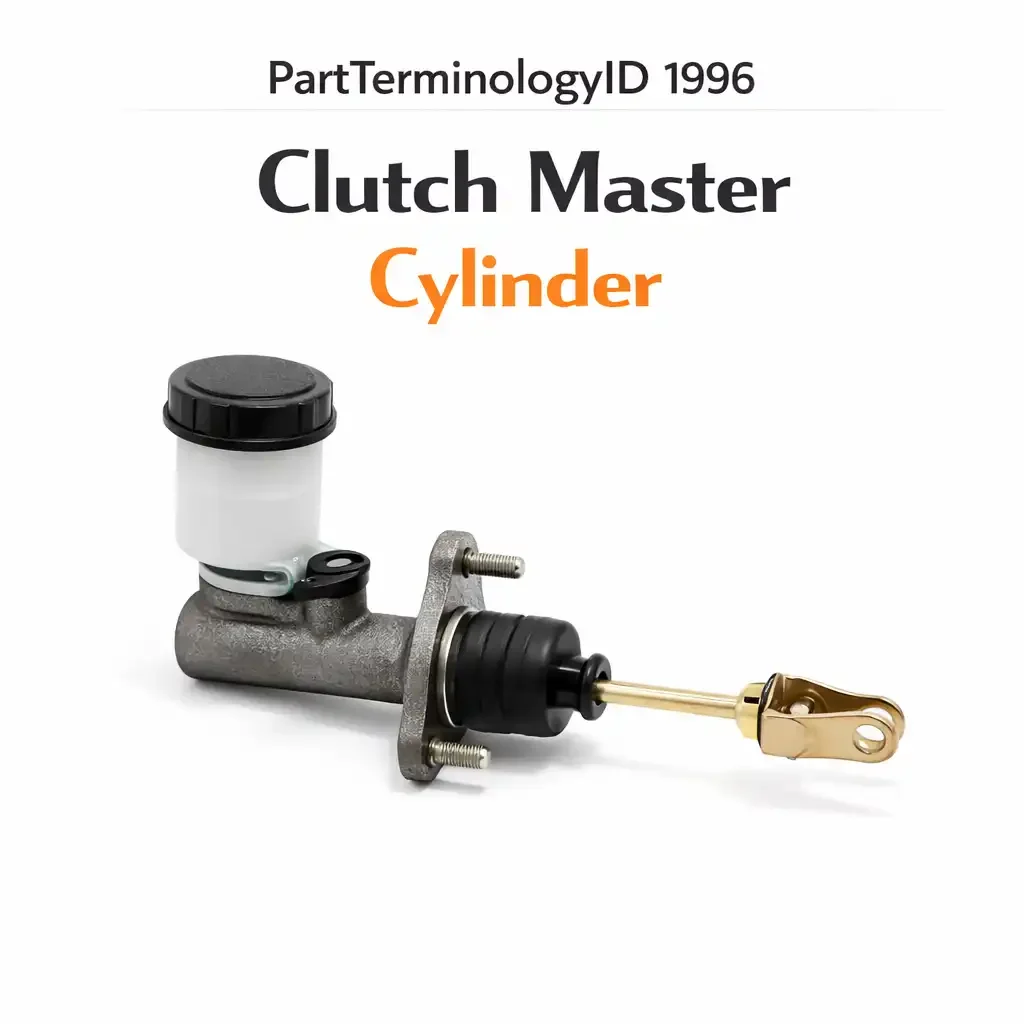
PartTerminologyID 1996, Clutch Master Cylinder, is the hydraulic pump mounted on the firewall at the clutch pedal that converts the driver's pedal force into hydraulic pressure. That pressure travels through a hydraulic line to the clutch slave cylinder (external or concentric), which actuates the clutch release mechanism. It is the master cylinder side of a hydraulic clutch system, functionally identical in principle to the brake master cylinder (PartTerminologyID 1836) but dedicated to the clutch circuit.
Hydraulic clutch actuation replaced cable actuation across the industry because it provides smoother, more consistent pedal feel, eliminates cable stretch and the manual or self-adjusting mechanisms that cables require, routes more easily through crowded engine bays, and allows the manufacturer to tune clutch engagement characteristics by changing bore diameters and hydraulic ratios rather than changing cable lengths and lever arms. On a hydraulic system, the driver pushes a piston. Fluid carries the force. A second piston at the other end moves the release mechanism. No cable to stretch, no housing to corrode, no self-adjuster to seize.
When the clutch master cylinder fails, it leaks internally. Brake fluid seeps past the piston seal inside the bore, the pedal slowly sinks to the floor under sustained pressure, and the clutch does not fully disengage. The driver cannot shift cleanly. In the early stages, the symptom is intermittent: the pedal feels normal on quick presses but sinks during long holds at traffic lights. In the late stages, the pedal goes straight to the floor and the clutch does not release at all. The vehicle is undriveable in any gear except first (where the driver can start from a stop without the clutch by putting the transmission in gear with the engine off and starting the engine).
For sellers, the clutch master cylinder is a moderate-volume replacement part with a set of fitment traps that mirror its brake system counterpart and a set of traps unique to the clutch system. The brake master cylinder post (PartTerminologyID 1836) covered bore diameter as the primary fitment variable. Everything in that post about bore diameter applies here. But the clutch master cylinder adds the reservoir configuration question, the pushrod interface question, the cable clutch knockout, and the slave cylinder pairing question, all of which create return scenarios that do not exist in the brake system.
How the Clutch Hydraulic System Works
Understanding the complete hydraulic circuit helps sellers understand why each fitment variable matters.
The circuit
The clutch hydraulic system is a closed circuit with four components: the master cylinder (mounted on the firewall at the clutch pedal), a hydraulic line or hose (connecting the master cylinder to the slave cylinder), the slave cylinder (mounted on the bellhousing or inside the bellhousing for CSC systems), and a fluid reservoir (either integrated into the master cylinder, mounted separately, or shared with the brake master cylinder reservoir).
When the driver presses the clutch pedal, the pushrod pushes the master cylinder piston forward. The piston pressurizes the fluid in the bore. Pressurized fluid flows through the hydraulic line to the slave cylinder. The slave cylinder piston extends, pushing the clutch fork (on external slave systems) or directly pushing the release bearing (on CSC systems) against the pressure plate diaphragm spring. The clutch disengages.
When the driver releases the pedal, the pressure plate's diaphragm spring pushes the release mechanism back, which pushes the slave cylinder piston back, which pushes fluid back to the master cylinder. The master cylinder piston returns to its rest position, and the replenishment port (a small hole in the bore connected to the reservoir) allows fluid to equalize between the bore and the reservoir.
Why the replenishment port matters
The replenishment port is a tiny hole in the bore wall that connects the pressurized bore to the unpressurized reservoir. At rest (pedal released), the port is open. Fluid flows freely between the bore and reservoir, compensating for thermal expansion, minor leaks, and fluid level changes. When the pedal is pressed, the piston moves past the replenishment port, sealing it, and the fluid ahead of the piston becomes pressurized.
If the pushrod is too long, the piston is held slightly forward at rest, blocking the replenishment port. Fluid cannot return to the reservoir. The slave cylinder remains partially pressurized. The clutch slips because the release mechanism is partially engaged at all times. This is the same problem that occurs with the brake master cylinder (PartTerminologyID 1836) when the booster pushrod is too long, and it is just as insidious: the system works fine when cold, but as the fluid warms and expands, the pressure increases, the clutch slips more, the disc overheats, and the problem accelerates.
If the pushrod is too short, there is excessive free play at the top of the pedal stroke. The driver presses the pedal but no hydraulic pressure is generated until the piston reaches the point where it covers the replenishment port. The result is a dead zone at the top of the pedal, and the clutch may not fully disengage at the bottom of the stroke because the piston does not travel far enough.
Bore Diameter: The Primary Fitment Variable
The clutch master cylinder bore diameter is the internal diameter of the cylinder bore in which the piston travels. It determines how much fluid volume is displaced per unit of piston travel (and therefore per unit of pedal travel). The bore diameter creates a hydraulic ratio with the slave cylinder bore diameter.
The hydraulic ratio
The relationship between the master cylinder bore and the slave cylinder bore determines the force multiplication and the volume transfer of the system.
Larger master bore, smaller slave bore: The master cylinder displaces a large volume of fluid per stroke. The slave cylinder, having a smaller bore, extends farther (more travel) but with less force. The pedal feels lighter, but the pedal travel is shorter (the master reaches its end of travel quickly because it moves a lot of fluid per inch of pedal movement).
Smaller master bore, larger slave bore: The master cylinder displaces less fluid per stroke. The slave cylinder, having a larger bore, extends less distance but with more force. The pedal feels heavier, and the pedal travel is longer (the master must travel farther to displace enough fluid to move the larger slave piston to full extension).
Vehicle manufacturers calibrate this ratio to achieve a specific pedal feel: enough travel for smooth modulation, enough force to disengage the clutch fully, and a pedal effort that is comfortable for the target driver. Changing either bore diameter changes the entire feel of the clutch system.
Common bore diameter splits
Engine type: Heavier engines (V8 vs. four-cylinder) may produce more torque, requiring a pressure plate with higher clamp load, which requires more force at the release bearing, which may require a different hydraulic ratio (and therefore a different master cylinder bore).
Transmission type: Different transmissions may use different slave cylinders (different bore sizes, different stroke requirements). The master cylinder bore must match the slave cylinder to achieve the correct pedal feel and full release bearing travel.
External slave vs. concentric slave cylinder (CSC): CSC systems typically have different volume requirements than external slave systems because the CSC piston is positioned differently relative to the release bearing, and the travel requirement may differ. The master cylinder bore for a CSC-equipped vehicle may be different than for the same vehicle with an external slave cylinder.
Vehicle weight class: On trucks and SUVs where GVW options create different clutch specifications (heavier-duty pressure plates for towing packages), the master cylinder bore may change to maintain appropriate pedal effort with the higher clamp load.
A bore diameter difference of 1mm or less can change pedal feel noticeably. A difference of 2mm changes the system from comfortable to either brick-heavy or floor-sinking. The listing must state the bore diameter as a mandatory attribute.
Reservoir Configuration: Three Options That Look Nothing Alike
The fluid reservoir is where the hydraulic fluid is stored when the system is at rest and where thermal expansion volume is accommodated. The reservoir configuration is one of the most common return drivers for clutch master cylinders because three fundamentally different configurations exist, and the listing rarely specifies which one.
Integrated reservoir
The fluid reservoir is molded or mounted directly on top of the clutch master cylinder body. The master cylinder and reservoir ship as one unit. The reservoir cap, fill port, and fluid level indicator are all on the master cylinder assembly. This is the simplest configuration and the most common on modern vehicles.
When the buyer orders a replacement master cylinder with an integrated reservoir, they receive a complete, self-contained unit. There is no additional reservoir to connect, no hose to route, and no question about where the fluid comes from.
Remote reservoir (dedicated)
The master cylinder has a small barbed or threaded inlet fitting on its body, connected by a short rubber hose to a separate reservoir mounted elsewhere in the engine bay (often on the firewall, fender apron, or strut tower). The reservoir is a small translucent plastic container dedicated to the clutch system.
When the buyer orders a replacement master cylinder for this configuration, the master cylinder ships without a reservoir. The buyer either reuses the existing remote reservoir (and the connecting hose) or orders a new reservoir separately. If the replacement master cylinder has an integrated reservoir instead of a remote inlet fitting, it will not connect to the existing hose, and the buyer will have a master cylinder with a built-in reservoir they do not need and no way to connect to the remote reservoir.
Shared reservoir (brake/clutch common)
On some vehicles, the clutch master cylinder draws fluid from the brake master cylinder reservoir through a dedicated port. The brake reservoir has an additional outlet (usually the smallest chamber) that feeds the clutch master cylinder via a short hose. There is no separate clutch reservoir.
This is the configuration that causes the most confusion, because the clutch master cylinder has no reservoir of its own (neither integrated nor dedicated remote). If the buyer receives a master cylinder with an integrated reservoir for a vehicle that uses a shared brake/clutch reservoir, they have a reservoir they do not need and no connection to the brake reservoir. If they install the integrated-reservoir master cylinder and do not connect to the brake reservoir, the clutch system works initially, but the brake reservoir now has an unused port (which may leak or allow air ingress if not sealed) and the two reservoirs are no longer balanced.
Conversely, if the buyer's vehicle has an integrated reservoir and they receive a master cylinder designed for a shared configuration (no reservoir, just an inlet fitting), they have a master cylinder with no fluid supply.
What the listing must state
Reservoir type: integrated, remote (dedicated, includes/does not include reservoir and hose), or shared with brake system (inlet fitting only, no reservoir included). This is a mandatory attribute. Without it, one in three buyers receives the wrong configuration.
The Pushrod Interface
The clutch master cylinder is actuated by a pushrod connected to the clutch pedal arm. The pushrod enters the rear of the master cylinder through a dust boot and pushes the internal piston forward when the pedal is pressed.
Pushrod length
As discussed in the replenishment port section, pushrod length is critical. Too long blocks the replenishment port and causes clutch slip. Too short creates dead pedal travel and prevents full clutch release. The correct pushrod length positions the piston just behind the replenishment port when the pedal is fully released.
Pushrod tip configuration
The end of the pushrod that contacts the master cylinder piston may be flat, spherical (ball-tipped), or cupped. The piston's rear face has a corresponding surface. A spherical pushrod tip into a cupped piston is common, as it allows angular misalignment between the pedal arc and the cylinder axis. A flat tip on a flat piston requires more precise alignment.
If the pushrod tip and piston interface do not match, the force is applied off-center, which accelerates seal wear on one side of the bore and causes premature failure of the replacement master cylinder. The buyer blames the new cylinder as "defective" when the real issue is the pushrod interface.
Pushrod attachment to the pedal
The pushrod attaches to the clutch pedal arm via a clevis pin, a snap-on ball socket, a threaded connection, or a U-clip. The attachment method and dimensions must match the pedal arm. If the master cylinder ships with a pushrod and the pushrod's pedal attachment does not match the pedal arm, the master cylinder cannot be actuated.
What ships in the box
Some master cylinders include the pushrod. Some do not (the buyer reuses the OE pushrod from the pedal arm). Some include an adjustable pushrod (threaded, with a lock nut for length adjustment). The listing must state whether a pushrod is included and, if so, whether it is adjustable or fixed and its length.
The Hydraulic Outlet Fitting
The master cylinder's hydraulic outlet connects to the clutch hydraulic line that runs to the slave cylinder. The outlet fitting is a threaded port with a specific thread size, thread pitch, and orientation (pointing forward, downward, or at an angle).
Thread size and type
Common outlet thread sizes include M10 x 1.0, M12 x 1.0, 3/8"-24 inverted flare, and various metric bubble flare sizes. The fitting must match the hydraulic line's end fitting exactly. A thread mismatch means the line will not connect (cross-threading a brake fluid fitting is a leak waiting to happen).
Fitting orientation
The outlet fitting's direction determines how the hydraulic line routes from the master cylinder. A fitting that points forward routes the line along the firewall. A fitting that points downward routes the line under the master cylinder. If the fitting orientation does not match the vehicle's line routing, the line will not reach or will kink at the connection.
On some vehicles, the outlet fitting is on the bottom of the master cylinder body. On others, it exits the front face. On others, it exits at an angle from the side. The listing must show the fitting position and orientation, or the buyer discovers the mismatch during installation when the hydraulic line does not align.
Flare type
Just like brake hydraulic fittings (covered in PartTerminologyID 1820), clutch hydraulic fittings use either double flare (SAE/domestic) or bubble flare (ISO/metric) connections. The flare type of the master cylinder outlet must match the flare type of the hydraulic line. A flare mismatch causes a leak at a pressurized connection.
The Cable Clutch Knockout
Vehicles with cable-actuated clutches have no clutch master cylinder. There is no hydraulic fluid, no slave cylinder, no hydraulic line, and no PartTerminologyID 1996 component. If a seller lists a clutch master cylinder for a cable-actuated vehicle, every order is a return.
The cable-to-hydraulic transition occurred at different times for different vehicles, and some model ranges span both systems. A listing that covers 1990 to 2005 on a vehicle that switched from cable to hydraulic in 1998 will attract cable-equipped buyers from 1990 to 1997 who cannot use the part.
The listing must specify hydraulic clutch actuation only, and the year range must not span the cable-to-hydraulic transition without flagging the split.
External Slave vs. CSC: Why the Master Cylinder May Differ
On some vehicles, the master cylinder specification changes depending on whether the vehicle is equipped with an external slave cylinder (fork-actuated) or a concentric slave cylinder (CSC).
Why the specs differ
External slave cylinders and CSCs have different bore diameters, different stroke requirements, and different volume demands. The master cylinder's bore and stroke are calibrated to the slave cylinder's characteristics. If the vehicle was available with both configurations (some model years had external slaves, some had CSCs, or different transmissions used different actuation methods), the master cylinder may have a different bore for each configuration.
A master cylinder bore matched to an external slave, installed on a CSC-equipped vehicle, will produce incorrect hydraulic volume. The pedal may not fully disengage the clutch (insufficient volume to extend the CSC piston fully), or the pedal may require excessive travel (the smaller bore does not displace enough fluid per stroke).
What the listing must state
Slave cylinder type: external or CSC. If the master cylinder bore differs between the two, the listing must specify which slave type the master cylinder is designed for.
Why This Part Generates Returns
Buyers order the wrong clutch master cylinder because:
they do not verify bore diameter
they do not verify reservoir configuration (integrated, remote dedicated, or shared with brake system)
they do not verify the pushrod interface (length, tip type, attachment, included or not)
they do not verify the hydraulic outlet fitting (thread size, flare type, orientation)
they do not verify firewall mounting bolt pattern and orientation
they confuse the clutch master cylinder with the brake master cylinder (PartTerminologyID 1836)
they order for a cable-actuated vehicle that has no master cylinder
they miss the external slave vs. CSC bore split
they do not verify whether the reservoir cap and seal are included (or match the existing cap)
Status in New Databases
PIES/PCdb: PartTerminologyID 1996, Clutch Master Cylinder
PIES 8.0 / PCdb 2.0: No change
Diagnostic Returns: The Master Cylinder That Works but Gets Blamed
A portion of clutch master cylinder returns are diagnostic errors. The buyer replaces the master cylinder, the symptom persists, and the master cylinder gets returned as "defective." Common misdiagnosis scenarios:
The slave cylinder is the actual failure
The internal seal on the slave cylinder (or CSC) is leaking, not the master cylinder. Both produce similar symptoms (pedal sinks under sustained pressure). The buyer replaces the master first (it is easier to access) and discovers the symptom persists because the slave is the actual problem.
Listing mitigation: "If your clutch pedal sinks under sustained pressure, the internal seal failure may be in the master cylinder or the slave cylinder. Both should be inspected or replaced as a pair to avoid diagnosing one and missing the other."
Air in the system
The system was not properly bled after the last service. Air in the hydraulic circuit compresses under pressure, mimicking the feel of a failing seal. The buyer replaces the master cylinder, re-bleeds the system, and the symptom is fixed, but the fix was the bleeding, not the master cylinder. The old master cylinder was fine.
Listing mitigation: "Before replacing the master cylinder, verify the system has been properly bled. Air in the hydraulic circuit produces a soft or sinking pedal that mimics master cylinder failure."
Contaminated fluid
Old, moisture-saturated brake fluid has a lower boiling point. Under sustained use (heavy traffic, repeated clutch actuation), the fluid can boil inside the master cylinder bore, creating vapor bubbles that compress like air. The pedal goes soft. The buyer replaces the master cylinder, fills with fresh fluid, and the problem is fixed by the fluid change, not the new cylinder.
Listing mitigation: "Flush and replace the clutch hydraulic fluid with fresh DOT 3 or DOT 4 brake fluid when installing a new master cylinder. Contaminated or moisture-laden fluid can cause soft pedal symptoms independent of master cylinder condition."
Top Return Scenarios
Scenario 1: "Bore is the wrong size"
Hydraulic ratio mismatch.
Prevention language: "Bore diameter: [X mm]. Verify bore size matches your original clutch master cylinder. Bore diameter varies by engine, transmission, and slave cylinder type (external vs. CSC)."
Scenario 2: "This has a built-in reservoir but my car uses a shared brake/clutch reservoir"
Reservoir configuration mismatch.
Prevention language: "Reservoir type: [integrated / remote (dedicated) / remote (shared with brake master cylinder reservoir)]. Verify your vehicle's clutch fluid reservoir configuration before ordering."
Scenario 3: "Outlet fitting doesn't match my hydraulic line"
Fitting size, flare type, or orientation mismatch.
Prevention language: "Hydraulic outlet fitting: [thread size and pitch, flare type (double/bubble), orientation (forward/down/angled)]. Verify fitting matches your clutch hydraulic line connection."
Scenario 4: "Mounting bolts don't line up"
Firewall bolt pattern mismatch.
Prevention language: "Firewall mounting: [bolt count, bolt spacing, bolt thread size]. Verify mounting pattern matches your firewall."
Scenario 5: "My vehicle has a cable clutch, there is no master cylinder"
Cable-actuated vehicle.
Prevention language: "For vehicles with hydraulic clutch actuation only. Not for vehicles with cable-actuated clutch. If your clutch pedal connects to a cable rather than a hydraulic cylinder on the firewall, your vehicle does not use a clutch master cylinder."
Scenario 6: "Clutch slips after installation"
Pushrod too long, blocking replenishment port.
Prevention language: "Pushrod: [included (adjustable / fixed, X mm length) / not included (reuse OE pushrod)]. Incorrect pushrod length causes clutch slip (too long) or excessive pedal free play (too short). Verify pushrod length per vehicle service manual before installation."
Scenario 7: "Pedal sinks but the new master cylinder doesn't fix it"
Slave cylinder is the actual failure, or system has air.
Prevention language: "If your clutch pedal sinks under sustained pressure, the failure may be in the master cylinder, the slave cylinder, or both. Consider replacing both as a pair. Ensure the system is fully bled after installation."
Scenario 8: "Reservoir cap doesn't fit"
Replacement master cylinder has a different reservoir neck diameter or cap style.
Prevention language: "Reservoir cap: [included / not included]. Cap type: [bayonet twist / screw-on / press-fit]. Verify cap compatibility if reusing your existing cap."
What to Include in the Listing
Core essentials
PartTerminologyID: 1996
component: Clutch Master Cylinder
condition: new or remanufactured
reservoir type: integrated, remote (dedicated), or shared with brake system
pushrod: included (adjustable/fixed with length and tip type) or not included
reservoir cap: included or not included
quantity: 1
Fitment essentials
year/make/model/submodel
engine code (if bore size varies by engine)
transmission code (if bore size varies by transmission or slave cylinder type)
clutch actuation: hydraulic only (exclude cable vehicles)
slave cylinder type: external or CSC (if master cylinder specification differs)
production date split (if master cylinder changed mid-year)
Dimensional essentials
bore diameter (mandatory)
stroke length
firewall mounting bolt pattern (count, spacing, thread)
hydraulic outlet fitting (thread size, pitch, flare type, orientation)
pushrod length and tip type (if included)
reservoir inlet fitting size (if remote type)
overall body length and width
Image essentials
full cylinder showing reservoir (if integrated), outlet fitting, and mounting flange
rear view showing pushrod entry and dust boot
outlet fitting close-up with thread callout and orientation reference
mounting flange detail with bolt spacing callout
reservoir connection detail (if remote type, showing inlet fitting)
reservoir cap detail (if included)
comparison image showing integrated vs. remote configurations (to clarify which type this listing is)
Catalog Checklist for ACES/PIES Teams
PartTerminologyID = 1996
require bore diameter (mandatory, non-negotiable)
require reservoir type (integrated/remote dedicated/shared with brake)
require pushrod inclusion attribute (included with length, or not included)
require outlet fitting size, flare type, and orientation
require mounting bolt pattern
require engine and transmission codes where bore varies
require slave cylinder type (external/CSC) where master cylinder spec differs
flag cable-actuated vehicles as non-applicable
flag the cable-to-hydraulic transition year for vehicles that changed mid-generation
flag vehicles where reservoir is shared with brake system
differentiate from brake master cylinder (PartTerminologyID 1836)
cross-reference to compatible slave cylinder part numbers
FAQ (Buyer Language)
Is this the same as the brake master cylinder?
No. The clutch master cylinder (PartTerminologyID 1996) serves the clutch hydraulic circuit only. The brake master cylinder (PartTerminologyID 1836) serves the brake hydraulic circuit. They are separate cylinders mounted near each other on the firewall. They use the same type of brake fluid but are completely different parts with different bore sizes, different mounting patterns, and different outlet fittings. They are not interchangeable.
What fluid does the clutch master cylinder use?
Most clutch master cylinders use DOT 3 or DOT 4 brake fluid, the same fluid as the brake system. Check your vehicle's owner's manual or the reservoir cap for the correct specification. Do not use DOT 5 silicone fluid unless the entire system was designed and built for it, as DOT 5 is not compatible with the rubber seals and hoses in systems designed for DOT 3/4. Also do not mix DOT 5 with DOT 3/4.
Do I need to bleed the system after replacing the master cylinder?
Yes. Any time the hydraulic circuit is opened (master cylinder replaced, slave cylinder replaced, line disconnected), air enters the system. The system must be bled to remove all air bubbles. Air in the clutch hydraulic system compresses under pressure, causing a spongy pedal and incomplete clutch release.
Bleeding a clutch hydraulic system is similar to bleeding brakes: open the bleeder valve on the slave cylinder, pump the pedal (or use a pressure/vacuum bleeder), and expel air and old fluid until clean, bubble-free fluid flows from the bleeder. On vehicles with a concentric slave cylinder (CSC), bleeding can be significantly more difficult because the CSC is inside the bellhousing and the bleeder location may be awkward. A pressure bleeder or vacuum bleeder is strongly recommended for CSC systems.
Should I replace the slave cylinder at the same time?
It is strongly recommended, particularly if the slave cylinder is original and the vehicle has significant mileage. Both cylinders contain rubber seals immersed in the same fluid, exposed to the same contaminants, and subjected to the same thermal cycling. If the master cylinder's seal failed, the slave cylinder's seal is likely near the end of its life as well. Replacing the master and leaving an aging slave in place risks a slave cylinder failure weeks or months later, requiring a second service visit.
On vehicles with a concentric slave cylinder (CSC), replacing the slave requires removing the transmission, which costs hundreds to thousands of dollars in labor. If the master cylinder is being replaced as a preventive measure or as part of a clutch job (where the transmission is already out), replacing the CSC at the same time is essential.
My clutch pedal slowly sinks to the floor at red lights. Is it the master cylinder?
This is the classic symptom of a failed internal seal in a clutch hydraulic cylinder. The seal allows fluid to bypass the piston under sustained pressure. The pedal feels firm on an initial quick press but slowly sinks if held for more than a few seconds.
This symptom can be caused by either the master cylinder or the slave cylinder. Both have internal seals that can fail the same way. If there is a visible external fluid leak at either cylinder, that is the failing component. If there is no visible external leak, the most common cause is the master cylinder internal seal. However, replacing only the master without inspecting the slave is a gamble. The recommended approach is to replace both as a pair.
My vehicle shares a reservoir between the brake and clutch systems. Is that a problem?
No, this is a normal OE configuration on some vehicles. The brake master cylinder reservoir has an additional chamber or port that feeds the clutch master cylinder through a short hose. When ordering a replacement clutch master cylinder for this configuration, ensure the replacement is designed for a shared reservoir (no integrated reservoir, has an inlet fitting for the hose from the brake reservoir). If you receive a master cylinder with an integrated reservoir, it is the wrong configuration for your vehicle.
Can I upgrade the bore size for a firmer pedal?
Changing the bore size changes the hydraulic ratio with the slave cylinder. A larger bore produces a firmer pedal with shorter travel. A smaller bore produces a lighter pedal with longer travel. However, changing the bore without changing the slave cylinder changes the force-to-travel relationship of the entire system. If the bore is too large, the pedal becomes uncomfortably heavy. If the bore is too small, the slave cylinder may not extend far enough to fully disengage the clutch, even with the pedal to the floor.
Bore changes should only be made as part of a complete hydraulic system recalibration (new master and new slave with matched bore ratios). For street vehicles, the OE bore size is the correct choice.
How do I know if my vehicle has a cable or hydraulic clutch?
Look at the firewall behind the engine. If you see a hydraulic cylinder (a small metal or plastic cylinder with a fluid reservoir or hose connection on top and a hydraulic line exiting the front) mounted near the clutch pedal position, your vehicle has a hydraulic clutch. If you see a cable running from the firewall to the transmission bellhousing, your vehicle has a cable clutch and does not use a master cylinder.
From inside the cabin, look at the top of the clutch pedal arm. If a pushrod connects the pedal to a cylinder mounted on the firewall, it is hydraulic. If a cable hooks to the pedal arm, it is cable-actuated.
Cross-Sell Logic
Clutch Slave Cylinder (external, replace as a pair with the master)
Concentric Slave Cylinder / Hydraulic Release Bearing (PartTerminologyID 1968 CSC type, replace as a pair)
Clutch Hydraulic Line / Hose (inspect for cracking, swelling, or corrosion during master cylinder replacement)
Brake Fluid (DOT 3 or DOT 4, correct specification for flushing and filling)
Clutch Bleeder Kit / Pressure Bleeder
Clutch Pedal Bearing (PartTerminologyID 1961, inspect during master cylinder service since the pedal area is accessible)
Reservoir Cap and Seal (if integrated reservoir, and cap is cracked or missing the seal)
Clutch Master Cylinder Pushrod (if sold separately and the existing pushrod is worn)
Remote Reservoir and Hose (if the existing remote reservoir is cracked or discolored)
Frame as "replace as a pair: master cylinder and slave cylinder. Both use the same fluid, contain the same seal materials, and wear at the same rate. Flush the fluid and bleed the system after replacement. Inspect the hydraulic line for deterioration while the system is open."
Final Take for PartTerminologyID 1996
Clutch Master Cylinder (PartTerminologyID 1996) mirrors its brake system counterpart (PartTerminologyID 1836) in operating principle and in its primary fitment variable: bore diameter. But the clutch master cylinder adds layers of complexity that the brake master cylinder does not have. The reservoir may be integrated, remote, or shared with the brake system. The pushrod may or may not be included, and its length determines whether the clutch slips or the pedal has dead travel. The outlet fitting's orientation determines whether the hydraulic line reaches. And the entire part category is invalidated on cable-actuated vehicles.
Five attributes prevent the majority of returns: bore diameter, reservoir type, pushrod inclusion and length, outlet fitting specification, and clutch actuation type (hydraulic, not cable). Add the slave cylinder type (external vs. CSC) where the bore differs between the two, and the listing covers the complete fitment matrix.
State the bore. State the reservoir type. State the pushrod. State the outlet fitting. Confirm the vehicle uses hydraulic actuation. That is the return prevention stack for the cylinder that turns pedal force into hydraulic pressure and gives the driver control over every shift.