
Transmission Clutch Kit (PartTerminologyID 1993): The Bundle That Should Simplify Everything and Instead Multiplies Every Fitment Problem
Written by Arthur Simitian | PartsAdvisory
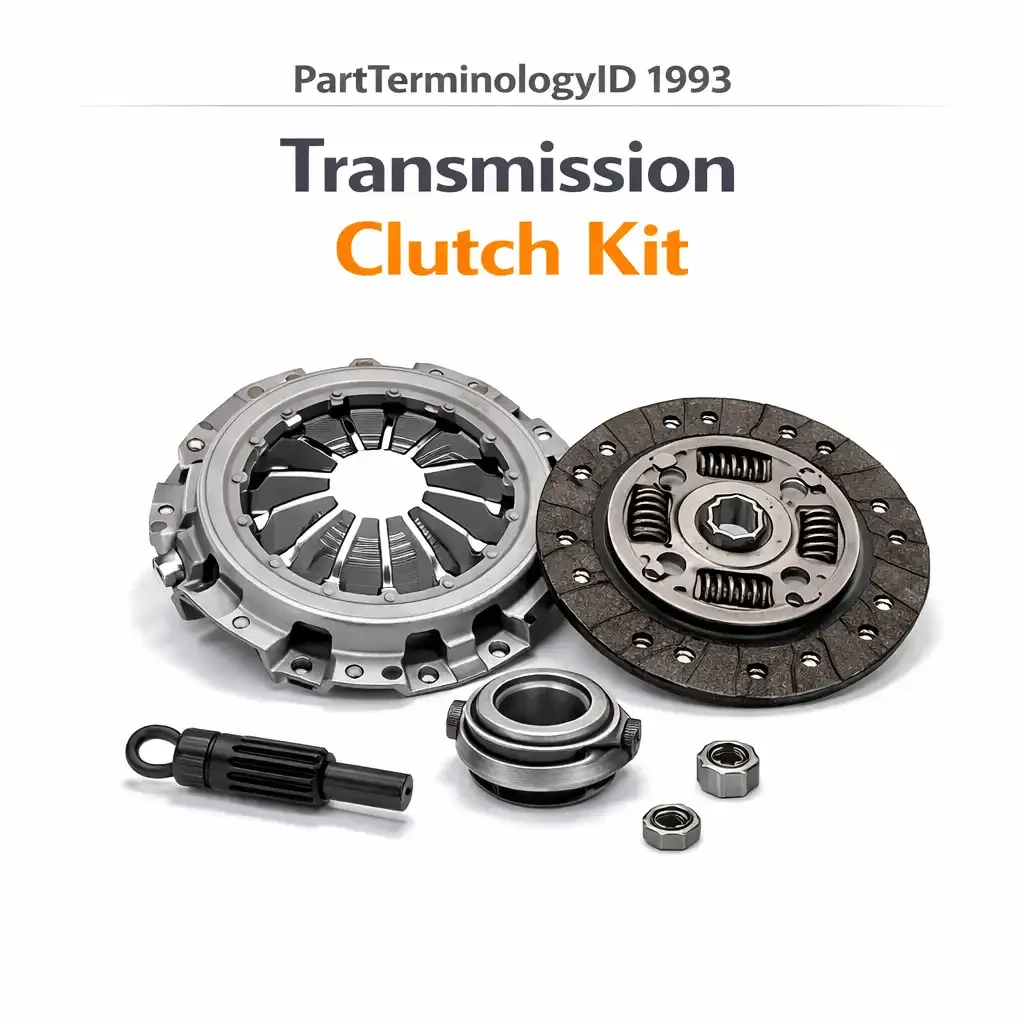
The Transmission Clutch Kit (PartTerminologyID 1993) is a bundled assembly that combines the primary clutch system wear components into a single box: the clutch disc, the pressure plate (PartTerminologyID 1988), the release bearing (PartTerminologyID 1968), and in some kits, the pilot bearing (PartTerminologyID 1964), the clutch alignment tool, and occasionally the clutch fork (PartTerminologyID 1992) or fork hardware. It is the most common way buyers purchase clutch components in the aftermarket, because buying the kit is simpler and usually cheaper than ordering each component individually.
The kit exists to solve a packaging problem: clutch jobs require multiple components that must all be replaced together, and the buyer who orders them separately risks receiving mismatched parts. The kit solves this by pre-matching the disc to the pressure plate, including the correct release bearing for the pressure plate type, and sometimes including the pilot bearing for the engine.
But the kit also amplifies every fitment problem discussed in the individual component posts, because the kit must satisfy every fitment variable of every component it contains simultaneously. The disc must match the transmission input shaft spline. The pressure plate must match the flywheel bolt pattern and type. The release bearing must match the transmission guide sleeve and the actuation system. The pilot bearing must match the crankshaft bore and the input shaft tip. If any one component in the kit does not fit, the entire kit gets returned, even if the other three components are correct.
For sellers, the clutch kit is the highest-dollar, highest-return-rate product in the manual transmission service category. It costs $80 to $500 for a standard kit, $200 to $1,200 for a performance kit. It is heavy and expensive to ship. And the return reasons span every fitment variable across four to six individual components, making it the single most complex listing in the drivetrain catalog.
What the Kit Contains (and What It Does Not)
Standard clutch kit contents
A standard (OE-replacement) clutch kit typically includes:
Clutch disc: The friction disc that sits between the pressure plate and the flywheel. The disc has friction material on both faces and a splined hub that slides onto the transmission input shaft.
Pressure plate (PartTerminologyID 1988): The spring-loaded assembly that clamps the disc against the flywheel.
Release bearing (PartTerminologyID 1968): The bearing that the clutch fork or concentric slave cylinder pushes into the pressure plate to disengage the clutch.
Clutch alignment tool: A plastic or metal pilot that centers the disc on the flywheel during installation so the transmission input shaft can slide through the disc hub when the transmission is reinstalled.
Extended clutch kit contents
Some kits include additional components:
Pilot bearing or bushing (PartTerminologyID 1964): The bearing in the crankshaft bore that supports the input shaft tip.
Clutch fork (PartTerminologyID 1992): Less common in kits, but some comprehensive kits include a new fork.
Fork ball stud or pivot hardware
Flywheel bolts
Hydraulic release bearing / concentric slave cylinder (CSC): On vehicles with CSC actuation, the kit may include the CSC instead of a conventional release bearing.
What the kit almost never includes
Flywheel: Sold separately. The flywheel must be resurfaced or replaced during clutch service, but it is not part of the clutch kit because flywheel specifications vary independently (solid vs. dual-mass, different weight classes, different surface types).
Clutch cable (PartTerminologyID 1972): Sold separately.
External slave cylinder: Sold separately on most kits (unless the kit includes a CSC for CSC-equipped vehicles).
Clutch fork shaft bearing (PartTerminologyID 1960): Almost never included in kits. Must be ordered separately.
Rear main seal: Not a clutch component, but commonly replaced during clutch service because it is only accessible with the transmission removed.
The "what's in the box" problem
The inconsistency in kit contents across manufacturers is one of the top return drivers. One manufacturer's "complete clutch kit" includes the pilot bearing. Another manufacturer's "complete clutch kit" does not. One brand includes the CSC for CSC-equipped vehicles. Another includes a conventional release bearing and expects the buyer to order the CSC separately.
The buyer orders a "clutch kit," assumes it has everything they need, pulls the transmission, opens the box, and discovers the pilot bearing is missing. The car is on jack stands. The transmission is on the floor. The buyer cannot drive to the store. They order the pilot bearing online and wait, or they reuse the old one (bad practice on a $1,500 job).
Every clutch kit listing must itemize the contents. Not "complete kit." Not "includes all necessary components." The actual list: disc, pressure plate, release bearing, pilot bearing (or not), alignment tool (or not), CSC (or not). The buyer must know before ordering what is in the box and what they need to order separately.
The Fitment Variables That Compound
Status in New Databases
PIES/PCdb: PartTerminologyID 1993, Transmission Clutch Kit
PIES 8.0 / PCdb 2.0: No change
A clutch kit must satisfy all fitment variables for all included components simultaneously. Here is the full matrix:
From the clutch disc
Spline count and diameter: Must match the transmission input shaft. This is the disc-to-transmission interface. Common spline counts include 10-spline, 14-spline, 21-spline, 23-spline, 24-spline, and 26-spline. A disc with 10 splines will not fit a 14-spline input shaft.
Disc diameter: Must match the pressure plate and the flywheel friction surface. Common diameters include 215mm, 228mm, 240mm, 250mm, and 280mm. A 228mm disc will not work with a 240mm pressure plate.
Disc type: Organic (street), cerametallic (performance), Kevlar, puck-style (racing). The disc type must be compatible with the pressure plate clamp load and the flywheel surface.
Hub type: Sprung (dampened, with torsion springs in the hub for smooth engagement) or unsprung (solid, for racing applications where engagement smoothness is sacrificed for durability and response).
From the pressure plate (PartTerminologyID 1988)
Bolt pattern: Must match the flywheel (bolt count, bolt circle diameter, bolt thread size).
Pressure plate type: Diaphragm, Borg and Beck, or Long-style. Determines the release bearing interface.
Flywheel compatibility: Solid flat, solid step, or dual-mass flywheel.
Diaphragm finger height: Must be compatible with the release bearing position and fork travel.
Clamp load: Determines torque capacity and pedal effort.
From the release bearing (PartTerminologyID 1968)
Bearing type: Conventional fork-actuated or concentric slave cylinder (CSC).
Guide sleeve diameter (bearing I.D.): Must match the transmission front bearing retainer.
Fork attachment: Must match the clutch fork's bearing contact geometry.
Overall height: Must provide correct clearance between the bearing contact face and the pressure plate diaphragm fingers.
From the pilot bearing (PartTerminologyID 1964, if included)
Bearing O.D.: Must match the crankshaft bore.
Bearing I.D.: Must match the transmission input shaft tip.
Bearing depth: Must fit the crankshaft bore without protruding.
The compounding effect
Each component has three to six fitment variables. A four-component kit has twelve to twenty-four fitment variables in total. If the listing resolves all of them correctly, the kit fits. If the listing misses one, the buyer may receive a kit where three components fit and one does not, and the entire kit gets returned.
The most common compound failure is a kit where the disc spline count matches the transmission, the pressure plate matches the flywheel, but the release bearing is the wrong type (conventional bearing in a kit for a CSC-equipped vehicle, or the bearing I.D. does not match the guide sleeve because the same vehicle had two transmission options with different front bearing retainer diameters).
The Engine-Plus-Transmission Requirement
A clutch kit listing requires both the engine code and the transmission code to resolve all fitment variables:
The engine code determines the flywheel (bolt pattern, step/flat/DMF), the crankshaft bore (pilot bearing O.D.), and on some vehicles, the pressure plate specification.
The transmission code determines the input shaft spline count (disc spline), the input shaft tip diameter (pilot bearing I.D.), the front bearing retainer diameter (release bearing I.D.), the fork geometry, and whether the system uses a conventional release bearing or a CSC.
A listing that specifies the engine but not the transmission can match the disc and pressure plate to the flywheel but may ship the wrong disc spline count, wrong release bearing I.D., or wrong pilot bearing I.D. for the buyer's actual transmission.
A listing that specifies the transmission but not the engine can match the disc spline and release bearing to the transmission but may ship a pressure plate with the wrong bolt pattern for the buyer's flywheel.
Both codes are required. Neither alone is sufficient.
The Dual-Mass Flywheel Question
The dual-mass flywheel (DMF) is the single most significant kit fitment variable on modern vehicles. As discussed in PartTerminologyID 1988, the pressure plate for a DMF application may have different specifications than the pressure plate for a solid flywheel.
Kit for DMF-equipped vehicle (keeping the DMF)
The kit includes a pressure plate and disc designed for the DMF. The disc may have a rigid center hub (no torsion springs) because the DMF's internal spring-and-damper system handles torsional vibration absorption. The pressure plate bolt pattern and finger height match the DMF secondary mass.
Kit for DMF-to-solid conversion
The kit includes a solid (single-mass) flywheel, a pressure plate designed for the solid flywheel, and a disc with a sprung hub (torsion springs in the hub to absorb the torsional vibrations that the DMF previously handled). The kit may also include longer flywheel bolts, a different release bearing height, and specific installation hardware.
A DMF-equipped buyer who orders a standard kit (designed for a solid flywheel) will receive a pressure plate that does not bolt to their DMF. A buyer who has already converted to a solid flywheel and orders a DMF-compatible kit will receive a pressure plate designed for a flywheel they no longer have.
The listing must specify: for dual-mass flywheel, for solid flywheel, or DMF-to-solid conversion kit (includes flywheel).
The Performance Kit Trap
Performance clutch kits carry all the same fitment issues as OE-replacement kits, plus the expectation issues discussed in PartTerminologyID 1988: stage labels that mean nothing, higher clamp loads that increase pedal effort, disc materials that change engagement characteristics, and cable actuation limits.
Stage labels in kits
Kit stage labels combine the ambiguity of the pressure plate stage label with the ambiguity of the disc type. A "Stage 2" kit from one manufacturer might be a high-clamp-load pressure plate with a full-face organic disc (moderate upgrade, livable on the street). A "Stage 2" kit from another manufacturer might be a high-clamp-load pressure plate with a segmented cerametallic disc (aggressive, chattery, miserable in traffic). Both are labeled "Stage 2." They produce completely different driving experiences.
What the listing must state
Clamp load of the pressure plate (in lbs or N, not just a stage number)
Disc material (organic, cerametallic, Kevlar, hybrid)
Disc hub type (sprung or unsprung)
Pedal effort impact (approximate percentage increase over OE)
Intended use case (daily driving, spirited street, weekend track, dedicated racing)
Cable actuation compatibility (yes/no)
Recommended flywheel surface condition (new, resurfaced, or specific flywheel)
Without this information, the buyer orders based on the stage number and the torque rating, receives a kit that chatters in first gear, requires an uncomfortable pedal effort in traffic, or shreds their cable in 5,000 miles, and returns it as "defective."
Top Return Scenarios
Scenario 1: "Disc doesn't slide onto my input shaft"
Spline count mismatch.
Prevention language: "Disc spline count: [X splines]. Input shaft spline diameter: [X mm]. For vehicles with [transmission code]. Verify your transmission's input shaft spline specification."
Scenario 2: "Pressure plate bolts don't line up with my flywheel"
Bolt pattern mismatch, often caused by DMF vs. solid flywheel confusion.
Prevention language: "Pressure plate bolt pattern: [X bolts, X mm bolt circle, M8/M10 thread]. Flywheel type: [solid flat / solid step / dual-mass]. Verify flywheel type and bolt pattern."
Scenario 3: "Release bearing doesn't fit on the guide sleeve"
Release bearing I.D. does not match the transmission's front bearing retainer.
Prevention language: "Release bearing I.D.: [X mm]. For vehicles with [transmission code]. Verify your transmission's front bearing retainer (guide sleeve) diameter."
Scenario 4: "Kit includes a conventional release bearing but my vehicle uses a CSC"
Actuation system mismatch.
Prevention language: "This kit includes a [conventional fork-actuated release bearing / concentric slave cylinder (CSC)]. Verify your vehicle's clutch actuation type. Vehicles with CSC require a kit that includes the CSC, not a conventional release bearing."
Scenario 5: "Pilot bearing isn't in the box"
Buyer expected a pilot bearing and the kit does not include one.
Prevention language: "Kit includes: [itemized list of every component]. Pilot bearing: [included / not included]. If not included, order separately (PartTerminologyID 1964). The pilot bearing must be replaced with every clutch service."
Scenario 6: "This kit is for a dual-mass flywheel, I converted to solid"
DMF-compatible kit shipped to a buyer with a solid flywheel conversion.
Prevention language: "This kit is designed for vehicles with [dual-mass flywheel / solid (single-mass) flywheel / includes solid flywheel conversion]. If you have converted from DMF to solid flywheel, verify the kit is designed for your current flywheel type."
Scenario 7: "Clutch chatters and the pedal is rock-hard"
Performance kit with high clamp load and aggressive disc material used for daily driving.
Prevention language: "Performance clutch kit. Clamp load: [X lbs / X N] ([X%] above OE). Disc material: [cerametallic / puck / organic]. This kit increases pedal effort and may produce aggressive engagement characteristics. [Recommended for hydraulic actuation / not recommended for cable actuation]. Intended for [street performance / weekend track / dedicated racing]. Not recommended for heavy traffic daily driving if pedal effort or engagement smoothness is a priority."
Scenario 8: "Disc is the right diameter but the wrong thickness for my flywheel"
Disc designed for a flat flywheel installed on a step flywheel, or vice versa.
Prevention language: "Disc diameter: [X mm]. Designed for [flat / step] flywheel surface. Verify your flywheel surface configuration."
What to Include in the Listing
Core essentials
PartTerminologyID: 1993
component: Transmission Clutch Kit
complete kit contents list (every component itemized, every component that is NOT included explicitly noted)
kit type: OE replacement, performance (with specific clamp load and disc material), or DMF-to-solid conversion
quantity: 1 kit
Fitment essentials
year/make/model/submodel
engine code (mandatory)
transmission code (mandatory)
flywheel type: solid flat, solid step, dual-mass, or solid conversion
clutch actuation type: cable, external hydraulic slave (fork-actuated), or CSC
production date split (if any kit component specification changed mid-year)
drive type (FWD/RWD/AWD, if bellhousing or input shaft differs)
Disc specifications
disc diameter (mm)
spline count
spline diameter (mm)
hub type: sprung or unsprung
friction material: organic, cerametallic, Kevlar, puck, hybrid
disc thickness
Pressure plate specifications
pressure plate type: diaphragm, Borg and Beck, Long-style
bolt count, bolt circle diameter, bolt thread size
clamp load (lbs or N)
diaphragm finger height
flywheel type compatibility
Release bearing specifications
bearing type: conventional fork-actuated or CSC
bearing I.D. (guide sleeve diameter)
fork attachment type (if conventional)
hydraulic fitting size (if CSC)
Pilot bearing specifications (if included)
bearing O.D. (crankshaft bore)
bearing I.D. (input shaft tip)
bearing type: sealed ball, bronze bushing, needle
Performance kit additional specifications
clamp load percentage above OE
pedal effort impact (approximate)
recommended use case (daily, street performance, track, racing)
cable actuation compatibility
recommended flywheel surface condition
Image essentials
all kit contents laid out and labeled
disc showing spline hub, friction material, and diameter
pressure plate showing bolt pattern and diaphragm fingers
release bearing showing I.D. and fork attachment
pilot bearing (if included)
alignment tool
dimensional callouts on critical specs
Catalog Checklist for ACES/PIES Teams
PartTerminologyID = 1993
require engine code AND transmission code (both mandatory)
require complete kit contents as a structured attribute (every included and excluded component)
require disc spline count and diameter
require pressure plate bolt pattern
require release bearing type (conventional or CSC)
require flywheel type compatibility (solid/step/DMF/conversion)
require clamp load for all kits (OE and performance)
require disc material attribute
require hub type attribute (sprung/unsprung)
flag DMF-equipped vehicles separately from solid flywheel vehicles
flag CSC-equipped vehicles separately from fork-actuated vehicles
flag vehicles where multiple transmissions were available with different spline counts
enforce production date splits where any kit component changed mid-year
differentiate OE replacement kits from performance kits from conversion kits
FAQ (Buyer Language)
Does the kit include the flywheel?
Standard clutch kits do not include the flywheel. DMF-to-solid conversion kits typically include a solid flywheel. Check the kit contents list. If the flywheel is not included, it should be resurfaced or replaced at the time of clutch service.
Does the kit include the pilot bearing?
Some kits do. Many do not. Check the contents list. If the pilot bearing is not included, order it separately (PartTerminologyID 1964). The pilot bearing must be replaced with every clutch service.
My vehicle has a concentric slave cylinder. Will this kit work?
Only if the kit includes a CSC (or specifies CSC-compatible release bearing). If the kit includes a conventional fork-actuated release bearing, it will not work on a CSC-equipped vehicle. Verify the kit's release bearing type before ordering.
Can I use this kit with a lightened aftermarket flywheel?
Verify the flywheel bolt pattern, surface type (flat or step), and friction surface diameter match the kit's pressure plate and disc specifications. Aftermarket flywheels may have different bolt patterns or surface diameters than OE.
What stage kit should I buy?
Ignore the stage number. Look at the clamp load, the disc material, and the intended use case. For daily driving, an OE-replacement kit with organic disc provides the smoothest pedal and engagement. For moderate performance (bolt-on turbo, mild tune), a kit with 15 to 25 percent higher clamp load and a full-face organic or Kevlar disc is the sweet spot. For dedicated track use, a kit with 30 to 50 percent higher clamp load and a cerametallic disc provides maximum holding power at the cost of pedal effort and engagement smoothness.
I have a cable clutch. Can I use a performance kit?
Check the kit's cable actuation compatibility. Kits with significantly higher clamp loads (30 percent or more above OE) may exceed the cable's designed load capacity, causing premature cable stretch or failure. Some performance kits are explicitly rated for hydraulic actuation only.
Should I replace the rear main seal at the same time?
It is strongly recommended. The rear main seal is only accessible with the transmission removed. If the seal is leaking or seeping, the oil will contaminate the new clutch disc. Replacing a $15 seal during a clutch job prevents a $1,500 clutch job from being ruined by oil contamination.
Cross-Sell Logic
Flywheel (solid replacement, DMF replacement, or solid conversion)
Flywheel Bolt Kit
Clutch Fork (PartTerminologyID 1992)
Clutch Fork Ball Stud
Clutch Fork Shaft Bearing (PartTerminologyID 1960)
Clutch Fork Dust Boot
Clutch Cable (PartTerminologyID 1972, for cable-actuated vehicles)
External Slave Cylinder (for hydraulic fork-actuated vehicles, if not included in kit)
Clutch Pedal Bearing (PartTerminologyID 1961)
Rear Main Seal
Transmission Input Shaft Seal
Brake Cleaner (for cleaning the flywheel surface before installation)
Clutch Alignment Tool (if not included in kit)
Frame as "the kit covers the primary wear components. These additional items are commonly replaced during the same service because they are only accessible with the transmission removed. Ordering everything together prevents a second disassembly."
Final Take for PartTerminologyID 1993
The Transmission Clutch Kit (PartTerminologyID 1993) is the part that bundles complexity. Every fitment variable from every component it contains must be resolved simultaneously: disc spline count from the transmission, pressure plate bolt pattern from the flywheel, release bearing type from the actuation system, pilot bearing dimensions from the engine and transmission, and flywheel type from the vehicle's original equipment or current configuration.
Two codes resolve the majority of these variables: engine code and transmission code. One attribute resolves the flywheel question: solid, step, DMF, or conversion. One attribute resolves the actuation question: conventional fork-actuated or CSC. And one list resolves the "what's in the box" question: a complete, itemized contents list that tells the buyer exactly what they are getting and exactly what they still need to order separately.
State both codes. State the flywheel type. State the actuation type. List the contents. That is the return prevention strategy for the most expensive, most complex, and most frequently returned product in the manual transmission aftermarket.