
Written by Arthur Simitian | PartsAdvisory
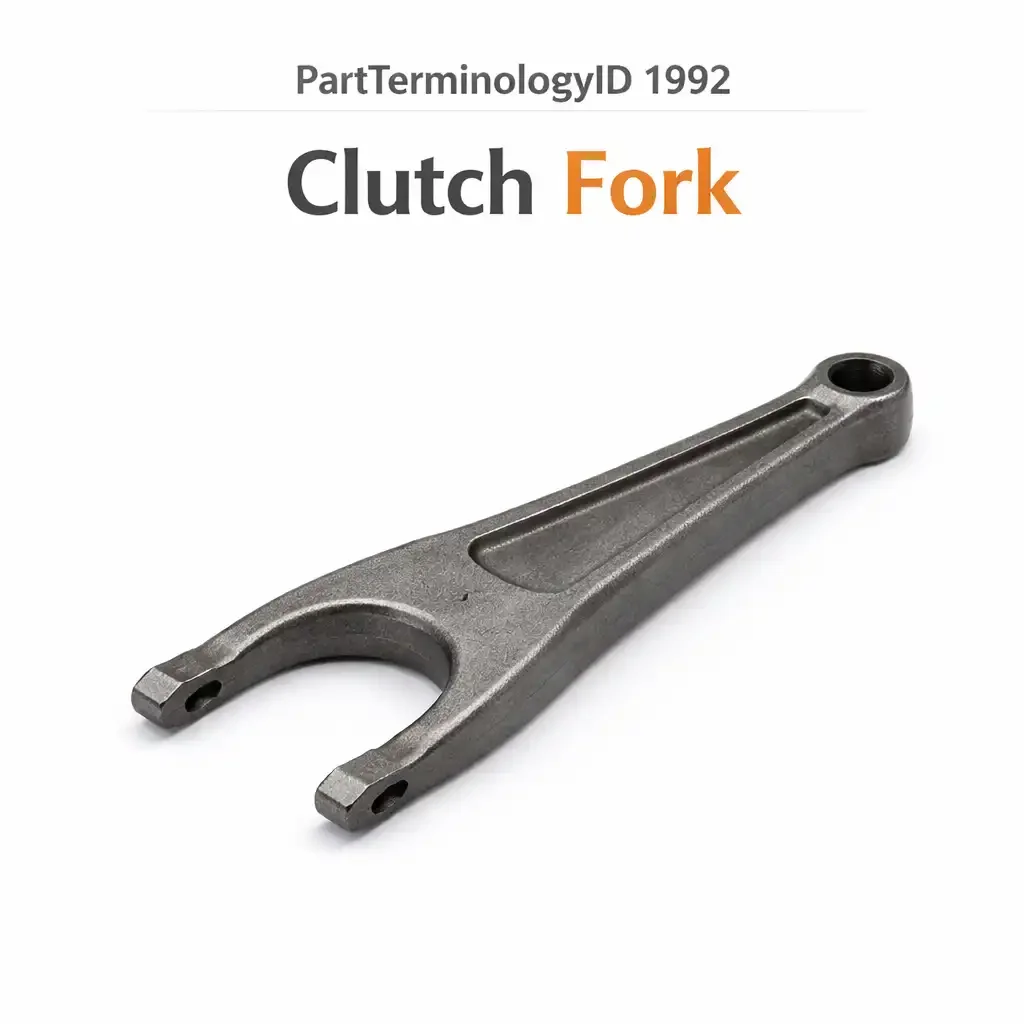
PartTerminologyID 1992, Clutch Fork, is the lever inside the bellhousing that transfers force from the clutch actuation system (cable or external hydraulic slave cylinder) to the clutch release bearing (PartTerminologyID 1968). The fork pivots on a shaft or ball stud mounted in the bellhousing. One end of the fork extends through an opening in the bellhousing where the cable or slave cylinder pushrod connects to it. The other end contacts the release bearing. When the driver presses the clutch pedal, the fork pivots and pushes the release bearing into the pressure plate's diaphragm spring fingers, disengaging the clutch.
It is a stamped or cast steel lever. It costs $15 to $50. It lives inside the bellhousing, invisible and inaccessible until the transmission is pulled. And it generates returns because the fork's geometry is determined by three interfaces the listing almost never specifies: the pivot type, the release bearing attachment method, and the actuation end fitting.
For sellers, the clutch fork sits at the mechanical center of the clutch actuation chain. The cable or slave cylinder pushes one end. The release bearing rides on the other end. The bellhousing provides the pivot in the middle. If any of those three interfaces is wrong by a few millimeters, the fork either does not mount, does not push the bearing squarely, or does not connect to the cable. And because the fork is only accessible with the transmission removed, a return on this part means the buyer has already done hours of labor, discovered the mismatch, and now must either source the correct fork or reassemble with the old one.
The Three Interfaces That Define Every Clutch Fork
Interface 1: The pivot
The pivot is where the fork contacts the bellhousing and creates the fulcrum for the lever action. There are two fundamentally different pivot designs, and they are not interchangeable.
Ball stud pivot: The most common design on modern vehicles. A hardened steel ball stud is pressed or threaded into a boss on the bellhousing. The fork has a hemispherical socket on its body that fits over the ball. The fork rocks on the ball like a seesaw on a fulcrum.
The ball stud diameter and the fork socket depth and diameter must match precisely. A fork socket that is 1mm too large will allow the fork to wobble on the stud, causing the release bearing to cock to one side and contact the diaphragm fingers unevenly. A socket that is 1mm too small will not seat fully onto the ball, causing the fork to bind, pop off the stud under load, or pivot at an incorrect angle.
Ball stud dimensions vary by transmission and bellhousing manufacturer. A bellhousing for a Tremec T5 may use a different ball stud diameter than a bellhousing for a Borg-Warner T56, even if both transmissions bolt to the same engine. The fork must match the actual bellhousing, not just the vehicle.
Ball studs also wear. The constant rocking motion under load creates a flat spot or groove on the ball surface over tens of thousands of clutch cycles. When the buyer replaces the fork but not the ball stud, the new fork socket seats on a worn ball and immediately develops the same play the old fork had. This is why the ball stud is a mandatory cross-sell with every fork replacement.
Shaft pivot: The fork has a cylindrical bore that slides over a shaft passing through the bellhousing. The fork rotates on the shaft. The shaft is supported by a bushing or bearing in the bellhousing wall (PartTerminologyID 1960, Clutch Fork Shaft Bearing).
Shaft-pivot forks are more common on older domestic vehicles (many GM, Ford, and Chrysler applications from the 1960s through the 1990s) and some heavy-duty and commercial applications. The fork bore I.D. must match the shaft O.D. The shaft's position in the bellhousing determines the fork's leverage geometry, bearing travel, and actuation end position.
Shaft-pivot and ball stud-pivot forks are not interchangeable even if the fork's other dimensions appear similar. The pivot location, the lever arm geometry, and the bellhousing interface are fundamentally different. A shaft-pivot fork installed on a ball stud bellhousing has nowhere to mount. A ball stud fork installed on a shaft bellhousing has no socket to engage.
The concentric slave cylinder knockout: Vehicles equipped with a concentric slave cylinder (CSC) have no clutch fork at all. The CSC is a hydraulic release bearing that mounts concentrically around the transmission input shaft, inside the bellhousing. Hydraulic pressure from the clutch master cylinder acts directly on the bearing. There is no lever, no pivot, no cable or external slave cylinder, and no PartTerminologyID 1992 component.
If a seller lists a clutch fork for a CSC-equipped vehicle, every order is a return. The listing must specify fork-actuated systems only, and the catalog must flag CSC applications as non-applicable.
The CSC transition happened at different times for different vehicles, and in some cases both fork-actuated and CSC versions of the same vehicle were produced concurrently (different model years, different markets, or different transmission options). The listing year range must not span the transition without specifying the actuation type.
Interface 2: The release bearing contact
The business end of the fork, the end inside the bellhousing, contacts the clutch release bearing (PartTerminologyID 1968). The fork pushes the bearing forward along the transmission's guide sleeve or front bearing retainer toward the pressure plate diaphragm spring fingers.
The contact interface between the fork and the release bearing varies by design:
Straddling fingers: The most common configuration. Two prongs (fingers or ears) on the fork straddle the release bearing's outer collar or housing. The fork pushes the bearing forward through contact on both sides. The finger spacing (distance between the inner edges of the two prongs) must match the bearing collar width. The finger width (the thickness of each prong) must fit into the bearing's fork groove or contact surface.
If the finger spacing is too wide, the fork pushes on the bearing off-center, cocking the bearing and causing uneven contact with the diaphragm spring. If the spacing is too narrow, the fingers bind against the bearing collar and the fork cannot move freely.
Spring clip retention: On some designs, the release bearing clips to the fork fingers with a spring retainer or wire clip. The fork fingers have specific notches, grooves, or dimples where the clip engages. A fork with different clip mounting geometry will not retain the bearing, and the bearing can fall off the fork during operation (catastrophic clutch failure).
Socket or cup contact: Some forks have a concave cup or socket at the bearing end rather than straddling fingers. The release bearing has a corresponding boss or guide that seats into the cup. The cup diameter and depth must match the bearing boss.
Integral bearing guide: Some fork designs have a tubular sleeve at the bearing end that the release bearing slides inside. The sleeve I.D. must match the bearing O.D.
The release bearing interface dimensions are specific to the fork and bearing combination, which is specific to the transmission and bellhousing. A fork with the correct pivot but the wrong bearing interface will mount to the bellhousing but will not actuate the bearing correctly.
Interface 3: The actuation end
The end of the fork that protrudes through the bellhousing opening connects to whatever pushes the fork: the clutch cable, the external slave cylinder pushrod, or in some cases a mechanical linkage. The actuation end fitting must match the cable or slave cylinder interface.
Cable hook slot: A formed slot or notch in the fork end where the clutch cable end hooks in. The slot width and depth must match the cable end fitting diameter. The slot orientation (horizontal, vertical, angled) must match the cable routing.
Cable ball-end socket: A hemispherical cup that receives the ball end of the clutch cable. Common on vehicles with self-adjusting cable systems (particularly Ford quadrant-and-pawl systems). The cup diameter must match the cable ball diameter. If the cup is too small, the ball will not seat. If the cup is too large, the ball will pop out under load.
Slave cylinder pushrod cup: A concave pocket that receives the convex tip of the external slave cylinder pushrod. The cup diameter and depth must match the pushrod tip. A flat-tipped pushrod on a cupped fork will concentrate force on a point rather than distributing it across the cup surface, accelerating wear.
Threaded adjuster mount: Some forks have a threaded boss for a cable adjustment mechanism. The thread size, pitch, and boss length must match the adjuster.
Clevis pin attachment: Some forks use a clevis (U-shaped bracket) at the actuation end with a pin that connects to the cable or linkage. The clevis width, pin hole diameter, and pin-to-pivot distance must match.
If the actuation end does not match the cable or slave cylinder, the connection is either impossible (no physical attachment point) or compromised (sloppy, misaligned, or under-supported), causing imprecise clutch actuation, noise, and premature wear.
The Transmission Code Is the Key
All three interfaces, the pivot, the bearing contact, and the actuation end, are determined by the transmission and bellhousing combination. The transmission code resolves all three:
The bellhousing determines the pivot type, pivot location, and ball stud or shaft dimensions.
The bellhousing and transmission front bearing retainer determine the release bearing type, which determines the fork's bearing interface.
The bellhousing opening position and the cable or slave cylinder mounting location determine the actuation end geometry.
A listing that specifies the vehicle year/make/model but not the transmission code is relying on the assumption that only one transmission was available. On many vehicles, particularly trucks, performance cars, and vehicles produced across generation boundaries, multiple manual transmissions were offered. A 1990s Ford Mustang may have a T5, a T45, or a Tremec 3650 depending on the year and engine. Each uses a different fork.
The transmission code is a mandatory fitment attribute for every clutch fork listing.
Fork Material and Construction
Stamped steel
The most common construction for OE and standard aftermarket forks. A flat steel blank is stamped into the fork shape, with the pivot socket, bearing fingers, and actuation end formed in the stamping process. Stamped forks are lightweight, inexpensive, and adequate for OE clamp loads and normal driving.
However, stamped forks can flex under high loads. On vehicles with performance pressure plates (higher clamp loads, as discussed in PartTerminologyID 1988), a stamped fork may deflect during actuation, reducing the effective bearing travel and causing incomplete clutch release. The driver feels a pedal that goes to the floor but the clutch does not fully disengage.
Cast steel or cast iron
Some OE and aftermarket forks are cast from steel or ductile iron. Cast forks are stiffer and more rigid than stamped forks, providing more precise bearing actuation under higher loads. They are heavier and more expensive but are the preferred choice for vehicles with performance clutch systems.
Billet or forged steel
Performance aftermarket forks machined from billet steel or forged blanks. These are the stiffest and strongest option, designed for racing and high-torque applications where fork flex is a real concern. Billet forks are significantly more expensive and are typically sold for specific transmission applications with known high-load requirements.
Why material matters for listings
A buyer upgrading to a Stage 2 or Stage 3 pressure plate (PartTerminologyID 1988) with 40 to 60 percent higher clamp load should also consider whether their stock stamped fork can handle the increased actuation force. If the fork flexes, the higher clamp load is wasted because the bearing does not travel far enough to fully release the clutch.
The listing should state the fork material and, for performance forks, the maximum recommended clamp load or pressure plate compatibility. This is a natural cross-sell opportunity: if the buyer is upgrading the pressure plate, recommend the appropriate fork material.
Fork Wear Patterns and When to Replace
The clutch fork wears at all three interfaces over its service life, and the wear patterns are diagnostic:
Pivot socket wear
On ball stud forks, the socket elongates from the constant rocking motion under load. The socket goes from a tight hemispherical fit to an oval shape, introducing play. The fork wobbles on the ball, and the release bearing no longer tracks straight along the guide sleeve.
On shaft forks, the bore elongates in the direction of the actuation force, creating an oval that allows the fork to shift on the shaft.
Visual inspection: Remove the fork from the pivot and inspect the socket or bore for visible elongation, scoring, or polishing. Any visible oval shape is cause for replacement.
Bearing finger wear
The fork fingers develop grooves where they contact the release bearing collar. These grooves change the contact point and angle, causing the bearing to cock slightly with every actuation. Deep grooves can also reduce the effective lever arm, changing the fork's mechanical advantage.
Visual inspection: Look for shiny wear grooves on the inner surfaces of the fork fingers. Any groove deep enough to feel with a fingernail warrants replacement.
Actuation end wear
The cable slot, ball socket, or pushrod cup wears from the thousands of actuation cycles. A worn cable slot allows the cable to shift position, changing the effective lever arm. A worn ball socket allows the cable ball to rock, introducing slop in the pedal feel. A worn pushrod cup creates a point contact instead of a surface contact, accelerating both fork and pushrod wear.
Visual inspection: Inspect the actuation end for elongated slots, wallowed-out sockets, or cupped surfaces that no longer match the cable or pushrod geometry.
The replacement decision
Given that the fork is only accessible with the transmission removed (the same labor required for any clutch job), the practical recommendation is to replace the fork during every clutch service. The part costs $15 to $50. The labor to access it costs hundreds to thousands of dollars depending on the vehicle. Reusing a fork with any visible wear to save $30 is a false economy that risks the quality of a $1,500 clutch job.
Top Return Scenarios
Scenario 1: "Ball stud socket doesn't fit my bellhousing stud"
Ball socket diameter mismatch.
Prevention language: "Pivot type: ball stud socket. Socket I.D.: [X mm]. Fits ball stud O.D.: [X mm]. Verify your bellhousing ball stud diameter."
Scenario 2: "My vehicle has a concentric slave cylinder, there is no fork"
CSC-equipped vehicle has no fork application.
Prevention language: "For vehicles with external clutch actuation (cable or external slave cylinder with clutch fork). Not for vehicles with concentric slave cylinder (CSC) / internal hydraulic release bearing. If your clutch hydraulic line enters the bellhousing directly with no external lever, your vehicle uses a CSC and has no clutch fork."
Scenario 3: "Fork fingers don't fit my release bearing"
Bearing contact finger spacing or width does not match the release bearing collar.
Prevention language: "Release bearing contact: fork finger spacing [X mm], finger width [X mm]. Verify fork finger geometry matches your release bearing (PartTerminologyID 1968). Release bearing collar width: [X mm]."
Scenario 4: "Cable doesn't attach to the fork"
Actuation end fitting mismatch.
Prevention language: "Actuation end: [cable hook slot (X mm wide) / cable ball socket (X mm diameter) / slave cylinder pushrod cup (X mm diameter) / clevis pin (X mm pin hole)]. Verify attachment matches your clutch cable or slave cylinder pushrod."
Scenario 5: "Wrong transmission, fork doesn't reach the bearing"
Fork length or lever ratio is wrong because the buyer has a different transmission and bellhousing.
Prevention language: "For vehicles with [transmission code]. The fork length, pivot location, and lever geometry are transmission-specific. Verify your transmission type. If your vehicle has had a transmission swap, the fork must match the actual installed transmission, not the original."
Scenario 6: "Fork is too flexible, clutch doesn't fully release with my Stage 3 pressure plate"
Stamped steel fork deflecting under higher-than-OE clamp load.
Prevention language: "Material: [stamped steel / cast steel / billet steel]. Stamped steel forks are designed for OE-level clamp loads. For vehicles with performance pressure plates (clamp loads exceeding [X lbs / X N]), consider a cast or billet steel fork for increased rigidity."
Scenario 7: "This is a shift fork, not a clutch fork"
Buyer confused the clutch fork (bellhousing, external) with the transmission shift fork (internal).
Prevention language: "Clutch release fork. Mounts in the bellhousing and actuates the clutch release bearing. This is not a transmission shift fork (which is an internal transmission component that moves synchronizer sleeves)."
What to Include in the Listing
Core essentials
PartTerminologyID: 1992
component: Clutch Fork (Clutch Release Fork)
pivot type: ball stud socket or shaft bore
actuation system: cable or external slave cylinder (not CSC)
material: stamped steel, cast steel, cast iron, billet steel
quantity: 1
Fitment essentials
year/make/model/submodel
transmission code (mandatory)
engine code (if fork differs by engine/transmission combination)
clutch actuation system: cable, external hydraulic slave, or CSC (CSC = no fork, do not list)
production date split (if fork design changed mid-year or if CSC replaced fork actuation mid-model)
Dimensional essentials
pivot socket I.D. (ball stud) or bore I.D. (shaft)
ball stud O.D. compatibility
overall fork length (pivot center to actuation end)
release bearing finger spacing and width
release bearing clip/retainer type (if applicable)
actuation end fitting type and dimensions
fork height/offset (some forks are angled or offset to clear bellhousing geometry)
Image essentials
full fork showing both ends with dimensional callouts
pivot socket or bore detail with diameter callout
release bearing finger detail with spacing callout
actuation end detail showing cable slot, ball socket, or pushrod cup
side profile showing any offset or angle
installed context showing fork in bellhousing with bearing and cable/slave cylinder
Catalog Checklist for ACES/PIES Teams
PartTerminologyID = 1992
require pivot type (ball stud or shaft)
require pivot socket/bore I.D.
require transmission code (mandatory)
require actuation end type and dimensions
require release bearing interface dimensions (finger spacing, width)
require material attribute
flag CSC-equipped vehicles where no fork exists
flag vehicles where both fork-actuated and CSC versions were produced
flag the fork-to-CSC transition year for vehicles that changed mid-generation
differentiate from transmission shift fork (internal transmission component)
cross-reference to compatible release bearing (PartTerminologyID 1968), fork shaft bearing (PartTerminologyID 1960), fork ball stud, and fork dust boot
FAQ (Buyer Language)
Is this the same as a shift fork?
No. The clutch fork is in the bellhousing and actuates the clutch release bearing to disengage the clutch. Shift forks are inside the transmission case and move the synchronizer sleeves to select gears. They are completely different components in different locations.
Does my vehicle have a clutch fork?
If your vehicle has a cable or an external slave cylinder that connects to a lever protruding from the bellhousing, yes. If your vehicle has a concentric slave cylinder (the hydraulic line goes directly into the bellhousing with no external lever visible), no. CSC-equipped vehicles have no clutch fork.
Should I replace the ball stud when I replace the fork?
Yes. The ball stud and fork socket are a matched wear pair. A new fork on a worn ball stud will develop play immediately. Ball studs are inexpensive ($3 to $10) and should be replaced with every fork replacement. Some ball studs are pressed in and require a press to install. Others are threaded and can be installed with a wrench.
When should I replace the clutch fork?
Every time the transmission is removed for clutch service. The fork costs $15 to $50. The labor to access it costs hundreds to thousands of dollars. Inspect the pivot socket, the bearing fingers, and the actuation end for wear. If any contact surface shows visible grooves, elongation, or deformation, replace the fork. Given the access cost, most technicians replace the fork as a matter of course during every clutch job.
Can I use a stamped steel fork with a performance pressure plate?
It depends on the clamp load increase. Moderate increases (15 to 25 percent above OE) are generally fine with a stamped fork. Significant increases (30 percent or more above OE) can cause a stamped fork to flex, reducing release bearing travel and causing incomplete clutch disengagement. For high-clamp-load applications, a cast or billet fork is recommended.
I swapped my transmission. Which fork do I need?
The fork must match the installed transmission and bellhousing, not the original. Identify your transmission code (stamped on the transmission case or on an ID tag), and order the fork for that transmission. If you have an aftermarket bellhousing (common on LS swaps, Coyote swaps, and similar builds), the fork must match the bellhousing manufacturer's specification, which may not correspond to any OE application.
My clutch pedal is spongy and the clutch barely disengages. Could it be the fork?
Possibly. A worn fork pivot (elongated socket or worn ball stud) allows the fork to wobble instead of transferring force cleanly to the release bearing. A fork with worn bearing fingers may push the bearing at an angle instead of straight forward. Both conditions reduce effective bearing travel. However, the same symptoms can also be caused by a failing clutch cable (PartTerminologyID 1972), a leaking slave cylinder, air in the hydraulic system, or a worn release bearing (PartTerminologyID 1968). Diagnose the full actuation chain before replacing individual components.
Cross-Sell Logic
Clutch Fork Ball Stud (mandatory cross-sell, replace with every fork)
Clutch Fork Dust Boot (the rubber boot that seals the bellhousing opening where the fork protrudes)
Clutch Release Bearing (PartTerminologyID 1968)
Clutch Fork Shaft Bearing (PartTerminologyID 1960, for shaft-pivot forks)
Clutch Pilot Bearing (PartTerminologyID 1964)
Clutch Disc and Pressure Plate Kit (PartTerminologyID 1988)
Clutch Cable (PartTerminologyID 1972, for cable-actuated vehicles)
External Slave Cylinder (for hydraulic fork-actuated vehicles)
Clutch Alignment Tool
Frame as "replace during every clutch job: fork, ball stud, release bearing, fork shaft bearing (if shaft-pivot), pilot bearing, and fork dust boot. All are only accessible with the transmission removed. The combined cost of these components is a fraction of the labor to access them."
The Fork as the Center of the Clutch Actuation Chain
The clutch fork is the physical center of the mechanical chain between the driver's foot and the clutch. Every other component in the chain connects to or through the fork:
The clutch cable (PartTerminologyID 1972) or external slave cylinder connects to the actuation end.
The release bearing (PartTerminologyID 1968) rides on the bearing end.
The fork shaft bearing (PartTerminologyID 1960) or ball stud provides the pivot.
The bellhousing provides the housing and the fork opening.
The fork dust boot seals the opening.
If the fork is worn, every other component in the chain is compromised. A perfect cable pulling a worn fork produces sloppy release. A new release bearing pushed by worn fork fingers tracks crooked. A new ball stud under a fork with an elongated socket still wobbles.
The fork is the one component that touches everything else, which means its condition affects everything else. And at $15 to $50 against a labor bill of $500 to $2,000, there is no economic argument for reusing a worn fork.
Final Take for PartTerminologyID 1992
Clutch Fork (PartTerminologyID 1992) is a lever defined by three interfaces: the pivot (ball stud socket I.D. or shaft bore I.D.), the release bearing contact (finger spacing and width), and the actuation end (cable slot, ball socket, or pushrod cup). All three interfaces must match. The transmission code determines all three, which is why the transmission code is the mandatory fitment attribute that resolves every dimensional question about the fork.
Miss the pivot type and the fork does not seat on the bellhousing. Miss the bearing interface and the fork does not push the bearing straight. Miss the actuation end and the cable or slave cylinder does not connect. Miss the CSC knockout and the part has no application at all.
State the transmission code. State the pivot type and dimensions. State the bearing finger geometry. State the actuation end fitting. State the material. And cross-sell the ball stud, because a new fork on a worn ball stud is money wasted on a part that will wobble from day one.
Three interfaces, one transmission code, and one ball stud. That is the complete return prevention strategy for the lever at the center of the clutch.