
Written by Arthur Simitian | PartsAdvisory
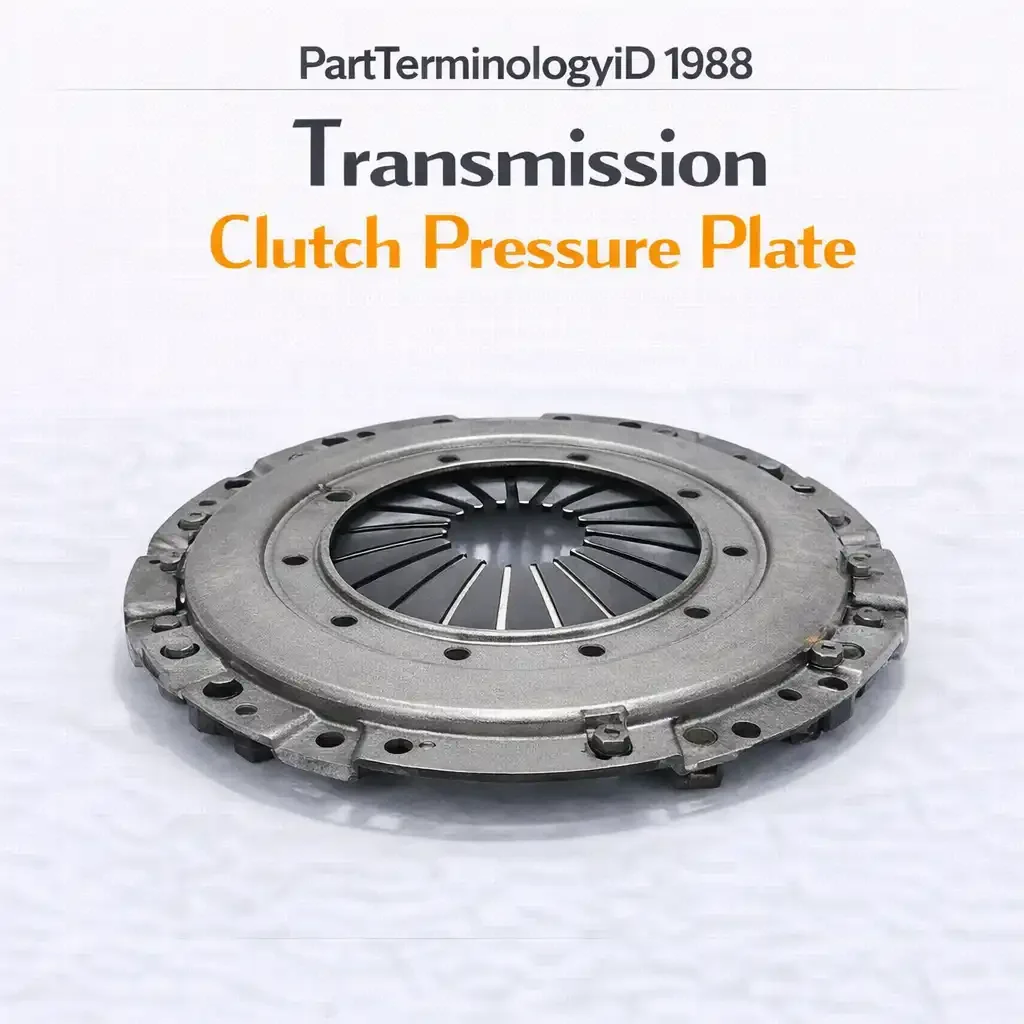
PartTerminologyID 1988, Transmission Clutch Pressure Plate, is the spring-loaded assembly that clamps the clutch disc against the flywheel to transmit engine torque to the transmission. When the clutch pedal is released, the pressure plate's diaphragm spring (or coil springs on older designs) presses the clutch disc friction material firmly against the flywheel. When the pedal is pressed, the release bearing pushes the diaphragm spring, relieving the clamping force and allowing the disc to spin freely between the pressure plate and the flywheel.
The pressure plate determines how much torque the clutch system can transmit (clamp load), how heavy the clutch pedal feels (pedal effort), and how smoothly the clutch engages (release characteristics). It is the most engineered component in the clutch system, and it is the one that buyers most frequently get wrong because they order based on price, appearance, or torque claims without verifying that the pressure plate matches their flywheel, their release bearing, and their pedal actuation system.
For sellers, the pressure plate generates returns from two distinct directions. The fitment direction: bolt pattern, diameter, finger height, and flywheel type mismatches that prevent physical installation. The expectation direction: performance pressure plates with higher clamp loads that the buyer's actuation system, disc choice, or driving habits cannot accommodate. Both categories are predictable and preventable. The listing just has to do the work.
Pressure Plate Types: Three Designs That Require Three Different Release Bearings
Diaphragm spring
The modern standard, used on virtually all passenger vehicles manufactured since the 1980s and most vehicles before that in European and Japanese markets. A single conical Belleville spring (diaphragm) provides the clamp load. The spring's fingers extend inward toward the center of the assembly, and the release bearing pushes against the finger tips to release the clutch.
Diaphragm pressure plates provide progressive pedal feel (effort increases gradually as the pedal is pressed) and consistent clamp load across the clutch disc's wear range. As the disc wears and becomes thinner, the diaphragm spring's geometry changes slightly, but the clamp load remains within a narrow operating band. This consistency is what makes the diaphragm design superior to coil spring designs for street use.
The diaphragm spring also acts as its own release mechanism. The same spring that clamps the disc also provides the return force that re-engages the clutch when the pedal is released. There are no separate release levers or return springs.
Borg and Beck (three-finger coil spring)
An older design common on American muscle cars, classic vehicles, and older trucks from the 1950s through the 1970s. The clamp load is generated by multiple coil springs arranged in a circle between the pressure plate cover and the pressure ring. Three cast release levers (fingers) extend inward from the pressure plate assembly. The release bearing pushes against the tips of these three levers, which pivot and lift the pressure ring away from the disc.
Borg and Beck pressure plates produce high clamp loads and were the dominant design on high-torque domestic V8 applications before diaphragm designs took over. The pedal feel is heavier and less linear than a diaphragm design. The three release levers require precise adjustment (all three must be at the same height) for even release, and maladjusted levers cause chattering, uneven disc wear, and incomplete disengagement.
The three-finger release lever interface is physically different from a diaphragm spring interface. The release bearing contact surface, the bearing travel distance, and the fork geometry are all different. A diaphragm-type release bearing (PartTerminologyID 1968) will not correctly actuate a Borg and Beck pressure plate, and a three-finger release bearing will not correctly actuate a diaphragm pressure plate.
Long-style (three-finger, centrifugally assisted)
Similar to the Borg and Beck design but with centrifugal weights on the release levers that increase clamp load as engine RPM rises. At idle and low RPM, the clamp load is moderate and the pedal is relatively light. As RPM increases, the weights swing outward and add force to the clamping mechanism, increasing torque capacity at the RPM range where it is most needed (during acceleration and high-RPM shifts).
Long-style pressure plates were used on some high-performance and heavy-duty applications. They share the three-finger release bearing interface with Borg and Beck designs. They are less common in the modern aftermarket but still appear on classic vehicle and racing applications.
Why the type designation matters for listings
A buyer replacing a diaphragm pressure plate must receive a diaphragm pressure plate (or must also change their release bearing if switching types). A buyer replacing a Borg and Beck must receive a Borg and Beck (or must also change the release bearing and potentially the fork). The listing must specify the pressure plate type, because shipping the wrong type means the buyer's existing release bearing does not interface correctly, the fork travel is wrong, and the clutch does not function.
On classic vehicle applications where both diaphragm and Borg and Beck options exist as aftermarket offerings (some manufacturers produce diaphragm conversion kits for vehicles that originally used Borg and Beck), the listing must clearly state whether the product is an OE-style replacement or a diaphragm conversion, and if it is a conversion, what additional components (release bearing, fork, pivot) are required.
The Performance Pressure Plate Trap
Aftermarket performance pressure plates are the highest-return-rate subcategory within PartTerminologyID 1988. They are marketed with stage designations, torque ratings, and aggressive imagery. They attract buyers who want "more holding power" without understanding what that means for the rest of the clutch system and the driving experience.
Stage designations are meaningless
There is no industry standard for stage designations. Every manufacturer defines their own stages. One manufacturer's Stage 2 may have 25 percent more clamp load than OE. Another manufacturer's Stage 2 may have 50 percent more. A third manufacturer's Stage 2 may have the same clamp load as OE but use a different disc material. The stage number communicates nothing specific about clamp load, pedal effort, disc compatibility, or actuation requirements.
Sellers who list a pressure plate as "Stage 2" without specifying the actual clamp load in pounds or Newtons are leaving the buyer to guess what they are getting. And when the buyer guesses wrong, the part comes back.
Higher clamp load means heavier pedal
This is the tradeoff that marketing materials omit. A pressure plate with 40 percent more clamp load than OE requires approximately 40 percent more force at the release bearing to disengage. That force comes from the driver's leg, transmitted through the clutch cable or hydraulic system. The pedal gets heavier. In traffic, the driver's left leg fatigues. On long drives, the experience goes from "upgraded" to "miserable."
On cable-actuated clutch systems, the problem compounds. The cable has a designed load rating. A significantly higher clamp load can exceed the cable's capacity, causing accelerated stretch, premature fatigue failure, or damage to the self-adjusting mechanism. Some high-clamp-load performance pressure plates explicitly require hydraulic actuation and are not compatible with cable systems.
On hydraulic systems, the higher clamp load increases the pressure the slave cylinder must generate, which increases the pedal effort at the master cylinder. The hydraulic system will handle it mechanically, but the driver will feel every pound of additional clamp load.
Disc compatibility
Performance pressure plates are often designed to work with specific performance clutch disc types. The interaction between pressure plate clamp load and disc friction material determines the clutch's engagement characteristics.
Organic discs (standard street material): Smooth engagement, progressive grab, good modulation. Paired with a high-clamp-load pressure plate, an organic disc will hold more torque than an OE setup, but the higher clamp force on the relatively soft organic material can cause the disc to glaze under spirited driving, reducing friction and causing slip.
Cerametallic or metallic discs: Aggressive friction material that handles heat better than organic but engages abruptly (on/off feel with little modulation). Designed to be paired with high-clamp-load pressure plates. When a buyer pairs their Stage 3 cerametallic-targeted pressure plate with a stock organic disc, the clutch may chatter, grab harshly, or not release cleanly because the release characteristics are designed for the stiffer cerametallic disc.
Puck-style (segmented) discs: Multiple friction pads (pucks) instead of a full-face lining. Extremely aggressive, designed for racing. Requires a specific pressure plate clamp load and release clearance. Street driving with a puck disc is miserable (chattering, shuddering, on/off engagement).
The listing must state which disc types the pressure plate is designed to work with. A pressure plate listed as compatible with "all disc types" is either a low-clamp-load OE-equivalent (in which case the performance marketing is misleading) or is genuinely indifferent to disc type (which is rare for high-clamp-load units).
What sellers should communicate
State the clamp load in pounds or Newtons, not just a stage number. State the percentage increase over OE clamp load. State the recommended disc type(s). State whether the pedal effort will increase and by approximately how much. State whether the pressure plate is compatible with cable actuation or requires hydraulic actuation. State whether the pressure plate is a direct bolt-in replacement or requires additional components (specific disc, specific release bearing, specific flywheel surface).
Set the expectation before the sale, or absorb the return after.
Flywheel Compatibility
The pressure plate bolts to the flywheel. The bolt pattern must match. But beyond the bolt pattern, the flywheel surface type also matters, and the dual-mass flywheel question has become one of the most significant fitment splits in the clutch category.
Flat flywheel (solid, single-mass)
Standard configuration on most vehicles. The clutch disc friction surface sits on a flat machined face on the flywheel. Most aftermarket pressure plates are designed for flat solid flywheels. The flywheel can be resurfaced when the clutch is replaced, providing a fresh friction surface for the new disc.
Step flywheel (recessed)
Some vehicles use a flywheel with a recessed (stepped) friction surface. The disc sits slightly below the outer bolt flange in a machined pocket. The pressure plate must be designed for this stepped configuration. A pressure plate designed for a flat flywheel installed on a step flywheel will not clamp the disc correctly because the disc is sitting lower than the pressure plate expects.
Step flywheels are more common on European vehicles (some VW, Audi, and BMW applications) and on some performance applications.
Dual-mass flywheel (DMF)
Dual-mass flywheels are two-piece assemblies with a primary mass (bolted to the crankshaft) and a secondary mass (connected to the primary by a spring-and-damper system). The secondary mass provides the friction surface for the clutch disc and the mounting face for the pressure plate. The spring-and-damper system absorbs torsional vibrations from the engine, reducing NVH (noise, vibration, harshness) and protecting the transmission from torque spikes.
DMFs are standard on many modern diesel vehicles, turbocharged vehicles, and vehicles with long-ratio transmissions where low-RPM torsional vibrations are prominent (VW/Audi TDI, BMW diesel, Ford PowerStroke, many European cars).
The pressure plate for a DMF application has a specific bolt pattern, finger height, and clamp load matched to the DMF's secondary mass. These specifications may differ from the pressure plate designed for a solid flywheel on the same vehicle because the DMF secondary mass has different thickness, mounting face height, and thermal characteristics than a solid flywheel.
The DMF-to-solid conversion
One of the most common modifications in the diesel and turbocharged vehicle market is converting from a dual-mass flywheel to a solid (single-mass) flywheel. DMFs are expensive ($500 to $1,500), and when they fail (the internal springs wear out, the secondary mass develops excessive play), many owners choose to convert to a solid flywheel with a conventional clutch kit rather than replace the DMF.
Conversion kits include a solid flywheel and a pressure plate designed for that flywheel. The conversion pressure plate has a different bolt pattern, different finger height, or different clamp load than the DMF-compatible pressure plate. A buyer who orders an OE-replacement pressure plate (designed for the DMF) but has already converted to a solid flywheel will receive a pressure plate that does not match their flywheel.
Conversely, a buyer who orders a conversion-kit pressure plate but still has the original DMF will receive a pressure plate that does not bolt to their flywheel.
The listing must specify flywheel type: solid flat, solid step, dual-mass, or solid flywheel conversion. This attribute is non-negotiable on any vehicle where a DMF was offered.
The Bolt Pattern
The pressure plate attaches to the flywheel with a ring of bolts. The bolt pattern is defined by the number of bolts, the bolt circle diameter (BCD), and the bolt thread size. Common configurations include six-bolt, eight-bolt, and nine-bolt patterns with bolt circles ranging from approximately 220mm to 295mm depending on the clutch size.
On most vehicles, the bolt pattern is consistent across the model range for a given engine and transmission combination. However, there are exceptions:
Flywheel revisions: The flywheel bolt pattern may change within a model year range due to a manufacturing revision. The pressure plate must match the flywheel that is actually on the vehicle, not the one that the year/make/model lookup assumes.
Aftermarket flywheels: Buyers who have installed aftermarket lightweight flywheels may have a different bolt pattern than OE. The pressure plate must match the actual flywheel.
Multi-pattern pressure plates: Some aftermarket pressure plates are machined with multiple bolt hole patterns to fit more than one flywheel configuration. This is convenient but adds complexity: the buyer must identify which set of holes to use, and improper alignment of the wrong holes can cause the pressure plate to sit off-center.
Diaphragm Finger Height and Release Bearing Interface
The diaphragm finger height is the distance from the pressure plate mounting face (where it bolts to the flywheel) to the tips of the diaphragm spring fingers (where the release bearing contacts). This dimension determines where the release bearing sits relative to the transmission front bearing retainer and how much travel the release bearing needs to fully disengage the clutch.
If the finger height is too tall, the release bearing is pre-loaded against the fingers at rest, causing the bearing to spin constantly (premature bearing failure and constant noise). If the finger height is too short, the release bearing cannot reach the fingers with normal fork or slave cylinder travel, and the clutch does not fully disengage (grinding when shifting).
Finger height is particularly critical when mixing components: a new pressure plate with an existing release bearing, or a new pressure plate on a flywheel that has been resurfaced (resurfacing removes material from the flywheel, effectively moving the pressure plate closer to the transmission, which changes the release bearing-to-finger relationship).
The listing should include the diaphragm finger height specification so that the buyer (or their technician) can verify compatibility with the existing release bearing and fork geometry.
Why This Part Generates Returns
Buyers order the wrong pressure plate because:
they do not verify the flywheel bolt pattern (bolt count, bolt circle diameter, bolt thread size)
they do not verify the pressure plate diameter (which must match the clutch disc and the flywheel friction surface)
they do not verify the diaphragm spring finger height
they do not verify the pressure plate type (diaphragm vs. Borg and Beck vs. Long-style)
they order a performance pressure plate with higher clamp load without understanding the pedal effort and disc compatibility implications
they miss the flywheel type split (flat vs. step vs. DMF vs. solid conversion)
they do not verify the spline count on the clutch disc that the pressure plate will be paired with (the pressure plate and disc must be the same diameter)
they confuse the pressure plate with the flywheel
they assume a stage-designated aftermarket pressure plate is a direct bolt-in when it may require a specific disc, flywheel surface, or release bearing
Sellers get caught because pressure plate listings frequently state a vehicle fitment and a stage designation without specifying the bolt pattern, the diaphragm finger height, the clamp load, the flywheel type, or the disc compatibility. The buyer orders based on vehicle and marketing, and the pressure plate arrives incompatible with their flywheel, their release bearing, or their driving expectations.
Status in New Databases
PIES/PCdb: PartTerminologyID 1988, Transmission Clutch Pressure Plate
PIES 8.0 / PCdb 2.0: No change
Top Return Scenarios
Scenario 1: "Bolt holes don't line up with my flywheel"
Bolt pattern mismatch.
Prevention language: "Bolt count: [X]. Bolt circle diameter: [X mm]. Bolt thread: [M8 / M10 / 3/8"-24]. Verify bolt pattern matches your flywheel."
Scenario 2: "Pedal is way too heavy for daily driving"
Performance pressure plate clamp load exceeds the buyer's comfort or the actuation system's capacity.
Prevention language: "Clamp load: [X lbs / X N], approximately [X%] higher than OE. This pressure plate increases pedal effort. [Recommended for hydraulic actuation only / compatible with cable and hydraulic actuation]. Not recommended for daily-driven vehicles in heavy traffic if pedal effort is a concern."
Scenario 3: "Clutch chatters and grabs harshly"
Pressure plate designed for performance disc, paired with standard organic disc.
Prevention language: "Designed for use with [organic disc / cerametallic disc / sprung hub / unsprung hub / puck-style]. Verify disc compatibility. Pairing this pressure plate with an incompatible disc type may cause chatter, harsh engagement, or incomplete release."
Scenario 4: "Release bearing doesn't contact the fingers correctly"
Diaphragm release bearing used with a three-finger pressure plate, or vice versa.
Prevention language: "Pressure plate type: [diaphragm spring / Borg and Beck three-finger / Long-style three-finger]. Requires a [diaphragm / three-finger] compatible release bearing (PartTerminologyID 1968). Verify your release bearing matches this pressure plate type."
Scenario 5: "I converted from dual-mass to solid flywheel and this plate doesn't fit"
Pressure plate is for DMF application, buyer has a solid flywheel conversion.
Prevention language: "For use with [dual-mass flywheel / solid (single-mass) flywheel / solid flywheel conversion kit]. If you have converted from DMF to solid flywheel, verify the pressure plate is designed for the solid flywheel configuration."
Scenario 6: "Pressure plate is the wrong diameter for my disc"
Disc and pressure plate diameter mismatch.
Prevention language: "Pressure plate diameter: [X mm / X inches]. Compatible disc diameter: [X mm / X inches]. Verify your clutch disc matches this pressure plate diameter."
Scenario 7: "The clutch drags after installation, won't fully disengage"
Finger height mismatch causing insufficient release bearing travel.
Prevention language: "Diaphragm finger height: [X mm from mounting face to finger tips]. Verify finger height is compatible with your release bearing position and fork travel. Flywheel resurfacing reduces effective finger height."
What to Include in the Listing
Core essentials
PartTerminologyID: 1988
component: Transmission Clutch Pressure Plate
pressure plate type: diaphragm, Borg and Beck, Long-style
clamp load (lbs or N, and percentage vs. OE for performance plates)
disc diameter compatibility
OE replacement or performance upgrade (state clearly)
quantity: 1
Fitment essentials
year/make/model/submodel
engine code
transmission code
flywheel type: solid flat, solid step, dual-mass, solid flywheel conversion
clutch actuation type: cable or hydraulic (mandatory for performance plates)
production date split (if pressure plate specification changed mid-year)
Dimensional essentials
pressure plate diameter (mm)
bolt count, bolt circle diameter, bolt thread size
diaphragm finger height (from mounting face to finger tips)
overall assembly height (depth)
weight
Compatibility essentials
recommended disc types (organic, cerametallic, Kevlar, puck, sprung/unsprung hub)
release bearing interface (diaphragm contact face or three-finger lever tips)
flywheel surface type (flat, stepped, DMF secondary mass)
cable actuation compatible: yes/no
Image essentials
friction side showing bolt holes with pattern callout
spring side showing diaphragm fingers or coil spring levers
side profile showing overall height and finger height with callouts
bolt pattern detail with bolt circle diameter measurement
finger tip contact area detail
Catalog Checklist for ACES/PIES Teams
PartTerminologyID = 1988
require pressure plate type (diaphragm, Borg and Beck, Long)
require bolt pattern (count, circle diameter, thread)
require disc diameter
require clamp load (mandatory for performance listings)
require flywheel type compatibility
require release bearing interface type
require engine and transmission codes
require finger height specification
flag dual-mass to solid flywheel conversions as a separate fitment path
flag performance plates that require hydraulic actuation
flag performance plates with disc type restrictions
differentiate from flywheel (the pressure plate bolts to it but is not it)
differentiate from clutch cover (some manufacturers use "clutch cover" as a synonym for pressure plate)
FAQ (Buyer Language)
Does the pressure plate come with the clutch disc?
Sometimes. Many clutch kits include the pressure plate, disc, and release bearing as a set. Standalone pressure plates are also sold separately for buyers who only need to replace one component or who are building a custom clutch combination. Check the listing to verify what is included.
What does "Stage 2" mean?
There is no industry standard for stage designations. Every manufacturer defines their own stages differently. Clamp load, disc compatibility, and pedal effort vary between manufacturers at the same stage number. Ignore the stage label and look at the clamp load specification (in lbs or N), the recommended disc type, and the actuation compatibility.
Will a higher clamp load damage my cable clutch system?
A significantly higher clamp load (30 percent or more above OE) can accelerate cable wear and stretch, particularly on self-adjusting cables where the ratchet mechanism may not handle the increased tension. Some high-clamp-load pressure plates explicitly require hydraulic actuation. If you are running a high-clamp-load pressure plate on a cable-actuated vehicle, monitor the cable condition closely and be prepared for more frequent cable replacement.
Can I reuse my old pressure plate with a new disc?
It is not recommended. The pressure plate's diaphragm spring loses tension over time (spring fatigue), and the friction surface where the disc contacts the pressure ring develops heat spots, hot spots, and wear marks that reduce friction consistency. Always replace the pressure plate with the disc to ensure consistent clamp load and smooth engagement throughout the new disc's service life.
My flywheel was resurfaced. Do I need a different pressure plate?
Not necessarily, but be aware that resurfacing removes material from the flywheel friction surface, which effectively moves the pressure plate's diaphragm fingers closer to the release bearing. If a significant amount of material was removed (more than 0.5mm), the release bearing may be pre-loaded against the fingers, causing the bearing to spin constantly and wear prematurely. Verify finger-to-bearing clearance after installation.
I have a dual-mass flywheel. Can I use any pressure plate for my vehicle?
No. The pressure plate must be specifically designed for DMF applications, or for solid flywheel applications if you have converted. DMF and solid flywheel pressure plates may have different bolt patterns, finger heights, and clamp loads. Verify flywheel type before ordering.
Can I upgrade from Borg and Beck to a diaphragm pressure plate?
Conversion kits exist for many classic vehicle applications. However, switching from a three-finger to a diaphragm design requires a diaphragm-compatible release bearing, and may require a different clutch fork or fork modification. It is not a simple pressure plate swap. If converting, order a complete diaphragm conversion kit that includes the pressure plate, disc, release bearing, and any necessary adapters.
My clutch slips under boost. Do I need a higher clamp load pressure plate?
Slipping under boost indicates the clamp load is insufficient for the torque being transmitted. A higher clamp load pressure plate will address this, but verify that your disc material is also appropriate for the power level. An organic disc with a high-clamp-load pressure plate may still slip at very high torque levels. Consider a cerametallic disc paired with the appropriate pressure plate for high-boost applications. Also ensure the flywheel surface is not glazed or contaminated with oil.
Cross-Sell Logic
Clutch Disc (matched to pressure plate type and clamp load)
Clutch Release Bearing (PartTerminologyID 1968, matched to pressure plate type: diaphragm or three-finger)
Clutch Pilot Bearing (PartTerminologyID 1964)
Clutch Fork Shaft Bearing (PartTerminologyID 1960)
Flywheel (solid replacement or DMF, or solid conversion flywheel)
Flywheel Bolt Kit (new bolts recommended with every flywheel removal)
Clutch Alignment Tool
Clutch Cable (PartTerminologyID 1972, if cable actuation)
Rear Main Seal (commonly replaced with the transmission out)
Frame as "replace as a matched set: pressure plate, disc, release bearing, and pilot bearing. Resurface or replace the flywheel at the same time. If your vehicle uses a cable clutch, inspect the cable condition and replace if worn."
Final Take for PartTerminologyID 1988
Transmission Clutch Pressure Plate (PartTerminologyID 1988) generates returns from two directions, and the listing must defend against both.
The fitment direction: bolt pattern, pressure plate diameter, finger height, pressure plate type (diaphragm vs. three-finger), and flywheel type (solid, step, DMF, conversion). Miss any of these and the pressure plate does not bolt on, does not interface with the release bearing, or does not clamp the disc correctly.
The expectation direction: stage labels that mean nothing without clamp load numbers, pedal effort increases that marketing omits, disc compatibility restrictions that the buyer discovers at installation, and cable actuation limits that the seller never mentioned.
Defend both directions. State the bolt pattern, the finger height, the flywheel type, and the pressure plate type for fitment. State the clamp load in real numbers, the recommended disc types, the pedal effort impact, and the actuation compatibility for expectations. The buyer who knows what they are getting does not return it. The buyer who is guessing returns it every time.