
Written by Arthur Simitian | PartsAdvisory
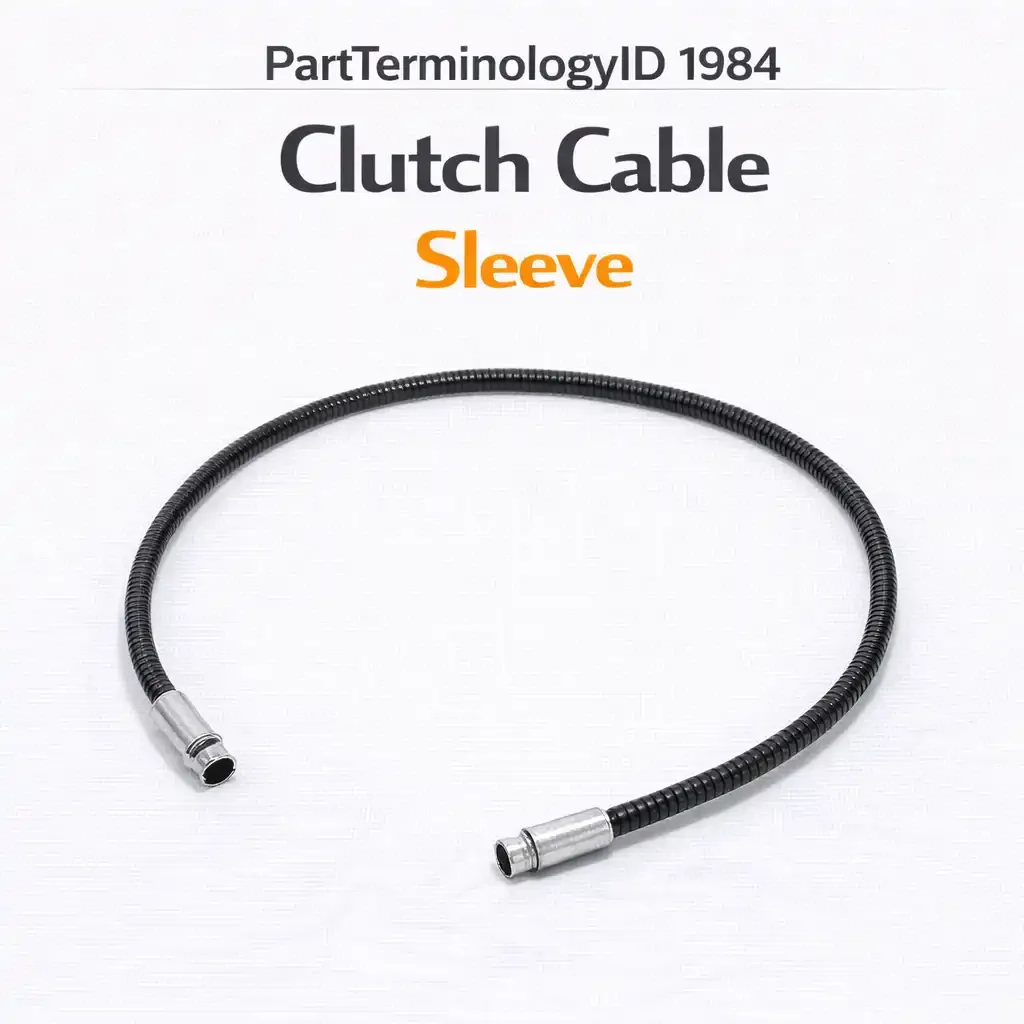
PartTerminologyID 1984, Clutch Cable Sleeve, is the protective outer sheath or guide tube through which the clutch cable travels between its anchor points. It serves two functions: it protects the inner cable from dirt, moisture, and abrasion, and it provides a fixed conduit that defines the cable's routing path so the inner cable can slide freely without binding against sharp edges, engine components, or body panels.
On vehicles with cable-actuated clutches (as opposed to hydraulic clutch systems), the clutch cable runs from the pedal assembly through the firewall and engine bay to the clutch fork on the transmission bellhousing. The sleeve is the outer housing that the cable slides inside, similar in concept to a bicycle brake cable housing. When the sleeve wears, cracks, collapses internally, or corrodes, the inner cable binds. The clutch pedal becomes stiff, sticky, or refuses to return. The driver fights the pedal with every shift.
This is a part that generates returns not because of fitment complexity (it is relatively simple), but because of naming confusion. "Clutch cable sleeve" can refer to the outer housing of the cable assembly, a separate replacement sleeve that slides over a section of the cable, a firewall pass-through grommet or guide, or a self-adjusting cable sleeve mechanism. Each of these is a different product, and listings that do not specify which one they are selling ship the wrong part to buyers who filled in the ambiguity with their own interpretation.
Why This Part Generates Returns
Buyers order the wrong clutch cable sleeve because:
they do not know whether their vehicle uses a cable-actuated or hydraulic clutch (hydraulic clutch vehicles have no cable and no cable sleeve, and ordering one is a return)
they confuse the cable sleeve with the complete clutch cable assembly (the sleeve is a component of or accessory to the cable, not the cable itself)
they do not verify the sleeve length, inside diameter, and end fitting type
they do not verify whether the sleeve is a standalone replacement part or whether it is only available as part of the complete cable assembly on their vehicle
they confuse the clutch cable sleeve with the shift cable sleeve, the parking brake cable sleeve, or the speedometer cable housing (all are cable-in-sleeve systems with similar construction)
they do not verify whether their vehicle's clutch cable uses a self-adjusting mechanism housed inside a sleeve section (common on many Ford and GM vehicles from the 1980s and 1990s), which is a different product than a simple guide sleeve
they miss that some "sleeves" are actually firewall pass-through bushings or grommets that guide the cable through the bulkhead
Sellers get caught because "clutch cable sleeve" is not a universally standardized term. One manufacturer's "sleeve" is another manufacturer's "cable housing." One listing's "sleeve" is a 4-inch firewall pass-through guide. Another listing's "sleeve" is a 36-inch outer housing that runs the full length of the cable route. Without dimensional specifications and a clear description of what the product actually is, the buyer is guessing.
Status in New Databases
PIES/PCdb: PartTerminologyID 1984, Clutch Cable Sleeve
PIES 8.0 / PCdb 2.0: No change
What This Part Actually Is (and the Four Things It Could Be)
Full-length outer cable housing
The complete outer sheath that runs from the pedal end to the bellhousing end. The inner cable slides inside this housing. On some vehicles, this housing is a separate replaceable component. On others, it is permanently attached to the inner cable and is only available as part of the complete cable assembly.
If the sleeve is only available as part of the complete cable assembly, listing a standalone sleeve under PartTerminologyID 1984 for that vehicle will attract buyers who cannot use it because their vehicle requires the complete cable with the housing pre-assembled.
Section sleeve or repair sleeve
A short length of tubing designed to slide over a damaged section of the existing cable housing as a repair. This is an aftermarket repair product, not an OE component. It is typically sold by length or in a universal kit with multiple diameters.
Firewall pass-through guide
A short bushing, grommet, or tube pressed into the firewall hole where the clutch cable passes from the cabin to the engine bay. It protects the cable from chafing against the sheet metal edges of the firewall hole. This is sometimes called a "cable sleeve" in parts catalogs, but it is functionally a grommet or bushing.
Self-adjusting cable sleeve mechanism
On many vehicles from the 1980s and 1990s (particularly Ford Mustang, Ford Ranger, GM S-10, and similar), the clutch cable uses a self-adjusting mechanism that consists of a ratcheting device housed inside a tubular sleeve at the pedal end of the cable. As the clutch disc wears and the cable effectively becomes longer, the ratchet mechanism takes up the slack automatically.
When this mechanism fails (the ratchet teeth wear, the internal spring breaks, or the housing cracks), the clutch pedal free play increases and the clutch may not fully disengage. The "clutch cable sleeve" that the buyer needs in this case is not a guide tube. It is a self-adjusting mechanism. The product, the price, and the function are completely different from a passive cable housing.
The Hydraulic Clutch Knockout
Vehicles with hydraulic clutch actuation (a clutch master cylinder and slave cylinder connected by a hydraulic line) have no clutch cable. There is no inner cable, no outer sleeve, and no PartTerminologyID 1984 application. If a seller lists a clutch cable sleeve for a vehicle that uses a hydraulic clutch, every order is a return.
The transition from cable clutches to hydraulic clutches happened at different times for different vehicles, sometimes mid-generation. A truck that used a cable clutch from 1994 to 1997 may have switched to a hydraulic clutch in 1998. The listing must specify cable-actuated clutch only, and the year range must not span the cable-to-hydraulic transition.
Top Return Scenarios
Scenario 1: "My vehicle has a hydraulic clutch, there is no cable"
Vehicle uses a clutch master cylinder and slave cylinder. No cable or sleeve exists.
Prevention language: "For vehicles with cable-actuated clutch only. Not for vehicles with hydraulic clutch systems (master cylinder and slave cylinder). Verify your clutch actuation type."
Scenario 2: "This is a guide tube, I need the self-adjusting mechanism"
Buyer needs the ratcheting self-adjuster assembly, received a passive sleeve.
Prevention language: "This is a [passive cable guide sleeve / self-adjusting cable mechanism]. Verify which component you need. If your clutch cable has an automatic adjustment feature, see self-adjusting clutch cable listings."
Scenario 3: "I need the complete cable, not just the sleeve"
Sleeve is not separately serviceable on the buyer's vehicle.
Prevention language: "Standalone replacement cable sleeve. Verify that your vehicle's clutch cable sleeve is separately replaceable. On some vehicles, the sleeve is only available as part of the complete clutch cable assembly."
Scenario 4: "This is a firewall grommet, not a cable sleeve"
Buyer expected a full-length housing and received a short pass-through bushing.
Prevention language: "Sleeve length: [X inches]. Type: [full-length cable housing / firewall pass-through guide / section repair sleeve]. Verify product type and length."
Scenario 5: "Wrong diameter, cable doesn't fit inside"
Sleeve I.D. does not match the cable O.D.
Prevention language: "Sleeve inside diameter: [X mm]. Cable outside diameter compatibility: [X mm]. Verify cable diameter before ordering."
What to Include in the Listing
Core essentials
PartTerminologyID: 1984
component: Clutch Cable Sleeve
product type: full-length housing, section repair sleeve, firewall pass-through guide, or self-adjusting mechanism sleeve
clutch actuation type: cable-actuated only
quantity: 1
Fitment essentials
year/make/model/submodel
transmission code (if clutch cable routing varies by transmission)
clutch actuation type: cable (applicable) or hydraulic (not applicable)
engine type (if cable routing or sleeve length differs by engine)
Dimensional essentials
sleeve length
sleeve inside diameter
sleeve outside diameter
end fitting type at each end (if applicable: ferrule, pressed end, open cut)
material (plastic, steel, nylon-lined steel, rubber)
Image essentials
full sleeve showing overall length
both ends showing end fittings or cut ends
I.D. visible or called out
installed routing reference showing the sleeve's path through the engine bay
Catalog Checklist for ACES/PIES Teams
PartTerminologyID = 1984
require product type attribute (full-length housing, pass-through guide, repair sleeve, self-adjusting mechanism)
require clutch actuation type (cable only, exclude hydraulic vehicles)
require sleeve length and I.D.
flag vehicles where the sleeve is not separately serviceable (only available with complete cable assembly)
flag the cable-to-hydraulic transition year for vehicles that changed mid-generation
differentiate from complete clutch cable assembly, shift cable sleeve, parking brake cable sleeve, and speedometer cable housing
FAQ (Buyer Language)
Is this the complete clutch cable?
No. The clutch cable sleeve is the outer housing or guide through which the inner cable slides. It is not the complete cable assembly. If you need the inner cable and outer housing together, order the complete clutch cable assembly.
My clutch pedal is stiff and doesn't return smoothly. Is it the sleeve?
Possibly. If the inner cable is binding inside a cracked, collapsed, or corroded sleeve, the pedal will feel stiff and sticky. However, the same symptom can be caused by a frayed inner cable, a worn clutch fork pivot, a dry pedal pivot, or a failing self-adjusting mechanism. Inspect the full cable path before ordering.
Does my car even have a clutch cable?
If your vehicle has a manual transmission and a clutch pedal, check under the hood for a cable running from the firewall to the transmission bellhousing. If you see a cable, your vehicle has a cable-actuated clutch. If you see a hydraulic line and a slave cylinder on the bellhousing instead of a cable, your vehicle has a hydraulic clutch and does not use a cable or sleeve.
Can I lubricate the cable inside the sleeve instead of replacing the sleeve?
Cable lubrication can temporarily improve a sticky pedal if the sleeve is intact but dry. However, if the sleeve is cracked, collapsed, or corroded internally, lubrication will not restore free cable movement. Inspect the sleeve condition before deciding between lubrication and replacement.
Cross-Sell Logic
Clutch Cable Assembly (complete cable with housing)
Clutch Cable Self-Adjuster (if applicable)
Clutch Fork (PartTerminologyID related)
Clutch Fork Shaft Bearing (PartTerminologyID 1960)
Firewall Cable Grommet
Cable Lubricant
Frame as "inspect and replace during clutch cable service. If the sleeve is damaged, the cable will bind regardless of cable condition."
Final Take for PartTerminologyID 1984
Clutch Cable Sleeve (PartTerminologyID 1984) is a part with a name that maps to four different products: a full-length cable housing, a section repair sleeve, a firewall pass-through guide, and a self-adjusting mechanism housing. The listing must declare which one it is, or the buyer will fill in the ambiguity with whatever they need and return whatever they receive.
State the product type. State the length. State the I.D. Confirm the vehicle uses a cable clutch, not hydraulic. Those four details resolve the naming ambiguity that drives returns on a part whose biggest problem is not fitment complexity but definitional confusion.