
Written by Arthur Simitian | PartsAdvisory
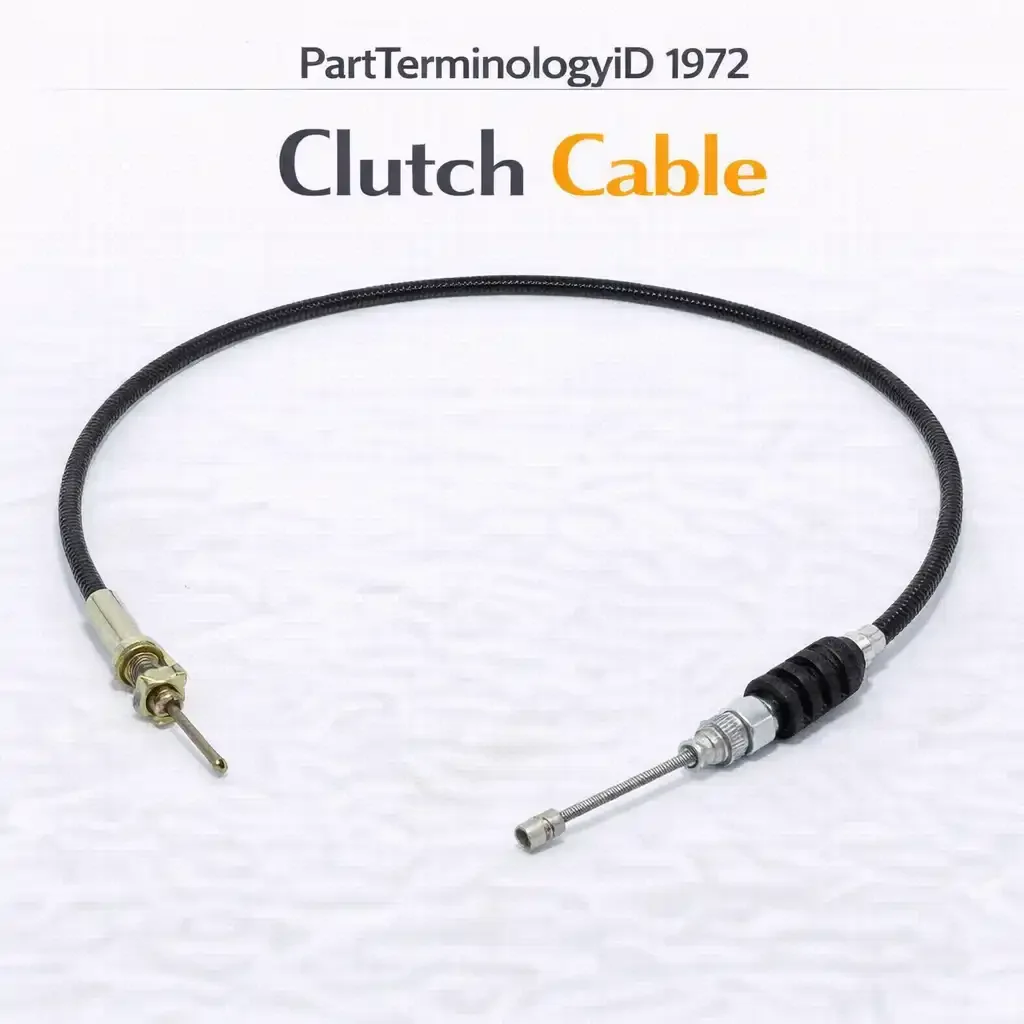
PartTerminologyID 1972, Clutch Cable, is the mechanical cable assembly that connects the clutch pedal to the clutch fork on the transmission bellhousing. When the driver presses the clutch pedal, the cable pulls (or pushes, depending on the routing design) the clutch fork, which moves the release bearing into contact with the pressure plate diaphragm spring, disengaging the clutch.
Cable-actuated clutches were the industry standard on manual transmission vehicles from the earliest days of automotive engineering through the early 2000s. They are mechanically simple, lightweight, inexpensive, and require no hydraulic fluid, no master cylinder, no slave cylinder, and no bleeding procedure. The cable connects the pedal to the fork and the driver's foot does the rest.
Hydraulic clutch actuation has largely replaced cable actuation on modern vehicles because it provides smoother pedal feel, consistent engagement across a wider range of temperatures and wear conditions, easier self-adjustment, and better packaging in engine bays that have become increasingly crowded. But the cable-actuated clutch remains the standard on millions of vehicles still on the road, particularly economy cars from the 1980s through the early 2000s, light trucks, classic vehicles, and the global market where cable clutches are still produced on new vehicles.
For the aftermarket seller, the clutch cable is a moderate-volume replacement part with a deceptive number of fitment variables. It looks like a simple cable. It is not. The routing path, the end fittings, the cable length, the self-adjusting mechanism (if equipped), and the outer housing configuration are all vehicle-specific, and a cable that is six inches too long, has the wrong end fitting, or lacks the self-adjusting mechanism will not work.
Why This Part Generates Returns
Buyers order the wrong clutch cable because:
they do not verify whether their vehicle uses a cable-actuated or hydraulic clutch (ordering a cable for a hydraulic vehicle is a complete mismatch)
they do not verify the cable's overall length (which varies by cab configuration on trucks, body style on cars, and engine type where different engines change the bellhousing position)
they do not verify the end fitting type at the pedal end (hook, clevis pin, ball end, threaded rod, or self-adjusting mechanism fitting)
they do not verify the end fitting type at the fork end (hook, ball end, barrel, or threaded adjuster)
they do not verify whether the cable has a self-adjusting mechanism and what type (quadrant and pawl, ratcheting sleeve, or spring-loaded automatic adjuster)
they miss the left-hand-drive vs. right-hand-drive split (the cable routes differently on opposite-side-drive vehicles, and the length, routing clips, and firewall pass-through location differ)
they miss cab configuration splits on trucks (regular cab, extended cab, crew cab all have different pedal-to-bellhousing distances)
they do not verify the firewall pass-through grommet or sleeve interface (PartTerminologyID 1984)
they confuse the clutch cable with the shift cable, throttle cable, speedometer cable, or parking brake cable
Sellers get caught because clutch cable listings typically show a year/make/model and a photo of a cable coiled in packaging. The end fittings, the overall length, the self-adjusting mechanism type, and the cab configuration qualifier are omitted. The buyer orders based on the vehicle match, and the cable arrives six inches too short for their crew cab, or with a hook fitting when their pedal uses a ball-and-socket, or without the self-adjusting ratchet their vehicle requires.
Status in New Databases
PIES/PCdb: PartTerminologyID 1972, Clutch Cable
PIES 8.0 / PCdb 2.0: No change
What This Part Actually Is
A clutch cable assembly consists of several integrated components:
Inner cable (wire rope)
The core of the assembly. A braided steel wire rope (typically multi-strand) that transmits the pulling force from the pedal to the fork. The wire rope diameter and construction (number of strands, strand lay) determine the cable's strength and flexibility. A frayed or broken inner cable is the most common failure mode.
Outer housing (cable sleeve)
The protective sheath that the inner cable slides inside. The outer housing defines the cable's routing path and provides a reaction surface for the inner cable's tension. The housing may be a flexible steel conduit, a plastic-lined steel tube, or a composite construction. On some cables, the outer housing is continuous from pedal to fork. On others, it is segmented (the cable is exposed along part of the route and the housing covers only the curved sections).
The outer housing condition determines cable feel. A collapsed, kinked, or internally corroded housing creates friction that makes the pedal stiff and the release sluggish. This is why clutch cable sleeve (PartTerminologyID 1984) exists as a separate category, because on some vehicles the housing is replaceable independently from the inner cable.
Pedal end fitting
The attachment point at the clutch pedal. This fitting must match the pedal arm's attachment mechanism. Common types include:
Hook: A formed hook on the cable end that latches into a slot or hole in the pedal arm. Simple, common on older vehicles.
Clevis pin: A forked fitting with a clevis pin that passes through the pedal arm. Provides a secure pivot connection.
Ball end (ball and socket): A spherical ball molded or swaged onto the cable end that snaps into a socket on the pedal arm or on a self-adjusting quadrant. Common on many Ford and GM vehicles from the 1980s and 1990s.
Threaded rod: A threaded extension on the cable end that passes through the pedal arm and is secured with a nut. Allows manual length adjustment.
Fork end fitting
The attachment point at the clutch fork on the bellhousing. This fitting must match the fork's cable attachment method. Common types include:
Hook: Latches into the fork lever.
Ball end: Snaps into a socket on the fork or on a cable bracket on the bellhousing.
Barrel (cylindrical): A cylindrical slug on the cable end that seats into a slot in the fork.
Threaded adjuster: A threaded rod with a nut that allows manual cable length adjustment at the fork end. The nut is turned to take up slack as the clutch disc wears.
Self-adjusting mechanism (on equipped cables)
Many clutch cables from the 1980s onward include an automatic self-adjusting mechanism that takes up cable slack as the clutch disc wears. Without this mechanism, the driver must periodically adjust the cable manually (turning a threaded adjuster at the fork end) to maintain correct clutch pedal free play. With the mechanism, the cable adjusts itself and the pedal feel remains consistent throughout the clutch disc's life.
Self-adjusting mechanisms are the single largest source of clutch cable return confusion, and they deserve their own section.
Self-Adjusting Clutch Cables: The Mechanism That Doubles the SKU Count
Quadrant and pawl system
Common on Ford vehicles (Mustang, Ranger, F-150, Bronco II) from the mid-1980s through the late 1990s. A toothed quadrant (a sector gear) is mounted at the clutch pedal, and a spring-loaded pawl engages the quadrant teeth. As the clutch disc wears and the cable effectively becomes longer (more slack), the pawl advances one tooth on the quadrant, taking up the slack. The mechanism is part of the pedal assembly, not the cable itself, but the cable must be designed to work with the quadrant (correct ball end size, correct cable tension range, correct routing to maintain engagement with the quadrant).
A non-adjusting cable installed on a quadrant-equipped vehicle will have the wrong end fitting and will not engage the quadrant mechanism. The clutch will work initially but will not self-adjust, and the pedal free play will increase as the disc wears until the clutch no longer fully disengages.
Ratcheting sleeve mechanism
Common on some GM and other domestic applications. The self-adjusting mechanism is built into a tubular sleeve section of the cable itself, typically near the pedal end. A ratcheting device inside the sleeve takes up slack incrementally. When this mechanism fails (the ratchet teeth strip, the internal spring breaks, or the sleeve cracks), the cable loses its adjustment capability and the pedal free play increases.
A standard (non-adjusting) cable will not fit in place of a ratcheting sleeve cable because the sleeve is an integral structural component of the cable assembly. The mounting points, overall length, and routing assume the sleeve is present.
Spring-loaded automatic adjuster
Some cables use a spring-loaded mechanism at the fork end that maintains constant cable tension regardless of disc wear. The spring compensates for slack by pulling the cable taut. This mechanism may be integrated into the cable assembly or may be a separate component on the bellhousing bracket.
Why this matters for listings
A vehicle that was sold with a self-adjusting clutch cable requires a self-adjusting replacement cable. A non-adjusting cable will not maintain pedal feel as the disc wears. Conversely, a self-adjusting cable installed on a vehicle that was not designed for one may have wrong end fittings, wrong overall length (the mechanism adds length to the assembly), or may interfere with pedal bracket components that were not designed to accommodate it.
The listing must specify: self-adjusting (with mechanism type) or non-adjusting. This is a mandatory attribute.
The Cab Configuration Split (Trucks)
On trucks that were available in multiple cab configurations (regular cab, extended cab, crew cab, and on some models, short bed vs. long bed), the distance from the clutch pedal to the bellhousing changes with cab length. A longer cab means a longer cable.
A clutch cable for a regular cab F-150 is several inches shorter than the cable for a crew cab F-150. They have the same end fittings, the same routing clips, the same self-adjusting mechanism. The only difference is length. And that length difference means the regular cab cable will not reach the fork on a crew cab, and the crew cab cable will have excessive slack on a regular cab.
Cab configuration is a required fitment attribute on all truck clutch cable listings.
The Engine Split
On vehicles where different engine options position the transmission bellhousing at different distances from the firewall (due to different engine lengths), the clutch cable length may vary by engine. A four-cylinder engine is shorter than a V6 or V8. The bellhousing sits closer to the firewall with the four-cylinder. The cable is shorter.
This is most common on compact trucks and economy cars that offered both four-cylinder and V6 options with manual transmissions. The cable route may also change because the larger engine fills more of the engine bay and forces the cable into a different path with different clip points.
Engine code is a required fitment attribute when cable length varies by engine.
The Hydraulic Clutch Knockout
The transition from cable clutches to hydraulic clutches is the most important knockout criterion for this PartTerminologyID. Vehicles with hydraulic clutch actuation have no cable. There is a master cylinder at the pedal, a hydraulic line, and a slave cylinder at the bellhousing (or a concentric slave cylinder inside the bellhousing). Ordering a clutch cable for a hydraulic vehicle is a complete mismatch.
The transition happened at different times for different vehicles:
Ford Mustang: cable through 1993, hydraulic from 1994
Ford Ranger: cable through 2000, hydraulic from 2001 (varies by market)
Chevrolet S-10/GMC S-15: cable through 1993, hydraulic from 1994
Honda Civic: cable through the mid-1990s on some markets, hydraulic on others depending on generation and trim
Toyota pickup/Tacoma: cable on older models, hydraulic on newer models (varies by generation)
A listing that spans a year range across the cable-to-hydraulic transition without specifying the actuation type will attract buyers on both sides of the transition. Half of them will receive a cable they cannot use.
Top Return Scenarios
Scenario 1: "My vehicle has a hydraulic clutch, there is no cable"
Cable-to-hydraulic transition mismatch.
Prevention language: "For vehicles with cable-actuated clutch only. Not for vehicles with hydraulic clutch systems (master cylinder and slave cylinder). Verify your clutch actuation type. [Vehicle] switched from cable to hydraulic actuation in [year]."
Scenario 2: "Cable is too short for my crew cab"
Cab configuration mismatch.
Prevention language: "Cable overall length: [X inches]. For [regular cab / extended cab / crew cab]. Verify cab configuration. Cable length varies by cab type."
Scenario 3: "Wrong end fitting at the pedal"
Pedal end fitting does not match the pedal arm attachment.
Prevention language: "Pedal end fitting: [hook / ball end / clevis pin / threaded rod]. Fork end fitting: [hook / ball end / barrel / threaded adjuster]. Verify both end fittings match your vehicle."
Scenario 4: "Cable doesn't have the self-adjusting mechanism"
Buyer's vehicle uses a self-adjusting cable and received a non-adjusting cable.
Prevention language: "[Self-adjusting with (quadrant/ratcheting sleeve/spring-loaded) mechanism / non-adjusting with manual threaded adjuster]. Verify whether your vehicle uses a self-adjusting clutch cable."
Scenario 5: "Cable is too long, bunches up in the engine bay"
Crew cab cable installed on a regular cab, or V6 cable installed on a four-cylinder application.
Prevention language: "Cable overall length: [X inches]. For [engine code] engine with [cab configuration]. Verify engine and cab type."
Scenario 6: "This is a shift cable, not a clutch cable"
Buyer confused clutch cable with manual transmission shift cable.
Prevention language: "Clutch cable. Connects the clutch pedal to the clutch fork on the transmission bellhousing. This is not a transmission shift cable, throttle cable, or parking brake cable."
What to Include in the Listing
Core essentials
PartTerminologyID: 1972
component: Clutch Cable
self-adjusting: yes (specify mechanism type) or no (manual adjustment)
clutch actuation type: cable (applicable) / hydraulic (not applicable)
quantity: 1
Fitment essentials
year/make/model/submodel
engine code (mandatory when cable length varies by engine)
transmission code (if cable end fitting or routing varies by transmission)
cab configuration (mandatory on trucks: regular, extended, crew)
body style (on cars where cable differs by sedan, coupe, hatchback, wagon)
drive type (FWD/RWD, if bellhousing position changes cable routing)
LHD/RHD (left-hand-drive vs. right-hand-drive, if listing covers both markets)
Dimensional essentials
overall cable length (inner cable, measured end fitting to end fitting)
outer housing length (if shorter than inner cable)
pedal end fitting type and dimensions
fork end fitting type and dimensions
threaded adjuster range (if equipped)
cable wire rope diameter
Self-adjusting mechanism essentials (if equipped)
mechanism type (quadrant/pawl, ratcheting sleeve, spring-loaded)
mechanism location (pedal end, cable body, fork end)
compatible pedal quadrant part number (if mechanism requires a specific quadrant)
Image essentials
full cable laid out showing overall length
pedal end fitting close-up
fork end fitting close-up
self-adjusting mechanism detail (if equipped)
routing clip locations marked
firewall pass-through grommet interface visible
Catalog Checklist for ACES/PIES Teams
PartTerminologyID = 1972
require self-adjusting attribute (yes/no with mechanism type)
require overall cable length
require both end fitting types (pedal end and fork end)
require cab configuration on trucks
require engine code when cable length varies by engine
enforce the cable-to-hydraulic transition year as a hard cutoff (do not allow year ranges to span the transition)
differentiate from clutch cable sleeve (PartTerminologyID 1984), shift cables, throttle cables, and parking brake cables
flag vehicles where both LHD and RHD versions exist with different cables
flag vehicles where different engines produce different cable lengths
FAQ (Buyer Language)
How do I know if my vehicle has a cable or hydraulic clutch?
Open the hood and look at the transmission bellhousing. If you see a mechanical cable running from the firewall to a lever (clutch fork) on the bellhousing, your vehicle uses a cable clutch. If you see a small hydraulic cylinder (slave cylinder) on the bellhousing with a hydraulic line running to it, or if there is no fork and the hydraulic line enters the bellhousing directly, your vehicle uses a hydraulic clutch and does not need a cable.
From inside the cabin, look at the top of the clutch pedal arm. If a cable attaches to it, your vehicle is cable-actuated. If a pushrod connects the pedal to a small cylinder mounted on the firewall (the clutch master cylinder), your vehicle is hydraulic.
My clutch pedal is stiff and hard to press. Is it the cable?
Possibly. A frayed, kinked, or internally corroded cable creates friction that makes the pedal stiff. However, the same symptom can be caused by a dry or worn pedal pivot bearing (PartTerminologyID 1961), a collapsed cable sleeve (PartTerminologyID 1984), a worn fork shaft bearing (PartTerminologyID 1960), or a failing pressure plate. Disconnect the cable at the fork end and press the pedal. If the pedal moves freely without the cable, the cable (or its routing) is the problem. If the pedal is still stiff, the issue is at the pedal pivot.
Can I adjust the cable instead of replacing it?
If your cable has a threaded adjuster at the fork end and the cable is not frayed or binding, you can adjust the free play by turning the adjuster nut. If the cable has stretched beyond the adjuster's range, or if the inner cable is frayed, kinked, or has broken strands, replacement is required. Adjusting a damaged cable is a temporary measure that will eventually fail.
My clutch pedal free play keeps increasing. Is the self-adjuster broken?
If your vehicle has a self-adjusting cable and the pedal free play is increasing, the self-adjusting mechanism has failed. On quadrant-and-pawl systems, the pawl teeth may be stripped or the spring may be broken. On ratcheting sleeve cables, the internal ratchet has worn out. The cable (or the quadrant mechanism, depending on the design) must be replaced.
Does the cable come with the firewall grommet?
Check the listing. Some cables include the firewall pass-through grommet. Most do not. If your grommet is cracked or missing, order it separately (see PartTerminologyID 1984 or firewall grommet listings).
Can I use a non-adjusting cable on a vehicle that had a self-adjusting cable?
Technically, a non-adjusting cable can be made to work if the end fittings match, but you will lose the automatic adjustment feature. The clutch pedal free play will need to be adjusted manually at the fork end as the disc wears. More importantly, if the end fittings do not match the self-adjusting mechanism (e.g., the pedal quadrant requires a specific ball end), the cable will not attach correctly.
I replaced the cable but the clutch still doesn't disengage fully. What else could it be?
If the cable is new and correctly adjusted but the clutch does not fully disengage (grinds going into gear), the problem may be a worn or seized clutch fork shaft bearing (PartTerminologyID 1960), a damaged clutch fork, a warped clutch disc, or a failing pressure plate. The cable can only transmit force. If the components on the receiving end are not functioning, a new cable will not fix the symptom.
Cross-Sell Logic
Clutch Cable Sleeve (PartTerminologyID 1984, for vehicles where the sleeve is separately serviceable)
Clutch Fork
Clutch Fork Shaft Bearing (PartTerminologyID 1960)
Clutch Pedal Bearing (PartTerminologyID 1961)
Clutch Pedal Self-Adjuster Quadrant (if the quadrant is worn and the cable is being replaced)
Firewall Cable Grommet
Clutch Disc and Pressure Plate Kit
Clutch Release Bearing (PartTerminologyID 1968)
Cable Lubricant
Frame as "replace the cable with every major clutch service. While the cable is disconnected, inspect the fork, fork shaft bearing, pedal bearing, and self-adjusting mechanism."
The Bigger Picture: Cable Clutch Vehicles Are Aging
The cable-actuated clutch is a technology in long-term decline on new vehicles. But the aftermarket demand for clutch cables is not declining at the same rate, because the vehicles that used cables are still being driven, maintained, and repaired. Economy cars from the 1990s, compact trucks from the 1980s and 1990s, and classic vehicles from every era all need clutch cables, and many of these vehicles are now driven by buyers who are cost-sensitive, do their own maintenance, and are ordering parts online.
These buyers are less likely to have a service manual. They are less likely to know their cab configuration code or engine code. They are more likely to order based on year/make/model alone and assume the cable will fit. And they are more likely to return a cable that does not fit because the listing did not tell them to check the cab type, the engine, the self-adjuster, or the end fittings.
The seller who includes those details captures the buyer and the sale. The seller who does not ships a cable that comes back, pays the return shipping, and loses the buyer to whoever had the more detailed listing.
Final Take for PartTerminologyID 1972
Clutch Cable (PartTerminologyID 1972) is a part with a simple concept (cable connects pedal to fork) and a layered fitment reality. The cable length varies by cab configuration, engine, and body style. The end fittings vary by pedal design and fork design. The self-adjusting mechanism varies by manufacturer and era. And the entire part category is invalidated by the hydraulic clutch transition.
Five attributes prevent the majority of returns: actuation type (cable, not hydraulic), overall length, pedal end fitting type, fork end fitting type, and self-adjusting mechanism (type or none). Add cab configuration on trucks and engine code where length varies, and the listing covers the full fitment matrix.
A clutch cable is not complicated. But it is specific. And "specific" is the word that separates a cable that fits from one that ships back.