
Written by Arthur Simitian | PartsAdvisory
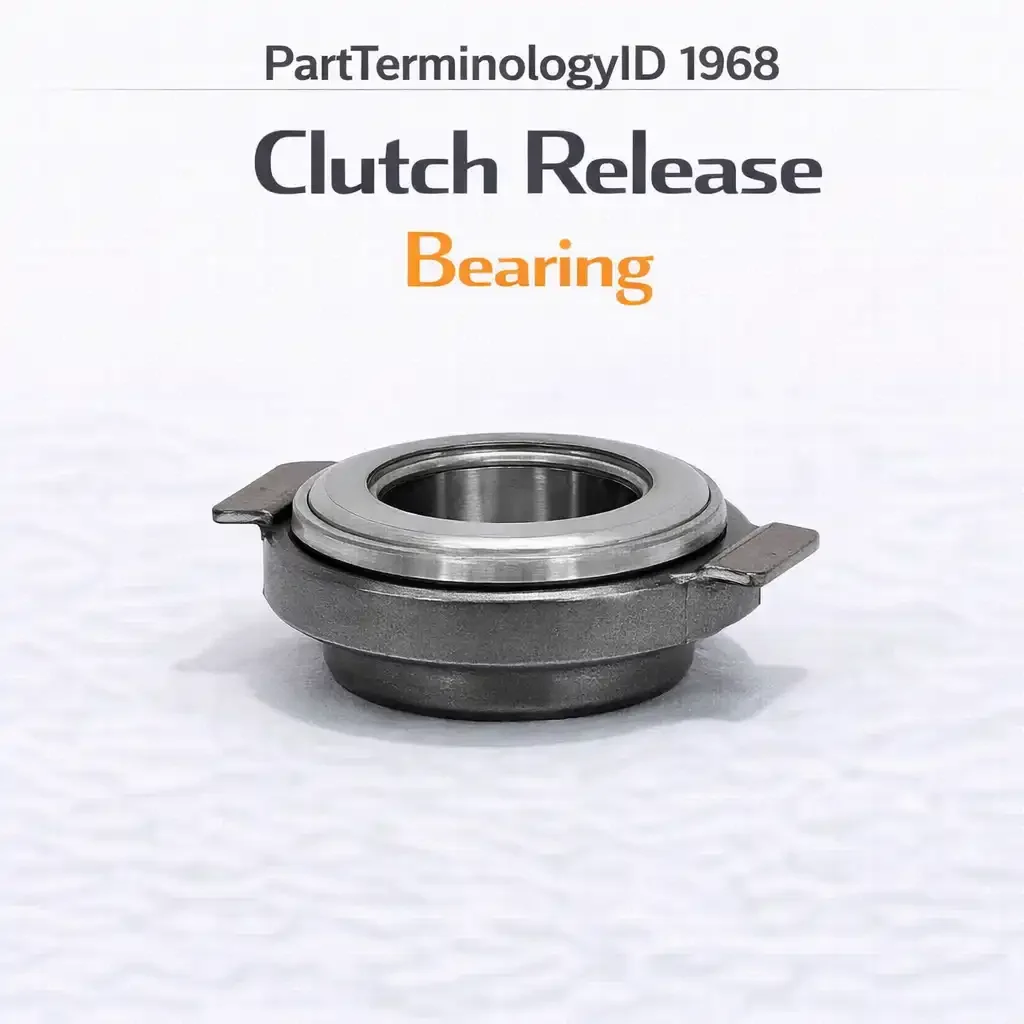
PartTerminologyID 1968, Clutch Release Bearing, is the bearing assembly that rides on the clutch fork (or on a concentric guide sleeve around the transmission input shaft) and presses against the pressure plate diaphragm spring fingers to disengage the clutch. When the driver pushes the clutch pedal, the fork (or hydraulic slave cylinder) pushes the release bearing forward into contact with the spinning pressure plate. The bearing allows the stationary fork to apply force against the rotating pressure plate without friction or heat destruction.
It is also universally called the throwout bearing. Same part, different name. Both terms appear in search queries, and both should appear in the listing.
When the release bearing fails, the driver hears a grinding, squealing, or chirping noise that appears when the clutch pedal is depressed and disappears when the pedal is released (the opposite pattern of a failed pilot bearing, which chirps when the pedal is released). In severe cases, the bearing seizes, the fork cannot press it forward, and the clutch will not disengage.
The release bearing is the highest-wear item in the clutch system. It is replaced during every clutch job, and it is included in most (but not all) clutch kits. For sellers, the return problem is that release bearings differ by transmission, fork type, and actuation system, and listings that specify only the vehicle without the transmission code cross-match incompatible bearings.
The Three Release Bearing Designs
Conventional fork-actuated release bearing
The traditional design used on most vehicles with a cable or external hydraulic slave cylinder clutch actuation. The bearing is a compact unit with a sealed ball bearing element, a flat contact face (that presses against the diaphragm spring), and a collar or clip that attaches to the clutch fork. The fork pushes the bearing forward along a guide sleeve or the transmission front bearing retainer (quill).
The bearing slides on the guide sleeve. The guide sleeve diameter, the bearing I.D., the overall height, and the fork attachment method (clip, spring, ball socket) are all fitment-critical dimensions.
Concentric slave cylinder (CSC) / hydraulic release bearing
On many modern vehicles, the release bearing is integrated into a hydraulic slave cylinder that mounts concentrically around the transmission input shaft. There is no mechanical clutch fork. The hydraulic line from the clutch master cylinder connects directly to the CSC, and hydraulic pressure pushes the bearing forward.
The CSC is a sealed, non-serviceable unit. When the bearing fails, the entire CSC must be replaced. When the hydraulic seal in the CSC fails (fluid leak at the bellhousing), the entire CSC must be replaced. It is both the actuator and the bearing in one assembly.
This design creates the most significant cross-reference trap in the release bearing category. A conventional fork-actuated release bearing and a CSC are both "clutch release bearings" under PartTerminologyID 1968. They are completely different products. One is a $15 bearing. The other is a $75 to $200 hydraulic assembly. One clips to a fork. The other bolts to the transmission and has a hydraulic line fitting. They are not interchangeable in any configuration.
Self-adjusting release bearing
Some release bearings incorporate a self-adjusting mechanism that compensates for clutch disc wear over time. As the disc wears and the diaphragm spring position changes, the adjuster maintains consistent pedal feel and engagement point. Self-adjusting bearings are physically different from non-adjusting bearings (additional internal components, different height, different preload) and must not be substituted with a standard bearing.
Why This Part Generates Returns
Buyers order the wrong clutch release bearing because:
they do not know whether their vehicle uses a conventional fork-actuated bearing or a concentric slave cylinder (CSC)
they do not verify the guide sleeve diameter (bearing I.D.) on fork-actuated systems
they do not verify the fork attachment method (clip style, spring retainer, ball socket pivot)
they order a conventional bearing for a CSC-equipped vehicle (or vice versa)
they do not verify the transmission code (different transmissions behind the same engine use different release bearings with different guide sleeve diameters, heights, and fork interfaces)
they confuse the release bearing with the pilot bearing (PartTerminologyID 1964) or the fork shaft bearing (PartTerminologyID 1960)
they assume the release bearing is included in their clutch kit and discover it is not (or that the kit includes a conventional bearing and their vehicle uses a CSC)
they miss self-adjusting vs. non-adjusting variants
Sellers get caught because "clutch release bearing" returns two fundamentally different products (conventional bearing vs. CSC) under the same PartTerminologyID, and the listing frequently does not specify which one. The buyer with a CSC-equipped vehicle orders a $15 conventional bearing and has no use for it. The buyer with a fork-actuated vehicle orders a $150 CSC and has no place to mount it.
Status in New Databases
PIES/PCdb: PartTerminologyID 1968, Clutch Release Bearing
PIES 8.0 / PCdb 2.0: No change
The Transmission Code Is Mandatory
The release bearing interfaces with the transmission, not the engine. The guide sleeve diameter, the input shaft quill dimensions, the fork geometry, and the bellhousing mounting face are all transmission-specific. The same vehicle with two available transmissions may use two completely different release bearings.
On trucks and performance vehicles where transmission swaps are common, the buyer may have a transmission that was not original to the vehicle. The VIN decodes to one transmission, but a different one is installed. The release bearing must match the actual transmission, not the VIN.
The transmission code is a required fitment attribute.
Top Return Scenarios
Scenario 1: "I have a concentric slave cylinder, this is a conventional bearing"
Actuation system mismatch.
Prevention language: "Conventional fork-actuated clutch release bearing. Not for vehicles equipped with a concentric slave cylinder (CSC) / hydraulic release bearing. If your vehicle has no mechanical clutch fork and the hydraulic line connects directly to a bearing assembly around the input shaft, your vehicle uses a CSC."
Scenario 2: "Bearing doesn't slide on the guide sleeve"
Guide sleeve diameter (bearing I.D.) mismatch due to different transmission.
Prevention language: "Bearing I.D. (guide sleeve diameter): [X mm]. For vehicles with [transmission code]. Verify transmission type and guide sleeve diameter."
Scenario 3: "Fork clip doesn't match"
Fork attachment style on the bearing does not match the clutch fork.
Prevention language: "Fork attachment: [wire clip / spring retainer / ball socket / snap ring]. Verify fork attachment method matches your clutch fork."
Scenario 4: "This is a release bearing, I need a pilot bearing"
Buyer confused the two.
Prevention language: "This is the clutch release bearing (throwout bearing), which presses against the pressure plate diaphragm spring. It is not the pilot bearing (PartTerminologyID 1964), which sits in the crankshaft bore and supports the input shaft tip."
Scenario 5: "Bearing is too tall, contacts the pressure plate at rest"
Bearing overall height does not match the bellhousing-to-pressure-plate clearance for the buyer's transmission and clutch combination.
Prevention language: "Bearing overall height: [X mm]. For use with [OE / specific aftermarket] pressure plate. Verify clearance between the release bearing contact face and the pressure plate diaphragm spring fingers."
Scenario 6: "My clutch kit already included a release bearing"
Duplicate purchase.
Prevention language: "Before ordering separately, check whether your clutch kit includes the release bearing. Many clutch kits include the release bearing. Some do not."
What to Include in the Listing
Core essentials
PartTerminologyID: 1968
component: Clutch Release Bearing (Throwout Bearing)
type: conventional fork-actuated, concentric slave cylinder (CSC), or self-adjusting
quantity: 1
Fitment essentials
year/make/model/submodel
transmission code (mandatory)
clutch actuation type: mechanical fork (cable or external slave) or concentric slave cylinder
self-adjusting: yes/no
engine code (if release bearing differs by engine within the same transmission)
Dimensional essentials
bearing I.D. (guide sleeve diameter)
bearing O.D.
bearing overall height (from base to contact face)
contact face diameter (must match diaphragm spring finger contact area)
fork attachment type (clip style, retainer method)
Hydraulic essentials (CSC only)
hydraulic line fitting size and type
mounting bolt pattern
bleed screw location
piston travel specification
Image essentials
front view showing contact face diameter
side view showing overall height
I.D. visible or called out
fork attachment detail (conventional) or hydraulic fitting detail (CSC)
installed context showing bearing position relative to pressure plate and fork
Catalog Checklist for ACES/PIES Teams
PartTerminologyID = 1968
require actuation type (conventional fork-actuated or CSC)
require transmission code (mandatory)
require bearing I.D., O.D., and overall height
require fork attachment type (for conventional bearings)
require hydraulic fitting specifications (for CSC)
require self-adjusting attribute (yes/no)
differentiate from pilot bearing (PartTerminologyID 1964) and fork shaft bearing (PartTerminologyID 1960)
flag vehicles where both conventional and CSC options existed across the model range
note whether the bearing is included in related clutch kit listings
FAQ (Buyer Language)
Is this the same as the throwout bearing?
Yes. "Clutch release bearing" and "throwout bearing" are two names for the same part. Both terms are used in the industry.
How do I know if my car has a concentric slave cylinder?
Look at the bellhousing. If you see a mechanical clutch fork (a lever protruding from the bellhousing), your vehicle uses a conventional release bearing on the fork. If there is no fork and the hydraulic line from the master cylinder runs directly into the bellhousing (usually through a fitting on the front face), your vehicle uses a concentric slave cylinder with an integrated release bearing.
Should I replace the release bearing with every clutch job?
Absolutely. The release bearing is a wear item that is only accessible with the transmission removed. It costs a fraction of the labor to access it. Reusing an old release bearing on a new clutch is a guarantee that you will hear it fail within the next clutch lifecycle.
My clutch kit includes a release bearing. Do I also need a pilot bearing?
Probably. Check the kit contents. Most kits include the release bearing. Many do not include the pilot bearing (PartTerminologyID 1964). Order the pilot bearing separately if it is not in the kit.
Can I convert from a CSC to a conventional fork-actuated system?
Conversion kits exist for some vehicles, but they require a different bellhousing or adapter plate, a clutch fork, a fork pivot, an external slave cylinder, and a different release bearing. It is a significant modification, not a part swap.
Cross-Sell Logic
Clutch Pilot Bearing (PartTerminologyID 1964)
Clutch Fork Shaft Bearing (PartTerminologyID 1960)
Clutch Disc and Pressure Plate Kit
Clutch Fork (if fork contact pads are worn)
Transmission Input Shaft Seal
Clutch Alignment Tool
Guide Sleeve / Front Bearing Retainer (if the guide sleeve is scored from a seized release bearing)
Frame as "the three clutch bearings: release bearing, pilot bearing, fork shaft bearing. Replace all three with every clutch job."
Final Take for PartTerminologyID 1968
Clutch Release Bearing (PartTerminologyID 1968) has one knockout question and one fitment question that prevent the majority of returns. The knockout: does the vehicle use a conventional fork-actuated release bearing or a concentric slave cylinder? These are two completely different products at two completely different price points with two completely different mounting interfaces, and they share one PartTerminologyID. The fitment question: what is the transmission code? The guide sleeve diameter, the bearing height, and the fork attachment method are all transmission-determined.
Answer both questions in the listing. State the actuation type. State the transmission code. State the I.D. and height. That separates a $15 bearing from a $150 hydraulic assembly and prevents the buyer from receiving a part designed for a transmission they do not have.