
Written by Arthur Simitian | PartsAdvisory
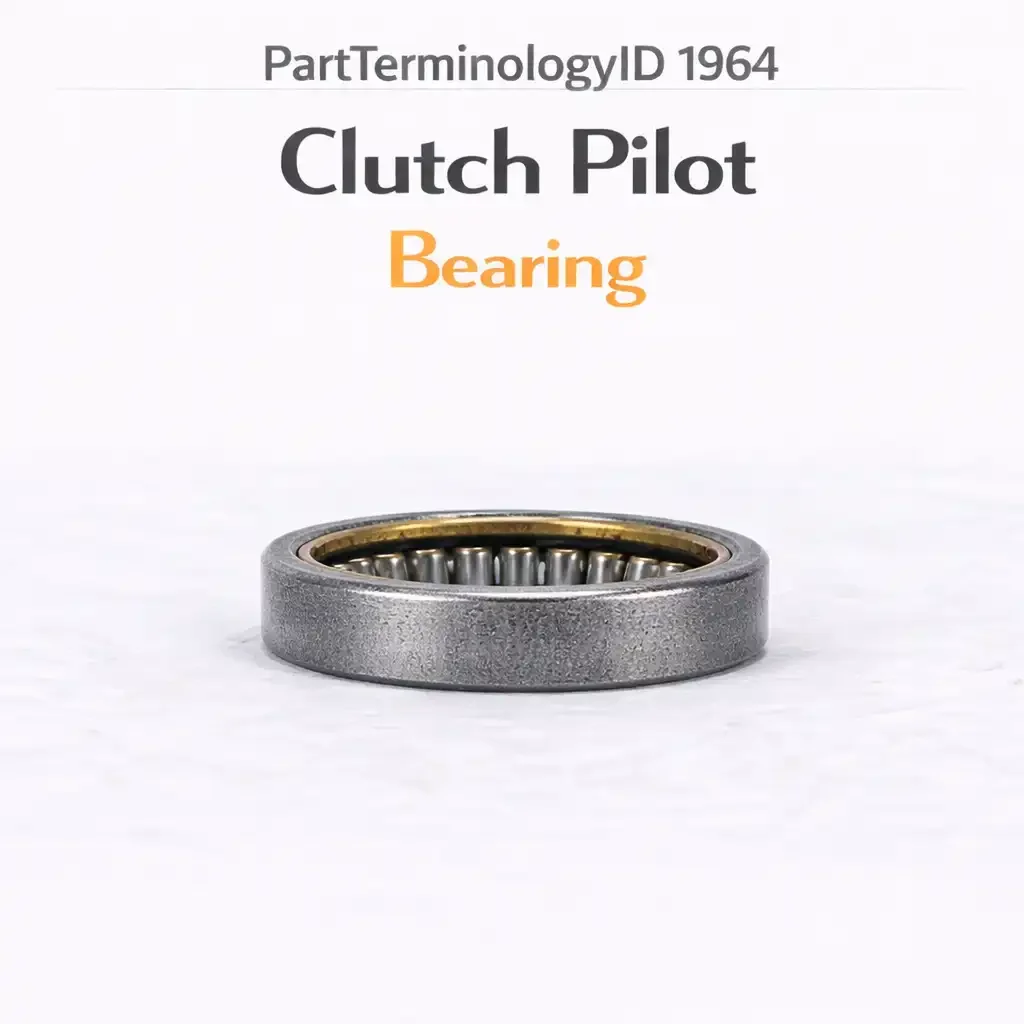
PartTerminologyID 1964, Clutch Pilot Bearing, is the small bearing or bushing pressed into the center bore of the engine crankshaft's rear flange (or into the rear face of the flywheel on some designs) that supports the tip of the transmission input shaft. When the clutch is disengaged (pedal pressed), the engine and transmission spin at different speeds. The pilot bearing allows the input shaft to rotate independently of the crankshaft without wobble, vibration, or friction.
When the pilot bearing fails, the input shaft is no longer held concentric with the crankshaft. The transmission may grind going into gear even with the clutch fully depressed. The vehicle may make a high-pitched whine or chirp at idle with the clutch pedal down that disappears when the pedal is released. In severe cases, a seized pilot bearing will drag the input shaft at engine speed even with the clutch disengaged, making it impossible to shift without grinding.
It is a five-dollar part that is only accessible when the transmission is removed. Nobody replaces it by itself. It is replaced during every clutch job, period. And it generates returns because the same crankshaft bore can accept either a bushing or a bearing, the bore dimensions change by engine, and the input shaft tip diameter changes by transmission.
Why This Part Generates Returns
Buyers order the wrong pilot bearing because:
they do not verify the crankshaft bore I.D. (which determines the pilot bearing O.D.)
they do not verify the input shaft tip O.D. (which determines the pilot bearing I.D.)
they do not verify whether their engine uses a pilot bushing (plain bronze or sintered metal) or a pilot bearing (sealed ball bearing or needle bearing), as both are valid options for many applications
they order based on engine code alone without accounting for the transmission (the same engine paired with different transmissions may need different pilot bearings because the input shaft diameters differ)
they confuse the pilot bearing with the throwout bearing (clutch release bearing, which rides on the fork and presses against the pressure plate) or the clutch fork shaft bearing (PartTerminologyID 1960, which supports the fork pivot in the bellhousing)
they assume the pilot bearing is included in their clutch kit (some kits include it, many do not)
they do not verify bearing depth (the bearing must press into the bore to a specific depth to properly engage the input shaft tip without bottoming out)
Sellers get caught because pilot bearing listings commonly provide an engine fitment or a vehicle fitment without specifying the transmission. Two transmissions behind the same engine can use input shafts with different tip diameters. A pilot bearing with a 15mm I.D. will not support a 17mm input shaft tip. The buyer installs the clutch, bolts the transmission back in, and the input shaft either will not enter the bearing or rattles inside it.
Status in New Databases
PIES/PCdb: PartTerminologyID 1964, Clutch Pilot Bearing
PIES 8.0 / PCdb 2.0: No change
Bushing vs. Bearing: The Persistent Choice
Pilot bushing
A plain cylindrical sleeve, typically bronze, brass, or sintered iron, pressed into the crankshaft bore. The input shaft tip rotates inside the bushing. Pilot bushings are cheap, self-lubricating (the sintered metal absorbs and releases oil), and were the standard for decades on domestic engines.
Bushings wear over time and can develop play. They are adequate for street use but generate slightly more friction than a rolling element bearing.
Pilot bearing (sealed ball bearing)
A miniature sealed ball bearing pressed into the same crankshaft bore. The input shaft tip rides in the bearing inner race. Sealed pilot bearings provide lower friction, longer life, and more precise shaft centering than plain bushings.
Many aftermarket clutch kits include a sealed ball bearing as a direct replacement for the OE pilot bushing, and this swap works on most applications because the O.D. (crankshaft bore) and I.D. (input shaft tip) are the same. However, the bearing is typically deeper (longer) than the bushing, and the crankshaft bore must be deep enough to accept it without the bearing protruding past the flange face.
Needle bearing
A caged needle roller bearing pressed into the crankshaft bore. Less common than sealed ball bearings in the aftermarket but used as the OE pilot bearing on some European and Japanese engines. The needle bearing has a very thin wall, which allows it to fit crankshaft bores where the difference between the bore I.D. and the input shaft O.D. is small.
The interchange question
On many applications, a bushing and a bearing are interchangeable (same O.D., same I.D., similar depth). On some applications, they are not (the bore depth may only accept a bushing, or the clearances may only work with a needle bearing). The listing should specify what the product is (bushing, sealed bearing, or needle bearing) and note whether it is a direct replacement for the OE type or a cross-type upgrade.
The Engine-Plus-Transmission Fitment
This is the return driver that sellers miss most often.
The pilot bearing O.D. is determined by the crankshaft bore. The crankshaft bore is determined by the engine. So far, the engine code is sufficient.
The pilot bearing I.D. is determined by the input shaft tip diameter. The input shaft tip is determined by the transmission. The same engine may have been paired with two, three, or even four different manual transmissions across the model range, and those transmissions may have different input shaft tip diameters.
A listing that specifies the engine but not the transmission will cross-match pilot bearings with different I.D. specifications. The buyer installs based on the engine match, and the input shaft either will not enter (I.D. too small) or has excessive play (I.D. too large).
Both the engine code and the transmission code are required for accurate pilot bearing fitment.
Top Return Scenarios
Scenario 1: "Bearing I.D. is too small, input shaft won't go in"
Input shaft tip diameter is larger than the bearing I.D. because the buyer has a different transmission than the listing covers.
Prevention language: "Bearing I.D. (input shaft tip): [X mm]. Bearing O.D. (crankshaft bore): [X mm]. For vehicles with [engine code] and [transmission code]. Verify both engine and transmission."
Scenario 2: "I ordered a bearing but my engine needs a bushing"
Sealed ball bearing is too deep for the crankshaft bore, or the bore geometry does not accept a bearing.
Prevention language: "Product type: [sealed ball bearing / bronze bushing / needle bearing]. Bearing depth: [X mm]. Crankshaft bore depth: verify bore can accept this depth. This is a [direct OE replacement / upgrade from OE bushing]."
Scenario 3: "I thought this was included in my clutch kit"
Buyer opened the clutch kit box during installation and discovered no pilot bearing.
Prevention language: "The pilot bearing is not always included in clutch disc and pressure plate kits. Verify your clutch kit contents. If not included, order separately."
Scenario 4: "This is a pilot bearing, I need a throwout bearing"
Buyer confused the two bearings.
Prevention language: "This is the clutch pilot bearing, which presses into the crankshaft bore and supports the transmission input shaft tip. It is not the throwout bearing (release bearing), which rides on the clutch fork and presses against the pressure plate."
Scenario 5: "Bearing O.D. doesn't fit my crankshaft bore"
Engine has a different crankshaft bore size than expected (engine revision, aftermarket flywheel with different bore, or incorrect engine identification).
Prevention language: "Crankshaft bore (bearing O.D.): [X mm]. Verify crankshaft bore diameter. Bore size may vary by engine revision or production date."
What to Include in the Listing
Core essentials
PartTerminologyID: 1964
component: Clutch Pilot Bearing
product type: sealed ball bearing, bronze bushing, sintered bushing, or needle bearing
quantity: 1
Fitment essentials
year/make/model/submodel
engine code (determines crankshaft bore O.D.)
transmission code (determines input shaft tip I.D.)
note if the product is an OE-type replacement or a cross-type upgrade (e.g., bearing replacing OE bushing)
Dimensional essentials
bearing/bushing I.D. (input shaft tip diameter)
bearing/bushing O.D. (crankshaft bore diameter)
bearing/bushing depth (width)
material (bronze, sintered iron, steel with sealed balls, caged needle)
Image essentials
bearing or bushing with I.D., O.D., and depth callouts
installed context showing position in crankshaft bore with input shaft tip reference
comparison image differentiating pilot bearing from throwout bearing and fork shaft bearing
Catalog Checklist for ACES/PIES Teams
PartTerminologyID = 1964
require I.D., O.D., and depth as mandatory attributes
require engine code
require transmission code (or input shaft tip diameter)
require product type attribute (bushing, sealed bearing, needle bearing)
flag applications where multiple transmissions pair with the same engine and require different I.D. specifications
differentiate from throwout bearing (release bearing) and fork shaft bearing (PartTerminologyID 1960)
note whether the pilot bearing is included in related clutch kit listings
FAQ (Buyer Language)
Should I use a bushing or a bearing?
Either works on most applications where the dimensions match. A sealed ball bearing provides lower friction and longer life. A bronze bushing is cheaper and slightly easier to remove at the next clutch job. If your clutch kit includes a bearing, use it. If you are ordering separately, either type in the correct dimensions will work for street driving.
How do I remove the old pilot bearing?
A pilot bearing puller (a slide-hammer tool with expanding collets or a threaded adapter) is the correct tool. Some technicians use the bread trick (packing grease or bread into the bore behind the bearing and driving the input shaft or a dowel into the bore to hydraulically push the bearing out). A puller is faster and does not risk crankshaft bore damage.
When should I replace the pilot bearing?
Every time the transmission is removed for clutch service. The bearing costs a few dollars and is only accessible with the transmission out. There is no reason to reuse it.
Is this the same as the throwout bearing?
No. The pilot bearing sits in the crankshaft and supports the input shaft tip. The throwout bearing sits on the clutch fork and presses against the pressure plate to disengage the clutch. They are different parts in different locations doing different jobs.
Cross-Sell Logic
Clutch Disc and Pressure Plate Kit
Clutch Throwout Bearing (Release Bearing)
Clutch Fork Shaft Bearing (PartTerminologyID 1960)
Flywheel or Flexplate (if resurfacing or replacing)
Rear Main Seal (commonly replaced with the transmission out)
Clutch Alignment Tool
Frame as "replace with every clutch job: pilot bearing, throwout bearing, and fork shaft bearing. All three are only accessible with the transmission removed."
Final Take for PartTerminologyID 1964
Clutch Pilot Bearing (PartTerminologyID 1964) is defined by two diameters and one depth: the I.D. matches the input shaft tip, the O.D. matches the crankshaft bore, and the depth must fit the bore without protruding. The I.D. is determined by the transmission. The O.D. is determined by the engine. A listing that specifies only the engine and not the transmission leaves the I.D. unresolved, and that is where the returns originate.
State the engine code. State the transmission code. State the three dimensions. State the bearing type. That is the complete fitment definition for a five-dollar part that costs five hundred dollars in labor to access.