
Written by Arthur Simitian | PartsAdvisory
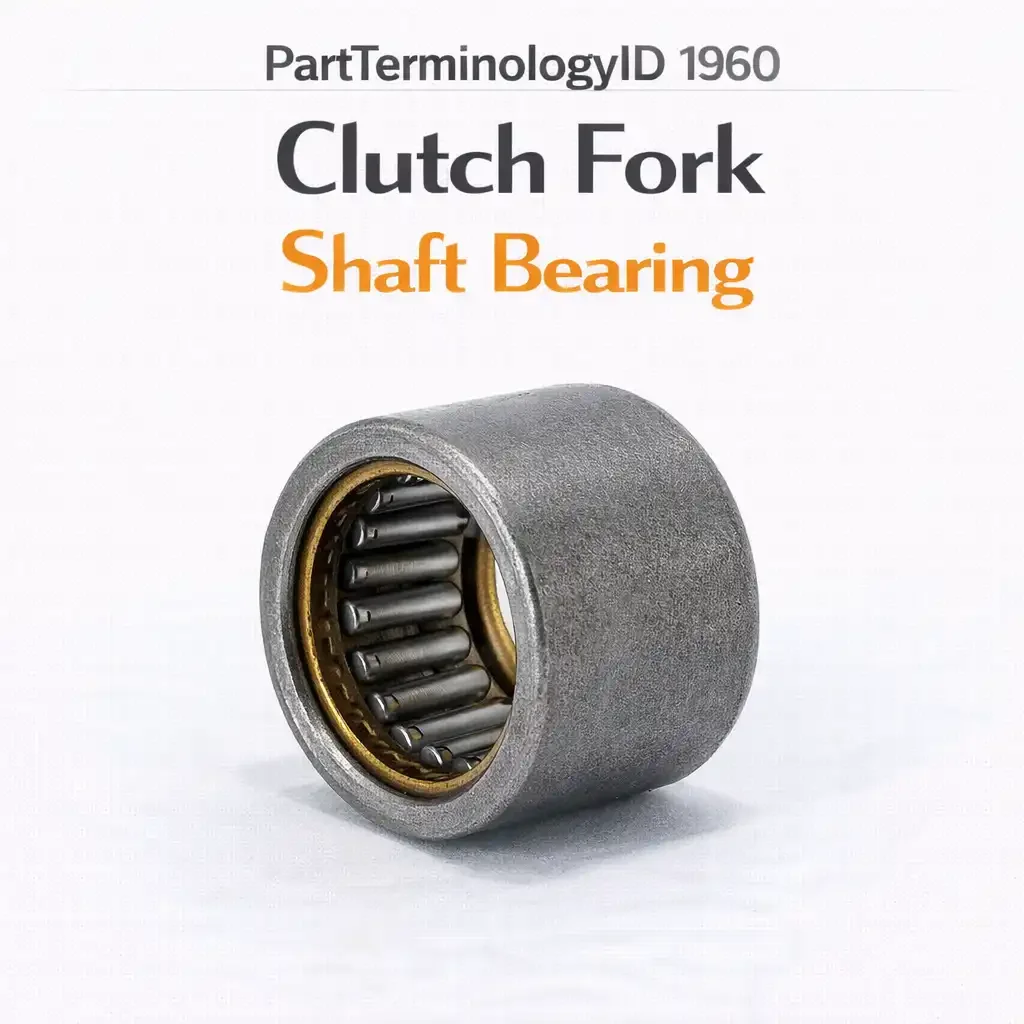
PartTerminologyID 1960, Clutch Fork Shaft Bearing, is the bushing or bearing that supports the clutch fork pivot shaft where it passes through the transmission bellhousing. The clutch fork is the lever that transfers pedal force (via the clutch cable or hydraulic slave cylinder) to the throwout bearing, which presses against the pressure plate diaphragm spring to disengage the clutch. The fork pivots on a shaft or ball stud, and this bearing (or bushing) is what allows that pivot motion to happen smoothly.
When the fork shaft bearing wears, the fork develops lateral play. The throwout bearing no longer contacts the pressure plate squarely. Clutch engagement becomes inconsistent, the pedal feel changes, and the driver may notice grinding, squealing, or a clutch that does not fully disengage even with the pedal to the floor. In severe cases, the fork can bind on a worn bearing and refuse to return, leaving the clutch partially disengaged and the transmission unable to fully engage gear.
It is a part that lives inside the bellhousing, is invisible from the outside, and is only accessible when the transmission is pulled. Nobody replaces it by itself. It is replaced as part of a clutch job, along with the disc, pressure plate, throwout bearing, pilot bearing, and fork. And that is precisely where the listing problem originates.
Why This Part Generates Returns
Buyers order the wrong clutch fork shaft bearing because:
they do not know whether their vehicle uses a bushing (a plain bearing, typically bronze or nylon) or a needle bearing (a rolling element bearing with a cage and needles) at the fork pivot
they do not verify the shaft diameter that the bearing supports (which varies by transmission type and bellhousing design)
they do not verify whether their fork pivots on a shaft that passes through the bellhousing or on a ball stud pressed into the bellhousing (ball stud designs have no shaft bearing, and ordering one for a ball stud application is a guaranteed return)
they confuse this bearing with the clutch pilot bearing (which sits in the end of the crankshaft and supports the transmission input shaft) or the throwout bearing (which rides on the fork and presses against the pressure plate)
they order based on vehicle year/make/model without specifying the transmission code (the same vehicle may have been offered with multiple manual transmissions that use different fork pivot designs)
they assume the bearing is included in a clutch kit and discover it is not
Sellers get caught because clutch fork shaft bearings are a low-visibility part. They are rarely the primary search item. The buyer is usually ordering a clutch kit, adds a fork, adds a throwout bearing, and then realizes they need the fork pivot bearing. The listing for the bearing often has minimal detail because it is treated as a minor accessory rather than a fitment-critical component.
Status in New Databases
PIES/PCdb: PartTerminologyID 1960, Clutch Fork Shaft Bearing
PIES 8.0 / PCdb 2.0: No change
What This Part Actually Is
Bushing type
A plain cylindrical bushing, typically bronze, brass, nylon, or Teflon-lined steel, pressed into the bellhousing bore where the fork shaft passes through. The shaft rotates inside the bushing. This is the simpler and more common design on older vehicles and many domestic transmissions.
The bushing O.D. must match the bellhousing bore. The bushing I.D. must match the fork shaft diameter. The bushing length must match the bellhousing wall thickness at the pivot location.
Needle bearing type
A caged needle roller bearing pressed into the bellhousing bore. The shaft rotates on the needle rollers, providing lower friction and longer life than a plain bushing. This design is common on many Japanese and European transmissions and some later domestic applications.
The needle bearing has the same three critical dimensions: O.D. (housing bore fit), I.D. (shaft diameter), and width. Additionally, the bearing must have the correct needle count and cage type to handle the loads and oscillating motion of the clutch fork.
Ball stud pivot (no shaft bearing)
Some clutch fork designs do not use a shaft at all. The fork pivots on a ball stud pressed into the bellhousing. The fork has a socket that fits over the ball, and the fork rocks on the ball stud like a lever on a fulcrum. Vehicles with ball stud pivots have no clutch fork shaft bearing. There is no shaft, no bushing, and no needle bearing at the pivot.
If a seller lists a fork shaft bearing for a vehicle that uses a ball stud pivot, every order is a return. The catalog must differentiate between shaft-pivot and ball-stud-pivot fork designs, and PartTerminologyID 1960 applies only to shaft-pivot designs.
The Transmission Code Problem
The clutch fork pivot design is determined by the transmission, not just the vehicle. A 1990s pickup truck may have been available with a Borg-Warner T5, a Tremec 3550, or a New Venture NV3500 manual transmission depending on the engine, model year, and option package. Each transmission uses a different bellhousing, a different fork, and a different pivot mechanism. One may use a shaft with a bronze bushing. Another may use a ball stud. A third may use a shaft with a needle bearing.
A listing for "clutch fork shaft bearing, 1994 to 2004 [truck]" without specifying the transmission code will cross-match parts across two or three incompatible pivot designs. The transmission code is a required attribute.
Top Return Scenarios
Scenario 1: "My fork uses a ball stud, there is no shaft bearing"
Vehicle has a ball stud pivot design. No shaft bearing exists.
Prevention language: "For vehicles with shaft-pivot clutch fork design. Not for vehicles with ball stud fork pivot. Verify your clutch fork pivot type. If your fork rocks on a ball pressed into the bellhousing, your vehicle uses a ball stud and does not require this bearing."
Scenario 2: "Wrong shaft diameter"
Bearing I.D. does not match the fork shaft O.D.
Prevention language: "Shaft diameter (bearing I.D.): [X mm / X inches]. Housing bore (bearing O.D.): [X mm / X inches]. Verify dimensions match your bellhousing and fork shaft."
Scenario 3: "I got a bushing but my transmission uses a needle bearing"
Bearing type mismatch.
Prevention language: "Bearing type: [bronze bushing / needle roller bearing / nylon bushing]. Verify your bellhousing uses a [bushing / needle bearing] at the fork pivot."
Scenario 4: "Wrong transmission"
Bearing does not match the bellhousing bore because the buyer has a different transmission than the listing covers.
Prevention language: "For vehicles equipped with [transmission code: T5 / NV3500 / TR-3650 / etc.]. Verify your transmission type. Multiple manual transmissions may have been available for your vehicle."
Scenario 5: "I thought this was included in my clutch kit"
Buyer expected the fork shaft bearing to be in the clutch kit box.
Prevention language: "The clutch fork shaft bearing is typically not included in clutch disc/pressure plate kits. Order separately when performing a complete clutch replacement."
What to Include in the Listing
Core essentials
PartTerminologyID: 1960
component: Clutch Fork Shaft Bearing
bearing type: plain bushing (bronze, nylon, Teflon-lined) or needle roller bearing
pivot type applicability: shaft-pivot only (not ball stud)
quantity: 1
Fitment essentials
year/make/model/submodel
transmission code (mandatory)
engine type (if transmission availability varies by engine)
fork pivot design: shaft (applicable) or ball stud (not applicable)
Dimensional essentials
bearing I.D. (shaft diameter)
bearing O.D. (housing bore diameter)
bearing width/length
material (bronze, nylon, steel cage with needle rollers)
Image essentials
bearing or bushing showing I.D. and O.D.
dimensional callouts
installed context showing position in bellhousing relative to fork shaft
comparison to pilot bearing and throwout bearing (to clarify which part this is)
Catalog Checklist for ACES/PIES Teams
PartTerminologyID = 1960
require transmission code attribute (mandatory)
require bearing type attribute (bushing or needle bearing)
require bearing I.D., O.D., and width
require fork pivot type attribute (shaft or ball stud, to flag non-applicable vehicles)
differentiate from clutch pilot bearing (crankshaft location), throwout bearing (fork-mounted), and fork ball stud
flag vehicles where multiple transmissions were available with different pivot designs
flag ball stud applications where no PartTerminologyID 1960 part exists
FAQ (Buyer Language)
Is this the same as a pilot bearing?
No. The pilot bearing (or pilot bushing) sits in the end of the crankshaft and supports the tip of the transmission input shaft. The clutch fork shaft bearing sits in the bellhousing and supports the fork pivot shaft. They are different parts in different locations.
Is this the same as a throwout bearing?
No. The throwout bearing (release bearing) rides on the fork and presses against the pressure plate diaphragm spring. The fork shaft bearing supports the shaft that the fork pivots on. They are different components.
When should I replace this bearing?
Every time the transmission is removed for clutch service. The bearing is only accessible with the transmission out, and the cost of the bearing itself is negligible. Replacing it during every clutch job is cheap insurance against a worn pivot that causes poor clutch engagement on the next clutch set.
Does my clutch kit include this bearing?
Most clutch kits include the clutch disc, pressure plate, throwout bearing, and sometimes the pilot bearing. The fork shaft bearing is almost never included. Order it separately.
Cross-Sell Logic
Clutch Fork
Clutch Throwout Bearing (Release Bearing)
Clutch Pilot Bearing / Bushing
Clutch Disc and Pressure Plate Kit
Fork Shaft Seal (if the bellhousing has a seal at the shaft exit)
Bellhousing Dowel Pins
Frame as "replace with every clutch job. Accessible only with the transmission removed."
Final Take for PartTerminologyID 1960
Clutch Fork Shaft Bearing (PartTerminologyID 1960) is a part that nobody orders alone but everybody needs when the transmission is out. The listing traps are the ball stud knockout (no bearing exists for ball stud pivot forks), the transmission code requirement (same vehicle, different transmissions, different pivot designs), and the bushing vs. needle bearing type split.
State the transmission code. State the bearing type. State the dimensions. Confirm that the vehicle uses a shaft-pivot fork, not a ball stud. Those four details prevent the buyer from ordering a bearing for a pivot that does not exist, a bushing for a bore that takes a needle bearing, or a bearing sized for a transmission their vehicle does not have.