
Written by Arthur Simitian | PartsAdvisory
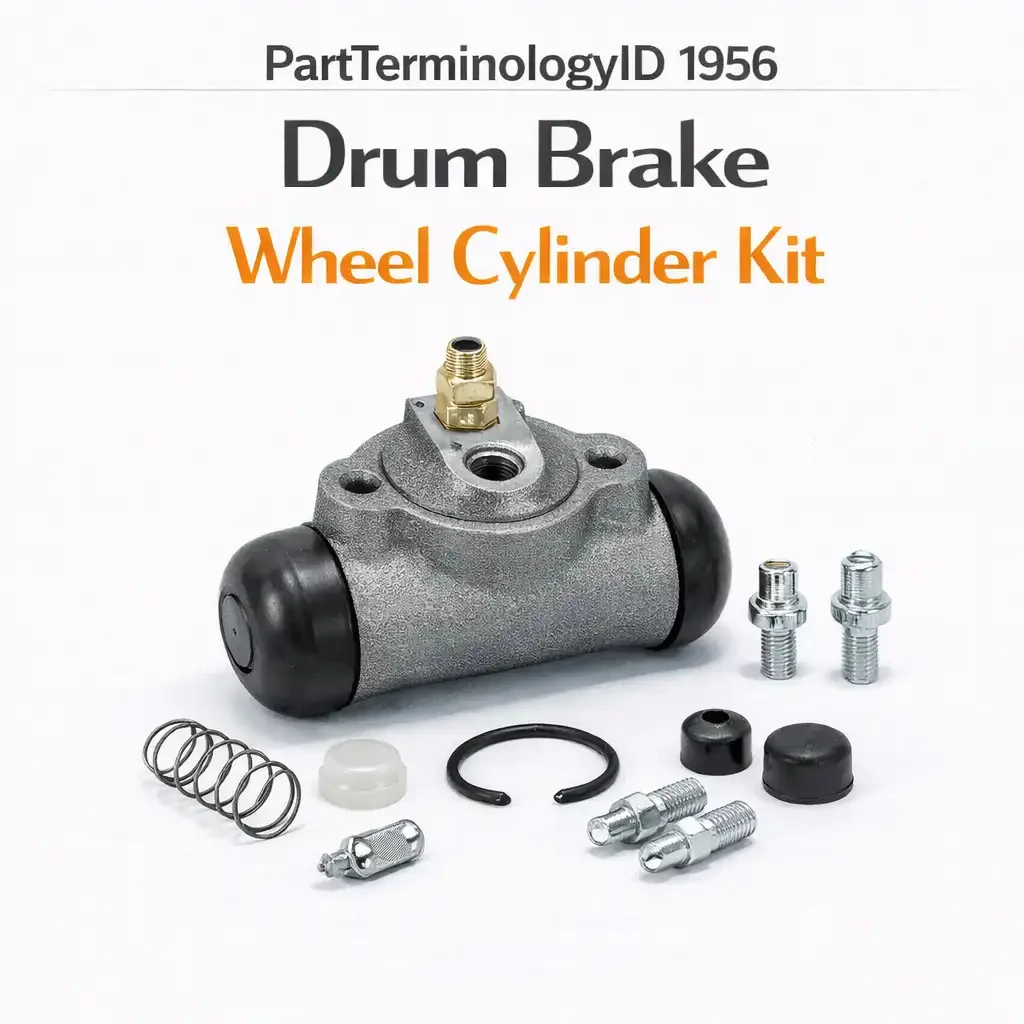
PartTerminologyID 1956, Drum Brake Wheel Cylinder Kit, is a seal and piston rebuild package for the drum brake wheel cylinder (PartTerminologyID 1952). It contains the internal wear items needed to restore a leaking wheel cylinder to serviceable condition without replacing the entire unit. The kit typically includes the piston cup seals, piston springs, and dust boots. Some kits also include the pistons themselves.
The logic behind this part is the same as the brake master cylinder repair kit (PartTerminologyID 1840): if the cylinder bore is smooth and undamaged, new seals will restore a leak-free seal and the cylinder can continue in service. The cost of the kit is a fraction of a new wheel cylinder.
The practical reality is different. A new wheel cylinder for most passenger vehicles costs $8 to $25. A rebuild kit costs $4 to $12. The labor to disassemble the wheel cylinder, clean the bore, inspect it for scoring, install new seals without nicking them, reassemble, and bleed the system is the same regardless of whether you are rebuilding the old cylinder or bolting on a new one. Most professional technicians install a new cylinder every time because the price difference does not justify the risk of a bore that looks clean but has microscopic pitting that causes the new seals to leak within months.
The wheel cylinder rebuild kit market still exists, and for good reason. It serves fleet shops rebuilding high volumes of cylinders on a bench. It serves the classic car and vintage vehicle market where OE-style wheel cylinders may be discontinued or unavailable. It serves the heavy-duty and commercial market where wheel cylinders are large, expensive, and worth rebuilding. And it serves the DIY buyer who wants to save every dollar and is willing to do the work.
For sellers, the return problem is identical to the master cylinder repair kit: bore diameter. The seals in the kit are manufactured to a specific bore tolerance, and if the bore does not match, the seals do not seal.
Why This Part Generates Returns
Buyers order the wrong wheel cylinder kit because:
they do not know the bore diameter of their wheel cylinder (see PartTerminologyID 1952 for all the variables that affect bore size: vehicle weight class, proportioning valve presence, power vs. manual brakes)
they assume all wheel cylinders for their vehicle have the same bore, when the bore may differ between submodels, GVWR ratings, or brake configurations
they confuse this kit with a drum brake hardware kit (PartTerminologyID 1772), which covers the external springs and hold down hardware, not the internal wheel cylinder seals
they expect the kit to include pistons when it only includes seals, or vice versa
they order the kit and discover during disassembly that the bore is scored, pitted, or corroded beyond what new seals can fix, making the kit useless and a new cylinder necessary
they do not verify whether the kit fits a single-piston or dual-piston cylinder (the seal count and spring configuration differ)
they miss left vs. right differences on vehicles where the left and right wheel cylinders have different bore sizes (uncommon, but it exists on some asymmetric brake systems)
Sellers get caught because the listing says "wheel cylinder kit" with a vehicle fitment and does not specify the bore diameter. The buyer orders, receives seals sized for a 3/4" bore, and discovers their cylinder has a 7/8" bore. The seals are too small. The kit goes back.
Status in New Databases
PIES/PCdb: PartTerminologyID 1956, Drum Brake Wheel Cylinder Kit
PIES 8.0 / PCdb 2.0: No change
What This Kit Contains
A standard drum brake wheel cylinder rebuild kit includes:
Piston cup seals: The rubber or elastomer cups that ride on the pistons and seal against the bore wall. These are the primary wear items. When they harden, crack, or lose elasticity, brake fluid leaks past them. On a dual-piston cylinder, the kit includes four cups (two per piston, one pressure cup and one secondary cup for each piston, or one cup per piston depending on the design).
Piston return spring: The spring between the two pistons (on dual-piston cylinders) that holds them apart and maintains light contact with the brake shoe webs when the brakes are released.
Dust boots: The rubber caps that seal each end of the cylinder bore, keeping dirt and water out and brake fluid in. Cracked or missing boots allow contamination that accelerates bore corrosion.
Pistons (in some kits): Higher-end kits include the aluminum or steel pistons. Budget kits include seals only, with the expectation that the original pistons will be reused if they are not scored or corroded.
What the kit does NOT include
the wheel cylinder body (housing)
the bleeder screw
the brake line port fitting
the mounting hardware
the brake shoes or drum brake springs
What the kit assumes
The bore is in rebuildable condition. If the bore has visible scoring (grooves you can feel with a fingernail), pitting (small craters from corrosion), or rust that does not clean up with light honing, new seals will not hold. The cylinder must be replaced with a new unit (PartTerminologyID 1952).
This assumption is the biggest return risk for the kit. A meaningful percentage of buyers who order a rebuild kit discover during disassembly that their bore is not rebuildable. They now need a new cylinder, and the rebuild kit goes back as an unwanted return.
Bore Diameter: The Same Problem as the Complete Cylinder
Every fitment variable that creates bore diameter splits on the complete wheel cylinder (PartTerminologyID 1952) applies identically to the rebuild kit. A 3/4" seal set will not seal a 7/8" bore. A 19mm seal will not seal a 20.64mm bore.
The bore diameter splits by vehicle weight class, brake system configuration (proportioning valve presence, ABS vs. non-ABS), and power vs. manual brake assist. The listing must specify the bore diameter the kit is designed for, and ideally cross-reference to the wheel cylinder part numbers the kit is compatible with.
Top Return Scenarios
Scenario 1: "Seals don't fit my bore"
Bore diameter mismatch.
Prevention language: "Designed for wheel cylinders with [X inch / X mm] bore diameter. Verify bore size by measuring your wheel cylinder bore or cross-referencing your wheel cylinder part number: [list compatible part numbers]."
Scenario 2: "My bore is scored, the kit is useless"
Buyer disassembled the cylinder and found an unrebuildable bore.
Prevention language: "This kit requires a wheel cylinder bore in serviceable condition (no scoring, pitting, or corrosion that cannot be removed with light honing). If the bore is damaged, replace the wheel cylinder. See PartTerminologyID 1952."
Scenario 3: "Kit doesn't include pistons"
Buyer expected a complete rebuild kit and received seals only.
Prevention language: "Kit includes: [itemized list]. This kit [includes / does not include] replacement pistons. If pistons are not included, original pistons must be undamaged for reuse."
Scenario 4: "I thought this was a drum brake hardware kit"
Buyer confused internal wheel cylinder seals with external drum brake springs and hardware.
Prevention language: "This is an internal rebuild kit for the wheel cylinder (seals, springs, boots). It is not a drum brake hardware kit (external springs and hold down hardware). For drum brake hardware, see PartTerminologyID 1772."
Scenario 5: "Kit is for a dual-piston cylinder, mine is single-piston"
Seal count and spring configuration do not match.
Prevention language: "For [single-piston / dual-piston] wheel cylinders. Verify your wheel cylinder's piston configuration."
What to Include in the Listing
Core essentials
PartTerminologyID: 1956
component: Drum Brake Wheel Cylinder Kit
complete kit contents list (every seal, spring, boot, piston itemized)
pistons included: yes/no
compatible wheel cylinder part numbers (OE and aftermarket cross-reference)
quantity: 1 kit (per cylinder)
Fitment essentials
year/make/model/submodel
position: front or rear, left or right (if bore size or cylinder type varies by side)
drum diameter and shoe width
GVWR or weight class (if bore size varies)
piston configuration: single or dual piston
Dimensional essentials
bore diameter (mandatory, primary attribute)
piston cup seal O.D.
dust boot I.D. and O.D.
spring free length
Image essentials
all kit contents laid out and labeled
seal diameter callout
comparison to wheel cylinder bore showing where each component installs
bore diameter reference
Catalog Checklist for ACES/PIES Teams
PartTerminologyID = 1956
require bore diameter attribute (mandatory, non-negotiable)
require piston configuration (single/dual)
require kit contents as structured attribute
require pistons-included attribute (yes/no)
require compatible wheel cylinder part number cross-reference
require position (front/rear, left/right where applicable)
differentiate from drum brake hardware kit (PartTerminologyID 1772) and master cylinder repair kit (PartTerminologyID 1840)
flag applications where multiple bore sizes exist for the same year/make/model
FAQ (Buyer Language)
Is it better to rebuild the wheel cylinder or replace it?
For most passenger vehicle applications, replacing is more practical. New wheel cylinders are inexpensive ($8 to $25), and the labor is the same either way. Rebuilding makes sense when the cylinder is expensive (heavy-duty or commercial), discontinued (classic vehicles), or when you are rebuilding multiple cylinders on a bench (fleet operations).
How do I know if my bore is rebuildable?
After removing the pistons and seals, inspect the bore with a flashlight. If you can see or feel grooves (scoring), small pits, or rust that does not wipe clean with a lint-free cloth, the bore is not rebuildable. A light haze or staining that cleans up with fine honing is acceptable. When in doubt, replace the cylinder.
Does this kit fit both sides?
One kit rebuilds one wheel cylinder. If you are rebuilding both sides, order two kits. Verify that both sides use the same bore diameter. On most vehicles they do, but check before assuming.
Can I use this kit on a leaking wheel cylinder without removing it from the vehicle?
Technically the cylinder can be rebuilt in place on some vehicles, but it is much easier and cleaner to remove it from the backing plate, rebuild it on a bench, and reinstall it. The bore must be inspected and possibly honed, which is difficult to do with the cylinder mounted.
Cross-Sell Logic
Drum Brake Wheel Cylinder (PartTerminologyID 1952, for buyers whose bore is not rebuildable)
Drum Brake Shoe Set (if fluid contamination has ruined the shoes)
Drum Brake Hardware Kit (PartTerminologyID 1772)
Brake Fluid (correct DOT specification)
Brake Bleeder Kit
Cylinder Hone (for light bore conditioning before seal installation)
Frame as "rebuild or replace: order the kit if you plan to rebuild, but have a new wheel cylinder available in case the bore is not serviceable."
Final Take for PartTerminologyID 1956
Drum Brake Wheel Cylinder Kit (PartTerminologyID 1956) shares the same single-attribute fitment problem as the master cylinder repair kit (PartTerminologyID 1840): bore diameter. The seals in the bag are cut to one bore size. If the bore does not match, every seal in the bag is wrong. And if the bore is damaged, no seal in any bag will fix it.
State the bore diameter. State what is in the kit. State which wheel cylinder part numbers the kit fits. Warn the buyer that the bore must be serviceable. Those four elements prevent the buyer from ordering seals that do not fit their bore, expecting pistons that are not included, or rebuilding a cylinder that should have been replaced.