
Drum Brake Wheel Cylinder (PartTerminologyID 1952): The Hydraulic Actuator That Leaks Quietly Until the Shoes Are Soaked
Written by Arthur Simitian | PartsAdvisory
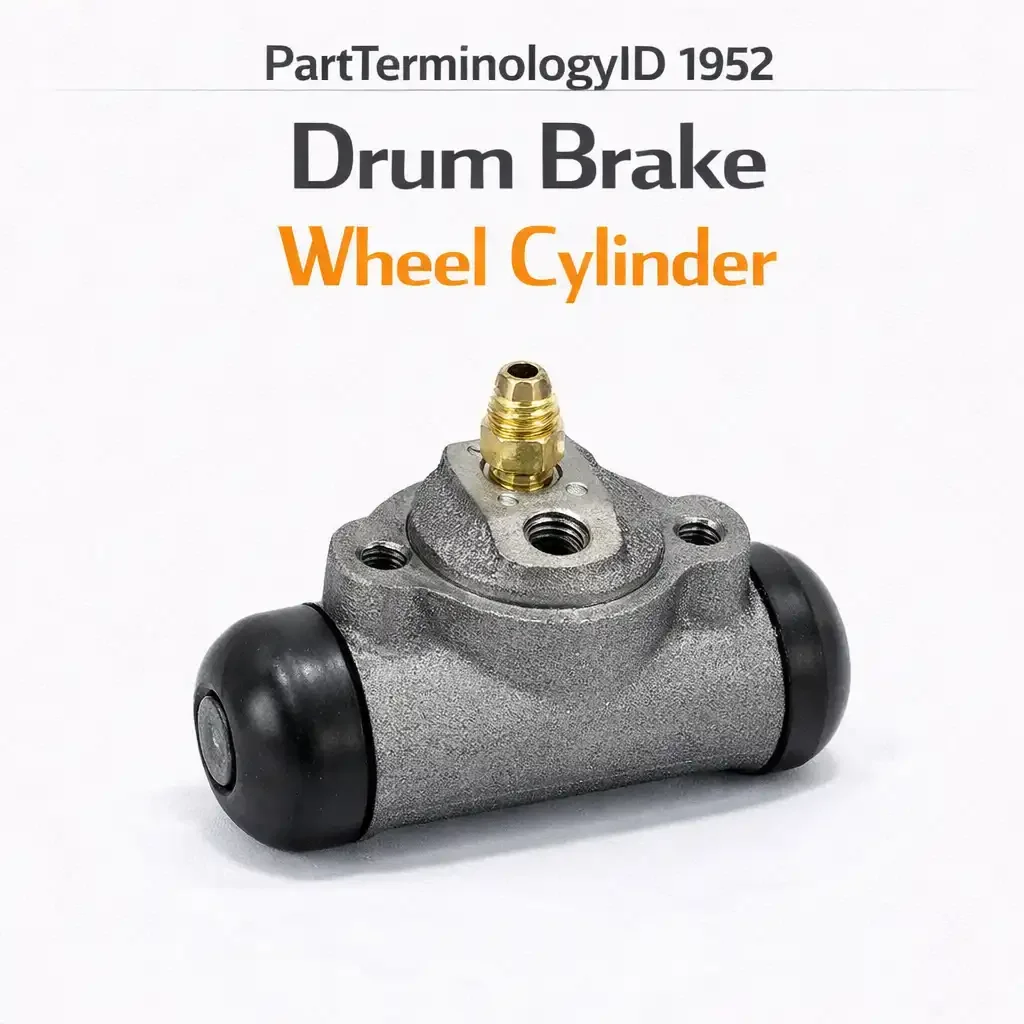
PartTerminologyID 1952, Drum Brake Wheel Cylinder, is the hydraulic actuator inside the drum brake assembly that converts brake line pressure into mechanical force to push the brake shoes outward against the drum. It is a small cylinder with one or two pistons, mounted to the backing plate at the top of the drum brake assembly (opposite the anchor pin). When the driver presses the brake pedal, pressurized brake fluid enters the wheel cylinder, pushes the pistons outward, and the pistons push the tops of the brake shoes apart and into contact with the drum.
When the wheel cylinder fails, it leaks. Brake fluid seeps past the internal piston seals, drips onto the brake shoes, saturates the friction material, and the brake on that wheel loses effectiveness. The leak may be slow enough that the driver does not notice the brake fluid level dropping in the reservoir for weeks. By the time the brake warning light comes on or the driver feels the vehicle pulling to one side under braking, the shoes are contaminated and must be replaced along with the cylinder.
For sellers, the wheel cylinder is a straightforward replacement part with one deceptive fitment trap: bore diameter. Two wheel cylinders that look identical externally (same body length, same mounting bolt spacing, same line port location) can have different bore diameters, and the bore determines how much force the cylinder applies to the shoes and how much fluid it displaces per stroke.
Why This Part Generates Returns
Buyers order the wrong wheel cylinder because:
they do not verify bore diameter (which varies by vehicle weight, brake shoe width, and whether the vehicle has a proportioning valve or load-sensing valve that changes rear brake pressure)
they do not verify whether their vehicle uses a single-piston or dual-piston wheel cylinder (single-piston cylinders push one shoe, dual-piston cylinders push both shoes simultaneously)
they do not verify the brake line port location and thread size (port on the back, port on top, port on the side, each with application-specific thread sizes)
they do not verify the mounting bolt spacing (which must match the backing plate holes)
they miss left vs. right on vehicles where the line port location or bleeder screw position is mirrored
they do not verify drum diameter and shoe width (larger drums often pair with larger wheel cylinders)
they confuse the wheel cylinder with the master cylinder (PartTerminologyID 1836), which is a different component at a different location
Sellers get caught because wheel cylinder listings typically show a vehicle fitment and a photo of a small cylinder. The bore diameter, piston count, port location, and mounting dimensions are omitted. The buyer orders based on vehicle match, and the cylinder arrives with the wrong bore or the brake line port on the wrong side.
Status in New Databases
PIES/PCdb: PartTerminologyID 1952, Drum Brake Wheel Cylinder
PIES 8.0 / PCdb 2.0: No change
Bore Diameter: The Hidden Split
The wheel cylinder bore diameter is the internal diameter of the cylinder in which the piston travels. A larger bore moves more fluid and generates more force per unit of line pressure. A smaller bore generates less force but requires less fluid displacement from the master cylinder.
Vehicle manufacturers match the wheel cylinder bore to the rest of the brake system: master cylinder bore, caliper piston area (on vehicles with front disc/rear drum), brake line pressure, and the presence or absence of a proportioning valve.
Common bore diameter splits
Vehicle weight or GVWR: Heavier versions of the same vehicle (higher payload rating, dual rear wheels, extended cab with longer bed) may use a larger wheel cylinder bore to generate more rear brake force. A 1/2-ton truck and a 3/4-ton truck may share the same drum size but use different bore diameter wheel cylinders.
Brake system configuration: Vehicles with a proportioning valve that limits rear pressure may use a larger rear wheel cylinder bore to compensate (more force per unit of reduced pressure). Vehicles without a proportioning valve (or with ABS handling rear proportioning electronically) may use a smaller bore.
Manual vs. power brakes: Some older vehicles that were available with or without power brake assist use different wheel cylinder bores. The power brake version may use a smaller bore (because the booster multiplies pedal force, delivering higher line pressure). The manual brake version may use a larger bore to compensate for lower line pressure.
A bore diameter difference of 1/16" (approximately 1.6mm) is enough to change the brake balance between front and rear. Too large a rear wheel cylinder bore will cause the rear brakes to do too much work, potentially locking the rear wheels before the fronts. Too small a bore will cause the rear brakes to be lazy, putting excessive load on the fronts and increasing stopping distance.
Single-Piston vs. Dual-Piston
Dual-piston (most common)
The standard wheel cylinder has two pistons, one at each end, with a common fluid inlet between them. When pressure enters, both pistons push outward simultaneously, spreading both brake shoes against the drum. This is the most common design on passenger vehicles and light trucks.
Single-piston
Some drum brake designs use a single-piston wheel cylinder that pushes only one shoe. The other shoe is anchored or actuated by a different mechanism (a second single-piston cylinder, or a mechanical linkage from the parking brake). This configuration is less common but appears on some older vehicles and certain heavy-duty applications.
A dual-piston cylinder will not fit in a single-piston application (different body length, different mounting, different line port position), and a single-piston cylinder cannot replace a dual-piston unit.
Top Return Scenarios
Scenario 1: "Bore is the wrong size"
Bore diameter does not match the vehicle's brake system calibration.
Prevention language: "Bore diameter: [X inches / X mm]. Verify bore size matches your original wheel cylinder. Bore diameter varies by vehicle weight rating and brake system configuration."
Scenario 2: "Line port is on the wrong side"
Brake line port location (left, right, top, rear) does not match the backing plate line routing.
Prevention language: "Brake line port: [location: top / rear / left side / right side]. Thread size: [X]. Position: [left wheel / right wheel]. Verify port location and thread size match your backing plate and brake line routing."
Scenario 3: "Mounting bolts don't line up"
Bolt spacing does not match the backing plate holes.
Prevention language: "Mounting bolt spacing: [X inches / X mm center to center]. Verify bolt spacing matches your backing plate."
Scenario 4: "I have front drums but this is for the rear"
Front and rear wheel cylinders differ in bore size, body length, and port location on vehicles with four-wheel drum brakes.
Prevention language: "Position: [front / rear]. Front and rear wheel cylinders are not interchangeable. Verify axle position."
Scenario 5: "Cylinder is dual-piston but I need a single-piston"
Piston count mismatch.
Prevention language: "Piston configuration: [single-piston / dual-piston]. Verify your drum brake design uses a [single / dual] piston wheel cylinder."
What to Include in the Listing
Core essentials
PartTerminologyID: 1952
component: Drum Brake Wheel Cylinder
piston configuration: single or dual piston
condition: new or remanufactured
quantity: 1
Fitment essentials
year/make/model/submodel
position: front or rear, left or right (if side-specific)
drum diameter and shoe width
GVWR or vehicle weight class (if bore size varies)
ABS vs. non-ABS (if wheel cylinder specification differs)
brake system type (power or manual, if bore varies)
Dimensional essentials
bore diameter (primary fitment attribute)
body length
mounting bolt spacing
brake line port location (top, rear, side)
brake line port thread size
bleeder screw location and thread size
Image essentials
cylinder body showing both piston ends (for dual-piston) or single piston end
brake line port and bleeder screw location visible
mounting bolt holes with spacing callout
bore diameter callout
Catalog Checklist for ACES/PIES Teams
PartTerminologyID = 1952
require bore diameter attribute (mandatory, non-negotiable)
require piston configuration (single or dual)
require position (front/rear, left/right)
require mounting bolt spacing
require brake line port location and thread size
require drum diameter and shoe width qualifiers
flag vehicles where bore diameter varies by GVWR, brake system type, or proportioning configuration
differentiate from master cylinder (PartTerminologyID 1836) and caliper (disc brake applications)
flag ABS/non-ABS split where applicable
FAQ (Buyer Language)
How do I know my wheel cylinder bore size?
Measure the bore of your existing cylinder with a caliper after removing the pistons, or look up the OE part number and cross-reference it to the bore specification. Do not assume based on vehicle model alone, because bore size can vary by weight rating and brake configuration within the same model.
Should I replace both wheel cylinders at the same time?
It is recommended. If one wheel cylinder has failed, the other is the same age and has the same internal seal condition. Replacing both sides ensures even braking force at the rear. At minimum, inspect the opposite side carefully for any signs of seepage.
Do I need to replace the brake shoes if the wheel cylinder leaked?
Yes. If brake fluid has contacted the friction material, the shoes are contaminated and will not generate consistent friction. They must be replaced. Attempting to clean fluid-soaked shoes with brake cleaner is not a reliable repair.
Is there a bleeder screw on the wheel cylinder?
Most wheel cylinders have a bleeder screw for purging air after installation. The bleeder screw must be at the highest point of the cylinder when installed. If the bleeder is at the bottom, air will be trapped inside the cylinder and cannot be bled out, resulting in a spongy pedal.
Can I rebuild the wheel cylinder instead of replacing it?
Wheel cylinder rebuild kits exist (new seals, pistons, and springs). However, if the bore is scored, pitted, or corroded, new seals will not hold. Given the low cost of a new wheel cylinder, most technicians replace rather than rebuild.
Cross-Sell Logic
Drum Brake Shoe Set (replace contaminated shoes)
Drum Brake Hardware Kit (PartTerminologyID 1772)
Brake Fluid (correct DOT specification)
Brake Bleeder Kit
Brake Hydraulic Line (PartTerminologyID 1820, if the line at the cylinder is corroded)
Wheel Cylinder Repair Kit (for buyers who prefer to rebuild)
Frame as "commonly replaced together: wheel cylinder, shoes, and hardware. If the cylinder leaked, the shoes are contaminated."
Final Take for PartTerminologyID 1952
Drum Brake Wheel Cylinder (PartTerminologyID 1952) is a part where bore diameter is the fitment attribute that matters most and is omitted most often. Two cylinders that look the same externally can have different bores that change the brake balance of the vehicle. The bore varies by weight rating, brake system configuration, and power/manual brake assist.
State the bore diameter. State the port location and thread. State the mounting bolt spacing. State the position. Those four attributes prevent the buyer from installing a cylinder that looks right, bolts on, and quietly pushes the wrong amount of force into the brake shoes.