
Written by Arthur Simitian | PartsAdvisory
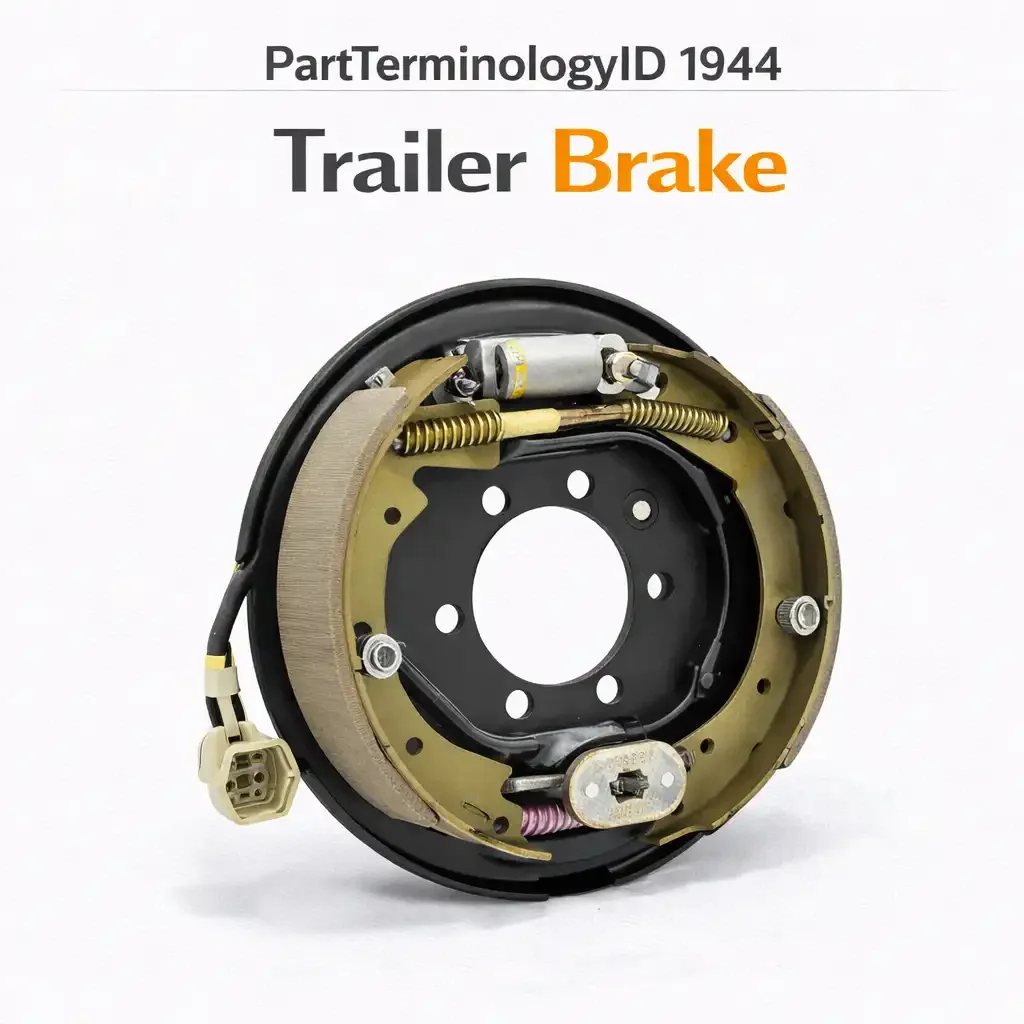
PartTerminologyID 1944, Trailer Brake, is the complete brake assembly designed for trailer axles. Unlike automotive brake parts that are cataloged by year/make/model of the vehicle, trailer brakes are cataloged by axle capacity, drum diameter, shoe width, backing plate bolt pattern, and whether the system is electric or hydraulic. Trailers do not have VINs that decode to a specific brake configuration the way cars and trucks do. A 2019 enclosed cargo trailer from one manufacturer may use a completely different axle and brake assembly than a 2019 enclosed cargo trailer from another manufacturer, even if both trailers have the same gross vehicle weight rating.
This is the fundamental catalog problem with PartTerminologyID 1944. There is no ACES fitment data for trailers. There is no year/make/model lookup that reliably identifies the brake assembly. The buyer must know their axle specifications, and the listing must publish the specifications clearly enough for the buyer to match them.
Electric vs. Hydraulic: The Primary Split
Electric trailer brakes
The most common type on towed trailers (utility, cargo, travel, horse, and flatbed trailers). An electromagnet built into the brake assembly is activated by the tow vehicle's brake controller through the trailer wiring harness. When the driver brakes the tow vehicle, the controller sends a proportional electrical signal to the trailer brake magnets. The magnets engage a rotating drum surface, and a cam or lever mechanism spreads the brake shoes against the drum.
Electric trailer brakes require a brake controller in the tow vehicle, a 7-pin (or equivalent) trailer wiring connector, and a 12V power supply. The magnet, wiring gauge, and shoe size are matched to the axle's rated capacity.
Hydraulic surge trailer brakes
Common on boat trailers, some car haulers, and trailers towed by vehicles without electric brake controllers. A surge actuator mounted at the trailer coupler uses the trailer's forward momentum during deceleration to compress a master cylinder, which sends hydraulic pressure to drum or disc brakes at the trailer wheels. No brake controller or electrical connection is needed beyond the standard lighting harness.
Hydraulic surge brakes use a different brake assembly than electric brakes. The backing plate, shoe configuration, and actuation mechanism are different. An electric brake assembly cannot be used on a surge brake system, and a surge brake assembly cannot be used on an electric system.
A listing that says "trailer brake" without specifying electric or hydraulic will cross-match two completely incompatible assemblies.
Free-backing electric brakes
A variant of electric trailer brakes designed to allow the trailer to roll backward freely without the brakes engaging. Standard electric trailer brakes can engage when the trailer is pushed backward (during reversing), making backing maneuvers difficult. Free-backing brakes use a modified cam mechanism that disengages when the drum rotates in reverse. This is common on horse trailers and car haulers where frequent backing is necessary.
Free-backing assemblies are not interchangeable with standard electric assemblies. The internal mechanism is different. The listing must specify standard or free-backing.
Why This Part Generates Returns
Buyers order the wrong trailer brake because:
they do not know whether their trailer uses electric or hydraulic brakes
they do not verify the drum diameter (10", 12", and 7" are common, and each uses a different assembly)
they do not verify the shoe width (2", 2-1/4", 3-3/8" are common sizes at each drum diameter)
they do not verify the backing plate bolt pattern (4-bolt, 5-bolt, with specific bolt circle dimensions)
they do not verify the axle capacity rating (the brake assembly is rated to match the axle: 2,000 lb, 3,500 lb, 5,200 lb, 6,000 lb, 7,000 lb, 8,000 lb, and higher)
they assume left and right are the same (trailer brake assemblies are side-specific, with mirrored shoe positioning and magnet/actuation orientation)
they do not verify whether their trailer uses self-adjusting or manually adjusting brakes
they confuse a complete brake assembly (PartTerminologyID 1944) with replacement brake shoes, magnets, or hardware kits (which are separate PartTerminologyIDs)
Sellers get caught because trailer brake listings often state a drum size and an axle rating without specifying the bolt pattern, shoe width, actuation type, or side. The buyer measures their drum, confirms the rating, orders, and the assembly arrives with the wrong bolt pattern, wrong shoe width, or wrong actuation method.
Status in New Databases
PIES/PCdb: PartTerminologyID 1944, Trailer Brake
PIES 8.0 / PCdb 2.0: No change
What This Part Actually Is
A trailer brake assembly (PartTerminologyID 1944) is the complete, ready-to-install unit. For electric brakes, it typically includes the backing plate, brake shoes (pre-installed), the electromagnet, the actuating arm or cam, return springs, hold down hardware, the self-adjuster mechanism (if equipped), and the wiring pigtail. For hydraulic surge brakes, it includes the backing plate, shoes, wheel cylinder, springs, and hardware.
The assembly bolts to the axle flange using the backing plate bolt pattern. The drum (sold separately on most trailer axles, as it is part of the hub assembly) fits over the shoes.
What is typically NOT included
the brake drum (usually part of the hub/drum assembly)
the hub and bearing assembly
the brake controller (tow vehicle component)
the surge actuator (coupler-mounted component)
the trailer wiring harness
The Axle Rating Matters for Safety Compliance
Trailer brake assemblies are rated to match specific axle capacities. A 3,500 lb rated brake assembly uses smaller shoes, a smaller magnet, and lighter-duty springs than a 7,000 lb rated assembly. Installing an undersized brake assembly on a higher-rated axle is a safety and liability issue: the brakes will not generate sufficient stopping force for the trailer's loaded weight.
Conversely, installing an oversized brake assembly on a smaller axle may not physically fit (the backing plate bolt pattern or drum diameter may not match) or may produce excessive braking force that locks the wheels prematurely.
The axle rating determines the drum size, shoe width, and magnet size. The listing must state the rated capacity, and the buyer must match it to their axle.
Top Return Scenarios
Scenario 1: "Bolt pattern doesn't match my axle flange"
Backing plate bolt pattern is incompatible with the axle mounting surface.
Prevention language: "Backing plate bolt pattern: [4-bolt / 5-bolt, X" bolt circle]. Verify your axle flange bolt pattern before ordering."
Scenario 2: "I have surge brakes, this is electric"
Actuation type mismatch.
Prevention language: "Electric brake assembly. Requires tow vehicle brake controller and 12V wiring. Not for hydraulic surge brake systems. Verify your trailer's brake actuation type."
Scenario 3: "Wrong side"
Assembly is for the opposite side of the trailer.
Prevention language: "Position: [left (driver side) / right (passenger side)]. Trailer brake assemblies are side-specific. Verify which side you are replacing."
Scenario 4: "Shoes are too narrow for my drum"
Shoe width does not match drum width.
Prevention language: "Drum diameter: [X"]. Shoe width: [X"]. Axle rating: [X,XXX lbs]. Verify all three dimensions match your axle and drum specifications."
Scenario 5: "Brakes engage when I back up"
Buyer needed free-backing brakes and received standard electric brakes.
Prevention language: "[Standard / free-backing] electric brake assembly. Standard brakes may engage during reverse. Free-backing brakes disengage automatically in reverse for easier backing maneuvers."
What to Include in the Listing
Core essentials
PartTerminologyID: 1944
component: Trailer Brake (complete assembly)
actuation type: electric, hydraulic surge, or free-backing electric
what is included: backing plate, shoes, magnet/wheel cylinder, springs, hardware, wiring pigtail
what is NOT included: drum, hub, controller, actuator
quantity: 1 (per side)
Fitment essentials
axle capacity rating (lbs)
drum diameter
shoe width
backing plate bolt pattern (bolt count and bolt circle diameter)
position: left or right
self-adjusting: yes/no
Electrical essentials (electric brakes)
magnet rating (amperage draw)
wiring pigtail length and connector type
compatible brake controller type (proportional, time-delay)
Image essentials
complete assembly from the front showing shoes, magnet/wheel cylinder, and springs
backing plate from the rear showing bolt pattern with bolt circle callout
wiring pigtail detail showing connector
drum diameter and shoe width callouts
Catalog Checklist for ACES/PIES Teams
PartTerminologyID = 1944
require actuation type (electric, hydraulic surge, free-backing)
require axle capacity rating
require drum diameter and shoe width
require backing plate bolt pattern
require position (left/right)
require self-adjusting attribute
differentiate from trailer brake shoes, trailer brake magnets, and trailer brake hardware kits (separate replacement components)
note that ACES year/make/model fitment does not apply to trailers; fitment is by axle specification
FAQ (Buyer Language)
How do I know what size brake my trailer has?
Measure the existing brake drum inner diameter (10", 12", or 7" are most common). Measure the shoe width. Check the axle rating on the axle tag or in the trailer's documentation. Count the backing plate bolts and measure the bolt circle. These four measurements identify your brake assembly.
Can I upgrade from 10" to 12" brakes?
Only if your axle, hub, and drum are rated and sized for 12" brakes. The drum must fit inside the wheel, and the backing plate bolt pattern must match the axle. A brake upgrade typically requires replacing the hub/drum assembly as well.
Do I need a brake controller for electric trailer brakes?
Yes. Electric trailer brakes require a brake controller installed in the tow vehicle. The controller sends a proportional electrical signal to the trailer brakes when the tow vehicle brakes. Without a controller, the trailer brakes will not activate.
Should I replace both sides at the same time?
Yes. Replacing one side and not the other will produce uneven braking, potentially causing the trailer to pull or jackknife under hard braking. Always replace trailer brakes in axle pairs.
Cross-Sell Logic
Trailer Brake Drum / Hub Assembly
Trailer Brake Magnet (replacement magnet for electric brakes)
Trailer Brake Shoe Set (replacement shoes)
Trailer Brake Hardware Kit
Brake Controller (tow vehicle)
Trailer Wiring Harness / 7-Pin Connector
Bearing Kit and Grease
Frame as "complete trailer brake service: assemblies, drums, bearings, and controller."
Final Take for PartTerminologyID 1944
Trailer Brake (PartTerminologyID 1944) is a part that exists outside the ACES year/make/model framework. There is no VIN decode for a trailer axle. The buyer must match the part by specification, and the listing must publish those specifications prominently: actuation type, axle rating, drum diameter, shoe width, bolt pattern, and side.
Miss any one of those and the assembly does not fit the axle, does not fit the drum, does not match the braking system, or installs on the wrong side. Publish all of them and the buyer can match with confidence, because unlike automotive brakes, there is no other way to look it up.