
Written by Arthur Simitian | PartsAdvisory
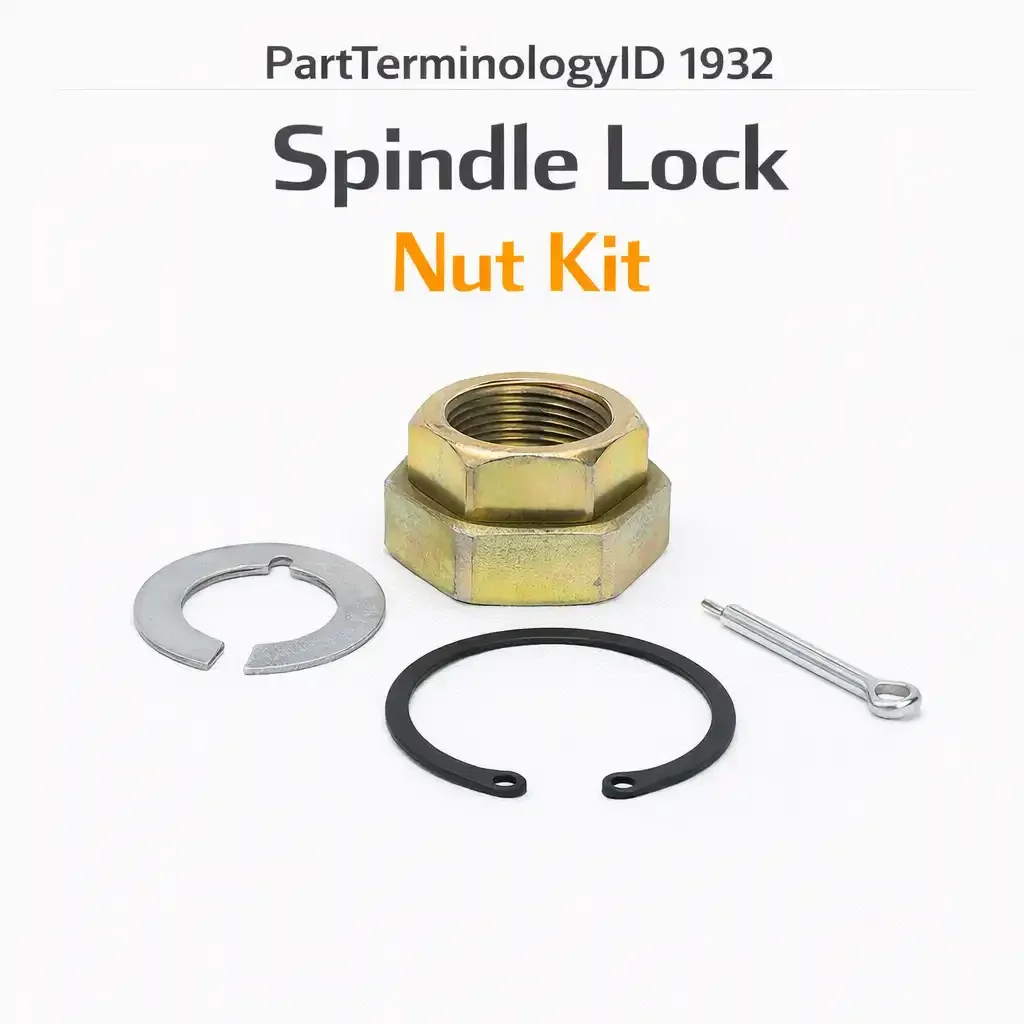
PartTerminologyID 1932, Spindle Lock Nut Kit, is the retention hardware that secures the wheel bearing assembly onto the spindle (axle shaft or steering knuckle stub). It typically includes the spindle nut (or a pair of nuts), a locking mechanism (cotter pin, lock tab, retaining washer, or staking feature), and in some configurations a thrust washer or bearing adjustment nut. This is the hardware that keeps the wheel bearing from walking off the spindle while the wheel turns at highway speed.
It is a category that sounds simple and is not. "Spindle lock nut" describes at least four different retention systems depending on the vehicle's hub and bearing design, and each system uses different hardware, different torque specifications, and different locking methods. A listing that says "spindle nut kit" with a vehicle fitment and nothing else is leaving the buyer to guess which of those four systems their vehicle uses.
The Four Retention Systems
Adjustable dual-nut system (serviceable tapered roller bearings)
The traditional system used on older rear-wheel-drive vehicles, trucks, and trailers with serviceable (non-sealed) tapered roller bearings on the front spindle. The kit includes:
an inner adjusting nut (threaded onto the spindle, torqued and then backed off to set bearing preload)
a lock washer or keyed washer with a tab that indexes into a keyway on the spindle
an outer lock nut (threaded against the lock washer to hold the inner nut in position)
a cotter pin (passed through a hole in the spindle to prevent the outer nut from backing off)
This is a four-piece system where every component is application-specific. The spindle thread size and pitch determine the nut dimensions. The spindle keyway width determines the lock washer. The spindle cotter pin hole diameter determines the cotter pin size.
If the inner nut thread does not match the spindle, the nut will not thread on. If the lock washer tab does not match the keyway, it will not index. If the cotter pin is too large for the hole, it will not install. If it is too small, it will not retain the nut securely.
Single nut with cotter pin (sealed bearing or hub assembly)
Common on many vehicles with sealed, non-adjustable wheel bearing and hub assemblies. A single large nut threads onto the axle shaft or spindle stub, is torqued to specification, and a cotter pin through the spindle retains the nut. There is no bearing preload adjustment. The nut simply clamps the hub assembly onto the spindle.
The kit may include the nut and a new cotter pin, or the nut may be sold separately with the cotter pin as a standalone item. The nut thread size, pitch, and hex size are application-specific.
Single nut with staking (deformation lock)
Used on many modern FWD and AWD vehicles where the front hub/bearing is retained by a large axle nut on the CV axle shaft. The nut is torqued to a high specification (often 150 to 250 ft-lbs) and then the nut collar is staked (deformed with a chisel or punch) into a notch in the axle shaft to prevent rotation.
These nuts are one-time-use. Once staked, the nut cannot be reused because the collar has been permanently deformed. Every bearing or CV axle service requires a new nut. The kit is often just the nut itself, sometimes with a new washer.
The thread size, pitch, hex size, flange diameter, and stake collar geometry are all vehicle-specific. A nut that threads onto the shaft but has the wrong flange diameter may not properly seat against the hub. A nut with the wrong collar may not stake into the axle notch correctly.
Castellated nut with cotter pin
Similar to the single nut with cotter pin, but the nut has integral castellations (slots cut into the top of the nut) through which the cotter pin passes. The nut is torqued to specification, then advanced or backed off slightly to align a castellated slot with the cotter pin hole in the spindle. This system is common on trucks, 4WD vehicles, and some heavy-duty applications.
The castellation pattern, thread size, and nut height must match the spindle. A nut with castellations that do not align with the pin hole at the correct torque creates a problem: the technician must either over-torque or under-torque the nut to find the next castellation alignment, both of which compromise bearing life.
Why This Part Generates Returns
Buyers order the wrong spindle lock nut kit because:
they do not know which retention system their vehicle uses (adjustable dual-nut, single nut with cotter pin, single staking nut, or castellated nut)
they do not verify the spindle thread size and pitch (which varies by axle, hub, and CV shaft across submodels)
they do not verify the hex size of the nut (which matters for tool selection but also confirms the correct part)
they assume the kit is complete when it only includes the nut (no washer, no cotter pin, no lock tab)
they do not verify whether the nut is reusable or one-time-use (staking nuts must be replaced every time they are removed)
they confuse the spindle lock nut with the axle shaft flange nut, the drive axle retaining nut, or the hub bolt (all related but different fasteners)
they miss the 4WD/AWD vs. 2WD split (4WD front hubs often use a different retention system than 2WD front hubs on the same vehicle)
they order a front kit for the rear or vice versa (front and rear spindle retention systems are frequently different)
Sellers get caught because spindle nut kit listings rarely specify the retention system type, the thread dimensions, or the kit contents. The listing says "spindle lock nut kit" with a year/make/model and a photo of a nut and a cotter pin. The buyer whose vehicle uses a staking nut receives a castellated nut. The buyer whose spindle has M22 x 1.5 threads receives a nut threaded 13/16" to 20. Both go back.
Status in New Databases
PIES/PCdb: PartTerminologyID 1932, Spindle Lock Nut Kit
PIES 8.0 / PCdb 2.0: No change
The 4WD / 2WD Split
On trucks and SUVs that were available in both 2WD and 4WD configurations, the front hub and spindle assembly is fundamentally different between the two drivetrain types. The 2WD front hub typically uses a serviceable tapered roller bearing on a conventional spindle (adjustable dual-nut system). The 4WD front hub uses a sealed unit bearing on a CV axle stub shaft (single staking nut or single nut with cotter pin).
These two systems use completely different spindle nuts with different thread sizes, different locking methods, and different kit contents. A "spindle lock nut kit" listing for a 2003 to 2006 pickup truck that does not specify 2WD or 4WD will ship the wrong hardware to roughly half its buyers.
This is one of the highest-volume fitment errors in the spindle hardware category on trucks, and it is entirely preventable with a single attribute.
One-Time-Use Nuts: The Replacement Frequency Problem
Staking-type spindle nuts are explicitly one-time-use. Vehicle manufacturers specify "replace nut, do not reuse" in their service procedures. The reason is that the staked collar, once deformed, cannot provide reliable locking force if straightened and re-staked. The metal fatigues at the deformation point, and the nut may loosen under vibration.
This means that every CV axle replacement, every front hub/bearing replacement, and every front brake rotor replacement (on vehicles where the hub nut must be removed to access the rotor) requires a new spindle nut. The nut is a consumable on these vehicles, and it should be cross-sold with every brake and hub service part.
Many buyers do not know this. They remove the old nut, straighten the staking, and plan to reuse it. The nut loosens after a few hundred miles, the bearing develops play, and the buyer returns to the parts store not for a nut but for a new bearing, blaming the bearing when the nut was the root cause.
A listing note about one-time-use requirements both protects the buyer and drives a legitimate accessory sale.
Top Return Scenarios
Scenario 1: "Wrong thread size"
Nut does not thread onto the spindle or axle shaft.
Prevention language: "Thread size: [M22 x 1.5 / 13/16" to 20 / M24 x 1.5 / etc.]. Verify spindle or axle shaft thread size before ordering."
Scenario 2: "I have 4WD, this is for 2WD"
Retention system type mismatch.
Prevention language: "For [2WD / 4WD] equipped vehicles. 2WD and 4WD front hubs use different spindle retention hardware. Verify your drivetrain type."
Scenario 3: "Kit doesn't include the cotter pin / lock washer"
Kit contents are incomplete for the buyer's retention system.
Prevention language: "Kit includes: [itemized list: nut, lock washer, cotter pin / nut only / nut and washer]. Verify kit contents match your retention system requirements."
Scenario 4: "This is a staking nut, my spindle uses a castellated nut with cotter pin"
Locking method mismatch.
Prevention language: "Locking method: [staking (one-time-use) / castellated with cotter pin / dual-nut with lock washer]. Verify your spindle's locking method before ordering."
Scenario 5: "I ordered a front kit but needed a rear"
Front and rear spindle retention systems differ.
Prevention language: "Position: [front / rear]. Front and rear spindle lock nut hardware is typically different. Verify position."
What to Include in the Listing
Core essentials
PartTerminologyID: 1932
component: Spindle Lock Nut Kit
retention system type: adjustable dual-nut, single with cotter pin, single staking, castellated with cotter pin
complete kit contents list (nut, washer, cotter pin, lock tab, all itemized)
one-time-use: yes/no
quantity: 1 kit (per side, or per axle, specify clearly)
Fitment essentials
year/make/model/submodel
position: front or rear
drivetrain: 2WD, 4WD, AWD (mandatory on trucks and SUVs)
hub/bearing type: serviceable tapered roller or sealed unit bearing
axle type (solid axle, independent, CV axle stub)
Dimensional essentials
thread size and pitch
hex size
nut flange diameter (if flanged)
lock washer keyway width (if applicable)
cotter pin diameter and length (if applicable)
castellated slot count and width (if castellated)
Image essentials
all kit contents laid out and labeled
thread callout on the nut
hex size callout
lock washer tab and keyway detail (if applicable)
staking collar detail (if staking nut)
cotter pin hole alignment reference (if castellated)
Catalog Checklist for ACES/PIES Teams
PartTerminologyID = 1932
require retention system type attribute
require thread size and pitch
require position (front/rear)
require drivetrain type (2WD/4WD/AWD) on trucks and SUVs
require one-time-use designation for staking nuts
require complete kit contents as a structured attribute
differentiate from axle shaft flange nuts, lug nuts, and hub bolts
flag vehicles where 2WD and 4WD use different spindle retention systems
cross-reference to compatible hub/bearing assembly part numbers
FAQ (Buyer Language)
Can I reuse my old spindle nut?
If your vehicle uses a staking-type nut (the collar was deformed into a notch on the axle shaft), no. These nuts are one-time-use and must be replaced every time they are removed. If your vehicle uses a castellated nut with a cotter pin, the nut can be reused if the threads and castellations are undamaged, but the cotter pin must always be new.
How do I know my spindle thread size?
The most reliable method is to measure the spindle threads with a thread pitch gauge, or to look up the OE spindle nut part number for your specific vehicle and drivetrain configuration. Do not assume based on vehicle model alone, because 2WD and 4WD versions of the same truck often have different spindle thread sizes.
Do I need this kit every time I replace my wheel bearing?
If your bearing service requires removing the spindle nut, and the nut is a staking type, yes. Always order a new nut kit with the bearing. If your vehicle uses a cotter pin retention system, you need at least a new cotter pin (never reuse cotter pins). The nut itself may be reusable if undamaged.
Is this the same as a lug nut?
No. Lug nuts attach the wheel to the hub. The spindle lock nut secures the hub/bearing assembly to the spindle or axle shaft. They are different sizes, different threads, and different locations.
Cross-Sell Logic
Wheel Hub/Bearing Assembly
CV Axle Shaft
Disc Brake Rotor (PartTerminologyID 1896, on vehicles where nut removal is required for rotor replacement)
Cotter Pin Assortment (for buyers who only need the pin, not the full kit)
Torque Wrench (spindle nuts require specific, often high, torque values)
Frame as "required during hub, bearing, CV axle, or brake rotor service. Staking nuts are one-time-use and must be replaced."
Final Take for PartTerminologyID 1932
Spindle Lock Nut Kit (PartTerminologyID 1932) is a fastener kit where the retention system type, the thread specification, and the drivetrain configuration are the three attributes that prevent most returns. Miss the retention system and the buyer receives a staking nut when they need a castellated nut. Miss the thread spec and the nut does not thread on. Miss the 2WD/4WD split and the entire system is wrong.
State the retention type. State the thread size. State the drivetrain. List every component in the kit. Note whether the nut is one-time-use. That is the complete return prevention stack for the hardware that keeps the wheel bearing on the spindle and the wheel on the vehicle.