
Written by Arthur Simitian | PartsAdvisory
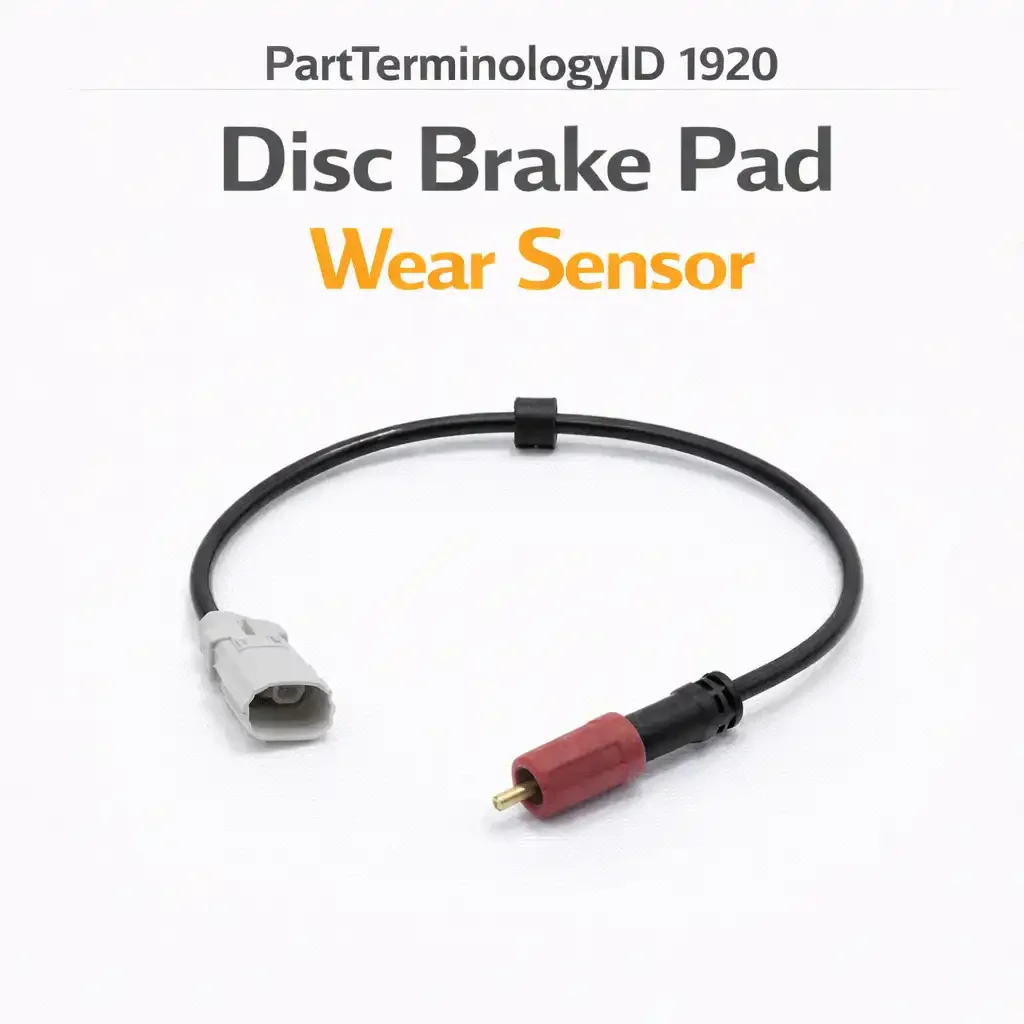
PartTerminologyID 1920, Disc Brake Pad Wear Sensor, is a thin wire or electronic sensor embedded in or attached to a brake pad that triggers a dashboard warning when the pad friction material wears down to its minimum thickness. When the pad wears to the point where the sensor wire contacts the rotor surface, the wire either breaks (completing or interrupting a circuit) or its resistance changes, and the vehicle's instrument cluster illuminates the brake pad wear indicator.
It is a consumable. It works once. When the wire contacts the rotor and the warning triggers, the sensor has done its job and must be replaced along with the brake pads. It cannot be reused, reset, or repaired. And yet, it is one of the most consistently mis-ordered brake components in the aftermarket, because the buyer rarely thinks about the wear sensor until they are already mid-brake-job, staring at a consumed sensor wire with no replacement in the box.
The aftermarket listing challenge is that brake pad wear sensors are position-specific, design-specific, and frequently omitted from brake pad box contents, leaving the buyer to figure out whether their pads came with sensors, whether they need to order sensors separately, and which of the several sensor designs fits their specific caliper and pad configuration.
Two Sensor Design Philosophies
The automotive industry uses two fundamentally different approaches to warning the driver about pad wear. Only one of them involves an electronic sensor. Understanding this split is the first step in listing PartTerminologyID 1920 correctly, because listing an electronic sensor for a vehicle that uses the other approach is a guaranteed return.
Electronic wear sensors (PartTerminologyID 1920)
Common on European vehicles (BMW, Mercedes-Benz, Audi, Porsche, Volkswagen, Mini, Land Rover, Volvo) and increasingly adopted by other manufacturers on premium trims and newer platforms. The sensor is a small plastic-bodied probe with a thin wire loop at the tip. The probe is inserted into a hole or channel in the brake pad and held in place by a clip or friction fit. The wire loop extends to a precise depth in the pad.
When the pad wears down to that depth, the spinning rotor grinds through the wire loop. The circuit changes state (opens, closes, or shifts resistance depending on the design), and the dashboard light illuminates. The driver gets a clear, unambiguous electronic warning that does not depend on hearing a noise over the radio, the road, or the wind.
The sensor connects to the vehicle's wiring harness via a dedicated connector routed along the suspension, and the signal is processed by the body control module, instrument cluster, or a dedicated brake monitoring ECU. These sensors are strictly one-time-use: once the wire is severed, the sensor is permanently consumed.
Mechanical tab (squealer) indicators
Many vehicles (common on Asian and domestic manufacturers, and on base trims of many European vehicles) do not use an electronic wear sensor at all. Instead, a small metal tab riveted or welded to the pad backing plate contacts the rotor when the pad is worn, creating a high-pitched metallic squealing noise. This is a mechanical warning, not an electronic one.
Vehicles with mechanical squealers do not have a PartTerminologyID 1920 component. There is no electronic sensor, no wiring harness, no dashboard light for pad wear. The squealer tab is part of the brake pad itself and ships with the pad set. There is nothing additional to order.
The buyer who searches for a "brake pad wear sensor" for a vehicle that uses squealers will find no applicable part, or worse, will find a sensor listed for a similar vehicle variant that happens to have the electronic system. If the seller's ACES data does not differentiate between trim levels or option packages that determine whether the vehicle has electronic wear monitoring, the wrong sensor ships to the wrong buyer.
Vehicles with both systems
Some vehicles use both. The electronic sensor provides the dashboard warning, and a mechanical squealer on the same or adjacent pad provides an audible backup. On these vehicles, the electronic sensor is still a separate, orderable component, and it must still be replaced with every pad change.
Electronic Sensor Types in Detail
Single-stage sensors
The simplest electronic design. A single wire loop is positioned at one depth in the pad. When the pad wears to that depth and the rotor cuts the wire, the circuit changes state and the dashboard displays a single "replace brake pads" warning. There is no advance notice, no graduated warning. The light is either off (pads have material) or on (pads are at minimum thickness).
Single-stage sensors are typically a two-wire design (signal and ground, or signal loop). The circuit is either closed or open. The vehicle's monitoring system checks the circuit continuity and triggers the warning when the state changes.
Two-stage (multi-stage) sensors
A more sophisticated design used on many German vehicles. The sensor contains two wire loops at different depths in the pad. The first loop is positioned at a moderate wear depth and triggers an early "service soon" or "brake pad wear" advisory. The second loop is positioned deeper and triggers an urgent "replace immediately" warning when the pad is near its absolute minimum.
Two-stage sensors allow the driver to plan their brake service rather than reacting to a sudden warning. The vehicle's monitoring system reads the resistance across the sensor to determine which stage has been reached. Intact sensor (both loops complete) reads one resistance value. First stage (outer loop severed) reads a different resistance. Second stage (both loops severed) reads a third value.
Two-stage sensors may use a two-wire or three-wire connector, and the resistance values are specific to the vehicle manufacturer's monitoring system. A single-stage sensor installed in a two-stage application will not provide the intermediate warning, and the resistance values may not match what the monitoring system expects, potentially causing false warnings or no warning at all.
The listing must specify single-stage or two-stage and match the vehicle's monitoring system.
Embedded vs. clip-on sensors
Embedded sensors are molded into the brake pad during manufacturing. The sensor wire is part of the pad structure and cannot be separated. When the pad is replaced, the old sensor is discarded with the pad, and the new pad either comes with a new embedded sensor or requires a separate sensor to be clipped on.
Clip-on sensors are standalone probes that insert into a pocket, hole, or channel in the pad backing plate or friction material. They can be removed from the old pad and theoretically transferred, but because the wire tip is consumed during the wear indication event, they must be replaced with a new sensor.
Most aftermarket replacement pad wear sensors are the clip-on type. The listing must specify the mounting method (clip, press-fit, slot) and verify that the replacement sensor's probe dimensions match the pad's sensor pocket.
Why This Part Generates Returns
Buyers order the wrong pad wear sensor because:
they do not know whether their vehicle uses electronic wear sensors or mechanical squealers (and trim level or option package determines this on many vehicles)
they do not verify position (front sensors and rear sensors are different lengths, different connectors, and mount to different pads)
they assume the wear sensor is included with the brake pad set (some aftermarket pad sets include sensors, many do not, and the box often does not make this clear)
they do not verify which pad in the caliper carries the sensor (typically one pad per caliper, usually the inboard pad, but not always)
they miss left vs. right differences (some vehicles use the same sensor on both sides, others use different wiring lengths for left and right)
they do not verify the connector type (which changes across model years, ABS/brake system revisions, and sometimes across production months)
they order a two-stage sensor when their vehicle uses a single-stage, or vice versa, and the connector or resistance values do not match
they confuse the pad wear sensor with the ABS wheel speed sensor (PartTerminologyID 1912), which is a completely different sensor at the same general wheel-area location
they do not realize that some vehicles monitor only two corners (diagonal pattern) rather than all four, and order sensors for positions that have no sensor wiring
Sellers get caught because pad wear sensor listings often state "front" or "rear" without specifying left, right, or both, and without noting which pad position the sensor installs into. The connector type and wire length are routinely omitted. The buyer orders "front brake pad wear sensor," receives a sensor with a 14-inch lead, and discovers their vehicle needs a 22-inch lead for the opposite side.
Status in New Databases
PIES/PCdb: PartTerminologyID 1920, Disc Brake Pad Wear Sensor
PIES 8.0 / PCdb 2.0: No change
Position Specificity: The Dimension Most Listings Omit
Front vs. rear
Front and rear pad wear sensors are almost always different parts. The wire lead length, the connector type, the sensor body shape, and the probe dimensions may all differ. Front sensors typically have a shorter lead because the wiring harness connector is closer to the caliper. Rear sensors may have a significantly longer lead to reach the harness connector routed along the subframe, trailing arm, or rear axle carrier.
On some vehicles, the front and rear sensors also differ in stage count. A vehicle might use two-stage sensors on the front (where the majority of braking occurs and pad wear is faster) and single-stage sensors on the rear (where wear is slower and less critical to monitor with granularity).
Left vs. right
On some vehicles, only one wheel per axle has a wear sensor. A common configuration is diagonal monitoring: front left and rear right, or front right and rear left. The vehicle manufacturer assumes that pads on the same axle wear at roughly the same rate, so monitoring one pad per axle is sufficient to indicate when all pads on that axle need replacement.
On other vehicles (particularly German premium brands), all four wheels have sensors. On these vehicles, the left and right sensors at the same axle position may be the same part number or different part numbers depending on wiring harness routing. If the harness routes along the subframe from the driver's side, the passenger-side sensor may need a longer lead to cross over, making left and right non-interchangeable.
The listing must specify exactly which corner(s) the sensor fits. "Front" is not specific enough if only the front left has a sensor, if left and right have different lead lengths, or if the connector position differs between sides.
Which pad carries the sensor
Within a single caliper, only one pad has the wear sensor. This is typically the inboard pad (the pad pushed directly by the caliper piston), because the inboard pad usually wears faster than the outboard pad on single-piston floating caliper designs. The inboard pad experiences the piston's direct force plus the drag from piston seal retraction, while the outboard pad is pushed by the caliper bracket sliding on guide pins.
The sensor probe is inserted into a hole, slot, or molded pocket in that specific pad. The other pad in the caliper has no sensor pocket.
If the buyer installs the sensor in the wrong pad (outboard instead of inboard), the sensor probe may not seat correctly (wrong pocket geometry) or the warning will trigger at the wrong wear level, since the outboard pad wears at a different rate.
The "Sensors Not Included" Problem
This is the single largest source of frustration, negative reviews, and mid-job parts runs associated with this PartTerminologyID.
What happens
A buyer orders an aftermarket brake pad set for their BMW, Mercedes, Audi, or other vehicle with electronic wear sensors. The pad set arrives. The buyer jacks up the car, removes the wheel, removes the caliper, removes the old pads, sees the old consumed wear sensor wire, reaches into the brake pad box for the new sensor, and finds no sensor.
The buyer is now stuck. The car is on jack stands with the brakes disassembled. The old sensor is consumed. The new pad set does not include sensors. The buyer either drives to a parts store on a different vehicle, orders sensors online and waits (leaving the car disassembled), or reinstalls the old consumed sensor and ignores the dashboard light.
Why it happens
Many aftermarket brake pad manufacturers sell pads and sensors as separate SKUs. The pad set listing may or may not mention that sensors are not included. The buyer, especially a first-time DIY buyer on a European vehicle, does not realize that the sensor is a separate purchase.
Some premium pad sets do include sensors. Some include sensors for one axle but not the other. Some include the sensor for one side but not both (on vehicles with diagonal monitoring). The inconsistency across manufacturers makes it impossible for the buyer to assume anything.
What sellers should do
Every brake pad set listing for a vehicle that uses electronic wear sensors should explicitly state whether sensors are included. If sensors are not included, the listing should recommend the buyer order sensors separately and, ideally, link to the correct sensor listing. This is both a customer service measure and a return prevention measure: the buyer who discovers mid-job that they need sensors will often return the entire pad set out of frustration, even though the pads are correct.
Every standalone wear sensor listing should note that sensors are sold separately from most aftermarket pad sets and should be ordered at the same time as pads.
The Reset Requirement
On many modern vehicles, replacing the pads and sensors does not automatically turn off the pad wear warning light. The vehicle's monitoring system must be reset through:
Dashboard menu: Some vehicles allow the driver to reset the brake pad indicator through the infotainment system or instrument cluster settings menu.
OBD-II scan tool: Other vehicles require a scan tool to clear the brake pad wear fault code and reset the monitoring system.
Automatic reset: A few vehicles detect the new sensor's intact circuit and automatically clear the warning on the next drive cycle.
If the buyer replaces the pads and sensor but the dashboard light stays on, they may assume the new sensor is defective and return it. A listing note about the reset requirement prevents this return.
Top Return Scenarios
Scenario 1: "My car doesn't use electronic wear sensors"
Vehicle uses mechanical squealers. No electronic sensor exists for this application.
Prevention language: "Electronic disc brake pad wear sensor. For vehicles equipped with electronic pad wear monitoring (dashboard pad wear warning light). Not for vehicles that use mechanical squealer tabs only. Verify your vehicle has electronic wear sensor wiring at the brake caliper."
Scenario 2: "Wire isn't long enough to reach the connector"
Lead length mismatch between left and right, or front and rear.
Prevention language: "Position: [front left / front right / rear left / rear right]. Wire lead length (sensor body to connector): [X inches / X mm]. Verify position and lead length match your vehicle's wiring harness routing."
Scenario 3: "I thought the sensors came with my brake pads"
Pad set did not include sensors. Buyer discovers during installation that the old sensors are consumed and they have no replacements.
Prevention language: "Brake pad wear sensors are typically not included with aftermarket brake pad sets. If your vehicle uses electronic pad wear sensors, order replacement sensors with your brake pads to avoid delays during installation."
Scenario 4: "Connector doesn't match"
Connector pin count, housing shape, or orientation does not match the vehicle's wiring harness.
Prevention language: "Connector type: [description, pin count, color, shape]. Verify connector matches your vehicle's pad wear sensor harness. Connector type may vary by production date within the same model year."
Scenario 5: "Dashboard light is still on after replacing pads and sensor"
System requires a reset through the dashboard menu or scan tool after sensor replacement.
Prevention language: "Some vehicles require a brake pad wear indicator reset through the dashboard controls or a scan tool after replacing pads and sensors. If the warning light remains on after installation, perform the reset procedure per your vehicle's service manual. A persistent light does not indicate a sensor defect."
Scenario 6: "This is a single-stage sensor but my car shows two warnings"
Single-stage sensor installed in a two-stage monitoring system.
Prevention language: "Sensor type: [single-stage / two-stage]. Two-stage sensors provide an early advisory warning and a final replacement warning. Single-stage sensors provide a single replacement warning only. Verify your vehicle's monitoring system type."
Scenario 7: "There's no sensor wiring at my rear caliper"
Vehicle uses diagonal monitoring (sensors only on two corners, not all four). Buyer ordered sensors for a position that has no sensor wiring.
Prevention language: "Sensor positions on this vehicle: [front left and rear right / all four wheels / front only]. Not all wheel positions have sensor wiring. Verify which positions are monitored on your vehicle before ordering."
What to Include in the Listing
Core essentials
PartTerminologyID: 1920
component: Disc Brake Pad Wear Sensor
sensor type: single-stage or two-stage
mounting method: clip-on, press-fit, slot-mount, or embedded
quantity: 1 per sensor (specify how many the vehicle needs per axle or per vehicle)
Fitment essentials
year/make/model/submodel
position: specific corner (front left, front right, rear left, rear right)
which pad: inboard or outboard
vehicles with electronic pad wear monitoring only (exclude squealer-only vehicles and trims)
monitoring pattern: all four corners, diagonal, or front-only
production date split (if sensor connector, lead length, or stage count changed mid-year)
Electrical and dimensional essentials
wire lead length (sensor body to connector end)
connector type, pin count, and housing shape/color
sensor probe length (depth into pad)
sensor probe diameter
single-stage or two-stage
resistance values per stage (if relevant for two-stage systems)
Image essentials
full sensor with wire lead laid out showing total length
connector close-up showing pin count and housing detail
sensor probe tip detail showing wire loop
installed reference showing sensor position in pad and caliper
lead length dimensional callout
Catalog Checklist for ACES/PIES Teams
PartTerminologyID = 1920
require position attribute (specific corner, not just "front" or "rear")
require wire lead length as a dimensional attribute
require connector type and pin count
require sensor stage attribute (single-stage or two-stage)
require pad position attribute (inboard or outboard)
flag vehicles that use mechanical squealers only (no electronic sensor exists, do not list PartTerminologyID 1920)
flag vehicles with diagonal monitoring (only two sensor positions exist)
flag trim levels or option packages that determine electronic vs. squealer configuration
note whether the sensor is included with related brake pad set listings to prevent missed or duplicate orders
differentiate from ABS wheel speed sensor (PartTerminologyID 1912)
require monitoring pattern attribute (all four, diagonal, front only)
FAQ (Buyer Language)
Do I need to replace the wear sensor every time I replace my brake pads?
Yes. If your vehicle uses electronic wear sensors, replace them with every pad change. Even if the sensor wire has not yet contacted the rotor, the sensor has been exposed to extreme heat cycling, brake dust contamination, and vibration for the full life of the pad set. It may not function reliably through another pad life cycle. Sensors are inexpensive compared to the cost of not knowing your pads are worn.
Are wear sensors included with brake pads?
Sometimes. Some premium aftermarket pad sets include the sensors. Most do not. Always check the pad set contents list before purchasing. If sensors are not included, order them separately at the same time as the pads so they are available during installation.
My car has a pad wear warning light but I don't see a sensor on my pads. Where is it?
The sensor is typically on one pad per caliper (usually inboard). It may be on only one or two wheels (diagonal monitoring pattern: front left and rear right, for example). Check each caliper carefully. The sensor probe is small and may be partially hidden by the caliper body or dust shield. Follow the sensor wire from the wiring harness connector back to the caliper to locate it.
Can I reuse the old wear sensor if the wire isn't broken?
It is not recommended. The sensor is designed as a consumable for one pad service interval. The probe tip has been exposed to temperatures exceeding 400 degrees Fahrenheit, saturated with brake dust, and vibrated continuously. Internal wire fatigue, insulation degradation, and connector corrosion accumulate over the pad's lifetime. Replace the sensor with the pads to ensure reliable monitoring through the next service interval.
My dashboard says "brake pad wear" but the pads still have material. Is the sensor bad?
Possibly. The sensor may have been damaged by a stone strike, by brake dust bridging the wire circuit, by water intrusion at the connector, or by a wiring harness fault between the sensor and the monitoring module. It is also possible that the sensor was installed in the wrong pad position (outboard instead of inboard) during a previous brake job, causing it to trigger before the inboard pad reached minimum thickness. Inspect the sensor, its wiring, and the connector before assuming a false reading.
How many sensors does my car need?
It depends on the monitoring configuration. Some vehicles have sensors at all four wheels (four sensors total). Some use diagonal monitoring (two sensors: front left and rear right, or front right and rear left). Some monitor front brakes only (two sensors). Check your vehicle's service manual or inspect each caliper for sensor wiring to determine how many sensors you need.
What is the difference between this sensor and the ABS sensor?
The pad wear sensor (PartTerminologyID 1920) monitors brake pad thickness and triggers a dashboard warning when the pads are worn. It is a consumable wire that is destroyed during the wear indication event. The ABS wheel speed sensor (PartTerminologyID 1912) measures wheel rotational speed and sends data to the ABS control module for anti-lock braking, traction control, and stability control. It is a permanent sensor that is not consumed during normal operation. They are completely different components despite both being located near the brake caliper.
Cross-Sell Logic
Disc Brake Pad Set (specify whether the pad set includes sensors or not)
Disc Brake Rotor (PartTerminologyID 1896)
Brake Pad Wear Sensor Connector Pigtail (if the harness-side connector is corroded or damaged)
Brake Hardware Kit (pad clips, shims, anti-rattle springs)
Brake Caliper (if caliper piston is seized)
Brake Caliper Guide Pin Kit (if caliper slides are binding, causing uneven pad wear)
Brake Cleaner
Frame as "replace sensors with every pad change. Order sensors with pads to avoid a second parts run mid-brake job." The pad set cross-sell is the most important relationship in this category: the sensor and the pads are always replaced together, and the buyer who orders one without the other will be back (or will return the pads in frustration).
For sellers listing brake pad sets, adding a prominent note ("Electronic pad wear sensors not included. Order separately for vehicles with electronic wear monitoring.") to every pad set listing for sensor-equipped vehicles is one of the highest-impact, lowest-effort changes available. It prevents the mid-job discovery that drives negative reviews, emergency parts runs, and pad set returns.
The Bigger Picture: Why a Ten-Dollar Sensor Drives Hundred-Dollar Returns
The disc brake pad wear sensor is a ten-dollar part. The brake pad set it accompanies is a forty to eighty dollar purchase. The return shipping on the pad set (when the frustrated buyer sends back the entire order because they cannot complete the brake job without sensors) costs more than the sensor itself.
The economics of this return are upside down. The seller loses the sale, pays for return shipping, reprocesses the pad set, and the buyer goes to a competitor who either included the sensor with the pads or made it clear that the sensor was a separate purchase and linked to it from the pad listing.
This is a category where listing clarity has an outsized impact on profitability. The part is simple. The listing requirements are simple. The cost of getting it wrong is disproportionate to the complexity involved.
Final Take for PartTerminologyID 1920
Disc Brake Pad Wear Sensor (PartTerminologyID 1920) is a consumable that the buyer needs exactly when they are mid-brake-job, and the listing needs to answer four questions before the buyer clicks order: which corner does this sensor fit, how long is the wire lead, what does the connector look like, and is it single-stage or two-stage.
Miss the position and the lead is too short. Miss the connector and it does not plug in. Miss the stage count and the monitoring system reads the wrong resistance. Miss the fact that the vehicle uses squealers instead of electronic sensors and the part has no application at all.
State the corner. State the lead length. State the connector. State the stage count. Note that sensors are not included with most aftermarket pad sets. Note the dashboard reset requirement. That is the full return prevention strategy for a wire that works once, costs ten dollars, and saves the buyer from grinding their brake pads to bare metal because nobody told them they needed to order it separately.