
Written by Arthur Simitian | PartsAdvisory
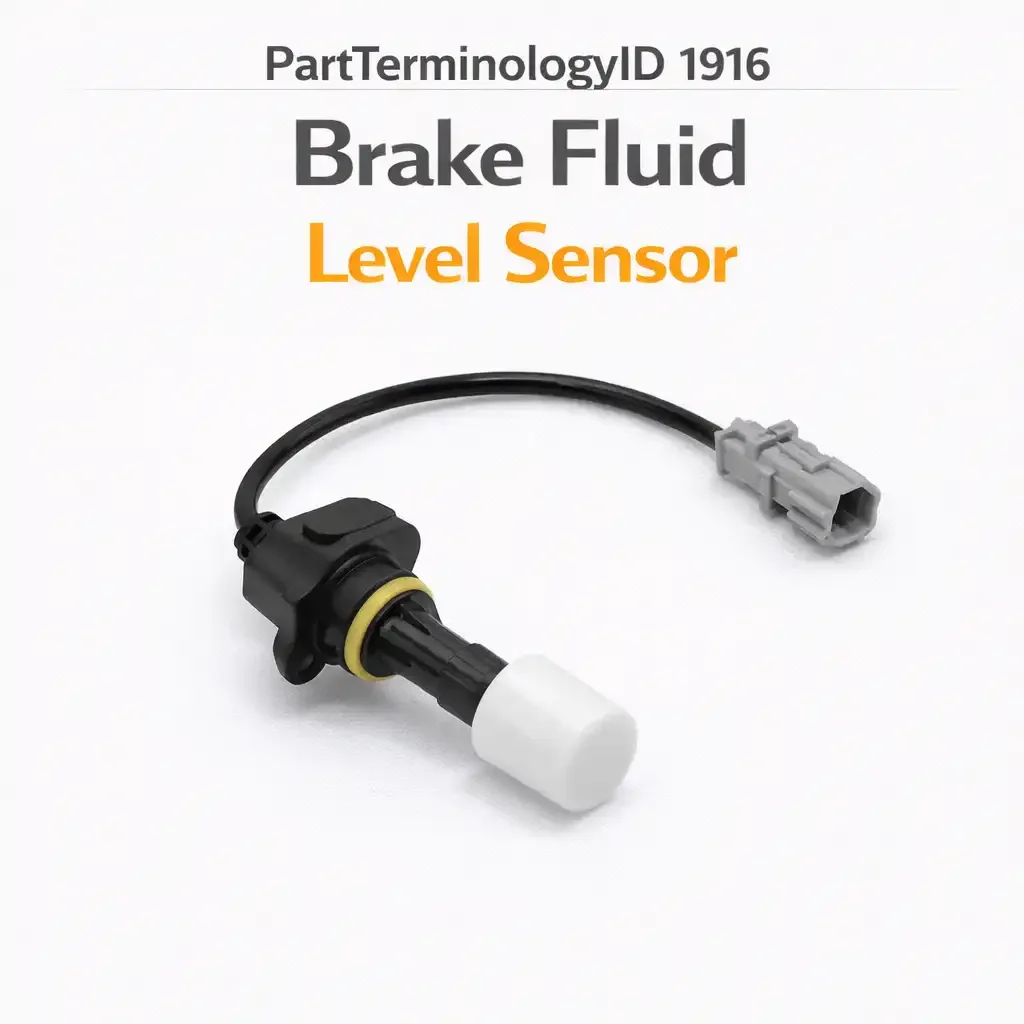
PartTerminologyID 1916, Brake Fluid Level Sensor, is the sensor that monitors the brake fluid level in the master cylinder reservoir and illuminates the brake warning light on the dashboard when the level drops below a safe threshold. Low brake fluid means one of two things: the brake pads have worn down (pushing the caliper pistons outward, which displaces fluid from the reservoir into the calipers) or there is a leak in the hydraulic system. Either condition requires the driver's attention.
The sensor itself is a simple device. A float rides on the surface of the brake fluid. When the float drops below a set point, it closes or opens a circuit (depending on the design), sending a signal to the instrument cluster. Dashboard light comes on. Driver investigates.
The return problem is not the sensor's function. The return problem is that this sensor lives in three different locations depending on the vehicle, uses three different mounting styles, and has three different connector configurations, and the listings almost never specify which version the buyer is getting.
The Three Mounting Locations
Mounted in the reservoir cap
On many vehicles (common on Asian and some domestic manufacturers), the brake fluid level sensor is integrated into the reservoir cap. The float mechanism hangs down from the underside of the cap into the reservoir. The electrical connector is on top of the cap. When the cap is removed for fluid inspection, the sensor comes with it.
Replacing this sensor means replacing the cap (or the cap-and-sensor assembly). The listing must specify whether the product is the sensor only (which clips into the existing cap), the cap with the sensor pre-installed, or just the cap without the sensor.
Mounted in the reservoir body (side or bottom)
On many European and some domestic vehicles, the sensor is mounted through a hole in the side or bottom of the reservoir body. The float sits inside the reservoir, and the electrical connector exits through the reservoir wall. The sensor is a press-fit or threaded unit that can be removed independently from both the cap and the reservoir.
This is the configuration most buyers picture when they search for "brake fluid level sensor." It is a standalone component that can be replaced without removing the reservoir or the cap.
Mounted in the master cylinder body
On some older vehicles and certain designs, the sensor is integrated into the master cylinder body itself, below the reservoir mounting surface. The float mechanism extends into a dedicated chamber or well in the master cylinder casting. Replacing this sensor may require removing the reservoir from the master cylinder.
Why the location matters for listings
A buyer whose sensor is in the reservoir cap will search "brake fluid level sensor," order a body-mounted sensor, and receive a part that has no way to attach to their cap. A buyer whose sensor threads into the reservoir body will order a cap-mounted sensor and receive a cap they do not need with a float that does not reach into their reservoir.
The listing must state the mounting location. Without it, one in three buyers is getting the wrong part.
Why This Part Generates Returns
Buyers order the wrong brake fluid level sensor because:
they do not know where the sensor is mounted on their vehicle (cap, reservoir body, or master cylinder)
they do not verify the connector type and pin count (connectors vary by manufacturer and model year)
they confuse the brake fluid level sensor with the coolant level sensor, washer fluid level sensor, or power steering fluid level sensor (all are float-based level sensors with similar operating principles and similar appearance)
they order a sensor expecting the reservoir cap to be included, or order a cap expecting the sensor to be included, when the two are sold separately
they do not verify float length (the float must reach the correct depth in the reservoir to trigger at the proper fluid level)
they miss reservoir changes (if the reservoir was updated mid-year, the sensor mounting may have changed with it)
Sellers get caught because the listing says "brake fluid level sensor" with a vehicle fitment and a photo that may not clearly show the mounting style. The buyer orders based on the vehicle match and receives a sensor they cannot physically install in their reservoir.
Status in New Databases
PIES/PCdb: PartTerminologyID 1916, Brake Fluid Level Sensor
PIES 8.0 / PCdb 2.0: No change
Sensor Operating Principles
Float and reed switch
The most common design. A magnetic float slides on a vertical guide rod inside the reservoir. As the float drops with the fluid level, the magnet passes a reed switch (a magnetically actuated electrical switch sealed in a glass tube). When the magnet aligns with the reed switch at the low-level position, the switch closes and completes the warning light circuit.
Float and contact
A simpler design where the float directly pushes or releases a mechanical contact. As the fluid level drops, the float drops, and a spring-loaded contact closes (or opens) the circuit.
Thermistor or resistive
Less common. The sensor uses a thermistor or resistive element that changes resistance based on whether it is submerged in fluid or exposed to air. The instrument cluster reads the resistance change. This type has no moving parts but is more expensive and less common in the aftermarket.
The operating principle affects the connector wiring. Reed switch sensors are typically two-wire (simple open/close circuit). Resistive sensors may have three wires (power, signal, ground). The connector must match the vehicle's wiring harness.
Top Return Scenarios
Scenario 1: "This sensor doesn't fit my reservoir cap"
Buyer has a cap-mounted sensor and received a body-mounted sensor, or vice versa.
Prevention language: "Mounting location: [reservoir cap / reservoir body (side mount) / reservoir body (bottom mount) / master cylinder body]. Verify where your brake fluid level sensor is mounted before ordering."
Scenario 2: "Connector doesn't match"
Pin count or connector housing shape does not match the vehicle's wiring harness.
Prevention language: "Connector: [2-pin / 3-pin, connector shape/color]. Verify connector matches your vehicle's brake fluid level sensor harness."
Scenario 3: "Float doesn't reach deep enough"
Float length does not match the reservoir depth, causing the sensor to trigger the warning light at the wrong fluid level (too early or too late).
Prevention language: "Float length: [X mm]. Designed for [specific reservoir depth]. Verify float length is appropriate for your reservoir."
Scenario 4: "I thought the cap was included"
Buyer expected a cap-and-sensor assembly and received the sensor only.
Prevention language: "This listing is for the [sensor only / cap with sensor / cap only without sensor]. Verify what is included."
Scenario 5: "This looks like a coolant sensor"
Buyer ordered a coolant level sensor or washer fluid sensor by mistake, or the listing cross-referenced incorrectly.
Prevention language: "Brake fluid level sensor for the brake master cylinder reservoir. Not a coolant level sensor, washer fluid sensor, or power steering fluid sensor. Verify system and location."
What to Include in the Listing
Core essentials
PartTerminologyID: 1916
component: Brake Fluid Level Sensor
mounting location: cap-mounted, body-mounted (side or bottom), or master cylinder-mounted
what is included: sensor only, cap with sensor, or sensor and cap separately
quantity: 1
Fitment essentials
year/make/model/submodel
master cylinder or reservoir part number cross-reference (where sensor compatibility depends on reservoir version)
production date split (if reservoir or sensor changed mid-year)
Electrical essentials
connector pin count and type
connector orientation and color
operating principle (reed switch, contact, resistive)
wire lead length (if not a direct plug connector)
Dimensional essentials
float length (from mounting surface to bottom of float travel)
sensor body diameter (for body-mounted press-fit sensors)
thread size (for threaded body-mount sensors)
cap fitment diameter (for cap-mounted sensors)
Image essentials
full sensor showing mounting interface and float
connector close-up showing pin count and housing
installed context showing sensor position in reservoir
float length callout
Catalog Checklist for ACES/PIES Teams
PartTerminologyID = 1916
require mounting location attribute (cap, reservoir body, master cylinder body)
require connector pin count and type
require "what is included" attribute (sensor only, cap with sensor, cap only)
require float length
differentiate from coolant, washer fluid, and power steering fluid level sensors
flag applications where the sensor is non-serviceable (integrated into the reservoir or master cylinder in a way that requires full assembly replacement)
cross-reference to compatible reservoir part numbers (PartTerminologyID 1764)
FAQ (Buyer Language)
Where is my brake fluid level sensor located?
Open the hood and find the brake master cylinder reservoir (the translucent plastic container on the driver's side of the engine bay, usually near the firewall). Look at the cap for an electrical connector. If the cap has a connector, your sensor is cap-mounted. If the cap has no connector, look at the side or bottom of the reservoir body for a sensor with a connector. If neither location has a visible sensor, the sensor may be internal to the master cylinder or integrated into the reservoir in a non-serviceable way.
My brake warning light is on. Is it the sensor?
Not necessarily. The brake warning light can be triggered by low fluid level (sensor), a pressure differential between brake circuits (combination valve switch), the parking brake being engaged (parking brake switch), or an ABS fault (on some vehicles, ABS faults illuminate the brake light). Check your fluid level first. If the level is adequate and the parking brake is released, the fault may be elsewhere.
Can I just top off the fluid instead of replacing the sensor?
If the fluid level is low because of pad wear (normal consumption as pads thin), topping off will turn the light off temporarily. However, when new pads are installed, the caliper pistons are pushed back, and the extra fluid may overflow the reservoir. If the fluid level is low because of a leak, topping off masks a dangerous hydraulic system failure. Diagnose the cause of low fluid before adding fluid.
Does the sensor come with the cap?
Check the listing. Some sensors are sold as standalone units. Some are sold as a cap-and-sensor assembly. Some caps are sold without the sensor. The listing should specify what is included.
Cross-Sell Logic
Brake Master Cylinder Reservoir (PartTerminologyID 1764)
Brake Master Cylinder Reservoir Cap
Brake Master Cylinder (PartTerminologyID 1836)
Brake Fluid (correct DOT specification)
Reservoir Grommet Set
Frame as "commonly replaced during master cylinder or reservoir service."
Final Take for PartTerminologyID 1916
Brake Fluid Level Sensor (PartTerminologyID 1916) is a part where one question prevents half the returns: where is the sensor mounted? Cap, reservoir body, or master cylinder body. Answer that, add the connector type and float length, and state what ships in the box (sensor only or sensor with cap).
Three attributes and one inclusion statement. That is the listing difference between a sensor the buyer can install and a sensor that goes back in the box because it has nowhere to mount on their reservoir.