
Written by Arthur Simitian | PartsAdvisory
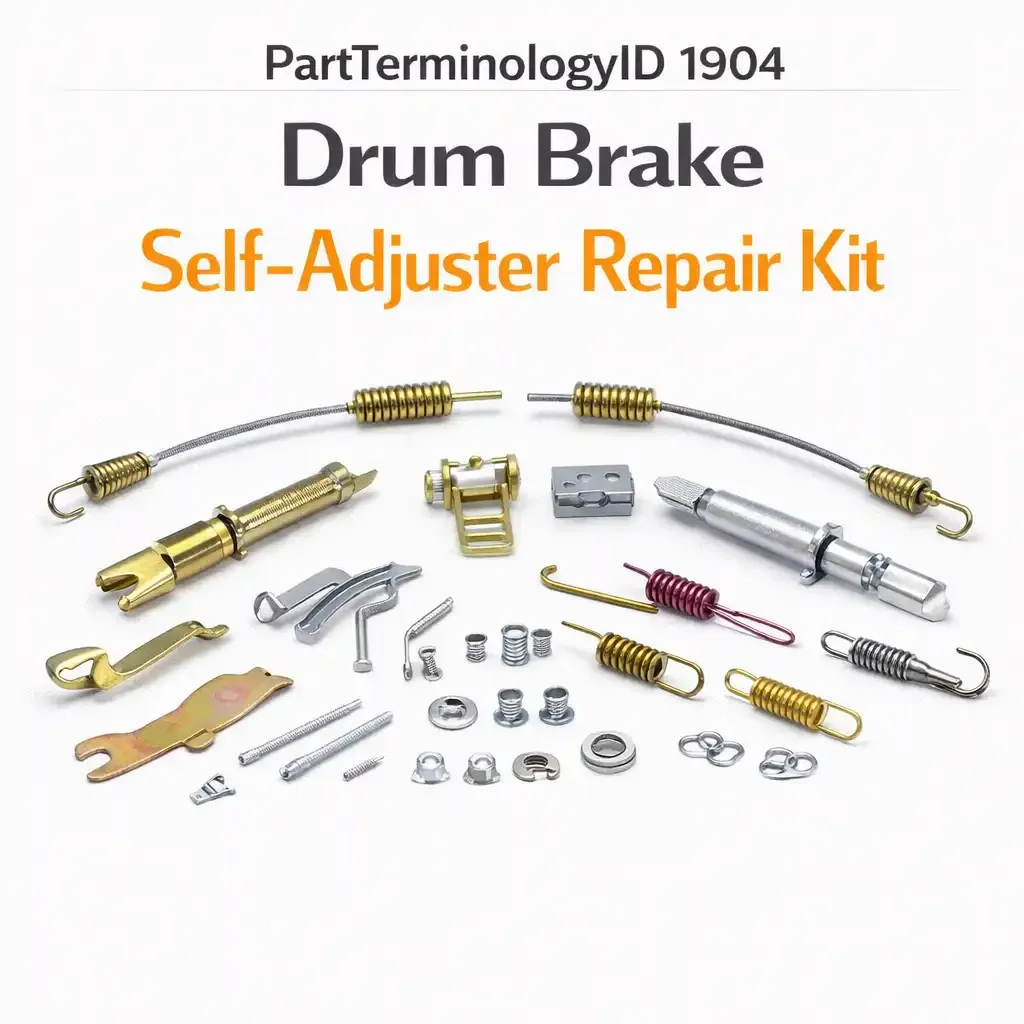
PartTerminologyID 1904, Drum Brake Self-Adjuster Repair Kit, is a replacement parts package for the existing self-adjusting mechanism inside a drum brake assembly. It replaces the wear items (cables, levers, springs, pivot clips, and adjuster links) that fatigue, stretch, corrode, or seize over time, causing the self-adjuster to stop functioning. When the adjuster stops working, the brake shoes wear without the mechanism taking up the slack, the shoe-to-drum clearance grows, and the brake pedal drops lower with each passing month until the driver notices they are pushing the pedal halfway to the floor before anything happens.
This is not a conversion kit. PartTerminologyID 1900, the Drum Brake Self-Adjuster Conversion Kit, changes the adjuster mechanism type. PartTerminologyID 1904 restores the existing adjuster mechanism to working condition using the same design the vehicle left the factory with. The distinction matters, because the two kits serve different buyers with different problems, and a listing that blurs the line between them ships the wrong kit to both.
Why This Part Generates Returns
Buyers order the wrong self-adjuster repair kit because:
they confuse it with the self-adjuster conversion kit (PartTerminologyID 1900) and receive parts for an adjuster type their vehicle does not have
they confuse it with the general drum brake hardware kit (PartTerminologyID 1772), which covers the service brake springs and hold down hardware but may or may not include the self-adjuster components
they do not verify whether their vehicle uses a cable-actuated or lever-actuated self-adjuster (the repair kit components are completely different between the two)
they do not verify left vs. right (the adjuster mechanism is side-specific, and the cable routing, lever orientation, and spring hook direction are mirrored)
they do not verify drum diameter (the adjuster screw length and cable/lever length are matched to the drum size)
they assume the kit includes the star wheel adjuster screw assembly when it only includes the actuating components (cable, lever, springs), or vice versa
they order the kit for a vehicle that has no self-adjuster at all (some older vehicles and base-model trucks used manual adjustment only)
Sellers get caught because "self-adjuster repair kit" is a category with inconsistent scope. One manufacturer's kit includes the cable, lever, adjuster link, pivot, and springs. Another manufacturer's kit includes only the cable and spring. A third includes the star wheel screw assembly but not the actuating components. The buyer orders based on the name, has no way to verify contents from the listing, and discovers during installation that the kit is either incomplete for their needs or contains parts they do not need.
Status in New Databases
PIES/PCdb: PartTerminologyID 1904, Drum Brake Self-Adjuster Repair Kit
PIES 8.0 / PCdb 2.0: No change
What This Kit Actually Contains
The contents vary by manufacturer, but a comprehensive self-adjuster repair kit for a cable-actuated system typically includes:
adjuster cable (the wire cable that connects the anchor pin to the adjuster lever)
cable guide or cable anchor bracket
adjuster lever (the stamped steel lever that engages the star wheel)
adjuster lever spring (pulls the lever away from the star wheel between adjustments)
adjuster lever pivot clip
cable return spring or cable tensioner
For a lever-actuated system (no cable), the kit typically includes:
adjuster lever
adjuster actuating link (the stamped or wire link that connects the lever to the shoe)
lever return spring
lever pivot hardware
override spring
Some kits also include the star wheel adjuster screw assembly (the threaded rod with star wheels that physically spreads the shoes). Others consider the star wheel a separate item because it rarely wears out (it seizes from corrosion, but the threads themselves do not wear under normal use).
The scope problem
The inconsistency in kit contents across manufacturers is the primary listing challenge. A buyer who needs a new adjuster cable and spring will be satisfied with a cable-and-spring-only kit. A buyer who needs the complete actuating mechanism will not. A buyer whose star wheel is frozen with corrosion needs the screw assembly, which may or may not be in the kit.
The listing must state the complete contents. Not "self-adjuster repair kit." Not "includes all necessary components." The actual list: cable, lever, spring, pivot, link, screw assembly (or not). Without that list, the buyer is ordering blind.
Cable-Actuated vs. Lever-Actuated: The Primary Split
Cable-actuated self-adjusters
Used on many GM, Ford, and Chrysler drum brakes from the 1960s through the 1990s. A braided steel cable runs from an anchor point on the backing plate, around the adjuster cable guide, and connects to the adjuster lever. When the brakes are applied in reverse (or on some designs, when the parking brake is applied), the cable pulls the lever, which rotates the star wheel one notch, expanding the shoes slightly to compensate for wear.
The cable is the most common failure point. It stretches, frays, or breaks. When the cable fails, the lever has no actuating force and the adjuster stops working.
Repair kit components for cable-actuated systems: cable, cable guide, lever, lever spring, pivot clip.
Lever-actuated self-adjusters
Used on many Asian and European vehicles and later domestic applications. Instead of a cable, a stamped steel lever and link mechanism actuates the star wheel directly through mechanical leverage when the shoes move outward during braking. There is no cable to stretch or fray.
The lever and link can seize from corrosion or lose their pivot action, but they generally last longer than cable-actuated systems.
Repair kit components for lever-actuated systems: lever, actuating link, lever return spring, pivot hardware.
A cable-actuated repair kit will not work on a lever-actuated system, and vice versa. The listing must specify which adjuster type the kit is designed for.
Left vs. Right
Self-adjuster mechanisms are side-specific for the same reason covered in PartTerminologyID 1900: the star wheel must rotate in the expanding direction when actuated, and the rotation direction is mirrored between left and right. The cable routing, lever arm orientation, and spring hook direction are all different.
A left-side repair kit installed on the right side will actuate the star wheel in the contracting direction, increasing clearance instead of reducing it. The brake pedal drops lower after every adjustment cycle instead of maintaining height.
Every listing must specify left, right, or sold as a pair.
Top Return Scenarios
Scenario 1: "This is a cable kit, my car has a lever adjuster"
Adjuster type mismatch.
Prevention language: "For vehicles with [cable-actuated / lever-actuated] self-adjusting drum brakes. Verify your self-adjuster type before ordering. Cable-actuated systems have a braided steel cable running from the anchor pin to the adjuster lever. Lever-actuated systems use a direct mechanical link with no cable."
Scenario 2: "Kit doesn't include the star wheel screw"
Buyer's star wheel is seized and needs replacement, but the kit only covers the actuating components.
Prevention language: "Kit includes: [itemized list]. Star wheel adjuster screw assembly: [included / not included]. If your star wheel is seized or damaged, order the adjuster screw assembly separately."
Scenario 3: "Wrong side"
Mirrored mechanism installed on the incorrect side.
Prevention language: "Position: [left / right / sold as pair]. Self-adjuster components are side-specific. Verify which side you are servicing."
Scenario 4: "I thought this was a conversion kit"
Buyer wanted to upgrade to a different adjuster type and received replacement parts for the existing type.
Prevention language: "This kit replaces wear items in your existing self-adjusting mechanism. It does not change the adjuster type. For kits that convert from one adjuster type to another, see PartTerminologyID 1900, Drum Brake Self-Adjuster Conversion Kit."
Scenario 5: "My brake hardware kit already included these parts"
Buyer ordered a drum brake hardware kit (PartTerminologyID 1772) that included self-adjuster components, then separately ordered this repair kit. Duplicate purchase.
Prevention language: "Before ordering, check whether your drum brake hardware kit (if purchased) includes self-adjuster components. Some hardware kits include the adjuster cable and spring. Others do not."
What to Include in the Listing
Core essentials
PartTerminologyID: 1904
component: Drum Brake Self-Adjuster Repair Kit
adjuster type: cable-actuated or lever-actuated
complete kit contents list (every component itemized)
star wheel adjuster screw: included or not included
quantity: 1 (per side)
Fitment essentials
year/make/model/submodel
axle position: front or rear
drum diameter and shoe width
position: left, right, or pair
self-adjuster actuation type (cable or lever)
Dimensional essentials
cable length (cable-actuated kits)
lever arm length
adjuster screw assembled length (if included)
spring free length and wire gauge
Image essentials
all kit contents laid out and labeled
installed diagram showing each component's position in the drum brake assembly
left vs. right orientation clearly indicated
cable or lever shown in context with star wheel engagement
Catalog Checklist for ACES/PIES Teams
PartTerminologyID = 1904
require adjuster type attribute (cable-actuated or lever-actuated)
require position attribute (left, right, pair)
require drum diameter and shoe width
require complete kit contents as a structured attribute
require star wheel inclusion attribute (yes/no)
differentiate from PartTerminologyID 1900 (conversion kit) and PartTerminologyID 1772 (general drum brake hardware kit)
flag overlap with drum brake hardware kits that include adjuster components to prevent duplicate purchasing
flag vehicles with no self-adjuster (manual adjust only) where this kit does not apply
FAQ (Buyer Language)
Is this the same as a drum brake hardware kit?
No. A drum brake hardware kit (PartTerminologyID 1772) typically covers the service brake springs, hold down pins, and retainers. Some hardware kits also include self-adjuster components, but many do not. This repair kit specifically targets the self-adjusting mechanism. Check your hardware kit contents before ordering both.
How do I know if my self-adjuster has failed?
If your brake pedal gradually drops lower over time despite the shoes having adequate lining thickness, the self-adjuster is likely not functioning. You can also inspect visually: pull the drum and try to rotate the star wheel with a brake spoon. If it turns freely, check whether the cable is intact and under tension (cable type) or whether the lever moves freely on its pivot (lever type).
Should I replace the star wheel too?
If the star wheel threads turn freely and the wheel teeth are not stripped, it can be reused. If the star wheel is seized (will not turn despite reasonable force), corroded through, or has stripped teeth, replace it. Some repair kits include the star wheel. Others do not.
Can I mix a new adjuster kit on one side with the old adjuster on the other?
It is recommended to replace both sides simultaneously. A new, properly functioning adjuster on one side paired with a worn, sluggish adjuster on the other will produce uneven rear brake adjustment and unbalanced braking, potentially causing the vehicle to pull to one side.
Cross-Sell Logic
Drum Brake Self-Adjuster Conversion Kit (PartTerminologyID 1900, for buyers who want to change adjuster type entirely)
Drum Brake Hardware Kit (PartTerminologyID 1772)
Star Wheel Adjuster Screw Assembly (if not included in kit)
Drum Brake Shoe Set
Wheel Cylinder
Brake Drum
Brake Fluid
Frame as "commonly ordered together for a complete drum brake rebuild with adjuster service."
Final Take for PartTerminologyID 1904
Drum Brake Self-Adjuster Repair Kit (PartTerminologyID 1904) is a kit with two identity problems. The first is the confusion with PartTerminologyID 1900 (the conversion kit that changes the adjuster type). The second is the overlap with PartTerminologyID 1772 (the general hardware kit that may or may not include the same components).
Clear both of those identity problems in the listing, then add the three essential attributes: adjuster type (cable or lever), side (left or right), and complete contents list. That is enough to prevent the buyer from ordering a cable kit for a lever system, installing a left kit on the right side, or duplicating components they already purchased in their hardware kit.