
Written by Arthur Simitian | PartsAdvisory
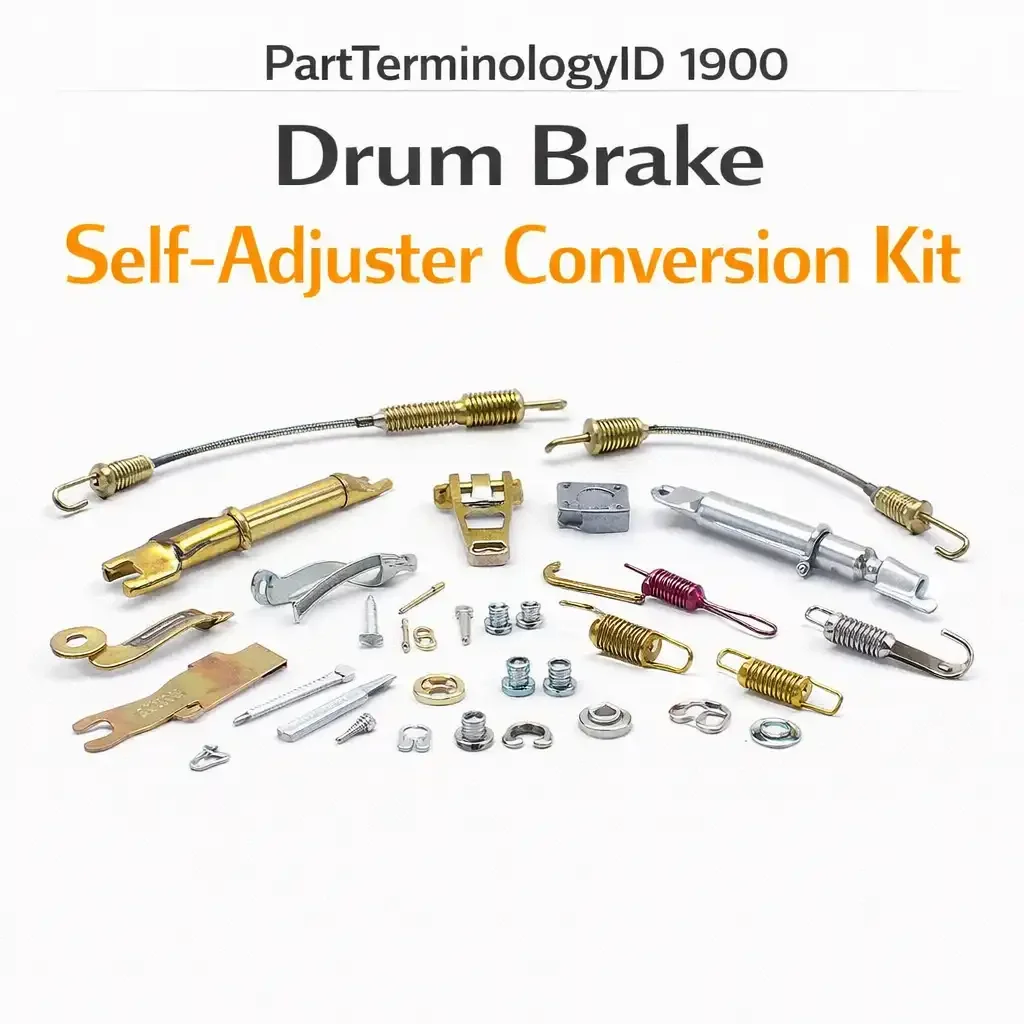
PartTerminologyID 1900, Drum Brake Self-Adjuster Conversion Kit, is a retrofit package that replaces the original manual or cable-actuated drum brake adjuster mechanism with an improved self-adjusting design. The kit converts a drum brake that requires periodic manual adjustment (crawling under the vehicle with a brake spoon through an access hole in the backing plate) into one that automatically takes up slack as the brake shoes wear, maintaining consistent pedal height and brake performance without manual intervention.
This is not a maintenance part. It is a design upgrade. The buyer is not replacing a failed self-adjuster. The buyer is installing a self-adjuster where one did not previously exist, or replacing an OE self-adjuster design that was unreliable, prone to seizing, or poorly engineered for the application.
The conversion kit market exists because many vehicles, particularly older trucks, muscle cars, and classic vehicles from the 1960s through the 1980s, shipped with self-adjuster mechanisms that were maintenance-intensive, corrosion-prone, or functionally inadequate. Some vehicles had no self-adjuster at all. The aftermarket responded with conversion kits that bolt into the existing drum brake assembly and provide reliable automatic adjustment using a different mechanism than the original.
Why This Part Generates Returns
Buyers order the wrong conversion kit because:
they do not verify which drum brake design their vehicle uses (the kit must match the backing plate layout, shoe type, anchor pin location, and adjuster mounting points)
they do not verify drum diameter and shoe width (the adjuster screw length and star wheel thread pitch are sized to the drum)
they assume the kit is universal when it is application-specific
they confuse a self-adjuster conversion kit with a standard self-adjuster repair kit (which replaces worn components in an existing self-adjuster, not converts from one type to another)
they do not verify whether the conversion changes the adjuster from the cable-actuated type to the lever-actuated type (or vice versa), which affects shoe orientation and return spring configuration
they miss left vs. right side differences (self-adjuster mechanisms are side-specific because the star wheel rotation direction and lever orientation are mirrored)
they do not verify what the kit includes and what it assumes is already present on the vehicle
Sellers get caught because "self-adjuster conversion kit" sounds like a bolt-on solution, and buyers expect it to be a complete, self-contained package. In reality, the kit may require the buyer to retain certain OE components (specific springs, pins, or anchor hardware) while replacing others. If the listing does not itemize what is in the kit and what the buyer must reuse from their existing setup, the buyer discovers gaps during installation.
Status in New Databases
PIES/PCdb: PartTerminologyID 1900, Drum Brake Self-Adjuster Conversion Kit
PIES 8.0 / PCdb 2.0: No change
What This Kit Actually Is
A drum brake self-adjuster conversion kit typically includes the adjuster mechanism (star wheel screw assembly, lever or cable, actuating link, and associated springs) plus any brackets, pins, or adapters needed to install the new mechanism in a backing plate that was not originally designed for it.
Two common conversion paths
Manual-to-self-adjusting: The vehicle's original drum brakes had no automatic adjuster. Shoe-to-drum clearance was set manually through an access hole in the backing plate or by pulling the drum. The conversion kit adds a self-adjusting mechanism (usually a star wheel with a lever or cable actuator) to the existing shoe and backing plate layout.
Cable-to-lever (or lever-to-cable) conversion: The vehicle's original self-adjuster used a cable-actuated mechanism that is known for stretching, fraying, or binding. The conversion kit replaces it with a lever-actuated mechanism (or vice versa) that is more reliable and easier to service.
What determines kit compatibility
The kit must interface with the existing backing plate, shoe webs, anchor pin, wheel cylinder, and return spring anchor points. These interfaces are fixed by the vehicle's drum brake design and cannot be modified without replacing the entire backing plate assembly. The conversion kit works within these constraints, adapting the new adjuster mechanism to the existing mounting points.
This means the kit is specific to:
the backing plate design (which is determined by vehicle, axle, and drum size)
the shoe type (long/short shoe, primary/secondary shoe orientation, web hole pattern)
the drum diameter and width (which determines the adjuster screw length)
the side of the vehicle (left or right, because the adjuster direction is mirrored)
What the kit is NOT
a standard drum brake hardware kit (PartTerminologyID 1772), which replaces wear items in the existing brake design without changing the adjuster type
a drum brake self-adjuster repair kit, which replaces worn springs, cables, or levers within the existing self-adjuster design
a complete drum brake backing plate assembly (the conversion kit works with the existing backing plate)
a drum brake shoe set
Left vs. Right: Why Every Kit Is Side-Specific
The self-adjuster star wheel must rotate in the correct direction to expand (take up clearance) when actuated by the lever or cable. Because the drum rotates in opposite directions on the left and right sides of the vehicle (both drums rotate forward when the vehicle moves forward, but "forward" is clockwise on one side and counterclockwise on the other), the adjuster mechanism is mirrored.
A left-side kit installed on the right side will adjust in the wrong direction. Instead of expanding to take up clearance as the shoes wear, it will contract, increasing clearance and dropping the brake pedal lower with every actuation. The brakes get worse instead of better, and the driver may not realize it until the pedal hits the floor.
Every listing must specify left, right, or sold as a left-right pair.
Top Return Scenarios
Scenario 1: "Kit doesn't fit my backing plate"
Adjuster mounting points, anchor pin location, or shoe web hole pattern do not match.
Prevention language: "Designed for [specific vehicle, axle type, backing plate design]. Verify your backing plate layout matches the kit's mounting requirements. This kit is not universal."
Scenario 2: "Wrong side"
Adjuster direction is backwards.
Prevention language: "Position: [left / right / sold as pair]. Self-adjuster mechanisms are side-specific. Installing on the wrong side causes the adjuster to contract instead of expand."
Scenario 3: "Kit doesn't include the springs I need"
Buyer expected a complete conversion and found that certain springs or hardware from the original setup must be retained.
Prevention language: "Kit includes: [itemized list]. This kit requires [specific OE components to be retained: primary return spring, shoe hold down hardware, anchor pin, etc.]. Verify you have these components before beginning installation."
Scenario 4: "I thought this was a repair kit for my existing adjuster"
Buyer has a functioning self-adjuster that needs new springs or a cable, and ordered a conversion kit instead.
Prevention language: "This is a conversion kit that changes the adjuster mechanism type. If your existing self-adjuster is the correct type and only needs replacement springs or cables, see drum brake self-adjuster repair kits."
Scenario 5: "Adjuster screw is too long/short for my drum"
Star wheel assembly length does not match drum diameter.
Prevention language: "Adjuster screw assembled length: [X inches]. Designed for [X-inch] drums. Verify drum diameter before ordering."
What to Include in the Listing
Core essentials
PartTerminologyID: 1900
component: Drum Brake Self-Adjuster Conversion Kit
conversion type: manual-to-self-adjusting, or cable-to-lever, or lever-to-cable
complete kit contents list (every component itemized)
components the buyer must retain from existing setup
quantity: 1 (per side)
Fitment essentials
year/make/model/submodel
axle position: front or rear
drum diameter and shoe width
backing plate design or OE part number cross-reference
position: left, right, or pair
original adjuster type being replaced
Dimensional essentials
adjuster screw assembled length
star wheel diameter
lever or cable length
spring free length and wire gauge (for included springs)
Image essentials
all kit contents laid out and labeled
installed diagram showing component positions on backing plate
left vs. right orientation clearly marked
adjuster screw length callout
Catalog Checklist for ACES/PIES Teams
PartTerminologyID = 1900
require position attribute (left, right, pair)
require drum diameter and shoe width
require conversion type attribute (what is being converted from and to)
require complete kit contents as a structured attribute
require "retained components" list (what the buyer must reuse)
differentiate from standard drum brake hardware kits (PartTerminologyID 1772) and self-adjuster repair kits
flag applications where the conversion changes shoe orientation or return spring configuration
FAQ (Buyer Language)
Do I need this kit for both sides?
Yes. If you are converting one side, convert both. Mismatched adjuster types between left and right will produce uneven brake adjustment and unbalanced braking. Order a left and right kit, or a pair.
Will this work with my existing brake shoes?
In most cases, yes. The conversion kit is designed to work with the standard shoe profile for your application. However, verify that your shoe web hole pattern matches the kit's lever or cable attachment points. Some conversions may require a specific shoe style.
Is this the same as a drum brake hardware kit?
No. A drum brake hardware kit (PartTerminologyID 1772) replaces wear items (springs, pins, retainers) within your existing brake design. A self-adjuster conversion kit changes the adjuster mechanism type. They are different products for different purposes.
How do I know if my vehicle needs this conversion?
If your drum brakes require frequent manual adjustment to maintain pedal height, if the OE self-adjuster cable is stretched or frayed and replacements are unavailable, or if the OE adjuster mechanism is a known reliability problem on your vehicle, the conversion kit is a practical upgrade.
Cross-Sell Logic
Drum Brake Shoe Set
Drum Brake Hardware Kit (PartTerminologyID 1772, for springs and hold down components the conversion does not replace)
Wheel Cylinder
Brake Drum
Brake Fluid
Frame as "commonly ordered together for a complete drum brake rebuild with adjuster upgrade."
Final Take for PartTerminologyID 1900
Drum Brake Self-Adjuster Conversion Kit (PartTerminologyID 1900) is a niche product with a loyal buyer base (classic car owners, truck owners, anyone tired of crawling under the vehicle with a brake spoon). The return prevention strategy is the same as any kit part: state exactly what is in the box, state what the buyer must retain from their existing setup, and specify the side.
Left or right. Drum diameter. Kit contents. Retained components. Those four details prevent a buyer from ordering a kit they cannot install, installing it on the wrong side, or discovering mid-job that they are missing a spring the kit assumed they already had.