
Disc Brake Rotor (PartTerminologyID 1896): Every Version, Every Tradeoff, and Why Your Listing Still Ships the Wrong One
Written by Arthur Simitian | PartsAdvisory
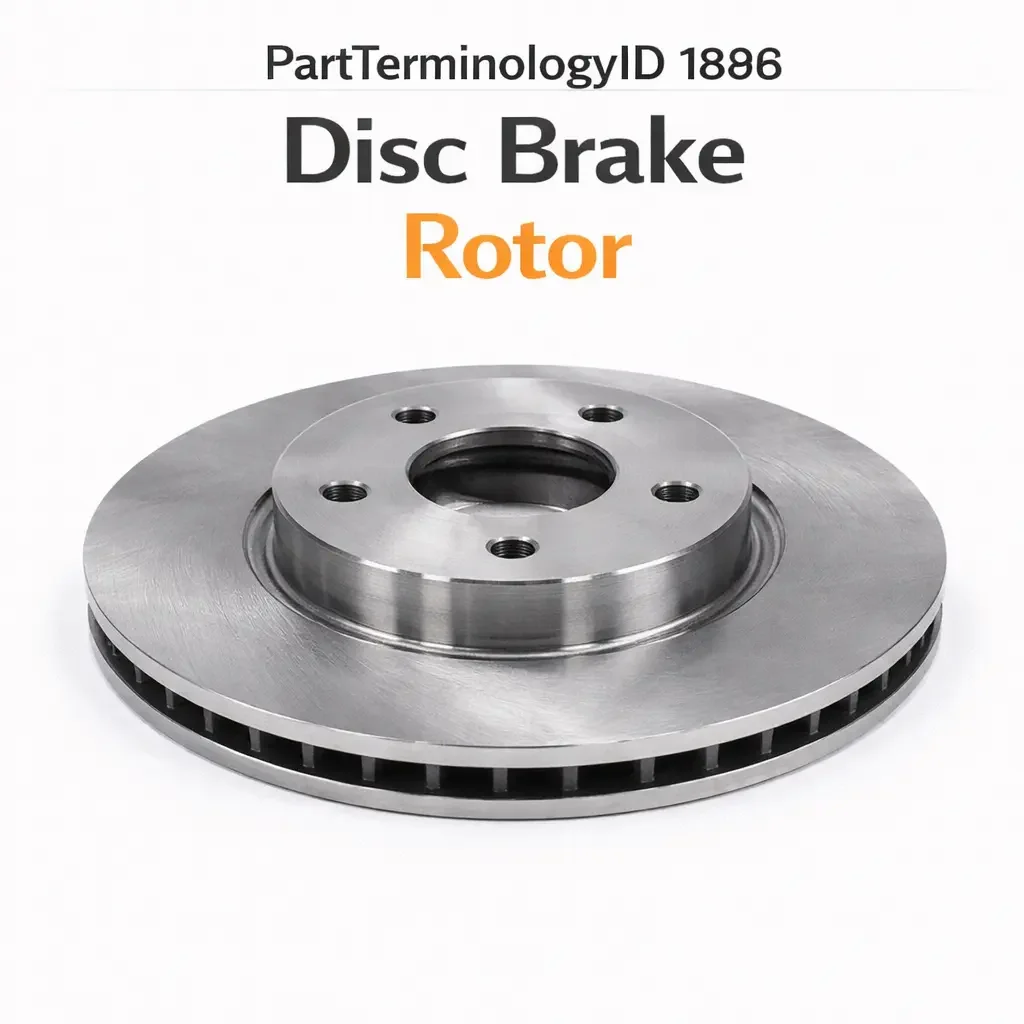
PartTerminologyID 1896, Disc Brake Rotor, is the flat, circular metal disc that the brake caliper clamps against to slow and stop the vehicle. It is the friction surface of the disc brake system. When the driver presses the brake pedal, hydraulic pressure pushes the caliper pistons against the brake pads, which squeeze the rotor. The kinetic energy of the moving vehicle is converted to heat through friction at the pad-to-rotor interface. The rotor absorbs that heat, dissipates it into the airstream, and the vehicle slows down.
It is the most frequently replaced brake component in the aftermarket. It is also one of the most return-prone, not because rotors are complicated to manufacture, but because the fitment variables are dense, the product options are wide, and buyers make purchasing decisions based on appearance, marketing claims, and price without understanding what they are actually getting or whether it matches what their vehicle requires.
This post covers every major rotor type available in the aftermarket, the real engineering tradeoffs behind each design, and the fitment variables that sellers must include in every listing to prevent the wrong rotor from reaching the wrong vehicle.
Why Disc Brake Rotors Generate Returns at Scale
Buyers order the wrong rotor because:
they do not verify the rotor outer diameter, which varies by brake package, model year, and trim level within the same vehicle
they do not verify vented vs. solid rotor construction (the rotor thickness and caliper bracket are designed for one or the other, and they do not interchange)
they do not verify the center bore diameter and hub pilot fit
they do not verify the bolt pattern and lug count (which should match but occasionally catches buyers swapping rotors across trims or aftermarket wheel setups)
they do not verify hat height (the offset between the friction surface and the mounting face), which determines whether the rotor sits in the correct plane relative to the caliper
they do not verify the minimum thickness specification and confuse it with the nominal (new) thickness
they order drilled, slotted, or drilled-and-slotted rotors without understanding the fitment and performance implications
they confuse front and rear rotors (front rotors are almost always larger and thicker than rears, and they are not interchangeable)
they miss ABS tone ring integration (some rotors have the ABS reluctor ring built into the rotor hat, and the ring tooth count must match the ABS sensor)
they miss directional rotor requirements (some slotted and vented rotors are directional, meaning left and right are different)
they order based on price and receive an economy rotor that does not meet the dimensional tolerances their vehicle requires
Sellers get caught because the typical rotor listing shows a diameter, a vehicle fitment, and maybe a photo. It does not show hat height, minimum thickness, vented vs. solid, directional vs. non-directional, or whether an ABS tone ring is integrated. The buyer orders, the rotor arrives, and it either does not fit the caliper bracket, sits in the wrong plane, wobbles because the center bore is wrong, or triggers an ABS fault because the tone ring is missing or has the wrong tooth count.
Status in New Databases
PIES/PCdb: PartTerminologyID 1896, Disc Brake Rotor
PIES 8.0 / PCdb 2.0: No change
Rotor Anatomy: What Every Seller Must Understand
Before discussing rotor types, sellers need to understand rotor anatomy, because every dimension on the rotor is a potential fitment variable.
Friction surface
The flat ring area where the brake pads make contact. The outer diameter and inner diameter of the friction surface define the swept area. Larger swept area means more braking torque and more heat dissipation capacity.
Hat (center section)
The raised center portion of the rotor that mates with the wheel hub. The hat contains the center bore (the hole that fits over the hub pilot) and the lug holes (where the wheel studs pass through). The hat height is the distance between the friction surface plane and the hub mounting face. This dimension determines where the rotor sits relative to the caliper, and it must match the vehicle's caliper bracket position exactly.
Vanes (on vented rotors)
Vented rotors are constructed with two friction surfaces separated by a gap containing radial or curved fins (vanes) that act as a centrifugal air pump. As the rotor spins, air is drawn through the center and expelled at the outer edge, cooling the rotor from the inside. The vane design (straight, curved, pillar) affects cooling efficiency and rotor weight.
Center bore
The precision-machined hole in the center of the hat that fits over the hub pilot. The center bore must match the hub diameter within close tolerances. Too loose, and the rotor is not properly centered on the hub, causing vibration. Too tight, and the rotor will not seat onto the hub.
ABS tone ring (on some rotors)
Some vehicles integrate the ABS reluctor ring (tone ring) into the rotor hat. The tone ring is a toothed ring that the ABS wheel speed sensor reads to determine wheel rotational speed. If the rotor is designed with an integrated tone ring, the replacement rotor must also have the tone ring with the correct tooth count. If the replacement rotor omits the tone ring, the ABS system will not function.
Rotor Construction Types
Solid rotors
A solid rotor is a single-piece disc of uniform thickness with no internal vanes or air passages. It is the simplest and lightest rotor construction. Solid rotors are typically used on rear brake applications (where braking loads are lower due to weight transfer) and on the front of very small, lightweight vehicles.
Solid rotors dissipate heat more slowly than vented rotors because they rely entirely on surface convection (heat radiating from the outer surfaces into the airstream) rather than internal airflow. They are adequate for light-duty applications but will overheat under repeated hard braking on heavier vehicles.
Fitment note for sellers: Solid and vented rotors are not interchangeable on the same vehicle, even if the outer diameter is the same. The vented rotor is significantly thicker (typically 20 to 28mm) than the solid rotor (typically 8 to 12mm), and the caliper bracket, caliper piston travel, and pad thickness are designed for one or the other. Installing a solid rotor where a vented rotor belongs will position the pads too far from the rotor, and the caliper pistons may not have enough travel to make full contact. Installing a vented rotor where a solid rotor belongs will jam against the caliper bracket.
Vented rotors (straight vane)
The most common rotor construction on modern passenger vehicles. Two friction surfaces are separated by straight radial vanes that channel cooling air from the center outward. Straight-vane rotors are non-directional (the same rotor can be used on the left or right side) because the vane geometry is symmetrical.
Straight-vane vented rotors provide a good balance of cooling performance, weight, structural strength, and manufacturing cost. They are the standard OE rotor on most front brake applications and many rear applications on larger vehicles.
Vented rotors (curved or directional vane)
Some OE and aftermarket rotors use curved vanes instead of straight vanes. The curved vane design improves airflow efficiency by acting as a more effective centrifugal pump, pulling more air through the rotor at a given speed. However, curved-vane rotors are directional: the vane curvature must trail the direction of rotation to pump air correctly. This means there is a left-side rotor and a right-side rotor, and they are not interchangeable.
Fitment note for sellers: If the rotor is directional (curved vane, and some slotted designs), the listing must specify left or right, or be sold as a pair with both sides. Installing a directional rotor on the wrong side reverses the airflow through the vanes, reducing cooling efficiency significantly. The brakes will still work, but they will run hotter under sustained use.
Vented rotors (pillar vane)
A less common design where the two friction surfaces are connected by individual cylindrical pillars instead of continuous radial fins. Pillar vane rotors offer high structural rigidity and are used on some heavy-duty and performance applications. They are typically non-directional.
Rotor Surface Treatments: Plain, Drilled, Slotted, and Drilled-and-Slotted
This is where the aftermarket gets noisy. Buyers see drilled and slotted rotors on race cars, in marketing photos, and on forum recommendation threads, and they assume that any upgrade from plain rotors is an improvement. The reality is more nuanced. Each surface treatment has engineering tradeoffs, and the "best" rotor depends on the vehicle, the driving conditions, and what problem the buyer is actually trying to solve.
Plain (smooth) rotors
A plain rotor has a smooth, uninterrupted friction surface on both sides. This is the standard OE rotor design on the vast majority of passenger vehicles.
Advantages:
Maximum friction surface area. Every square millimeter of the rotor face is available for pad contact, which maximizes braking torque and distributes heat evenly across the surface.
Maximum structural integrity. No holes or slots that create stress risers in the casting. Plain rotors are the least likely to crack under thermal stress.
Longest pad life. The smooth surface does not abrade the pads any faster than necessary. Pad wear is determined by friction material chemistry and braking demand, not by rotor surface features.
Quietest operation. No slots or holes to generate noise, vibration, or pulsation.
Lowest cost. Plain rotors are the simplest to manufacture.
Disadvantages:
Under extreme conditions (sustained mountain descending, track driving, towing heavy loads on grades), plain rotors can develop a thin layer of brake pad material transfer on the friction surface called pad glazing. This layer reduces the friction coefficient and causes brake fade (reduced stopping power despite full pedal pressure). Plain rotors rely entirely on the pad formulation and the driver's technique to manage this condition.
Gas and dust outgassing from the pad friction material has no dedicated escape path. On aggressive braking, gases can form a thin boundary layer between the pad and rotor that momentarily reduces friction. This is a real phenomenon, but on modern street pads it is minimal compared to the outgassing that occurred with older asbestos-based pad formulations.
Who should buy plain rotors:
Daily drivers. Commuter vehicles. Vehicles that never see a track, never tow, and never descend sustained mountain grades. This is the overwhelming majority of vehicles on the road. For these applications, plain rotors are the correct choice. They provide the best pad life, the quietest operation, and the most predictable performance. There is no engineering reason to "upgrade" from a plain rotor on a vehicle that never exceeds the thermal capacity of the OE brake system.
Drilled rotors (cross-drilled)
A drilled rotor has a pattern of holes bored through the friction surface from one side to the other. The holes are typically arranged in a radial pattern across the friction surface.
Advantages:
Gas evacuation. The holes provide escape paths for gases and debris generated at the pad-to-rotor interface. This was the original engineering purpose of drilled rotors, developed in an era when brake pads produced significantly more gas under heat than modern formulations do.
Wet weather performance. Water on the rotor surface can momentarily reduce friction (the first brake application in rain feels less effective). The holes help channel water away from the friction surface, restoring grip slightly faster than a plain rotor.
Aesthetics. Drilled rotors are visible through open-spoke wheels and look aggressive. This is a meaningful purchase motivator in the aftermarket, even though it has nothing to do with braking performance.
Marginal weight reduction. The material removed by drilling reduces rotor mass slightly, which reduces unsprung weight and rotational inertia. The effect is real but small (typically less than a pound per rotor).
Disadvantages:
Stress risers. Every hole in the rotor is a stress concentration point. Under severe thermal cycling (repeated hard braking from high speed), cracks can initiate at the edges of the drilled holes and propagate across the friction surface. This is not a theoretical risk. It is a documented failure mode on drilled rotors subjected to track use or heavy-duty braking. The rotor does not fail catastrophically (it does not shatter), but the cracks reduce braking effectiveness and require replacement.
Reduced friction surface area. The holes remove material from the contact patch, reducing the total area available for pad contact. This marginally reduces maximum braking torque.
Accelerated pad wear. The leading edge of each hole acts as a scraper against the pad face. Over thousands of miles, this accelerates pad wear compared to a smooth rotor. Some pads develop a scalloped wear pattern corresponding to the hole positions.
Noise potential. Drilled holes can create a rhythmic pulsation or humming noise as the pad passes over the hole pattern, particularly as the pad wears and the contact geometry changes.
Who should buy drilled rotors:
Buyers who prioritize appearance through open-spoke wheels and who drive in wet climates where marginally faster wet-to-dry brake recovery is desirable. Drilled rotors are not recommended for track use, repeated hard braking, or any application where thermal cracking is a concern. On a daily driver that never approaches the rotor's thermal limits, drilled rotors are cosmetically appealing and functionally equivalent to plain rotors, with the tradeoff of slightly faster pad wear and higher cost.
Slotted rotors
A slotted rotor has shallow grooves (slots) machined into the friction surface, running from the inner diameter toward the outer diameter in a curved or straight pattern. The slots do not pass through the rotor (unlike drilled holes); they are surface features only.
Advantages:
Gas and debris evacuation. Like drilled holes, slots provide channels for gases and brake dust to escape from under the pad. Slots are more effective than holes for this purpose because they create a continuous channel rather than isolated escape points.
Pad surface conditioning. The leading edge of each slot acts as a gentle scraper that continuously removes the top layer of glazed pad material, keeping the pad surface fresh and maintaining a consistent friction coefficient. This is the primary engineering benefit of slotted rotors: they resist pad glazing under sustained heavy braking.
No stress risers from through-holes. Because slots are shallow surface features rather than through-holes, they do not create the same crack initiation points that drilled holes do. Slotted rotors are significantly more resistant to thermal cracking than drilled rotors.
Structural integrity maintained. The rotor's full cross-sectional thickness is preserved between the slots, maintaining structural strength.
Disadvantages:
Accelerated pad wear. The slot edges scrape the pad face with every rotation. Pad wear is noticeably faster with slotted rotors than with plain rotors. Depending on pad formulation and driving style, pad life may be reduced by 15 to 30 percent.
Noise. Slots can generate a slight swooshing or scraping sound, particularly with certain pad compounds. The noise is typically less objectionable than drilled rotor noise but more noticeable than plain rotors.
Cost. Slotted rotors cost more than plain rotors due to the additional machining step.
Slightly reduced friction surface area. The slots remove a small amount of contact area, though less than drilled holes.
Who should buy slotted rotors:
Drivers who subject their brakes to sustained heavy use: towing, mountain driving, spirited driving on canyon roads, autocross, or occasional track days. Slotted rotors are the performance rotor choice that actually works as advertised, because their primary benefit (pad surface conditioning to prevent glazing) addresses a real failure mode that occurs under repeated hard braking. They are the rotor that professional brake engineers recommend when a customer says they want "better brakes" and actually uses them hard enough to benefit.
Drilled and slotted rotors
A rotor that combines both cross-drilled holes and machined slots on the same friction surface.
Advantages:
Maximum gas and debris evacuation. The combination of holes and slots provides the most aggressive pad surface management of any rotor design.
Appearance. Drilled and slotted rotors are the most visually dramatic option, which matters in the aftermarket cosmetic market.
Disadvantages:
All the disadvantages of both designs combined. The drilled holes create stress risers. The slots accelerate pad wear. Together, they produce the fastest pad wear rate, the highest cracking risk, the most noise, and the most reduced friction surface area of any rotor configuration.
Highest cost. Drilled and slotted rotors require two additional machining operations (drilling and slotting) on top of the base casting, making them the most expensive option.
Overkill for street use. The gas evacuation provided by either drilling or slotting alone exceeds what any modern street pad produces under normal driving. Combining both provides no additional benefit on the street and simply adds the drawbacks of each.
Who should buy drilled and slotted rotors:
Buyers who prioritize appearance above all other considerations. From a pure braking performance standpoint, drilled and slotted rotors offer no advantage over slotted-only rotors and add the thermal cracking risk of drilled rotors. They are a cosmetic product marketed as a performance product. If a buyer wants performance, slotted-only is the better engineering choice. If a buyer wants appearance, drilled and slotted delivers the look.
Dimpled rotors
A less common variant where the rotor surface has shallow, rounded dimples pressed or machined into the surface instead of through-holes. Dimpled rotors attempt to provide the gas evacuation benefits of drilled rotors without the through-hole stress risers. The dimples are blind (they do not pass through the rotor).
Advantages over drilled: No through-hole stress concentration. Better thermal crack resistance. Maintains more structural material.
Disadvantages: Less effective gas evacuation than either drilled or slotted (the blind dimples trap debris rather than channeling it away). Less visual impact than drilled rotors. Limited aftermarket availability.
Who should buy dimpled rotors: Buyers who like the look of drilled rotors but are concerned about cracking. Dimpled rotors are a compromise product that splits the difference between plain and drilled.
Rotor Material and Coating Options
Standard cast iron (gray iron)
The overwhelming majority of brake rotors are cast from gray iron (a specific grade of cast iron with graphite flake inclusions that provide self-lubricating properties and excellent vibration damping). Gray iron is the benchmark rotor material. It has high heat capacity, good thermal conductivity, excellent friction characteristics with all common pad formulations, and is inexpensive to cast and machine.
All OE rotors on non-exotic passenger vehicles are gray iron. Any aftermarket rotor that does not specify its material is gray iron.
High-carbon cast iron
Some premium aftermarket and OE-upgrade rotors use a high-carbon variant of gray iron with a higher carbon content (typically 3.6 to 3.8 percent vs. 3.2 to 3.4 percent for standard gray iron). The higher carbon content improves the rotor's resistance to thermal cracking and reduces the tendency to develop hard spots (cementite formations caused by uneven cooling during manufacturing or by extreme thermal events during use).
High-carbon rotors are a meaningful upgrade for vehicles subjected to heavy braking loads. They cost more than standard gray iron but less than exotic materials. They are compatible with all standard brake pads.
Coated rotors
Many aftermarket rotors are available with a protective coating on the non-friction surfaces (hat, vanes, inner edges). Common coatings include:
E-coating (electrocoat): A thin polymer coating applied by electrical deposition. Provides corrosion protection for the hat and vane areas that are not swept by the pads. Reduces the "rusty rotor" appearance on vehicles with open-spoke wheels.
Geomet / zinc-aluminum flake coating: A more durable corrosion-resistant coating. Provides longer-lasting protection than e-coat and is increasingly common on OE rotors.
Black oxide / black zinc: A thin conversion coating that provides moderate corrosion resistance and a uniform dark appearance.
Coated rotors are functionally identical to uncoated rotors in terms of braking performance. The coating wears off the friction surfaces immediately upon first brake application. The benefit is cosmetic (no visible rust on the hat through open wheels) and longevity (reduced corrosion of the hat and vanes in salt-belt environments, which can extend rotor life by preventing structural rust-through of the vane area).
Fitment note for sellers: Coated vs. uncoated is not a fitment split. Any coated rotor that matches the dimensional specifications of the application will function correctly. However, some buyers specifically want coated rotors (for appearance), and some specifically want uncoated (for lower cost). The listing should state whether the rotor is coated and what type of coating is applied.
Carbon-ceramic rotors
Carbon-ceramic (carbon silicon carbide, or CSiC) rotors are composite rotors used on high-end sports cars and supercars (Porsche PCCB, Ferrari CCM, Lamborghini, some AMG and BMW M models). They are made from a carbon fiber and silicon carbide matrix that is lighter than cast iron, more resistant to thermal fade, and virtually immune to corrosion.
Carbon-ceramic rotors are extraordinarily expensive (often $2,000 to $8,000 per rotor) and require specific brake pads formulated for the ceramic surface. Standard metallic or semi-metallic pads will damage a carbon-ceramic rotor. The rotors also have different thermal characteristics (they perform poorly when cold and require a warm-up period, but resist fade better than any iron rotor when hot).
Fitment note for sellers: Carbon-ceramic rotors are not interchangeable with cast iron rotors. The caliper, pad formulation, brake fluid specification, and sometimes the ABS calibration are different on vehicles equipped with carbon-ceramic brakes. A listing for a cast iron replacement rotor that includes vehicles originally equipped with carbon-ceramic brakes will generate returns from buyers who discover the rotor is the wrong material. The listing must specify the brake package.
Two-piece (floating) rotors
Two-piece rotors separate the hat (center section) from the friction ring (outer disc). The two pieces are connected by drive pins or bobbins that allow the friction ring to expand and contract thermally without warping the hat or creating stress at the hat-to-ring transition.
Two-piece rotors are primarily a motorsport and high-performance aftermarket product. They are lighter than one-piece rotors (aluminum hat with iron friction ring reduces unsprung weight) and resist thermal distortion better under extreme use. They are significantly more expensive and are not necessary for street driving.
Fitment note for sellers: Two-piece rotors may have different hat heights, center bore dimensions, or overall thickness compared to OE one-piece rotors. The listing must include all dimensional specifications and should note whether the rotor is designed as a direct replacement for the OE one-piece unit or requires additional modifications (caliper spacers, different mounting hardware).
The Fitment Variables That Drive Returns
Beyond rotor type, the following dimensions must be in every listing:
Outer diameter
The most basic fitment dimension. Rotor diameter varies by brake package within the same vehicle model. A base trim with 15-inch wheels may use a 280mm rotor. The sport trim with 17-inch wheels may use a 320mm rotor. Both are "the same car." The rotors are not the same.
Thickness (nominal and minimum)
Nominal thickness is the rotor's measurement when new. Minimum thickness (often stamped on the rotor or cast into the hat) is the thinnest the rotor can wear before it must be replaced. The caliper and pads are designed for a rotor within this thickness range. If the replacement rotor's nominal thickness does not match the OE specification, the caliper piston position, pad contact, and pedal travel will be affected.
Hat height (offset)
The distance between the rotor friction surface plane and the hub mounting face. This dimension positions the rotor laterally within the caliper bracket. If the hat height is wrong, the rotor will be offset to one side of the caliper, and the pads will not contact the rotor evenly (or at all on one side).
Hat height is the most commonly omitted rotor dimension in aftermarket listings, and it is one of the most common causes of returns. Two rotors with the same outer diameter and thickness but different hat heights are not interchangeable.
Center bore
The hub pilot diameter. Must match the vehicle's hub within close tolerances. An undersized center bore will not fit over the hub. An oversized center bore will allow the rotor to sit off-center, causing vibration.
Lug hole count, bolt circle diameter, and lug hole diameter
Must match the vehicle's wheel stud pattern. While this is rarely a mismatch on application-specific rotors (they are manufactured for the correct bolt pattern), it becomes a concern when buyers cross-reference rotors across different vehicles or when universal-fitment rotors are marketed.
Vented vs. solid
As discussed above, these are not interchangeable. The listing must state which construction the rotor uses.
Directional vs. non-directional
If the rotor has curved vanes or directional slots, the listing must specify left or right (or sold as a pair).
ABS tone ring
If the rotor includes an integrated ABS tone ring, the listing must state the tooth count and confirm ABS compatibility. If the rotor does not include a tone ring and the vehicle requires one, the buyer will have an ABS fault after installation.
Number of mounting holes vs. lug holes
Some rotors have separate mounting screw holes (small Phillips or hex screws that hold the rotor to the hub during wheel-off service) in addition to the lug bolt holes. The presence, number, and position of these mounting screw holes can vary.
What Buyers Actually Need (A Seller's Decision Framework)
Sellers listing brake rotors face a product breadth decision: which rotor types to offer for each application. Here is a practical framework:
For volume and lowest return rate: List plain (smooth), OE-equivalent rotors with all dimensional specifications. This covers the vast majority of buyers who are replacing worn rotors on daily drivers. Plain rotors have the fewest subjective complaints (no noise, no accelerated pad wear, no cracking) and the broadest buyer satisfaction.
For the upgrade market: List slotted rotors as the performance option. Slotted rotors are the most defensible "upgrade" from an engineering standpoint, and they have a lower complaint rate than drilled rotors (no cracking issues). Pair slotted rotor listings with a clear note about accelerated pad wear so the buyer's expectation is set correctly.
For the appearance market: List drilled or drilled-and-slotted rotors with explicit disclaimers about thermal cracking risk under heavy use and accelerated pad wear. These buyers are purchasing on aesthetics, and the listing should be transparent about the tradeoffs so the buyer does not file a warranty claim when the rotors develop hairline cracks after a track day.
For specialty applications: List high-carbon, coated, or two-piece rotors with full dimensional specs and compatibility notes. These are low-volume, high-margin products for informed buyers who know what they want.
Top Return Scenarios
Scenario 1: "Rotor diameter is wrong"
Buyer's vehicle has a different brake package than the listing covers.
Prevention language: "Rotor outer diameter: [X mm]. Fits vehicles with [standard / sport / heavy-duty] brake package. Verify your rotor diameter before ordering. Measure your existing rotor or check your vehicle's brake package option code."
Scenario 2: "Rotor doesn't sit right in the caliper"
Hat height mismatch.
Prevention language: "Hat height (offset): [X mm]. This dimension determines rotor position within the caliper bracket. Verify hat height matches your original rotor."
Scenario 3: "Rotor is too thick/thin for my caliper"
Vented rotor shipped for a solid rotor application, or vice versa.
Prevention language: "Rotor construction: [vented / solid]. Nominal thickness: [X mm]. Minimum thickness: [X mm]. Vented and solid rotors are not interchangeable."
Scenario 4: "ABS light came on after installation"
Replacement rotor missing the integrated ABS tone ring.
Prevention language: "ABS tone ring: [integrated, X teeth / not included]. If your vehicle has ABS with a tone ring on the rotor, verify the replacement includes the correct ring."
Scenario 5: "Drilled rotor cracked after track use"
Buyer used drilled rotors on a track day and developed thermal cracks.
Prevention language: "Cross-drilled rotors may develop hairline cracks under severe thermal cycling (track use, sustained mountain descending, repeated high-speed braking). This is a characteristic of drilled rotor design, not a defect. For high-thermal-demand applications, consider slotted or plain rotors."
Scenario 6: "I installed both rotors but the slots face the wrong direction on one side"
Buyer received two identical directional rotors instead of a left/right pair.
Prevention language: "Directional rotor. Position: [left / right / sold as left-right pair]. Slot direction must match the direction of rotor rotation on the installed side."
What to Include in the Listing
Core essentials
PartTerminologyID: 1896
component: Disc Brake Rotor
rotor type: plain, drilled, slotted, drilled and slotted, dimpled
construction: vented or solid
material: standard gray iron, high-carbon iron, carbon-ceramic
coating: none, e-coat, Geomet, zinc, black oxide
condition: new
quantity: 1 (or 2 if sold as a pair)
Fitment essentials
year/make/model/submodel
position: front or rear
brake package: standard, sport, heavy-duty, performance, carbon-ceramic
ABS tone ring: integrated (with tooth count) or not included
directional: yes (specify left/right) or non-directional
production date split (if rotor size changed mid-year)
Dimensional essentials (all mandatory)
outer diameter (mm)
nominal thickness (mm)
minimum thickness (mm)
hat height / offset (mm)
center bore diameter (mm)
lug hole count and bolt circle diameter
vane count (vented rotors)
weight (useful for buyers comparing to OE)
Image essentials
friction surface showing rotor type (plain, drilled, slotted)
hat showing center bore and lug holes
side profile showing thickness and hat height
ABS tone ring visible (if integrated)
coating coverage visible
dimensional callouts on at least one image
Catalog Checklist for ACES/PIES Teams
PartTerminologyID = 1896
require outer diameter, nominal thickness, and hat height as mandatory attributes (these three dimensions prevent the majority of fitment returns)
require vented/solid attribute
require front/rear position
require ABS tone ring attribute (integrated with tooth count, or not included)
require directional/non-directional attribute with left/right designation if directional
require brake package qualifier where multiple packages exist for the same vehicle
require rotor type attribute (plain, drilled, slotted, drilled and slotted)
require material attribute
require coating attribute
enforce production date splits where rotor specification changed mid-year
flag vehicles where carbon-ceramic brakes were an option (these require a different rotor and the cast iron listing must exclude them)
FAQ (Buyer Language)
Should I buy drilled, slotted, or plain rotors?
For daily driving, plain rotors are the best choice. They provide the longest pad life, quietest operation, and most predictable performance. If you tow, drive aggressively on mountain roads, or do occasional track days, slotted rotors offer real performance benefits by preventing pad glazing. Drilled and drilled-and-slotted rotors are primarily cosmetic upgrades that look good through open wheels but offer no performance advantage over slotted rotors and add cracking risk.
Will drilled rotors crack?
They can, under severe thermal cycling. If you drive on the street in normal conditions, drilled rotors are unlikely to crack during their service life. If you do track days, tow heavy loads on grades, or brake hard repeatedly from high speed, drilled rotors are more likely to develop hairline cracks than plain or slotted rotors. This is a design characteristic, not a defect.
Do slotted rotors wear pads faster?
Yes. The slot edges scrape the pad surface with each rotation, accelerating wear. Expect 15 to 30 percent shorter pad life with slotted rotors compared to plain rotors, depending on pad formulation and driving style. This is the tradeoff for the pad surface conditioning that prevents glazing.
What is hat height and why does it matter?
Hat height is the distance between the friction surface and the hub mounting face. It determines where the rotor sits laterally within the caliper. If the hat height is wrong, the rotor will be offset, and the pads will not contact it properly. Always verify hat height when ordering a replacement rotor.
Do I need to replace rotors in pairs?
It is recommended to replace rotors in axle pairs (both fronts or both rears) to maintain even braking performance. If only one rotor is worn or damaged, replacing both ensures consistent friction characteristics and thickness on both sides. At minimum, the new rotor should be within specification of the opposite side's remaining rotor.
My new rotors are rusty out of the box. Are they defective?
No. Uncoated cast iron rotors develop surface rust within hours of exposure to air. This is normal and does not affect performance. The rust on the friction surfaces will be removed during the first few brake applications. If you want rotors that resist visible rust on the hat and non-friction surfaces, order coated rotors (e-coat or Geomet).
Do I need to bed in (break in) new rotors?
Yes. New rotors and pads require a bed-in procedure to transfer an even layer of pad material onto the rotor surface. This layer is essential for optimal friction and quiet operation. A typical bed-in procedure involves a series of moderate stops from 30 to 40 mph followed by a cool-down period. Skipping bed-in can result in uneven pad transfer, vibration, and noise.
Cross-Sell Logic
Disc Brake Pad Set (matched to rotor type: standard pads for plain rotors, performance pads for slotted/drilled)
Brake Caliper (if caliper is seized or leaking)
Brake Caliper Bracket / Mounting Hardware
Brake Hardware Kit (pad clips, shims, anti-rattle springs)
Brake Rotor Mounting Screws
Brake Cleaner
Brake Fluid (correct DOT specification)
Hub Assembly or Wheel Bearing (if hub runout is causing rotor vibration)
Frame as "complete brake service: rotors, pads, hardware, and fluid. Replace pads whenever rotors are replaced."
The pad cross-sell is critical. Buyers who upgrade to slotted or drilled rotors should also upgrade to a pad formulation that is compatible with the increased thermal demands. Pairing an aggressive slotted rotor with a bargain-bin economy pad produces noise, dust, and uneven wear. The listing or product recommendation should note pad compatibility.
Final Take for PartTerminologyID 1896
Disc Brake Rotor (PartTerminologyID 1896) is the highest-volume brake replacement part in the aftermarket and one of the most return-prone because the fitment variables are layered: diameter, thickness, hat height, vented vs. solid, ABS tone ring, directional vs. non-directional, and brake package. Miss any one of those dimensions and the rotor does not fit.
On top of the fitment variables, the product type decision (plain, drilled, slotted, drilled and slotted) creates a secondary return stream driven by mismatched expectations. Buyers who install drilled rotors and develop cracks file warranty claims. Buyers who install slotted rotors and burn through pads 30 percent faster leave negative reviews. Both outcomes are preventable with listing language that sets expectations about what each rotor type actually does and what it trades off to do it.
Three dimensions prevent the majority of fitment returns: outer diameter, hat height, and nominal thickness. One attribute prevents the majority of ABS returns: tone ring inclusion with tooth count. One sentence prevents the majority of product-type complaints: a clear, honest statement of the tradeoffs specific to the rotor surface treatment.
That is the listing strategy for the most replaced brake part in the aftermarket. Dimensions, ABS, and honesty.