
Written by Arthur Simitian | PartsAdvisory
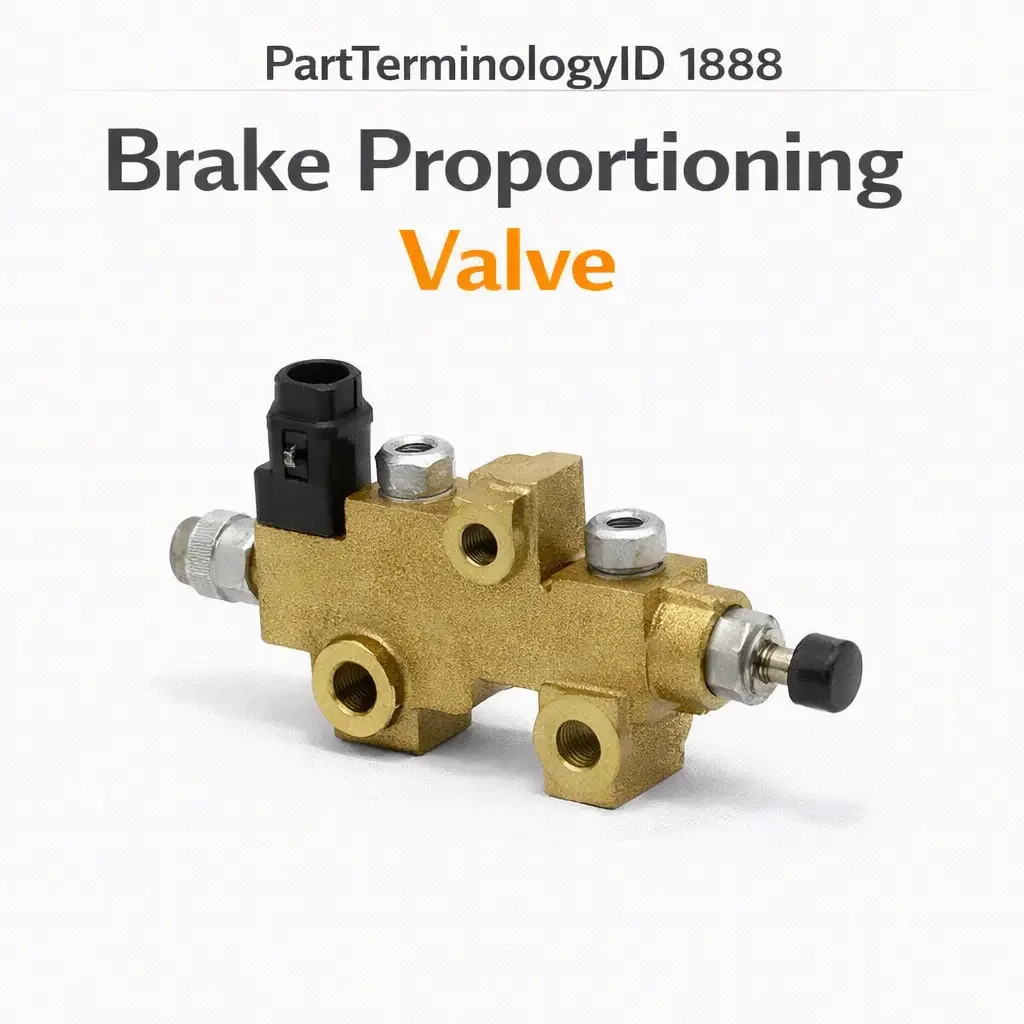
PartTerminologyID 1888, Brake Proportioning Valve, is a hydraulic pressure regulator in the brake system that reduces brake line pressure to the rear brakes relative to the front brakes during hard stops. It exists because of weight transfer. When a vehicle brakes, weight shifts forward, loading the front tires and unloading the rears. If full system pressure reached the rear brakes during a hard stop, the lighter rear wheels would lock before the fronts, causing the vehicle to swap ends.
The proportioning valve prevents this by limiting the maximum pressure the rear circuit can receive. Below a certain threshold (the split point), front and rear pressure rise equally. Above that threshold, the valve restricts rear pressure to a fraction of front pressure, keeping the rear wheels rotating while the fronts do the heavy braking work.
It is a critical safety component. It is also a return problem, because "brake proportioning valve" describes at least three different physical components depending on the vehicle, and the listings rarely specify which one.
The Three Faces of PartTerminologyID 1888
Standalone proportioning valve
An inline valve plumbed into the rear brake circuit, typically mounted under the vehicle on the frame rail or near the rear axle. It has an inlet port (from the master cylinder) and an outlet port (to the rear brakes). It contains a spring-loaded piston that limits rear pressure above the split point. This is the simplest version and is common on older vehicles and trucks.
Load-sensing proportioning valve
A proportioning valve connected to the rear suspension by a lever or spring. As the rear of the vehicle squats under load (heavy cargo, towing), the lever adjusts the valve's split point to allow more rear brake pressure. When the vehicle is lightly loaded, the valve restricts rear pressure more aggressively. This design is common on trucks, vans, and SUVs where payload variation is significant.
The load-sensing version has a mounting bracket with a specific geometry and a linkage arm that connects to the rear axle or suspension. The bracket mounting location, arm length, and spring preload are vehicle-specific. A proportioning valve with the wrong arm length or bracket geometry will set the split point incorrectly, either over-braking or under-braking the rear wheels for the vehicle's actual weight.
Combination valve
Many vehicles do not use a standalone proportioning valve. Instead, the proportioning function is integrated into a combination valve that also includes a metering valve (which delays front disc brake application until the rear drums overcome their return spring preload) and a pressure differential switch (which illuminates the brake warning light if one circuit loses pressure). The combination valve is a single block with multiple ports and internal functions.
If the buyer's vehicle uses a combination valve and they order a standalone proportioning valve, the part will not connect. If the vehicle uses a standalone valve and the buyer receives a combination valve, they have ports they cannot use and a mounting configuration that does not match.
The listing must state which type is being sold.
Why This Part Generates Returns
Buyers order the wrong proportioning valve because:
they do not know whether their vehicle uses a standalone valve, a load-sensing valve, or a combination valve
they confuse the proportioning valve with the brake hydraulic tee (PartTerminologyID 1824), which is a passive junction with no internal valving
they miss the ABS split (on ABS-equipped vehicles, the proportioning function is often handled internally by the ABS control module, and there is no separate proportioning valve at all)
they do not verify port count, port thread size, and port location on standalone and combination valves
they do not verify the linkage arm length and bracket geometry on load-sensing valves
they order a proportioning valve for an ABS-equipped vehicle that does not have one
Sellers get caught because the listing says "brake proportioning valve" without specifying standalone, load-sensing, or combination, and without noting whether the vehicle's ABS system eliminates the need for a separate valve entirely.
Status in New Databases
PIES/PCdb: PartTerminologyID 1888, Brake Proportioning Valve
PIES 8.0 / PCdb 2.0: No change
The ABS Knockout
This is the single most important catalog note for this PartTerminologyID.
On most vehicles equipped with ABS, the ABS control module (PartTerminologyID 1844) handles rear brake pressure modulation electronically through the ABS hydraulic modulator. There is no mechanical proportioning valve in the brake system. The ABS system reads wheel speed at all four corners and modulates pressure dynamically, which is far more precise than a fixed or load-sensing mechanical valve.
This means that for many vehicles, the proportioning valve only exists on the non-ABS version. If a seller lists a proportioning valve for a year/make/model range that includes both ABS and non-ABS vehicles without specifying the ABS split, buyers with ABS-equipped vehicles will order a part their car does not use and has no place to install.
Some vehicles retained a mechanical proportioning valve even with ABS, particularly trucks with load-sensing valves. But this is the exception, not the rule. The listing must specify whether the valve is for ABS-equipped, non-ABS, or both.
Top Return Scenarios
Scenario 1: "My car has ABS, there's no proportioning valve"
Buyer's vehicle uses ABS for rear pressure management. No mechanical valve exists.
Prevention language: "For vehicles without ABS. On ABS-equipped vehicles, rear brake proportioning is managed by the ABS control module. Verify your brake system type."
Scenario 2: "I need a combination valve, this is just a proportioning valve"
Buyer's vehicle integrates proportioning into a multi-function combination valve.
Prevention language: "This is a [standalone proportioning valve / load-sensing proportioning valve / combination valve with proportioning, metering, and pressure differential functions]. Verify your vehicle's valve type."
Scenario 3: "Linkage arm doesn't reach my axle"
Load-sensing valve arm length or bracket geometry does not match the vehicle's rear suspension.
Prevention language: "Load-sensing proportioning valve. Linkage arm length: [X inches]. Bracket bolt spacing: [X mm]. Designed for [specific rear suspension type]. Verify arm length and bracket mounting match your vehicle."
Scenario 4: "Port threads don't match my brake lines"
Thread size or flare type mismatch at the valve ports.
Prevention language: "Inlet port: [thread size]. Outlet port(s): [thread size]. Flare type: [double / bubble]. Verify thread and flare compatibility with your brake lines."
Scenario 5: "This is a tee fitting, not a proportioning valve"
Buyer received a passive tee (PartTerminologyID 1824) or the listing conflated the two.
Prevention language: "This is an active proportioning valve with internal pressure regulation. It is not a passive brake tee fitting. For passive tee fittings, see PartTerminologyID 1824."
What to Include in the Listing
Core essentials
PartTerminologyID: 1888
component: Brake Proportioning Valve
valve type: standalone, load-sensing, or combination valve
quantity: 1
Fitment essentials
year/make/model/submodel
ABS vs. non-ABS (mandatory)
rear brake type (disc or drum, since the proportioning ratio differs)
suspension type (for load-sensing valves)
production date split (if valve changed mid-year or if ABS became standard mid-year)
Dimensional and interface essentials
port count
port thread size at each port
flare type at each port
port orientation (for line routing)
mounting style and bracket bolt spacing
linkage arm length (load-sensing valves)
linkage attachment type (hook, ball, clevis)
split point pressure (if published by manufacturer)
Image essentials
all ports visible with thread callouts
mounting bracket visible with bolt spacing
linkage arm visible with length callout (load-sensing)
installed position reference showing frame/axle mounting context
Catalog Checklist for ACES/PIES Teams
PartTerminologyID = 1888
require valve type attribute (standalone, load-sensing, combination)
require ABS/non-ABS attribute (non-negotiable for this part)
require port count and thread sizes
require mounting and linkage dimensions for load-sensing valves
differentiate from brake hydraulic tee (PartTerminologyID 1824)
flag applications where ABS eliminates the proportioning valve entirely
flag vehicles where the proportioning valve is integrated into the master cylinder (some designs build the proportioning function into the master cylinder body)
FAQ (Buyer Language)
Does my car have a proportioning valve?
If your vehicle has ABS, it likely does not have a separate mechanical proportioning valve. The ABS system handles rear pressure management electronically. If your vehicle does not have ABS, look under the vehicle along the rear brake line for a small valve mounted to the frame or rear axle area.
What is the difference between a proportioning valve and a combination valve?
A proportioning valve only limits rear brake pressure. A combination valve integrates proportioning, a metering valve (for front disc/rear drum systems), and a pressure differential switch (brake warning light). If your vehicle uses a combination valve, a standalone proportioning valve will not replace it.
Can I adjust the proportioning valve?
Standalone and load-sensing factory valves are not adjustable. Aftermarket adjustable proportioning valves exist for performance and racing applications, but they are not OE replacements and require tuning. If you are replacing a factory valve on a street vehicle, use the correct OE-equivalent fixed valve.
The brake warning light on my dash is on. Is this the proportioning valve?
The brake warning light is triggered by the pressure differential switch, which may be part of the combination valve or mounted separately. It illuminates when pressure is unequal between the front and rear circuits, indicating a leak or failure. The proportioning valve itself does not trigger the light.
Cross-Sell Logic
Brake Hydraulic Tee (PartTerminologyID 1824)
Brake Hydraulic Line (PartTerminologyID 1820)
Brake Master Cylinder (PartTerminologyID 1836)
Brake Fluid (correct DOT specification)
Brake Bleeder Kit
Frame as "commonly inspected or replaced during brake hydraulic system service."
Final Take for PartTerminologyID 1888
Brake Proportioning Valve (PartTerminologyID 1888) is a part with one knockout question and one classification question that prevent most returns. The knockout: does the vehicle have ABS? If yes, there is likely no proportioning valve to sell. The classification: is the part a standalone valve, a load-sensing valve, or a combination valve? Answer those two questions in the listing, add the port specs, and the buyer can determine whether their vehicle needs this part and whether this part matches what their vehicle has.
Skip those two questions and the listing attracts ABS-equipped buyers who have nowhere to install it and non-ABS buyers who receive the wrong valve configuration. Both return the part. Both cost more to process than the valve is worth.