
Power Brake Booster (PartTerminologyID 1884): The Force Multiplier That Depends on Everything Bolted to Both Sides of It
Written by Arthur Simitian | PartsAdvisory
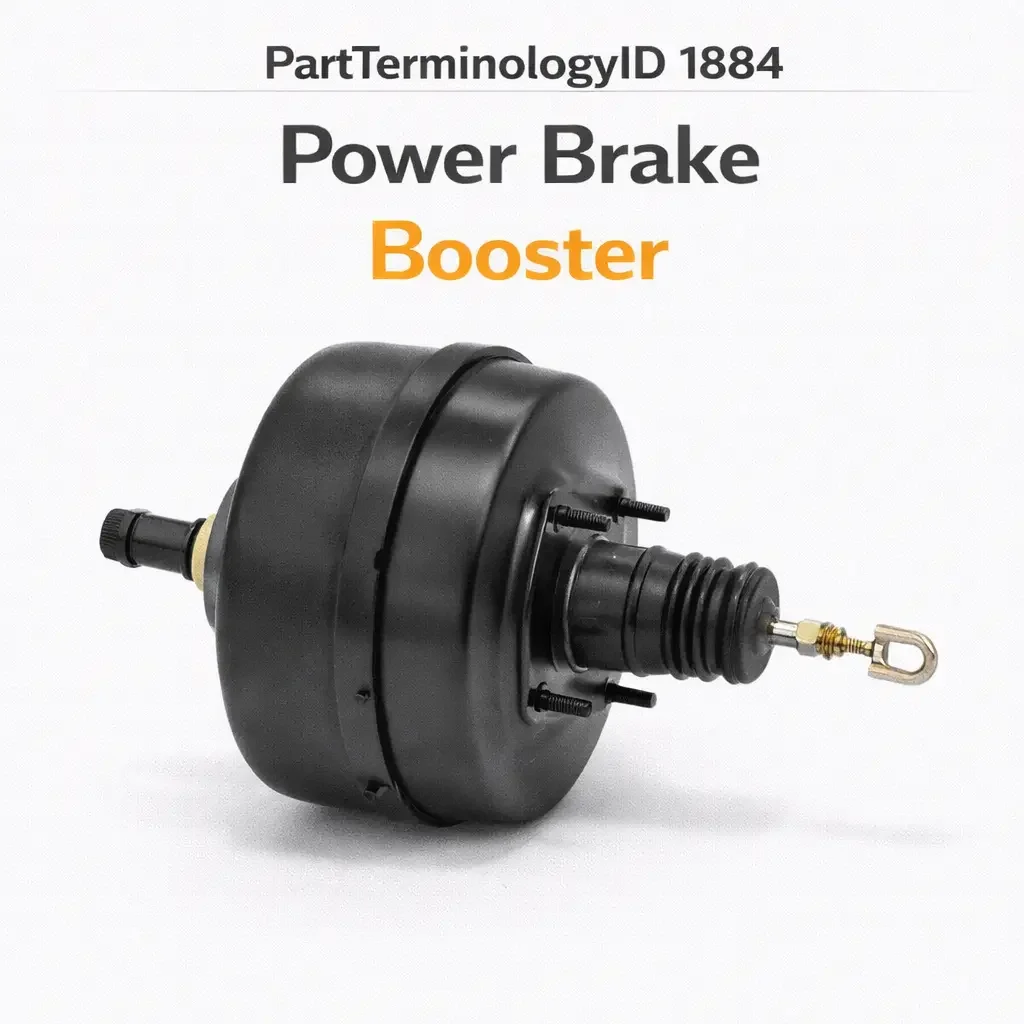
PartTerminologyID 1884, Power Brake Booster, is the vacuum-assisted force multiplier mounted between the brake pedal and the master cylinder on the firewall. When the driver presses the brake pedal, the booster uses engine vacuum (or vacuum from an external pump) to amplify that pedal force before it reaches the master cylinder. A booster typically multiplies pedal force by a factor of three to four, which means the driver applies 30 pounds of force to the pedal and the master cylinder receives 90 to 120 pounds.
Without the booster, the brake system still works. The brakes are fully manual. But the pedal effort required to stop a 4,000-pound vehicle without assist is extreme, and no modern vehicle is designed to be operated that way. The booster is what makes power brakes feel like power brakes.
For parts sellers, the booster is a mid-frequency replacement part that sits at the intersection of three fitment systems: the firewall and pedal assembly on one side, the master cylinder on the other side, and the vacuum supply circuit feeding into it. If any of those three interfaces is wrong, the booster does not fit, does not function, or produces the wrong pedal feel. And because the booster is physically large, heavy, and expensive to ship, a return on this part costs more than most brake components.
Why This Part Generates Returns
Buyers order the wrong booster because:
they do not verify single-diaphragm vs. dual-diaphragm (tandem) booster configuration, which determines the booster diameter, depth, and output force
they miss the ABS vs. non-ABS split (some vehicles use a different booster size or output rating depending on whether the brake system has ABS, because the ABS modulator introduces additional system volume that requires different boost characteristics)
they do not verify the master cylinder bolt pattern on the front face of the booster (bolt spacing and stud diameter must match the master cylinder)
they do not verify the pushrod length and tip configuration (too long causes brake drag, too short causes excessive pedal travel)
they do not verify the firewall mounting bolt pattern on the rear of the booster
they miss engine-based splits (a turbocharged engine with lower manifold vacuum may use a larger booster than the naturally aspirated version of the same vehicle, or may use a vacuum pump-assisted system with a different booster entirely)
they do not verify whether the booster includes the check valve, grommet, and mounting hardware, or whether these are sold separately
they confuse vacuum-assisted boosters with hydroboost units (hydraulic brake assist systems that use power steering pressure instead of vacuum)
Sellers get caught because booster listings typically show a year/make/model fitment with a photo and no specification data. The buyer sees a round canister that looks like their old one, confirms the vehicle, and orders. The booster arrives with the wrong diameter, wrong depth, wrong master cylinder bolt spacing, or wrong pushrod length. It goes back in the box.
Status in New Databases
PIES/PCdb: PartTerminologyID 1884, Power Brake Booster
PIES 8.0 / PCdb 2.0: No change
What This Part Actually Is
The power brake booster is a large, round, sealed chamber mounted on the firewall. Inside the chamber, one or two flexible rubber diaphragms divide the space into a vacuum side and an atmospheric side. When the driver presses the brake pedal, a control valve inside the booster opens, allowing atmospheric pressure to enter one side of the diaphragm while vacuum holds the other side. The pressure differential across the diaphragm creates a force that pushes the master cylinder pushrod forward, amplifying the driver's pedal input.
Single diaphragm vs. dual diaphragm (tandem)
Single diaphragm boosters have one diaphragm and are smaller in depth (front to back). They produce less boost force and are found on lighter vehicles or older designs.
Dual diaphragm (tandem) boosters stack two diaphragms in series, doubling the effective area without increasing the diameter. They produce more boost force in the same diameter footprint and are standard on most modern vehicles, heavier vehicles, and vehicles with four-wheel disc brakes.
The single vs. dual diaphragm split is critical because it determines the booster's overall depth, output force, and master cylinder compatibility. A single-diaphragm booster produces less force at the pushrod, which means the master cylinder bore size is matched to that lower force output. Installing a single-diaphragm booster on a vehicle designed for a tandem booster (or vice versa) changes the force-to-pressure relationship in the brake system and produces a pedal feel that is either dangerously hard or uncomfortably soft.
Vacuum boosters vs. hydroboost
Most vehicles use vacuum-assisted boosters. However, some trucks, diesel vehicles, and vehicles with high-demand power steering systems use hydroboost, a hydraulic brake assist system that uses the power steering pump as its pressure source instead of engine vacuum.
Hydroboost units mount in the same location as vacuum boosters and interface with the master cylinder the same way, but they have hydraulic line connections instead of a vacuum hose port. They are completely non-interchangeable with vacuum boosters. A vehicle designed for hydroboost cannot use a vacuum booster without significant modification (adding a vacuum source, changing the master cylinder, recalibrating the pedal ratio).
A listing under PartTerminologyID 1884 should specify vacuum-assist. If the vehicle also had a hydroboost option, the listing must differentiate between the two.
What is typically included vs. what is not
A power brake booster may ship as:
booster only (no check valve, no grommet, no master cylinder, no hardware)
booster with check valve and grommet pre-installed
booster with master cylinder pre-assembled (a combined unit)
booster with mounting nuts and firewall gasket
The most common return trigger in this category after fitment errors is the "what's in the box" problem. A buyer who expects the booster with check valve and grommet and receives a bare booster with open vacuum ports will file a return or a negative review, even if the booster itself is correct.
What it is NOT
a master cylinder (PartTerminologyID 1836), though the master cylinder bolts to the booster
a hydroboost unit (hydraulic, not vacuum)
a vacuum pump (which generates vacuum for the booster on diesel and some turbo vehicles)
a brake pedal assembly
The Pushrod Problem
The pushrod is the interface between the booster and the master cylinder. It transfers the amplified force from the booster diaphragm to the master cylinder primary piston. The pushrod length is matched to the specific booster and master cylinder combination.
Too long: The pushrod holds the master cylinder piston slightly forward, blocking the replenishment port. Brake fluid cannot return to the reservoir, the brakes drag, the fluid overheats, and the brakes may lock on.
Too short: Excessive free play between the pushrod and piston. The driver feels a dead spot at the top of the pedal stroke before any braking begins. In extreme cases, the pedal may not generate full braking force before reaching the floor.
Some boosters ship with an adjustable pushrod (threaded tip that can be lengthened or shortened). Others ship with a fixed-length pushrod that must match the master cylinder. The listing should specify whether the pushrod is adjustable or fixed, and if fixed, the pushrod length.
This is especially important when the buyer is replacing the booster but keeping the original master cylinder, or when the buyer is replacing both and the new booster and new master cylinder are from different manufacturers. An aftermarket booster with a pushrod 2mm longer than OE, paired with an aftermarket master cylinder with a slightly shallower piston bore, can produce enough pushrod preload to cause brake drag that the buyer will not discover until the vehicle is driven.
Top Return Scenarios
Scenario 1: "Booster is too deep, hits the pedal assembly"
Dual-diaphragm booster shipped for a vehicle that uses a single-diaphragm booster, or overall depth does not clear the firewall-to-pedal space.
Prevention language: "Diaphragm type: [single / dual (tandem)]. Booster overall depth: [X inches]. Verify clearance between the booster rear shell and the brake pedal assembly."
Scenario 2: "Master cylinder bolt holes don't line up"
Front mounting stud spacing does not match the master cylinder.
Prevention language: "Master cylinder mounting: [2 studs, X mm center to center, M10 / M8 thread]. Verify bolt pattern matches your master cylinder."
Scenario 3: "Pedal drags after installation"
Pushrod is too long for the master cylinder.
Prevention language: "Pushrod: [adjustable / fixed, X mm length]. If adjustable, set pushrod length per vehicle service manual before installing master cylinder. Incorrect pushrod length causes brake drag or excessive pedal free play."
Scenario 4: "My truck uses hydroboost, not vacuum"
Buyer's vehicle has hydraulic brake assist, not vacuum assist.
Prevention language: "Vacuum-assisted power brake booster. Not for vehicles equipped with hydroboost (hydraulic brake assist). If your booster has power steering line connections instead of a vacuum hose port, your vehicle uses hydroboost."
Scenario 5: "No check valve or grommet in the box"
Buyer expected these components to be included.
Prevention language: "This booster is sold [with / without] the check valve (PartTerminologyID 1876) and vacuum port grommet (PartTerminologyID 1880). [If without: Transfer your existing check valve and grommet, or order separately.]"
Scenario 6: "Wrong booster for my engine"
Turbo engine requires a larger booster or vacuum pump-assisted booster that differs from the naturally aspirated version.
Prevention language: "Designed for [naturally aspirated / turbocharged / diesel] engine. Verify your engine type. Turbocharged and diesel vehicles may use a different booster size or a vacuum pump-assisted system."
What to Include in the Listing
Core essentials
PartTerminologyID: 1884
component: Power Brake Booster
assist type: vacuum (not hydroboost)
condition: new or remanufactured
core charge (if reman)
included components: check valve (yes/no), grommet (yes/no), mounting hardware (yes/no), master cylinder (yes/no)
quantity: 1
Fitment essentials
year/make/model/submodel
engine type (naturally aspirated, turbo, diesel)
ABS vs. non-ABS
diaphragm type (single or dual/tandem)
vacuum source (manifold vacuum or vacuum pump)
production date splits
Dimensional and interface essentials
booster diameter (shell O.D.)
booster overall depth (front face to rear shell)
master cylinder mounting stud spacing (center to center)
master cylinder mounting stud thread size
firewall mounting bolt pattern
pushrod type (adjustable or fixed) and length
pushrod tip configuration (flat, spherical, cupped)
vacuum port location and style (grommet press-in or threaded)
Image essentials
front view showing master cylinder mounting studs with spacing callout
side view showing overall depth
rear view showing firewall mounting pattern
vacuum port location
pushrod visible with length reference
Catalog Checklist for ACES/PIES Teams
PartTerminologyID = 1884
require diaphragm type (single or dual/tandem)
require assist type (vacuum vs. hydroboost differentiation)
require engine type attribute where booster spec differs
require ABS/non-ABS attribute where booster spec differs
require master cylinder mounting stud spacing
require pushrod type and length
require booster diameter and depth
require "included components" attribute (check valve, grommet, hardware)
require condition attribute (new/remanufactured)
flag vehicles where both vacuum booster and hydroboost options exist
FAQ (Buyer Language)
Does this come with the master cylinder?
Usually not. The booster and master cylinder are typically sold separately. Some listings offer a pre-assembled booster and master cylinder combination. Check the listing to verify what is included.
How do I know if I have a single or dual diaphragm booster?
Measure the depth of your existing booster from the front face (where the master cylinder mounts) to the rear shell (against the firewall). Dual diaphragm boosters are significantly deeper (typically 7 to 9 inches) than single diaphragm boosters (typically 4 to 6 inches). You can also count the visible "steps" on the rear shell: a dual diaphragm booster has a stepped profile.
My pedal is hard. Is the booster bad?
A hard brake pedal can be caused by a failed booster diaphragm, a vacuum leak at the hose, check valve, or grommet, a failed vacuum pump (diesel/turbo), or a restricted vacuum hose. Test the vacuum supply and check valve before replacing the booster. With the engine off, pump the brake pedal several times to deplete vacuum, then hold the pedal and start the engine. If the pedal sinks slightly when the engine starts, the booster is functioning. If nothing changes, the booster or vacuum supply has failed.
Is there a core charge?
Remanufactured boosters typically carry a core charge that is refunded when the old booster is returned. Check the listing for core charge details.
Cross-Sell Logic
Brake Master Cylinder (PartTerminologyID 1836)
Power Brake Booster Check Valve (PartTerminologyID 1876)
Power Brake Booster Grommet (PartTerminologyID 1880)
Brake Vacuum Hose (PartTerminologyID 1812)
Brake Master Cylinder Mounting Nut Kit
Firewall Gasket / Booster Seal
Frame as "the booster ecosystem: booster, master cylinder, check valve, grommet, and vacuum hose. Inspect all during booster replacement."
Final Take for PartTerminologyID 1884
Power Brake Booster (PartTerminologyID 1884) is the largest and most expensive component in the brake vacuum circuit, and every return on it is costly. The diaphragm type (single vs. tandem) determines the output force and overall depth. The master cylinder mounting pattern determines what bolts to the front. The pushrod length determines whether the brakes drag or the pedal has dead travel. The vacuum vs. hydroboost split determines whether the part belongs on the vehicle at all.
State the diaphragm type, the master cylinder stud spacing, the pushrod configuration, and what ships in the box. Those four details prevent the majority of returns on a part that weighs ten pounds, costs forty dollars to ship back, and leaves the buyer without braking assist while they wait for the correct replacement.