
Power Brake Booster Grommet (PartTerminologyID 1880): The Rubber Seal That Holds the Entire Vacuum Circuit Together
Written by Arthur Simitian | PartsAdvisory
PartTerminologyID 1880, Power Brake Booster Grommet, is the rubber seal pressed into the booster shell where the check valve or vacuum hose connector passes through. It provides the airtight interface between the booster housing and the vacuum supply. Without it, or with a hardened, cracked, or incorrectly sized grommet, ambient air leaks into the booster, destroys the vacuum reserve, and the driver gets a hard brake pedal with no power assist.
It is a molded rubber ring. It costs a few dollars. And it is the single most common cause of slow vacuum leaks on aging brake boosters, because rubber hardens with heat cycling and age, and this grommet sits inches from the exhaust manifold, baking for the life of the vehicle.
The return problem is not that the part is complicated. The return problem is that "booster grommet" describes the function without describing the dimensions, and the dimensions vary by booster manufacturer, booster diameter, check valve style, and whether the grommet seats one component or two.
Why This Part Generates Returns
Buyers order the wrong grommet because:
they do not verify the grommet bore diameter (the hole the check valve or connector passes through)
they do not verify the grommet outer diameter (the size of the port in the booster shell it presses into)
they do not verify grommet depth (how thick the booster shell is at the port determines the grommet's required length)
they confuse this grommet with the master cylinder reservoir grommets (PartTerminologyID 1764 territory), which seal the reservoir to the master cylinder body and are a completely different size and shape
they do not verify whether their booster uses a grommet-mount check valve (PartTerminologyID 1876) or a direct-thread connector (some boosters have a threaded port with no grommet)
they order the grommet without realizing their booster port has elongated or cracked from age, meaning the new grommet will not seal in the damaged housing regardless of size
Sellers get caught because grommet listings almost never include the three dimensions that define the part: bore I.D., outer O.D., and depth. The listing says "brake booster grommet" with a vehicle fitment, the buyer orders based on the vehicle match, and the grommet arrives with the wrong bore diameter for their check valve or the wrong O.D. for their booster port.
Status in New Databases
PIES/PCdb: PartTerminologyID 1880, Power Brake Booster Grommet
PIES 8.0 / PCdb 2.0: No change
What This Part Actually Is
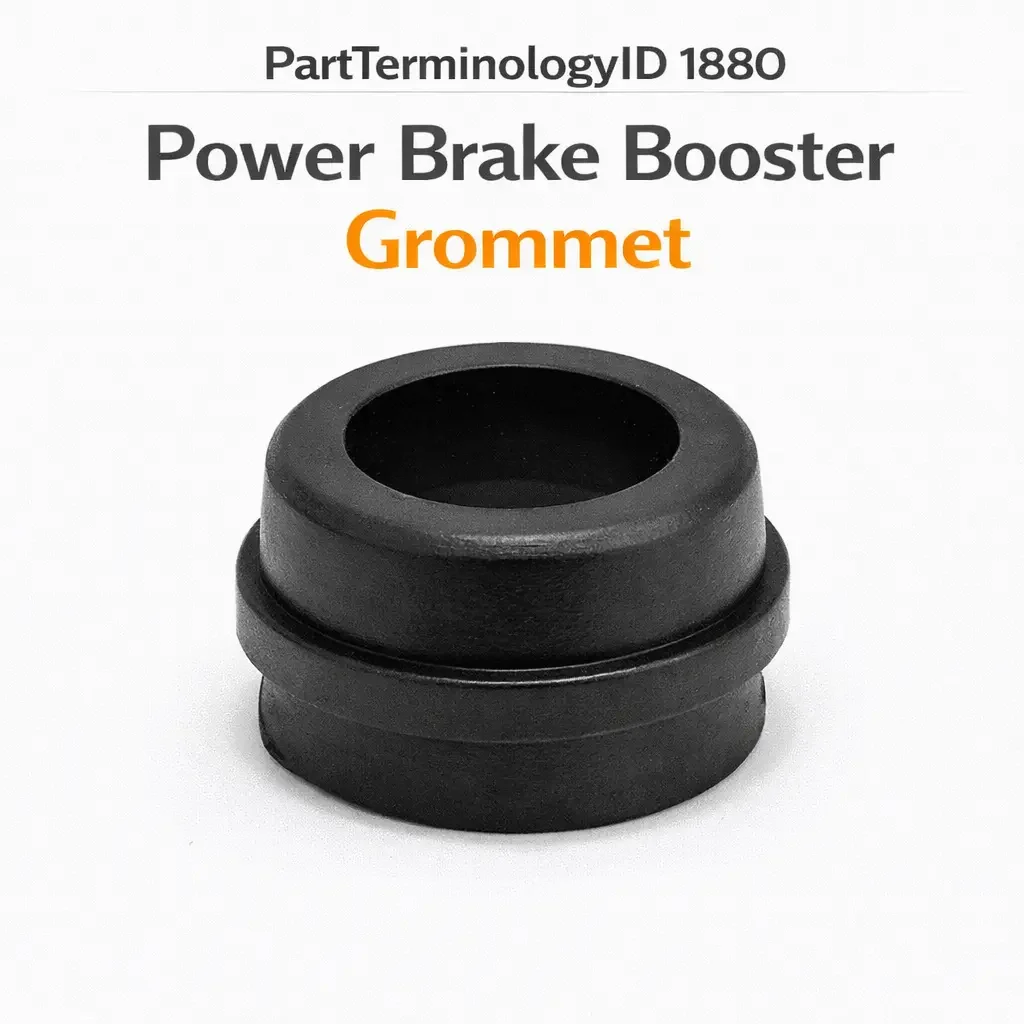
The power brake booster grommet is a molded rubber or elastomer seal with a cylindrical body and a flanged or lipped edge. It presses into the vacuum port hole on the booster shell (the large round canister on the firewall). The check valve or vacuum hose connector then inserts into the center bore of the grommet, and the rubber provides a friction fit and airtight seal on both interfaces: the outer surface seals against the booster shell, and the inner bore seals against the check valve or connector body.
One grommet, two sealing surfaces
This dual-sealing function is what makes dimensional accuracy essential. The grommet must seal against the booster port (a stamped or cast hole in the booster housing) on the outside and against the check valve body (a smooth cylindrical surface) on the inside. If either surface does not maintain full contact, air leaks into the booster.
The outer seal is a press fit. The grommet O.D. must be slightly larger than the booster port to create an interference fit that holds the grommet in place and prevents air ingress around the outside.
The inner seal is also a friction fit. The grommet bore must be slightly smaller than the check valve or connector O.D. to grip the valve and prevent air leakage around it.
If the grommet I.D. is too large, the check valve sits loosely and air leaks around it. If the grommet O.D. is too small, it does not seat firmly in the booster port and air leaks around the outside. Either failure mode produces the same symptom: gradual vacuum loss and a hard brake pedal.
Single-port vs. dual-port grommets
Most boosters have a single vacuum port, requiring one grommet. Some boosters (particularly on vehicles with accessories that also draw vacuum, such as HVAC actuators or cruise control) may have a second port with its own grommet for a secondary vacuum line. The secondary grommet is typically a different size than the primary.
A listing that does not specify primary vs. secondary (or the only port vs. auxiliary port) may ship the wrong size grommet to a buyer working on a dual-port booster.
What it is NOT
a master cylinder reservoir grommet (the rubber seals between the brake fluid reservoir and the master cylinder body, associated with PartTerminologyID 1764)
a firewall grommet (a larger rubber seal where wiring or cables pass through the firewall)
an exhaust manifold grommet or isolator
a vacuum hose (PartTerminologyID 1812) or check valve (PartTerminologyID 1876)
The reservoir grommet confusion is the most frequent. Both are rubber grommets associated with the brake system. Both are located in the engine bay near the master cylinder. Both look like small rubber rings. But the reservoir grommets seal brake fluid and sit on top of the master cylinder, while the booster grommet seals vacuum and sits on the front face of the booster canister. Their dimensions, materials, and chemical compatibility requirements are different. Reservoir grommets must resist brake fluid (which attacks many rubber compounds). Booster grommets must resist heat and maintain elasticity for vacuum sealing.
Top Return Scenarios
Scenario 1: "Grommet I.D. is too large, check valve is loose"
Bore diameter does not match the check valve body O.D.
Prevention language: "Grommet bore I.D.: [X mm / X inches]. Designed for check valves with [X mm / X inches] body O.D. Verify your check valve diameter before ordering."
Scenario 2: "Grommet won't stay in the booster port"
O.D. is too small for the booster housing port, or the port has elongated from age/damage.
Prevention language: "Grommet O.D.: [X mm / X inches]. Fits booster port diameter: [X mm / X inches]. If your booster port is damaged or enlarged, the grommet may not seal. Inspect the port before ordering."
Scenario 3: "I ordered a booster grommet and received a reservoir grommet"
Listing or search result conflated the two grommets.
Prevention language: "This is a vacuum port grommet for the brake booster shell. It is not a master cylinder reservoir grommet. For reservoir grommets, see PartTerminologyID 1764."
Scenario 4: "My booster doesn't use a grommet"
Vehicle has a threaded vacuum port on the booster with no grommet interface.
Prevention language: "For boosters with a press-in rubber grommet vacuum port. Some boosters use a threaded vacuum fitting with no grommet. Verify your booster's port style."
What to Include in the Listing
Core essentials
PartTerminologyID: 1880
component: Power Brake Booster Grommet
port position: primary vacuum port (or auxiliary/secondary, if applicable)
quantity: 1
Fitment essentials
year/make/model/submodel
booster manufacturer/type (if multiple boosters used across the model range)
vacuum port style: grommet press-in or threaded (to confirm this part applies)
Dimensional essentials
grommet bore I.D. (the hole the check valve passes through)
grommet O.D. (the outside diameter that presses into the booster port)
grommet depth/length (how far it extends through the booster shell)
flange diameter (if flanged)
material (EPDM, nitrile, silicone)
durometer/hardness (if specified by OE)
Image essentials
grommet shown from the front (bore visible) with I.D. callout
grommet shown from the side (depth visible) with O.D. and depth callouts
installed context showing grommet seated in booster port with check valve inserted
comparison image showing booster grommet vs. reservoir grommet (to prevent confusion)
Catalog Checklist for ACES/PIES Teams
PartTerminologyID = 1880
require grommet I.D., O.D., and depth attributes
require port position attribute (primary or auxiliary)
require booster port style confirmation (grommet-type vs. threaded, to prevent listing for non-grommet applications)
differentiate clearly from master cylinder reservoir grommets (PartTerminologyID 1764)
differentiate from the check valve itself (PartTerminologyID 1876) and the vacuum hose connector (PartTerminologyID 1804)
flag vehicles where the booster changed mid-year or where multiple booster options exist
FAQ (Buyer Language)
Is this the same as the master cylinder reservoir grommet?
No. The booster grommet seals the vacuum port on the brake booster. The reservoir grommets seal the fluid reservoir to the master cylinder body. They are different sizes, different materials, and located in different places.
How do I know if my grommet is bad?
With the engine running, listen for a hissing sound near the booster. You can also spray soapy water around the grommet and check valve area. Bubbles indicate an air leak. A hardened or cracked grommet that has lost elasticity will not seal even if it looks intact.
Can I use silicone sealant instead of replacing the grommet?
Sealant is not a reliable long-term fix for a booster grommet. The grommet must maintain a flexible, airtight seal under vibration, heat cycling, and the constant push/pull of the check valve during hose movement. A new grommet is the correct repair.
Does the grommet come with the check valve?
Usually not. The grommet (PartTerminologyID 1880) and the check valve (PartTerminologyID 1876) are typically sold separately. Some booster rebuild kits may include both. Verify what is included in the listing.
Cross-Sell Logic
Power Brake Booster Check Valve (PartTerminologyID 1876)
Brake Vacuum Hose (PartTerminologyID 1812)
Brake Vacuum Hose Connector (PartTerminologyID 1804)
Brake Booster Assembly
Master Cylinder Reservoir Grommet Set (for buyers who found this listing while actually looking for reservoir grommets)
Frame as "the vacuum sealing trio: grommet, check valve, and hose. Replace together when diagnosing vacuum leaks."
Final Take for PartTerminologyID 1880
Power Brake Booster Grommet (PartTerminologyID 1880) is a rubber ring defined by three numbers: bore I.D., outer O.D., and depth. Those three dimensions are the entire fitment story. They determine whether the grommet seals against the check valve on the inside, seats in the booster port on the outside, and extends the correct depth through the housing wall.
A listing without those three numbers is asking the buyer to gamble on a part they cannot verify until it arrives. A listing with those three numbers, plus a clear statement that this is the booster vacuum port grommet and not the reservoir grommet, eliminates the two most common reasons buyers return this part.
Three dimensions. One clarification. That is the full return prevention strategy for a part that holds the entire brake vacuum circuit together.