
Written by Arthur Simitian | PartsAdvisory
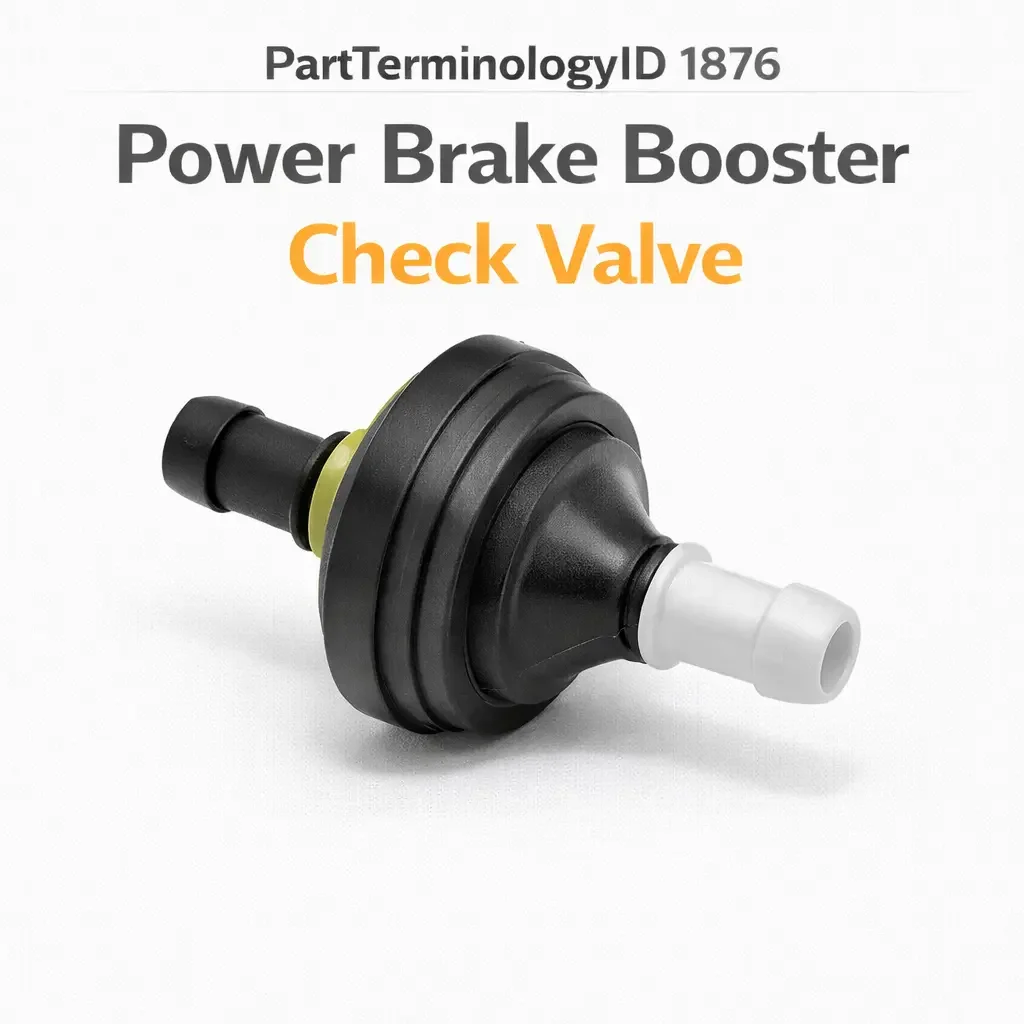
PartTerminologyID 1876, Power Brake Booster Check Valve, is a one-way valve that sits between the vacuum hose and the brake booster. It allows vacuum to flow from the engine's intake manifold (or vacuum pump) into the booster, but prevents air from flowing back out of the booster when manifold vacuum drops. It is the component that gives you one or two good brake pedal applications after the engine stalls, because it traps the vacuum reserve inside the booster diaphragm.
When the check valve fails, vacuum bleeds out of the booster the moment manifold vacuum drops (during hard acceleration, at high altitude, or if the engine stalls). The brake pedal goes hard immediately. There is no reserve. The driver who is used to a power-assisted pedal suddenly needs twice the leg force to stop the vehicle.
It is a small, inexpensive component. It is also the subject of a three-way confusion that drives returns across three PartTerminologyIDs and costs sellers more in shipping and processing than the part is worth.
The Three-Part Confusion
The brake vacuum circuit between the engine and the booster consists of three components that buyers and sellers constantly conflate:
Brake Vacuum Hose (PartTerminologyID 1812): The flexible hose that runs from the manifold to the booster.
Brake Vacuum Hose Connector (PartTerminologyID 1804): The fitting that joins the hose to the booster or to the manifold port.
Power Brake Booster Check Valve (PartTerminologyID 1876): The one-way valve that prevents vacuum loss from the booster.
On some vehicles, all three are separate components. On others, the check valve is integrated into the hose as a molded-in, non-serviceable part. On still others, the check valve is pressed into a grommet on the booster shell and the hose pushes onto the valve's barb. And on some designs, the connector and the check valve are the same part: a single fitting that both connects the hose to the booster and contains the one-way valve element.
A buyer searching for any one of these three parts may receive any of the other two, because listings in this category frequently do not clarify what the product actually is.
Why This Part Generates Returns
Buyers order the wrong check valve because:
they do not know whether their vehicle uses a standalone check valve, an integrated hose-and-valve assembly, or a valve built into the booster grommet fitting
they confuse the check valve with the hose connector (PartTerminologyID 1804), which may look identical externally but lacks the internal one-way valve element
they do not verify the valve's barb diameter or grommet O.D. for the booster port
they do not verify the hose connection size on the other end of the valve
they order a check valve when their actual problem is a torn booster diaphragm or a cracked vacuum hose (the valve tests good, the return gets filed)
they miss that diesel and some turbocharged vehicles use a vacuum pump instead of manifold vacuum, and the check valve on pump-fed systems may have a different pressure rating or flow direction
Sellers get caught because the listing says "brake booster check valve" and shows a photo of a small plastic or metal fitting with two barbs. The buyer matches it visually, orders, and discovers that the barb diameters are wrong, the valve does not seat in their booster grommet, or the part is actually a connector without a valve element.
Status in New Databases
PIES/PCdb: PartTerminologyID 1876, Power Brake Booster Check Valve
PIES 8.0 / PCdb 2.0: No change
What This Part Actually Is
The power brake booster check valve is a spring-loaded or elastomeric one-way valve. Vacuum (negative pressure) from the engine pulls the valve open, allowing the booster chamber to evacuate. When manifold vacuum drops below the booster's stored vacuum level, the valve closes, trapping the vacuum inside the booster.
Construction types
Inline check valve: A cylindrical body with a barb on each end. One barb connects to the vacuum hose from the engine. The other barb connects to a short hose segment or directly to the booster grommet. The valve element (a rubber disc, a ball, or a diaphragm) sits inside the body.
Grommet-mount check valve: A valve with one barbed end for the hose and a smooth, tapered end that presses directly into a rubber grommet on the booster shell. The grommet provides the seal. The valve body may be plastic or metal.
Integrated valve (in hose or connector): The check valve element is molded into either the vacuum hose (PartTerminologyID 1812) or the booster connector (PartTerminologyID 1804). There is no separate serviceable check valve. If the valve fails, the entire hose or connector assembly must be replaced.
For sellers, the construction type determines whether PartTerminologyID 1876 applies at all. If the check valve is integrated into the hose or connector, there is no standalone check valve to sell. A listing under 1876 for a vehicle that uses an integrated design will attract buyers who cannot use a standalone valve and will return it.
What it is NOT
a vacuum hose (PartTerminologyID 1812)
a vacuum hose connector (PartTerminologyID 1804)
a PCV valve (positive crankcase ventilation valve, which is in the engine's emission system, not the brake system)
an EGR valve
a heater control valve
The PCV valve confusion is more common than sellers realize. Both the PCV valve and the brake booster check valve are small one-way valves connected to the intake manifold by rubber hoses. A buyer who searches "one-way valve intake manifold" can land on either part.
How to Test (and Why This Matters for Returns)
A significant percentage of brake booster check valve returns are not fitment errors. They are diagnostic errors. The buyer replaced the check valve because they had a hard brake pedal, but the actual problem was a cracked vacuum hose, a torn booster diaphragm, or a failed vacuum pump. The new check valve did not fix the symptom, so the buyer returns it as "defective."
Sellers cannot prevent diagnostic errors, but they can reduce them with listing language that sets expectations:
"If your brake pedal is hard or lacks power assist, test the check valve before replacing it. Remove the valve from the hose, blow through it from each direction. Air should flow freely in one direction (toward the booster) and be blocked in the other direction (away from the booster). If the valve passes this test, the problem is elsewhere in the vacuum circuit (hose, grommet, or booster diaphragm)."
This language does not eliminate returns, but it reduces the percentage of buyers who replace a good valve and blame the part.
Top Return Scenarios
Scenario 1: "This valve doesn't fit my booster grommet"
Grommet-end diameter mismatch. Valve is too large or too small for the booster port.
Prevention language: "Booster end: [grommet-mount, X mm O.D. / barbed, X mm O.D.]. Hose end: [barbed, X mm O.D.]. Verify both connection diameters."
Scenario 2: "This is a connector, not a check valve"
Buyer received a fitting that looks like a valve but has no internal one-way element.
Prevention language: "This is a one-way check valve with an internal valve element. It is not a passive connector. For passive connectors without a valve element, see PartTerminologyID 1804."
Scenario 3: "My vehicle doesn't use a separate check valve"
Vehicle has an integrated check valve in the hose or connector. No standalone valve exists for this application.
Prevention language: "For vehicles with a standalone (serviceable) brake booster check valve. Some vehicles integrate the check valve into the vacuum hose (PartTerminologyID 1812) or booster connector (PartTerminologyID 1804). Verify your vehicle's configuration."
Scenario 4: "New valve didn't fix my hard pedal"
Check valve was not the problem. Booster diaphragm, hose, or vacuum source is the actual failure.
Prevention language: "Before replacing, test your existing check valve: remove and blow through from each direction. Air should pass in one direction only. If the valve passes this test, inspect the vacuum hose, booster grommet, and booster diaphragm for leaks."
What to Include in the Listing
Core essentials
PartTerminologyID: 1876
component: Power Brake Booster Check Valve
type: standalone serviceable check valve (not integrated into hose or connector)
quantity: 1
Fitment essentials
year/make/model/submodel
vacuum source: intake manifold or vacuum pump (diesel/turbo)
booster type (single diaphragm, tandem/dual diaphragm)
integrated vs. standalone check valve for this application
Dimensional and interface essentials
booster end connection: grommet-mount O.D. or barb O.D.
hose end connection: barb O.D.
valve body material (plastic, metal, composite)
overall length
flow direction marking or orientation indicator
Image essentials
valve showing both ends with diameter callouts
flow direction arrow visible (most valves are marked)
installed context showing valve position between hose and booster
grommet interface detail (if grommet-mount style)
Catalog Checklist for ACES/PIES Teams
PartTerminologyID = 1876
require connection diameter at both ends
require connection type (grommet-mount vs. barbed inline)
require valve body material
differentiate from PartTerminologyID 1804 (connector without valve) and PartTerminologyID 1812 (hose, which may include integrated valve)
flag applications where no standalone check valve exists (valve is integrated into hose or connector)
require vacuum source attribute (manifold vs. pump) for diesel and turbo applications
FAQ (Buyer Language)
Is this the same as the vacuum hose connector?
No. The check valve (PartTerminologyID 1876) contains a one-way valve element that traps vacuum in the booster. The connector (PartTerminologyID 1804) is a passive fitting with no valve. They may look similar externally.
Which direction does the valve face?
The valve allows air to flow from the booster toward the engine (creating vacuum in the booster) and blocks flow in the opposite direction. Most valves have a flow direction arrow stamped or printed on the body. If installed backwards, the booster will not build vacuum.
Can I test the valve without removing it?
The quickest test is to start the engine, let vacuum build, then turn the engine off and press the brake pedal. You should get one or two firm, assisted brake applications. If the pedal goes hard immediately after the engine stops, the check valve may not be holding vacuum. Remove and test by blowing through it.
Cross-Sell Logic
Brake Vacuum Hose (PartTerminologyID 1812)
Brake Vacuum Hose Connector (PartTerminologyID 1804)
Brake Booster Grommet
Vacuum Hose Clamp
Brake Booster Assembly
Frame as "the three-part vacuum circuit: hose, connector, check valve. Inspect all three when diagnosing vacuum loss."
Final Take for PartTerminologyID 1876
Power Brake Booster Check Valve (PartTerminologyID 1876) lives at the intersection of three parts that buyers confuse constantly: the hose, the connector, and the valve. On some vehicles all three are separate. On others, two of the three are combined into a single component. The listing must state whether this is a standalone check valve, specify the connection diameters at both ends, and clarify that it contains an internal one-way valve element.
Without those details, the buyer is choosing between three PartTerminologyIDs and guessing which one they need. With those details, the choice is obvious, the part fits, and the vacuum stays where it belongs.