
Written by Arthur Simitian | PartsAdvisory
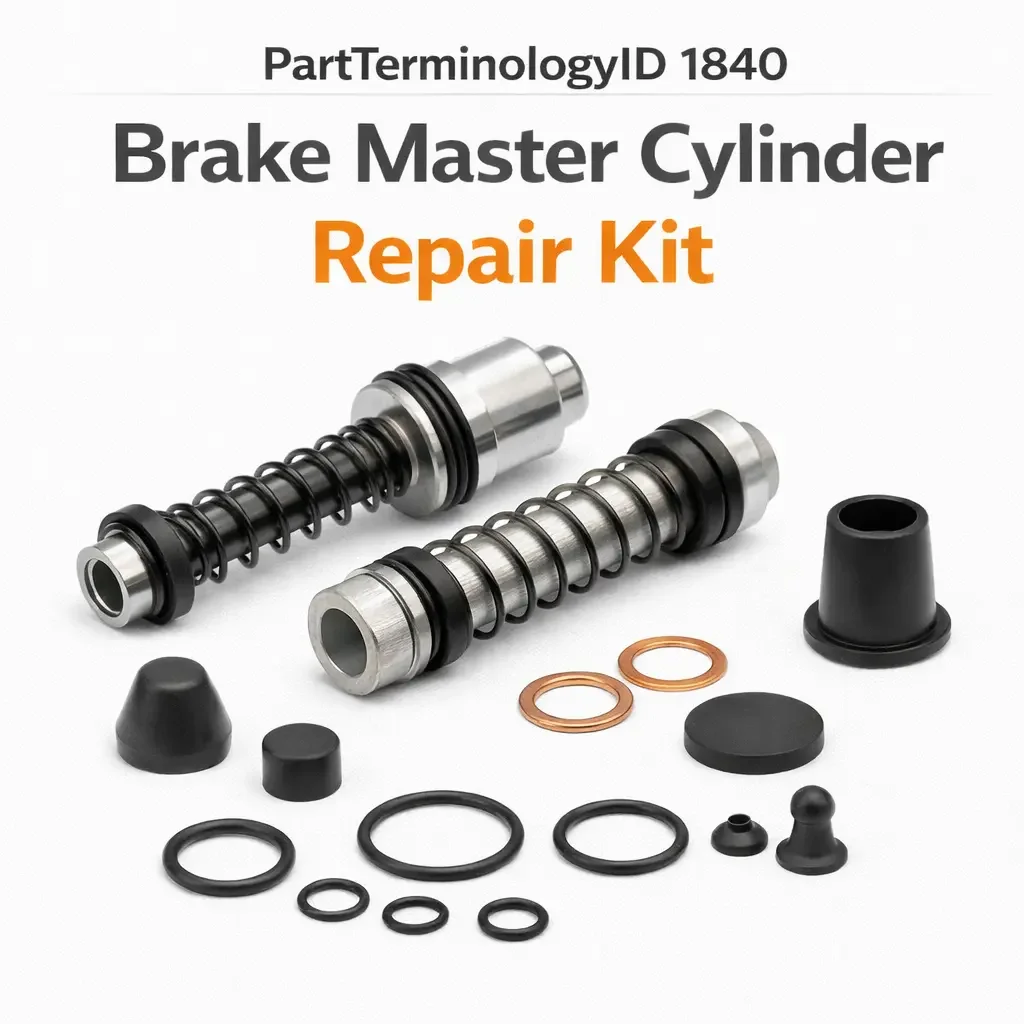
PartTerminologyID 1840, Brake Master Cylinder Repair Kit, is a seal and piston kit that allows a technician to rebuild an existing brake master cylinder instead of replacing the entire unit. The kit typically contains the internal rubber seals (primary and secondary cup seals), the piston springs, and in some cases the pistons themselves. The idea is straightforward: if the master cylinder bore is not scored, pitted, or corroded, you can replace the soft internals, reassemble the unit, and restore full hydraulic function without buying a complete master cylinder.
It is a cost-effective option for professional shops, restoration work on classic vehicles where OE-style master cylinders are discontinued, and fleet operations where minimizing parts cost across dozens of vehicles matters. It is also a return magnet when the listing gets the bore size wrong.
Every fitment variable that applies to the complete master cylinder (PartTerminologyID 1836) applies to the repair kit, because the kit must match the bore of the cylinder it is going into. But where the complete master cylinder listing at least gives the buyer a physical unit they can compare to their original, the repair kit is a bag of seals and springs that the buyer cannot verify until they have already disassembled their master cylinder. If the kit is wrong, the buyer is stuck with a disassembled master cylinder and no way to drive the vehicle.
Why This Part Generates Returns
Buyers order the wrong repair kit because:
they do not know the bore diameter of their master cylinder and assume all kits for their vehicle are the same
they do not verify ABS vs. non-ABS, which often means different bore sizes and therefore different internal seal dimensions
they do not verify whether their master cylinder is original or has been previously replaced with a different bore size unit
they assume the kit includes pistons when it only includes seals, or vice versa
they order based on year/make/model without checking whether the master cylinder changed mid-year
they confuse this kit with a caliper repair kit, wheel cylinder repair kit, or clutch master cylinder repair kit
Sellers get caught because the repair kit listing often states a vehicle fitment without specifying the bore diameter the kit is designed for. The bore diameter is the kit. A 7/8" bore seal set will not seal a 15/16" bore. A 22mm piston will not fit a 23.8mm cylinder. There is no workaround, no trimming, no forcing. The parts either match the bore or they do not.
Status in New Databases
PIES/PCdb: PartTerminologyID 1840, Brake Master Cylinder Repair Kit
PIES 8.0 / PCdb 2.0: No change
What This Kit Actually Contains
A brake master cylinder repair kit is an internal rebuild package. The specific contents vary by manufacturer and application, but a complete kit typically includes:
Primary piston seal (primary cup): The forward-facing seal on the primary piston that creates hydraulic pressure when the piston moves forward. This is the seal that fails most often, causing a soft pedal or internal bypass (fluid leaks past the seal instead of building pressure).
Secondary piston seal (secondary cup): The forward-facing seal on the secondary piston. Same function as the primary cup, but for the second hydraulic circuit.
Piston return springs: The springs that return each piston to its rest position when the brake pedal is released. Weak or broken springs cause slow pedal return and delayed brake release.
Replenishment port seals / residual valve components: Some kits include small seals or check valve components that sit at the replenishment ports (the ports that allow fluid to flow from the reservoir into the bore when the pistons retract).
Pistons (in some kits): Higher-end or OE-equivalent kits may include the actual pistons (aluminum or steel cylinders with seal grooves). Budget kits often include seals only, requiring the original pistons to be reused if they are not scored or worn.
Snap rings, retaining clips, and dust boots: The mechanical fasteners that hold the assembly together and the rubber boot that seals the rear of the cylinder where the pushrod enters.
What the kit does NOT include
the master cylinder body (the housing)
the reservoir
the reservoir cap, grommets, or fluid level sensor
the pushrod
the mounting hardware
What the kit assumes
The kit assumes the master cylinder bore is in serviceable condition. If the bore is scored, pitted, corroded, or out-of-round, new seals will not create a reliable seal and the master cylinder must be replaced entirely (see PartTerminologyID 1836). The kit is not a fix for a damaged bore. It is a maintenance item for a sound bore with worn seals.
Bore Diameter: The Only Specification That Matters
Every seal in the kit is manufactured to a specific diameter tolerance. A primary cup seal designed for a 7/8" (22.22mm) bore will not seal a 15/16" (23.81mm) bore. The difference is 1.59mm. That is less than the thickness of a dime, and it is the difference between a functional rebuild and a master cylinder that bypasses internally and sends the brake pedal to the floor.
Why bore sizes vary within the same vehicle
As covered in the PartTerminologyID 1836 post, the master cylinder bore diameter can vary within the same make, model, and year based on:
ABS vs. non-ABS brake system
manual vs. automatic transmission (affecting booster size and therefore bore sizing)
engine type (affecting vacuum source and booster output)
brake package (standard vs. heavy-duty vs. performance)
production date changes
All of these splits apply equally to the repair kit. If there are two different master cylinder bore sizes for a given vehicle, there are two different repair kits. A listing that covers both bore sizes without specifying which one the kit fits will generate returns from half of its buyers.
How the buyer should verify bore diameter
The most reliable method is to measure the bore of the disassembled master cylinder with a caliper or bore gauge. The second most reliable method is to check the OE part number of the master cylinder and cross-reference it to the correct bore size. The least reliable method is to assume based on year/make/model alone.
Sellers can help by stating the bore diameter prominently in the listing and by noting which master cylinder part numbers (OE or aftermarket) the kit is designed to fit. This gives the buyer a cross-reference point they can verify before disassembly.
The "Seals Only" vs. "Complete Kit" Problem
Some repair kits contain only the rubber seals. Others contain seals plus pistons, springs, clips, and boots. The term "repair kit" does not have a standard definition in the aftermarket, and two kits for the same application from different manufacturers may contain different components.
A buyer who orders a "repair kit" expecting pistons and receives seals only may not have the parts they need to complete the rebuild. A buyer who orders a kit with pistons when they only needed seals has overpaid.
The listing must state exactly what is in the kit. A generic "brake master cylinder repair kit" description with no contents list is a return waiting to happen.
Top Return Scenarios
Scenario 1: "Seals don't fit my bore"
Bore diameter mismatch. Kit is for a different bore size than the buyer's master cylinder.
Prevention language: "Designed for master cylinders with [X mm / X inch] bore diameter. Verify bore size by measuring your master cylinder or cross-referencing your master cylinder part number: [list compatible OE/aftermarket part numbers]."
Scenario 2: "Kit doesn't include pistons"
Buyer expected a complete rebuild kit and received seals only.
Prevention language: "Kit includes: [list every component]. This kit [includes / does not include] replacement pistons. If pistons are not included, original pistons must be in serviceable condition for reuse."
Scenario 3: "I have ABS, this kit is for non-ABS"
ABS/non-ABS bore size mismatch.
Prevention language: "For vehicles [with / without] ABS. ABS and non-ABS master cylinders use different bore diameters. Verify your brake system type before ordering."
Scenario 4: "My bore is scored, the new seals still leak"
Buyer installed the kit in a damaged bore. Not a kit defect, but the buyer blames the product.
Prevention language: "This kit requires a master cylinder bore in serviceable condition (no scoring, pitting, or corrosion). If the bore is damaged, the master cylinder must be replaced. See PartTerminologyID 1836, Brake Master Cylinder."
What to Include in the Listing
Core essentials
PartTerminologyID: 1840
component: Brake Master Cylinder Repair Kit
complete contents list (every seal, spring, piston, clip, boot in the kit)
quantity: 1 kit
Fitment essentials
year/make/model/submodel
ABS vs. non-ABS
transmission type (if bore size differs)
compatible master cylinder part numbers (OE and major aftermarket)
production date split (if master cylinder changed mid-year)
Dimensional essentials
bore diameter the kit is designed for (primary attribute, must be prominent)
primary piston seal O.D.
secondary piston seal O.D.
piston diameter (if pistons included)
Image essentials
all kit contents laid out and labeled
seal diameter callout
bore diameter reference
comparison to a complete master cylinder showing where each component installs
Catalog Checklist for ACES/PIES Teams
PartTerminologyID = 1840
require bore diameter attribute (mandatory, non-negotiable)
require ABS/non-ABS attribute
require kit contents list as a structured attribute (not just in the description text)
require compatible master cylinder part number cross-reference
differentiate from wheel cylinder repair kits, caliper repair kits, and clutch master cylinder repair kits
flag applications where multiple bore sizes exist for the same year/make/model
enforce transmission type split where bore size varies by transmission
FAQ (Buyer Language)
How do I know what bore size my master cylinder is?
Measure the inside diameter of the bore with a caliper after removing the pistons, or look up the OE part number of your master cylinder and cross-reference it to the bore specification. Do not assume based on vehicle year/make/model alone, as multiple bore sizes may apply.
Does this kit include pistons?
Check the kit contents in the listing. Some kits include replacement pistons. Others include seals, springs, and clips only, requiring you to reuse your original pistons. If your pistons are scored or worn, you need a kit that includes them or a complete replacement master cylinder.
Is it better to rebuild or replace the master cylinder?
If the bore is smooth and undamaged, a rebuild kit is a cost-effective repair. If the bore is scored, pitted, or corroded, rebuilding will not produce a reliable seal and the master cylinder should be replaced. For critical daily drivers, many technicians prefer a complete new or remanufactured master cylinder for warranty coverage and known-good bore condition.
Do I still need to bench-bleed after rebuilding?
Yes. A rebuilt master cylinder must be bench-bled just like a new unit. Fill the cylinder with fresh brake fluid, cycle the pistons to purge air from the internal chambers, and then install the cylinder on the vehicle. Follow with a complete system bleed at all four wheels.
Cross-Sell Logic
Brake Master Cylinder (PartTerminologyID 1836, for buyers whose bore is not rebuildable)
Brake Master Cylinder Reservoir Grommet Set
Brake Fluid (correct DOT specification)
Bench Bleed Kit
Brake Bleeder Kit
Brake Master Cylinder Reservoir (PartTerminologyID 1764)
Frame as "commonly needed during master cylinder rebuild." The complete master cylinder is the most important cross-sell, because a meaningful percentage of buyers who order a repair kit will discover upon disassembly that their bore is not rebuildable.
Final Take for PartTerminologyID 1840
Brake Master Cylinder Repair Kit (PartTerminologyID 1840) is a part where the listing is only as good as one number: the bore diameter. Every seal in the bag is cut to a specific bore. If the bore diameter is wrong, every seal in the bag is wrong. There is no partial fit.
State the bore diameter. State what is in the kit. State which master cylinder part numbers the kit fits. Those three details prevent the buyer from ordering seals that do not match their bore, expecting pistons that are not included, or discovering after disassembly that they bought a kit for the wrong system.