
Written by Arthur Simitian | PartsAdvisory
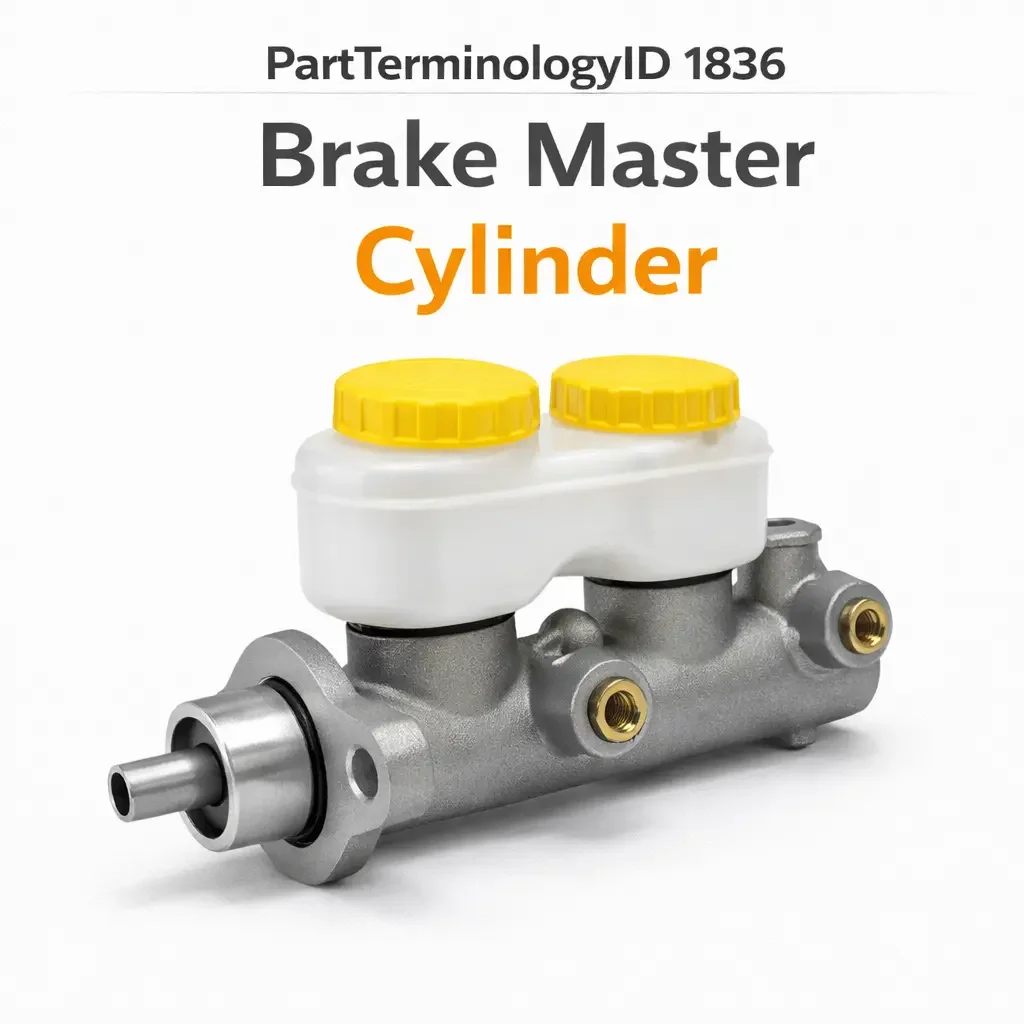
PartTerminologyID 1836, Brake Master Cylinder, is the hydraulic pump that converts brake pedal force into hydraulic pressure and distributes that pressure to the front and rear brake circuits. It is the central component of the entire brake hydraulic system. Every caliper, every wheel cylinder, every brake hose, every hard line, and every ABS modulator downstream depends on the master cylinder to generate and meter the correct pressure.
When sellers think about high-return brake parts, they think about rotors and pads. But the brake master cylinder is quietly one of the most return-prone components in the brake category, not because the parts are defective, but because the fitment variables are dense, poorly documented, and easy to get wrong. Bore size, port configuration, reservoir style, pushrod length, mounting bolt pattern, ABS compatibility, brake booster match, and whether the reservoir is included or sold separately all create potential mismatches that a generic "brake master cylinder" listing cannot resolve.
This is the part where a single millimeter of bore diameter difference changes the pedal feel, the pressure output, and the stopping distance of the vehicle. Getting it wrong is not an inconvenience. It is a safety failure.
Why This Part Generates Returns
Buyers order the wrong master cylinder because:
they do not verify bore diameter and assume all master cylinders for their vehicle are the same
they do not know whether their vehicle has ABS or non-ABS, and the master cylinder differs between the two
they miss transmission-based splits (manual transmission vehicles often use a different bore size than automatics because manual cars do not have a vacuum source as strong as automatic cars in some configurations, or because the booster size differs)
they do not verify whether the reservoir is included, sold separately, or integrated (non-removable)
they assume the master cylinder includes the brake fluid level sensor, cap, and reservoir grommets when it does not
they confuse the brake master cylinder with the clutch master cylinder (both are hydraulic master cylinders, both mount on the firewall, and on some vehicles they are adjacent)
they do not verify port size, port thread, and port location for the brake lines
they order based on a visual match without confirming the pushrod length or booster interface dimensions
they do not account for production date splits where the master cylinder changed mid-year
Sellers get caught because the master cylinder listing often shows a year/make/model fitment with no qualifiers for bore size, ABS/non-ABS, transmission type, reservoir inclusion, or port configuration. The buyer clicks "add to cart," the part ships, and it either does not bolt up, does not connect to the brake lines, does not include the reservoir the buyer expected, or produces the wrong pedal feel because the bore diameter is wrong.
Status in New Databases
PIES/PCdb: PartTerminologyID 1836, Brake Master Cylinder
PIES 8.0 / PCdb 2.0: No change
What This Part Actually Is
The brake master cylinder is a hydraulic pump mounted on the brake booster (or directly on the firewall on non-boosted systems). When the driver presses the brake pedal, the booster multiplies the pedal force and pushes a rod into the master cylinder. Inside the master cylinder, one or two pistons compress brake fluid, generating hydraulic pressure that is sent through the brake lines to the wheel brakes.
Dual-circuit design
All modern brake master cylinders are dual-circuit (tandem) designs. This means the cylinder contains two pistons in series, each feeding a separate brake circuit. If one circuit develops a leak, the other circuit continues to function, providing at least partial braking. The two circuits are typically split front/rear (one circuit feeds the front brakes, the other feeds the rear) or diagonally (one circuit feeds the left front and right rear, the other feeds the right front and left rear).
The circuit split configuration affects the port locations on the master cylinder body. A front/rear split cylinder has its two outlet ports positioned differently than a diagonal split cylinder. If the wrong split configuration is installed, the brake lines will not reach the correct ports, or worse, they will connect but route pressure to the wrong wheels.
Reservoir configurations
The brake fluid reservoir sits on top of the master cylinder and supplies fluid to both circuits. Reservoirs come in three configurations:
Integrated (cast-in) reservoir: The reservoir is part of the master cylinder body casting. It cannot be removed or replaced separately. The entire master cylinder must be replaced if the reservoir is damaged. This design is common on older vehicles.
Bolt-on (removable) reservoir: The reservoir is a separate plastic component that attaches to the master cylinder body with grommets pressed into ports on top of the cylinder. The reservoir can be removed and replaced independently. This is the most common design on modern vehicles.
Remote reservoir: The reservoir is mounted separately from the master cylinder (on the fender, firewall, or strut tower) and connected by a hose. This is less common on passenger cars but appears on some trucks, performance vehicles, and specialty applications.
For sellers, the reservoir configuration is critical because it determines what the buyer receives in the box. If the listing says "brake master cylinder" and the buyer expects the reservoir to be included, but the master cylinder ships without one (because the aftermarket part is sold as cylinder-only with the expectation that the buyer will transfer their old reservoir), the return is immediate.
What is typically included vs. what is not
A brake master cylinder listing may or may not include:
the fluid reservoir (the most common source of confusion)
the reservoir cap
the reservoir grommets (the rubber seals between reservoir and cylinder body)
the brake fluid level sensor (mounted in the reservoir or cap)
the pushrod (some master cylinders include the pushrod that interfaces with the booster, others do not)
the mounting nuts or bolts
the brake line port fittings or plugs
Every one of these items is a potential return trigger if the buyer expects it and it is not in the box, or if the buyer does not expect it and receives a different configuration than their original. The listing must state what is included.
Bore Diameter: The Invisible Fitment Split
Why bore size matters
The bore diameter of the master cylinder (the internal diameter of the cylinder in which the pistons travel) is the single most critical specification for brake system performance. A larger bore moves more fluid per stroke but generates less pressure per unit of input force. A smaller bore generates more pressure per stroke but moves less fluid.
Vehicle manufacturers size the master cylinder bore to match the specific caliper piston areas, rotor diameters, booster output, and vehicle weight of each application. Changing the bore size by even 1mm alters the pedal feel, pedal travel, and pressure distribution to the front and rear brakes.
Common bore size splits
ABS vs. non-ABS: On many vehicles, the ABS-equipped version uses a different bore size than the non-ABS version. The ABS hydraulic modulator introduces additional fluid volume into the system, which requires a master cylinder bore that compensates for the modulator's internal volume. Installing a non-ABS master cylinder on an ABS-equipped vehicle (or vice versa) will result in incorrect pedal feel, potentially longer stopping distances, and possible ABS malfunction.
Manual vs. automatic transmission: On some vehicles, the manual transmission version uses a different brake booster size or a different master cylinder bore than the automatic transmission version. This is because the vacuum source for the booster may differ between manual and automatic configurations (some manual cars have less manifold vacuum available, especially turbocharged manuals). The bore size is matched to the booster output, so the transmission type becomes a proxy for the booster specification.
Engine type: Vehicles with different engine options may have different booster sizes (a V8 with strong manifold vacuum vs. a turbocharged four-cylinder with weak manifold vacuum, for example), and the master cylinder bore is matched to the booster. A "fits all engines" listing on a vehicle with multiple engine options may ship the wrong bore size.
Brake package: Some vehicles offer multiple brake packages (standard, heavy-duty, performance, towing). Each package may use different caliper piston sizes and rotor diameters, and the master cylinder bore is matched to the package. A standard-brake master cylinder on a heavy-duty brake vehicle will not produce correct pressure distribution.
Production date splits: Manufacturers sometimes change the master cylinder specification mid-year, often in response to a recall, a running change to the brake system, or a switch from one supplier to another. A listing that covers a full model year without noting the production date split will ship the wrong cylinder to buyers on one side of the changeover.
For sellers, bore diameter must be a required attribute in the listing. If you are listing a "Volvo 244 brake master cylinder, 1986 to 1993" and the bore size changed between ABS and non-ABS models, between manual and automatic transmission cars, or between B230F and B230FT engine options, the listing needs to specify which bore size this part has and which configuration it fits.
Port Configuration: Where the Lines Connect
The master cylinder has outlet ports where the brake lines connect. The number of ports, their location on the cylinder body, their thread size, and their orientation vary by application.
Number of ports
A standard dual-circuit master cylinder has two outlet ports (one per circuit) plus one or two reservoir feed ports on top. Some master cylinders have additional ports for a brake pressure warning switch, a residual pressure valve, or a port that feeds a secondary component like a hydraulic brake booster accumulator.
Port location
The two outlet ports may be located on the end of the cylinder (axial ports, facing the front of the vehicle), on the side of the cylinder body, or a combination. The port location must match the brake line routing on the vehicle. If the ports are on the end and the vehicle's lines approach from the side, the lines will not connect.
Port thread size
Common port thread sizes include 9/16" to 18, 1/2" to 20, M12 x 1.0, M10 x 1.0, and others. A master cylinder with the wrong port threads will not accept the brake line fittings. The threads may start but will not seal, or the fitting may bottom out before seating the flare.
Flare type compatibility
The port seats must match the flare type of the brake lines (double flare or bubble flare). A port machined for a double flare seat will not seal properly against a bubble flare line end, creating a leak in the highest-pressure point of the brake system.
The ABS Split in Detail
ABS-equipped vehicles route the brake lines from the master cylinder to the ABS hydraulic modulator, which then distributes pressure to the individual wheels. Non-ABS vehicles route lines directly from the master cylinder to the wheels (through a proportioning valve or combination valve).
This routing difference affects the master cylinder in several ways:
Bore size: As noted above, the bore often differs between ABS and non-ABS.
Port configuration: The lines leaving an ABS master cylinder go to the ABS modulator, which may require different port locations, thread sizes, or line lengths than the non-ABS routing.
Reservoir capacity: ABS systems may require additional fluid reserve volume to account for the modulator's internal volume. The reservoir on an ABS master cylinder may be larger or differently shaped than the non-ABS reservoir.
Electrical connector: ABS-equipped master cylinders may include a fluid level sensor with a different connector type than the non-ABS version, because the ABS control module monitors fluid level as part of its diagnostic routine.
Residual pressure: Non-ABS master cylinders for vehicles with rear drum brakes sometimes include an internal residual pressure valve (typically 10 PSI) that keeps slight pressure on the rear circuit to hold the drum brake cup seals in place. ABS master cylinders typically omit this internal valve because the ABS modulator manages rear pressure independently. Installing a master cylinder with an unwanted residual pressure valve on an ABS vehicle can cause rear brake drag. Installing one without the valve on a non-ABS drum brake vehicle can cause a slow pedal on the first brake application after the vehicle has been sitting.
For sellers, the ABS/non-ABS split is not optional. It is the most common single-attribute return driver for brake master cylinders. Every listing must state ABS or non-ABS, and the buyer must be able to verify which system their vehicle has before ordering.
Booster Interface: The Mounting Side
The master cylinder bolts to the brake booster (or to the firewall on non-boosted systems) using two studs or bolts. The bolt pattern, bolt spacing, and the depth of the booster pushrod cavity must match.
Bolt pattern and spacing
Most master cylinders use a two-bolt mounting pattern, but the bolt spacing varies by application. A cylinder designed for one booster will not bolt to a different booster if the bolt spacing is off by even a few millimeters.
Pushrod interface
The booster pushrod enters the rear of the master cylinder and contacts the primary piston. The pushrod diameter, tip shape (flat, spherical, cupped), and the depth at which it engages the piston are all matched to the specific booster and master cylinder combination.
If the pushrod is too long, it will hold the primary piston slightly forward, preventing it from fully returning and blocking the replenishment port. This causes the brakes to drag and the fluid to overheat. If the pushrod is too short, there will be excessive free play in the pedal and delayed brake response.
Some master cylinders include the pushrod. Others do not (the pushrod stays with the booster). The listing must specify whether the pushrod is included and, if so, its length and tip configuration.
Mounting flange depth
The flange where the master cylinder meets the booster has a specific depth and sealing surface. On some vehicles, a gasket or O-ring sits between the master cylinder and the booster. If the flange depth or sealing surface differs from the original, the joint may leak vacuum (reducing booster assist) or allow brake fluid to seep.
The Reservoir Inclusion Problem
This deserves its own section because it accounts for a disproportionate share of master cylinder returns.
What buyers expect
When a buyer orders a "brake master cylinder," they expect to receive a complete, ready-to-install unit. For most modern vehicles, that means the cylinder body with the reservoir already attached, the cap on the reservoir, and the fluid level sensor installed.
What sellers sometimes ship
Many aftermarket master cylinders are sold as the cylinder body only, without the reservoir. The expectation is that the buyer (or installer) will transfer the reservoir, cap, grommets, and sensor from the old master cylinder to the new one. This is a common practice in the professional installer market, where the technician knows to transfer these components and has the tools and experience to do it without damaging the grommets.
But the DIY buyer, the online buyer who is ordering parts for their home garage, does not always know this. They receive the master cylinder, see that there is no reservoir, and file a return because the part appears incomplete.
The grommet trap
Even when the listing specifies "reservoir included," the grommets that seal the reservoir to the master cylinder body are a separate wear item. Old grommets that have hardened with age may not seal properly on the new cylinder, causing a slow fluid weep from the reservoir mounting points. Some aftermarket master cylinders include new grommets. Others do not. If the listing does not specify, the buyer discovers the omission only after installation, when they see fluid seeping from under the reservoir.
The sensor trap
The brake fluid level sensor may be integrated into the reservoir, mounted in the reservoir cap, or mounted in the master cylinder body. If the replacement master cylinder or reservoir uses a different sensor style, connector type, or mounting location than the original, the sensor either will not fit, will not connect to the vehicle's wiring harness, or will throw a dashboard warning light.
What to state in the listing
Every master cylinder listing should explicitly state:
reservoir included: yes or no
if yes, reservoir type (integrated, bolt-on)
cap included: yes or no
grommets included: yes or no (and quantity)
fluid level sensor included: yes or no
if sensor included, connector type
This level of detail eliminates the most common "incomplete part" returns.
The Clutch Master Cylinder Confusion
On vehicles with a manual transmission and a hydraulic clutch, the clutch master cylinder is mounted on the firewall near the brake master cylinder. Both are cylindrical hydraulic pumps with reservoirs, both have brake-fluid-like hydraulic lines coming out of them, and both are actuated by a pedal in the cabin.
Buyers who are not mechanically experienced may search for "master cylinder" and receive results for both the brake and clutch units. If the listing title says "master cylinder" without the "brake" qualifier, or if the search algorithm returns both types, the buyer may order the clutch master cylinder thinking it is the brake master cylinder, or vice versa.
The two parts are not interchangeable. They have different bore sizes, different port configurations, different mounting locations, and different pushrod interfaces. Installing a clutch master cylinder in place of a brake master cylinder (or the reverse) is mechanically impossible in most cases, but the return still happens because the buyer ordered the wrong one.
Listings must include "Brake" in the title, not just "Master Cylinder." And catalog data should clearly differentiate PartTerminologyID 1836 (Brake Master Cylinder) from the clutch master cylinder PartTerminologyID.
Remanufactured vs. New: The Listing Disclosure
Brake master cylinders are commonly available as both new and remanufactured units. Remanufactured master cylinders are original cores that have been disassembled, cleaned, inspected, fitted with new internal seals and pistons, and reassembled.
Remanufactured units are typically less expensive than new, and many are perfectly functional. However, the buyer must know what they are receiving. A listing that does not specify "new" or "remanufactured" creates a mismatch in buyer expectations. Some buyers specifically want new. Others are happy with reman. The listing must state which it is.
Additionally, remanufactured master cylinders often require a core return. If the listing does not mention the core charge or core return requirement, the buyer may be surprised by an additional charge or by the need to ship back their old cylinder.
What to state
condition: new or remanufactured
if remanufactured: core charge amount and core return policy
what has been replaced in the reman process (seals, pistons, bore honing)
Top Return Scenarios
Scenario 1: "Bore size is wrong, pedal feels different"
Buyer installed the master cylinder and the brake pedal is too hard, too soft, or has too much travel. Bore diameter does not match the vehicle's booster and caliper combination.
Prevention language: "Bore diameter: [X mm / X inches]. Designed for [ABS / non-ABS] equipped vehicles with [manual / automatic] transmission. Verify bore diameter matches your original master cylinder."
Scenario 2: "No reservoir in the box"
Buyer expected a complete unit and received the cylinder body only.
Prevention language: "This master cylinder is sold [with reservoir / without reservoir]. [If without: Transfer your existing reservoir, cap, grommets, and sensor to the new cylinder body.] Verify what is included before ordering."
Scenario 3: "Brake line ports don't match"
Port thread size, port location, or flare seat type does not match the vehicle's brake lines.
Prevention language: "Outlet port 1: [thread size, location]. Outlet port 2: [thread size, location]. Flare type: [double / bubble]. Verify port configuration matches your brake line fittings."
Scenario 4: "This is for a non-ABS car, mine has ABS"
Master cylinder bore, port configuration, or internal valving does not match the ABS-equipped vehicle.
Prevention language: "Designed for vehicles [with / without] ABS. ABS and non-ABS master cylinders are not interchangeable. Verify your brake system type."
Scenario 5: "I ordered a brake master cylinder and received a clutch master cylinder"
Buyer searched "master cylinder" and received the wrong component.
Prevention language: "Brake Master Cylinder. For brake hydraulic system only. Not a clutch master cylinder. If your vehicle has a hydraulic clutch, verify you are ordering the correct component."
Scenario 6: "Mounting bolts don't line up with my booster"
Bolt pattern spacing does not match the brake booster.
Prevention language: "Mounting bolt spacing: [X mm center to center]. Designed for [specific booster type or vehicle configuration]. Verify bolt pattern matches your brake booster."
Scenario 7: "Fluid level sensor connector doesn't match my harness"
Sensor included in the replacement does not match the vehicle's wiring connector.
Prevention language: "Fluid level sensor connector: [2-pin / 3-pin / bayonet / blade]. Verify connector type matches your vehicle's wiring harness."
What to Include in the Listing
Core essentials
PartTerminologyID: 1836
component: Brake Master Cylinder
condition: new or remanufactured
what is included: cylinder body, reservoir (yes/no), cap (yes/no), grommets (yes/no, quantity), fluid level sensor (yes/no), pushrod (yes/no)
core charge: amount and return policy (if remanufactured)
quantity: 1
Fitment essentials
year/make/model/submodel
ABS vs. non-ABS (mandatory, non-negotiable)
transmission type (manual or automatic, if bore size differs)
engine type (if booster size or vacuum source differs by engine)
brake package (standard, heavy-duty, performance, towing)
production date split (if master cylinder changed mid-year)
circuit split type (front/rear or diagonal)
Dimensional and interface essentials
bore diameter (primary and secondary if different)
outlet port thread size at each port
outlet port location (end, side, angled)
flare type at outlet ports (double flare or bubble flare)
mounting bolt pattern (center-to-center spacing)
pushrod length and tip configuration (if included)
reservoir type (integrated, bolt-on, remote)
reservoir grommet count and size (if bolt-on)
fluid level sensor type and connector configuration
overall cylinder body length
Image essentials
front view showing outlet ports with thread callouts
top view showing reservoir mounting (with or without reservoir)
rear view showing booster mounting flange and bolt holes
sensor connector close-up
bore diameter marked or referenced
scale reference
Catalog Checklist for ACES/PIES Teams
PartTerminologyID = 1836
require ABS/non-ABS attribute on every application (no exceptions)
require bore diameter attribute
require transmission type attribute where bore size differs
require "reservoir included" attribute (yes/no)
require "sensor included" attribute (yes/no) with connector type
require "grommets included" attribute (yes/no) with quantity
require outlet port thread size at each port
require condition attribute (new/remanufactured)
enforce production date splits where master cylinder changed mid-year
differentiate from clutch master cylinder in part title, description, and category mapping
flag vehicles where multiple brake packages create different master cylinder specifications
flag vehicles where engine type affects booster size and therefore master cylinder bore
FAQ (Buyer Language)
Does this come with the reservoir?
Check the listing. Some master cylinders include the reservoir pre-installed. Others are sold as the cylinder body only, and you must transfer your old reservoir. If you need a new reservoir, order it separately (see PartTerminologyID 1764, Brake Master Cylinder Reservoir).
How do I know if my car has ABS?
Check for an ABS warning light on your dashboard (it illuminates briefly when you start the car). Look under the hood for an ABS hydraulic modulator (a metal block with multiple brake lines connected to it, usually near the master cylinder or on the fender). Check your vehicle's build sheet or VIN decoder for the ABS option.
My brake pedal feels different after installing the new master cylinder. Is it defective?
Not necessarily. If the bore diameter is different from your original (even by 1mm), the pedal feel will change. Verify that the bore diameter of the replacement matches the original. Also ensure the master cylinder has been properly bench-bled before installation, as air trapped in the cylinder will cause a soft or spongy pedal.
Do I need to bench-bleed the master cylinder before installing it?
Yes. A new or remanufactured master cylinder must be bench-bled (filled with fluid and cycled to purge air from the internal chambers) before it is installed on the vehicle. Failure to bench-bleed will result in air trapped in the system that is extremely difficult to remove through normal wheel bleeding. Most master cylinders ship with bench-bleed fittings or plugs for this purpose.
Is there a core charge?
If the master cylinder is remanufactured, there is typically a core charge that is refunded when you return your old master cylinder. Check the listing for core charge amount and return instructions.
Can I use a non-ABS master cylinder on my ABS-equipped vehicle?
No. The bore size, port configuration, and internal valving differ between ABS and non-ABS master cylinders. Using the wrong type will result in incorrect brake pressure, abnormal pedal feel, and potential ABS system malfunction.
What is the difference between the brake master cylinder and the clutch master cylinder?
Both are hydraulic pumps mounted on the firewall, but they serve different systems. The brake master cylinder (PartTerminologyID 1836) pressurizes the brake hydraulic system. The clutch master cylinder pressurizes the clutch hydraulic system. They have different bore sizes, port configurations, and mounting locations. They are not interchangeable.
Cross-Sell Logic
Brake Master Cylinder Reservoir (PartTerminologyID 1764)
Brake Master Cylinder Reservoir Grommet Set
Brake Fluid Level Sensor
Brake Fluid (correct DOT specification)
Brake Booster (if buyer is replacing due to booster failure that damaged the master cylinder)
Brake Bleeder Kit
Bench Bleed Kit
Brake Hydraulic Line (PartTerminologyID 1820, if lines are corroded at the master cylinder ports)
Brake Hydraulic Hose (PartTerminologyID 1792)
Frame as "commonly replaced or needed during master cylinder replacement." The reservoir, grommets, and sensor are particularly strong cross-sells because many buyers discover they need new grommets only after they open the box and realize theirs are hardened and cracked.
The Bigger Picture: Why Master Cylinder Data Quality Matters More Than Most Parts
The brake master cylinder is the one brake component where a fitment error has the widest impact on vehicle safety. A wrong brake pad still provides some braking. A wrong brake hose may not connect but will not compromise the system if the buyer returns it before installation. A wrong master cylinder, if installed, changes the pressure output to every wheel on the vehicle. It can make the brakes too aggressive, too weak, or unbalanced between front and rear.
A bore size that is too large will produce a pedal that feels firm but generates less hydraulic pressure than the system requires. Stopping distances increase. A bore size that is too small will produce a pedal that feels soft and travels too far, potentially running out of stroke before generating full braking force.
Both conditions are dangerous, and both are invisible to the buyer until they press the brake pedal in traffic.
This is why the master cylinder listing demands more attributes than most brake parts. Bore diameter, ABS configuration, port specs, reservoir inclusion, and sensor compatibility are not optional details. They are the minimum information the buyer needs to verify that the part will function correctly on their vehicle.
Final Take for PartTerminologyID 1836
Brake Master Cylinder (PartTerminologyID 1836) is the most attribute-dense part in the brake hydraulic system. The bore diameter split (ABS vs. non-ABS, manual vs. automatic, engine type, brake package) drives fitment errors that affect braking performance. The reservoir inclusion question drives "incomplete part" returns that could be prevented with a single yes/no attribute. The port configuration and flare type drive connection failures at the most pressurized point in the system.
Five attributes prevent the majority of returns: bore diameter, ABS/non-ABS, reservoir included, port thread size, and condition (new vs. reman). Five attributes. That is the difference between a master cylinder listing that converts cleanly and one that generates returns, chargebacks, and buyer reviews that mention the word "dangerous."
State the bore. State the ABS. State what is in the box. That is the entire return prevention strategy for the most important hydraulic component in the brake system.